



 Chat with AI
Exam 12: Pharmacology

Exam 1: Anatomy291 Questions
Exam 2: Behavioral science240 Questions
Exam 3: Biochemistry156 Questions
Exam 4: Biostatistics117 Questions
Exam 5: Embryology52 Questions
Exam 6: Genetics103 Questions
Exam 7: Histology24 Questions
Exam 8: Immunology129 Questions
Exam 9: Microbiology336 Questions
Exam 10: Pathology816 Questions
Exam 11: Pathophysiology464 Questions
Exam 12: Pharmacology538 Questions
Exam 13: Physiology272 Questions
Select questions type


A 26-year-old pregnant woman at 16 weeks gestation comes to the office for prenatal follow-up. The patient has a 2-year history of mild hyperthyroidism due to Graves disease and started taking propylthiouracil when she decided to attempt pregnancy. The patient has had no tremulousness, palpitations, diarrhea, or heat intolerance. She has no other medical problems and no drug allergies. She takes a prenatal vitamin. The patient does not use tobacco, alcohol, or illicit drugs. Temperature is 36.7 C (98 F), blood pressure is 110/60 mm Hg, and pulse is 88/min. Physical examination reveals no lid lag, exophthalmos, or hand tremors. The thyroid gland is normal to palpation. Fetal heart rate is normal. Thyroid hormone levels are within the laboratory's reference ranges. During this visit, her thyroid treatment is changed from propylthiouracil to methimazole. Switching the patient's therapy at this time is aimed at decreasing which of the following complications?
(Multiple Choice)
5.0/5  (87)
(87) A 64-year-old man is evaluated for persistent fever and weakness. He has a history of aortic valve replacement for aortic stenosis. Physical examination reveals a new cardiac murmur with scattered petechiae and splinter hemorrhages seen on his extremities. Echocardiogram shows a vegetation involving one of the aortic valve leaflets, and blood cultures grow enterococci. As part of the patient's treatment, 240 mg of intravenous gentamicin is started. The pharmacy calculates that, in this patient, gentamicin has a volume of distribution of 30 L, a half-life of 4 hours, and demonstrates first-order and one-compartment kinetics. Which of the following is the most likely serum drug concentration just before the next dose 8 hours later?
(Multiple Choice)
4.9/5 (81)
(81) A 25-year-old man comes to the office due to bilateral hip pain for the last 6 months. The pain started insidiously and has progressively worsened to the point where he has difficulty walking. The patient has no history of trauma. Medical history is significant for a seizure disorder, for which he has taken phenytoin for the past 5 years. The patient does not use tobacco or alcohol. X-ray of the hip joint shows bilateral, symmetric, narrow radiolucent lines of 2-3 mm in width with sclerotic borders as well as diffuse cortical thinning. Which of the following is the most likely cause of this patient's current condition?
(Multiple Choice)
4.7/5 (70)
(70) A boy is delivered via spontaneous vaginal delivery at 39 weeks gestation to a woman, gravida 1 para 0. The boy is vigorous with a strong cry, requiring no interventions after delivery except for warming and drying. APGAR scores are 8 and 9 at 1 and 5 minutes, respectively. Head circumference measures <10th percentile, and the placenta has numerous calcifications. Serology is consistent with congenital toxoplasmosis. As part of treatment, he is prescribed a combination of pyrimethamine and sulfadiazine. Which of the following best describes the reason for using multiple drugs during this patient's treatment?
(Multiple Choice)
4.8/5 (81)
(81) A 52-year-old man comes to the office for an annual preventive visit. He has a history of seasonal allergies, and has recently started taking a medication that has improved his runny nose, sneezing, and watery eyes. Medical history is remarkable for diet-controlled type 2 diabetes mellitus and eczema. He is not on any other medications. He does not use tobacco, alcohol, or illicit drugs. Examination shows a well-appearing man with flushed cheeks and dilated pupils. This patient's physical examination findings are best explained by which of the following mechanisms?
(Multiple Choice)
4.8/5 (76)
(76) A 58-year-old airline captain comes to the office after he was found to have abnormal vision testing during a pilot medical certification examination. The patient feels well and has no ocular symptoms. Vision testing shows normal visual acuity but moderate loss of peripheral vision in both eyes. Results of the funduscopic examination are shown in the image below. 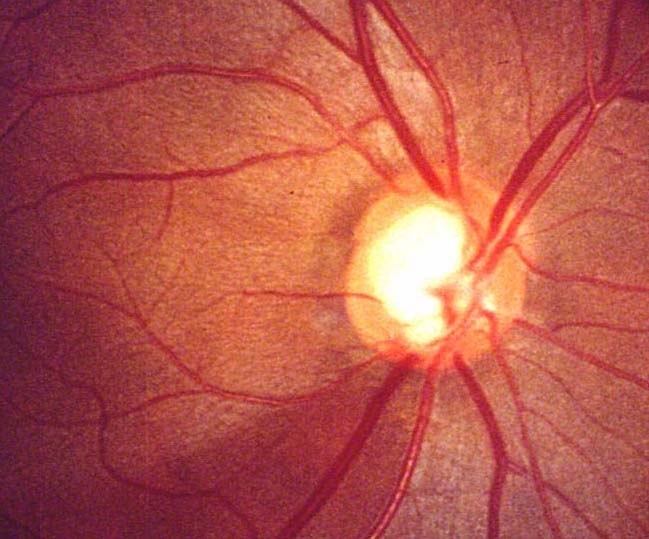 Other neurologic and cardiopulmonary examination findings are unremarkable. He is started on latanoprost eyedrops. The medication is most likely to improve this patient's condition through which of the following mechanisms?
 (Multiple Choice)
4.8/5 (80)
(80) A 75-year-old woman is brought to the office by her son for evaluation of worsening forgetfulness over the past few years. She has had difficulty remembering names of the people she meets and frequently misplaces household items. Recently, the patient forgot to turn off the stove after cooking but had no major fire. She has also had disrupted sleep with frequent awakenings throughout the night. Vital signs are within normal limits. On physical examination, the patient is alert and cooperative but disoriented to time and can recall only 1 of 3 items on a short-term memory test. MRI of the head reveals diffuse cortical atrophy. A medication with which of the following effects would be most beneficial for this patient?
(Multiple Choice)
4.8/5 (77)
(77) A 72-year-old woman is brought to the office due to forgetfulness. Her family has noticed that the patient quickly forgets conversations and misplaces household items. The symptoms have progressively worsened over the past 2-3 years. A month ago, the patient became lost while driving in the neighborhood where she has lived most of her adult life. She has no significant medical history, and her only medication is a daily multivitamin. The patient does not use tobacco, alcohol, or illicit drugs and lives with her son and his wife. Vital signs are within normal limits. On physical examination, the patient has a short-term memory deficit with no other significant neurologic findings. After discussion, an oral cholinesterase inhibitor is prescribed. Which of the following is the most likely effect of the drug prescribed for this patient?
(Multiple Choice)
4.9/5 (86)
(86) An elderly patient is diagnosed with aggressive non-Hodgkin's lymphoma. The tumor cells are shown to stain strongly for the CD20 marker. Which of the following biologic agents can be added to this patient's chemotherapy regimen to help improve the treatment response?
(Multiple Choice)
4.8/5 (71)
(71) A 23-year-old man is evaluated for excessive bruising since childhood. He says some of his family members "bleed easily" and sometimes require blood transfusions. Temperature is 36.7 C (98.1 F). Physical examination is unremarkable. Complete blood cell count is unremarkable. Platelet aggregometry is abnormal. Genetic testing identifies a defect in a platelet surface glycoprotein receptor that normally binds fibrinogen to support platelet aggregation. The abnormal glycoprotein receptor found in this patient is most likely targeted by which of the following medications?
(Multiple Choice)
4.8/5 (90)
(90) A 70-year-old man develops progressive fatigue and easy bruising. He has had unintentional weight loss and episodic fevers. Physical examination shows splenomegaly and enlarged lymph nodes in the cervical, axillary, and inguinal regions. Complete blood count reveals anemia, thrombocytopenia, and leukocytosis. Peripheral blood smear shows an increased number of small, mature-appearing, abnormal lymphocytes, which express CD20 and kappa light chains. During treatment, the patient receives an agent that directly binds and inhibits BCL-2 protein. Which of the following is the most likely effect of this therapy on the abnormal cells?
(Multiple Choice)
4.8/5 (87)
(87) A 60-year-old man with known coronary artery disease comes to the office due to exertional chest tightness for the last 6 months. The symptoms occur when he walks more than 3 blocks, especially in cold weather. The patient underwent coronary artery bypass graft surgery 3 years ago for progressive angina. Past medical history also includes asthma, benign prostate hyperplasia, and peripheral artery disease. The physician discusses adding isosorbide dinitrate to his current therapy but the patient is concerned about adverse effects. Which of the following is most likely to occur in this patient with the add-on therapy?
(Multiple Choice)
4.9/5 (80)
(80) A 66-year-old man comes to the office for hypertension follow-up. The patient takes lisinopril and amlodipine, but his blood pressure recordings have been 140-150/85-95 mm Hg over the past 2 office visits. He has had no chest pain or shortness of breath. The patient also reports worsening urinary symptoms over the past year that include hesitancy, straining during urination, poor urinary flow, and waking up once or twice a night to urinate. He feels the symptoms are bothersome but are not affecting his quality of life. The patient has no other medical conditions and does not use tobacco, alcohol, or illicit drugs. Blood pressure is 142/88 mm Hg and pulse is 70/min. Physical examination shows a mildly enlarged, smooth prostate but is otherwise unremarkable. Serum chemistry studies and urinalysis are normal. Which of the following medications would be most effective for treating both of this patient's medical issues?
(Multiple Choice)
4.8/5 (88)
(88) A 43-year-old man is hospitalized due to severe epigastric pain radiating to his back. He does not drink alcohol. Temperature is 37.9 C (100.2 F), blood pressure is 114/68 mm Hg, and pulse is 85/min. BMI is 34 kg/m2. The patient appears restless. Physical examination shows significant epigastric tenderness. Laboratory results are as follows: 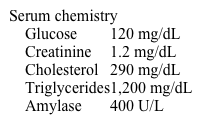 Administration of intravenous fluids and analgesics is begun. In addition, insulin is administered to rapidly reduce the elevated lipid levels. This medication is likely to improve this patient's condition by stimulating which of the following enzymes?
 (Multiple Choice)
4.9/5 (82)
(82) A newly developed inhaled anesthetic has an improved safety profile compared to traditional fluorinated anesthetics. Preliminary pharmacodynamic properties of the agent are determined through a series of experiments on human volunteers. The tests show that the agent demonstrates relatively high potency. Which of the following parameters best correlates with the potency of an inhaled anesthetic?
(Multiple Choice)
4.8/5 (82)
(82) A 40-year-old woman comes to the office with a 4-week history of diarrhea accompanied by occasional abdominal bloating. She has noticed that her stools contain mucus but has not seen any blood. The patient also has intermittent mild heartburn. She has no fevers, chills, or weight loss. The patient has also noticed an unpleasant taste with dairy products and now avoids them. Past medical history is significant for chronic allergic rhinitis. Current medications include only a multivitamin supplement. Vital signs and physical examination are normal. After a basic evaluation, the patient is started on a trial of diphenoxylate therapy. Which of the following is the primary target of this drug?
(Multiple Choice)
4.9/5 (87)
(87) A 21-year-old man comes to the emergency department due to several days of dizziness and extreme fatigue. The patient has been drinking a lot of water and urinating more than usual for the past 2 weeks. He developed nausea and vomiting a day ago and has had difficulty keeping food and liquids down since then. The patient has no other medical conditions and takes no medications. Blood pressure is 90/60 mm Hg, pulse is 120/min, and respirations are 20/min. Urinalysis is positive for glucose and ketones. The patient is given intravenous fluids and an intravenous infusion of recombinant human insulin without any amino acid modification. After his condition is stabilized, the insulin infusion is stopped, and the same insulin formulation is administered subcutaneously. Which of the following drug concentration curves is most likely to be obtained after the subcutaneous insulin injection? 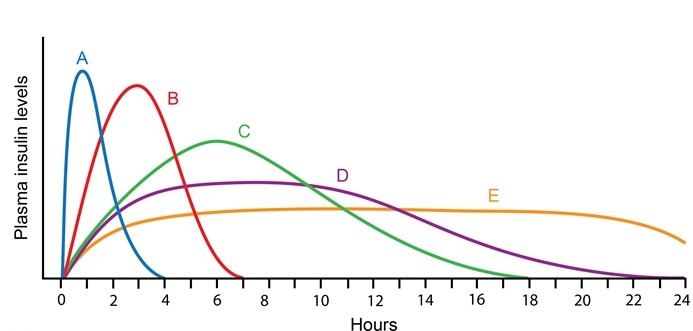
(Multiple Choice)
4.7/5 (85)
(85) A 67-year-old woman comes to the office for follow-up of type 2 diabetes mellitus. She was diagnosed with diabetes 6 months ago. Lifestyle modification was initially advised, but the patient had no significant glycemic improvement. One month ago, the patient was started on metformin, to which she has been adherent; however, she has been experiencing abdominal discomfort and diarrhea attributed to the therapy. She has no other medical conditions. BMI is 28 kg/m2. Physical examination is unremarkable. Laboratory tests show hemoglobin A1c is 8.2%. After further discussion, metformin is discontinued and glyburide is prescribed. Compared to metformin, this new therapy is most likely to increase the risk of which of the following?
(Multiple Choice)
4.8/5 (70)
(70) A 47-year-old man comes to the office due to worsening muscle weakness and dark urine for the past several days. Two weeks ago, the patient was evaluated for dyspepsia and found to have Helicobacter pylori infection; he was started on treatment and has had partial symptom improvement. Medical history includes hypertension and hyperlipidemia, for which he takes amlodipine and simvastatin. Temperature is 37.1 C (98.8 F), blood pressure is 130/80 mm Hg, and pulse is 74/min. Physical examination shows diffuse muscle tenderness. Laboratory evaluation reveals elevated blood urea nitrogen and serum creatinine levels. Urine microscopy shows no red or white blood cells. Which of the following medications most likely precipitated this patient's current condition?
(Multiple Choice)
4.8/5 (79)
(79) Cancer cells from a 23-year-old male with testicular cancer demonstrate high sensitivity to etoposide. The etoposide-killed cancer cells show a high number of double-stranded DNA fractures. These fractures are due to dysfunction of which of the following?
(Multiple Choice)
4.9/5 (70)
(70) 
Filters
- Essay(0)
- Multiple Choice(0)
- Short Answer(0)
- True False(0)
- Matching(0)