



 Chat with AI
Exam 12: Pharmacology

Exam 1: Anatomy291 Questions
Exam 2: Behavioral science240 Questions
Exam 3: Biochemistry156 Questions
Exam 4: Biostatistics117 Questions
Exam 5: Embryology52 Questions
Exam 6: Genetics103 Questions
Exam 7: Histology24 Questions
Exam 8: Immunology129 Questions
Exam 9: Microbiology336 Questions
Exam 10: Pathology816 Questions
Exam 11: Pathophysiology464 Questions
Exam 12: Pharmacology538 Questions
Exam 13: Physiology272 Questions
Select questions type


A 36-year-old woman comes to the office due to dyspnea and weakness that are brought on while doing ordinary chores around the house. The patient has no other medical conditions and takes no medications. She does not use tobacco, alcohol, or illicit drugs. Her mother had similar symptoms and died at age 42. After an extensive workup, a lung biopsy is performed. Light microscopy of the tissue sample shows medial hypertrophy, intimal fibrosis, and decreased intraluminal diameter of the small branches of the pulmonary artery. Which of the following is the most appropriate pharmacotherapy for this patient's current condition?
(Multiple Choice)
4.9/5  (75)
(75) A 67-year-old man is evaluated for persistent lower back pain and fatigue. The patient has no other medical conditions and takes no medications. Laboratory testing shows anemia and renal dysfunction. Serum total protein levels are elevated, and electrophoresis of the serum proteins reveals a narrow spike in the gamma globulin region. A subsequent bone marrow biopsy shows abnormal marrow cells. A medication that blocks cellular proteasome action is administered. This treatment is most likely to cause which of the following effects on the abnormal cells?
(Multiple Choice)
4.9/5 (67)
(67) A 26-year-old woman, gravida 1 para 1, comes to the office for a contraception counseling visit. The patient has been using a progestin-only pill for contraception since giving birth a year ago. She would like to switch to a combined hormonal contraceptive as she is no longer breastfeeding. The patient has no chronic medical conditions and takes no other daily medications. Vital signs and physical examination are unremarkable. Which of the following is the primary mechanism of pregnancy prevention when the patient switches to a combined hormonal contraceptive?
(Multiple Choice)
4.9/5 (81)
(81) A 50-year-old woman comes to the emergency department due to fever and abdominal pain. The patient has a history of type 2 diabetes mellitus. Her temperature is 38.3 C (101 F). Abdominal examination is notable for right upper quadrant tenderness to palpation that is worsened by deep inspiration. Laboratory studies show leukocytosis. An ultrasound of the abdomen reveals multiple gallstones and gallbladder wall thickening with pericholecystic fluid. Blood cultures are drawn, and surgical consultation is requested. The patient is initiated on intravenous piperacillin combined with tazobactam. Which of the following is the most likely reason to use this drug combination in this patient?
(Multiple Choice)
4.9/5 (95)
(95) A 34-year-old woman with sleep problems comes to the office. Over the last year, she has had increasing difficulty falling asleep at night and is exhausted during the day. The patient does not use alcohol, tobacco, or illicit drugs. She has a family history of heart disease and depression. The patient has failed a number of nonpharmacological approaches, including cognitive-behavioral therapy for insomnia. She requests pharmacologic treatment and is prescribed a short course of zolpidem. Which of the following is the most likely mechanism of action of this medication?
(Multiple Choice)
4.8/5 (79)
(79) A 14-year-old boy is brought to the physician by his mother for seizures. His seizures are usually characterized as a blank stare and lip smacking, followed by generalized shaking. The patient occasionally bites his tongue during the episodes and feels confused afterwards. His seizures have been refractory to various antiepileptic medications, and he is started on lamotrigine. The patient should be instructed to see his physician immediately if which of the following symptoms occurs?
(Multiple Choice)
4.9/5 (74)
(74) A 70-year-old man is diagnosed with a pulmonary nocardia infection. Medical conditions include hypertension and diet-controlled type 2 diabetes mellitus. Therapy is started with trimethoprim-sulfamethoxazole for a planned duration of 3-6 months. This patient is at greatest risk for which of the following drug-induced adverse effects?
(Multiple Choice)
4.8/5 (87)
(87) A 37-year-old woman is evaluated for exertional shortness of breath. The patient has had progressive dyspnea for the last year and for the last 2 months has been unable to walk half a block without stopping to rest. She also describes lightheadedness during exertion. Medical history is insignificant, and vital signs are within normal limits. BMI is 23 kg/m2. Physical examination reveals a 2/6 holosystolic murmur at the lower sternal border, which increases with inspiration. Further evaluation indicates no evidence of obstructive or interstitial lung disease or venous thromboembolism. Cardiac catheterization results are as follows:  Pharmacotherapy blocking the effects of which of the following substances is most likely to benefit this patient?
 (Multiple Choice)
4.8/5 (76)
(76) A 45-year-old man who was recently started on medication for paroxysmal atrial fibrillation undergoes stress ECG testing. The patient exercises on a treadmill for 9 minutes and reaches 98% of age-predicted maximal heart rate without chest pain or ST-segment changes. His pre-test resting QRS complex duration is 95 msec (normal: 80-120 msec) and corrected QT (QTc) interval duration is 410 msec (normal <440 msec). ECG findings recorded at his maximally achieved heart rate show a QRS complex duration of 125 msec and QTc interval duration of 400 msec. Based on the patient's test results, which of the following medications is most likely being used to treat his atrial fibrillation?
(Multiple Choice)
4.8/5 (90)
(90) A 36-year-old woman with mitral valve prolapse comes to the office due to dyspnea and is found to have severe mitral valve regurgitation. Two weeks later, the patient undergoes elective mechanical mitral valve replacement. Continuous heparin infusion and oral warfarin are initiated following the procedure. Coagulation studies during admission are as follows: 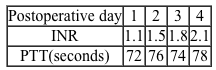 The patient achieves the goal of INR ≥2.5 on postoperative day 5 and heparin infusion is discontinued. Which of the following likely caused the delay in achieving therapeutic INR in this patient?
 (Multiple Choice)
4.9/5 (87)
(87) A 27-year-old woman, gravida 0 para 0, comes to the office for contraceptive management. The patient recently started a new relationship and would like a more reliable form of contraception than barrier contraception. Her menstrual cycles occur every 4-5 weeks with 3-6 days of heavy bleeding. The patient has occasional migraines that are associated with visual disturbances. She had low-grade cervical dysplasia a year ago and was treated for Chlamydia trachomatis cervicitis 3 months ago. Vital signs are normal. BMI is 31 kg/m2. Physical examination, including pelvic examination, is normal. Urine pregnancy test is negative. Which of the following is a contraindication for combined estrogen/progestin oral contraceptive pills in this patient?
(Multiple Choice)
5.0/5 (75)
(75) A 20-year-old college student comes to the office due to persistent fatigue, irregular menstrual periods, and difficulty losing weight despite intensive exercise. Several times a week, the patient has episodes where she uncontrollably consumes large amounts of cookies, bread, and potato chips. She feels disgusted with herself afterward and subsequently does additional exercise. Although the patient hates her appearance and constantly compares herself to her slimmer friends, she denies feeling persistently depressed. She has no other medical problems. Weight is 70 kg (154.3 lb) and height is 160 cm (5 ft 3 in). Blood pressure is 100/60 mm Hg and pulse is 92/min. Examination shows pharyngeal erythema and minimal parotid enlargement bilaterally. Potassium level is 3.4 mEq/L and amylase is 140 U/L. Pregnancy test is negative. Which of the following medications would be most effective in treating this patient?
(Multiple Choice)
4.7/5 (78)
(78) A 68-year-old man reports myalgia and fatigue during a follow-up office visit. The patient has been taking high-intensity statin therapy since he had an acute myocardial infarction several weeks ago. His other medical problems include hypertension and type 2 diabetes mellitus. On examination, there is mild generalized muscle tenderness. Serum creatine kinase level is 456 U/L. Vitamin D and TSH levels are within normal range. The patient's statin therapy is discontinued, and he is started on a medication that inhibits cholesterol absorption at the brush border of the small intestine. Which of the following drugs was most likely started in this patient?
(Multiple Choice)
4.9/5 (68)
(68) A 57-year-old woman comes to the office due to left breast pain associated with fatigue, nausea, and unexplained weight loss. She is referred for mammography, which reveals a 3-cm dominant mass in the left breast. Biopsy confirms the mass to be adenocarcinoma, and subsequent studies find that the tumor is estrogen receptor-positive and human epidermal growth factor receptor 2- (HER2) negative. The patient experienced menopause at age 52, and her past medical history is otherwise unremarkable. Anastrozole treatment is initiated and leads to a substantial decrease in the size of the primary tumor. Which of the following is the best explanation for the therapeutic effect of this agent?
(Multiple Choice)
4.8/5 (81)
(81) A 32-year-old woman comes to the physician for a health maintenance examination. She has been well and has no specific complaints. She eats a well-balanced diet and exercises on a stationary bicycle 3 days a week. She works as a nursing assistant at a local hospital. Review of her records shows that she is due for her annual influenza vaccination. Prior to administration of the vaccine, her skin is disinfected with 70% isopropanol. Which of the following mechanisms is most likely responsible for the antiseptic properties of isopropanol?
(Multiple Choice)
4.8/5 (72)
(72) A 17-year-old girl is brought to the emergency department after an episode of syncope. The patient was sitting on the couch watching television when she suddenly passed out. She had no symptoms prior to the event and regained consciousness spontaneously after approximately 2 minutes. Her family noticed a brief twitching while the patient was unconscious, but she had no tongue biting or bowel or bladder incontinence. The patient is taking an antimicrobial agent for a recent infection but has no other chronic medical conditions. Her uncle died suddenly 2 years ago. A detailed evaluation reveals a decrease-in-function mutation in the KCNH2 gene, which codes for a voltage-gated potassium channel that is active during the repolarization phase of cardiomyocyte action potential. The patient's medication was causing further impairment of the ion channel function, leading to the incident of syncope. This patient was most likely taking which of the following medications?
(Multiple Choice)
4.7/5 (84)
(84) A 64-year-old man comes to the office for follow-up after a recent hospitalization. Ten days ago, he was admitted due to fever, dysuria, urinary urgency, and perineal pain. Evaluation revealed acute prostatitis, and urine culture was positive for Escherichia coli that was sensitive to all tested antibiotics. He received intravenous ciprofloxacin with improvement in his symptoms and was subsequently discharged on oral ciprofloxacin. The patient has been taking the antibiotic as prescribed, but over the past 2 days he has had recurrent fever and dysuria. He takes diltiazem for palpitations, atorvastatin for hyperlipidemia, and an over-the-counter antacid for frequent heartburn. Temperature is 37.3 C (99.1 F), blood pressure is 118/68 mm Hg, and pulse is 90/min. Physical examination shows a mildly enlarged and tender prostate. Repeat urine culture grows E coli. Which of the following is the most likely cause of this patient's recurrent symptoms?
(Multiple Choice)
4.9/5 (85)
(85) A 46-year-old man comes to the office to follow up mixed hyperlipidemia. His lipid levels have progressively worsened over the last 10 years associated with gradual weight gain. In the last 6 months, the patient has attempted to modify his diet and exercise regimen, but his lipid levels have not improved. Past medical history is unremarkable, and he currently takes no medications. The patient does not use tobacco, alcohol, or illicit drugs. Blood pressure is 130/86 mm Hg, pulse is 76/min, and BMI is 28 kg/m2. Cardiovascular examination is normal. Which of the following drugs, when used as monotherapy, would be most likely to increase triglyceride levels in this patient?
(Multiple Choice)
4.9/5 (82)
(82) A 72-year-old man with a history of Parkinson disease comes to the office for follow-up. The patient has been taking levodopa/carbidopa since being diagnosed 5 years ago, and has required increasing doses of medication to control his symptoms. He is currently on a maximum dose, but for the past several months has experienced bothersome motor fluctuations. The patient also reports worsening stiffness and difficulty moving before his next scheduled dose, which improves after taking the medication. Entacapone is added to his treatment regimen. This drug most likely improves this patient's symptoms by which of the following mechanisms?
(Multiple Choice)
4.9/5 (79)
(79) A 34-year-old man diagnosed with advanced non-Hodgkin lymphoma undergoes doxorubicin-containing chemotherapy with good clinical response. Several weeks after the last chemotherapy cycle, the patient comes to the office with progressive exertional dyspnea. He has difficulty sleeping flat at night and needs to use multiple pillows to fall asleep. The patient is a lifetime nonsmoker and has no family history of heart disease. Blood pressure is 124/72 mm Hg, pulse is 86/min, and respirations are 16/min. Oxygen saturation on room air is 96%. Which of the following is most likely responsible for this patient's current symptoms?
(Multiple Choice)
4.8/5 (83)
(83) 
Filters
- Essay(0)
- Multiple Choice(0)
- Short Answer(0)
- True False(0)
- Matching(0)