Multiple Choice
A novel aminoglycoside antibiotic is developed that is intravenously administered and excreted unchanged in urine with an elimination half-life of 4 hours. Two different dosing regimens are tested in a clinical trial: smaller doses given 3 times a day and a higher dose given once a day. The total administered drug amount per kilogram of body weight per day (mg/kg/day) is the same in both regimens. Serum drug concentration is monitored in both groups and is shown in the graph below:[Blue: once-daily (extended interval) dosing, Green: multiple-daily dosing, MIC: minimum inhibitory concentration] 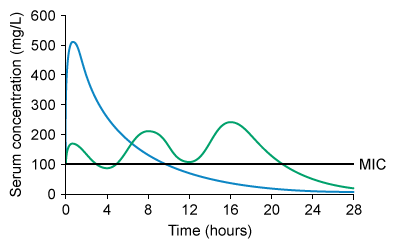 It is found that both regimens are effective against gram-negative pathogens, with clinical improvement occurring slightly earlier on average with once-daily dosing. Which of the following best explains the efficacy of once-daily dosing despite the short half-life of this antibiotic?
A) Concentration-dependent killing
B) High therapeutic index
C) Linear dose-response relationship
D) Low threshold dose
E) Time-dependent killing
Correct Answer:

Verified
Correct Answer:
Verified
Q25: A 75-year-old man comes to the office
Q26: A 60-year-old man who was recently diagnosed
Q27: A 64-year-old man comes to the office
Q28: A 42-year-old man is brought to the
Q29: A 62-year-old man is hospitalized for chest
Q31: A 35-year-old man was hospitalized for a
Q32: A 54-year-old man is transferred to the
Q33: A 23-year-old woman with a history of
Q34: A 3-year-old, previously healthy boy is brought
Q35: A 34-year-old kidney transplant patient treated with