



 Chat with AI
Exam 6: Genetics

Exam 1: Anatomy291 Questions
Exam 2: Behavioral science240 Questions
Exam 3: Biochemistry156 Questions
Exam 4: Biostatistics117 Questions
Exam 5: Embryology52 Questions
Exam 6: Genetics103 Questions
Exam 7: Histology24 Questions
Exam 8: Immunology129 Questions
Exam 9: Microbiology336 Questions
Exam 10: Pathology816 Questions
Exam 11: Pathophysiology464 Questions
Exam 12: Pharmacology538 Questions
Exam 13: Physiology272 Questions
Select questions type


A 28-year-old man is evaluated for abnormal movements of the hands and face. The patient reports that he started experiencing involuntary grimacing a year ago, which has gradually worsened. He is taking a selective serotonin reuptake inhibitor for major depression but has not taken any antipsychotic medications. His 52-year-old father was diagnosed with an inherited movement disorder 2 months ago. Physical examination shows normal strength and normal deep tendon reflexes. No sensory deficits are noted. Which of the following best explains the difference in disease presentation between this patient and his father?
(Multiple Choice)
4.9/5  (83)
(83) A 20-year-old man suddenly collapses while walking on a college campus. He is found to be unresponsive and pulseless by a bystander. Despite efforts by emergency medical personnel, the man is unable to be resuscitated. His friends say he appeared fatigued and described palpitations and dyspnea with exertion in the weeks leading up to the event. He had no known medical history and did not use tobacco, alcohol, or illicit drugs. The man's 3 younger siblings are healthy. His parents confirm a history of "early heart disease" in a paternal grandfather and request an autopsy and genetic testing for further evaluation. Genetic studies reveal a defect in a TTN gene exon resulting in a truncated titin protein. Autopsy findings are most likely to show which of the following phenotypes?
(Multiple Choice)
4.9/5 (86)
(86) A 12-year-old girl is brought to the physician by her parents, who are concerned about her loss of interest in playing sports at school. During a recent competition, she walked off the field in the middle of the game, complaining about the pain in her legs. The patient has no other medical conditions and takes no medications. Her vaccination schedule is up-to-date. Physical examination shows pulsatile vessels within the intercostal spaces and diminished femoral pulses relative to brachial pulses. This patient's symptoms are most likely associated with which of the following conditions?
(Multiple Choice)
4.8/5 (81)
(81) A pharmaceutical researcher develops a novel antibacterial drug that works by inhibiting exonuclease activity during DNA replication. When actively dividing Escherichia coli is exposed to the drug, enzyme-mediated nucleotide removal in the 5' to 3' direction is impaired, leading to inhibition of bacterial growth. Which of the following enzymes is the most likely target of this drug?
(Multiple Choice)
4.9/5 (77)
(77) A healthy, nulliparous 29-year-old woman with regular 28-day cycles comes to the office for a fertility evaluation. Over the past year, she and her 30-year-old husband have been trying to conceive. Her only medications are prenatal vitamins. She tracks her periods, cervical mucus, basal temperature, and intercourse with a smartphone app. The couple has intercourse every other day from cycle day 8 through the LH surge. The patient's urine pregnancy test is positive. The oocyte was most likely arrested in which of the following stages of meiosis immediately prior to fertilization?
(Multiple Choice)
4.8/5 (80)
(80) A 50-year-old previously healthy man is evaluated for progressive fatigue, weakness, and recurrent gingival bleeding. Laboratory studies reveal normocytic normochromic anemia, thrombocytopenia, and leukocytosis with circulating myeloblasts. Bone marrow biopsy establishes a diagnosis of acute myeloid leukemia. Induction chemotherapy followed by allogeneic hematopoietic cell transplantation (HCT) is planned. Molecular typing of human leukocyte antigen (HLA) -A, -B, -C, -DP, -DQ, and -DR is performed. The patient's biological sister, with whom he shares both parents, is eligible for stem cell donation and undergoes HLA typing. Which of the following is the most likely probability that the sibling will be an identical HLA match with this patient?
(Multiple Choice)
4.9/5 (78)
(78) A 5-year-old boy is being evaluated for progressive muscle weakness that has resulted in numerous recent falls. There is no family history of muscle disorders. Physical examination reveals bilateral calf enlargement. When the patient is asked to stand, he uses his hands and arms to help push himself to an upright position. Serum creatine kinase is 12,600 U/L (normal: 30-170 U/L). Molecular tests reveal a large muscle protein that is defective due to the loss of 508 amino acid residues. Genetic analysis reveals a single base substitution within exon 48 of the gene encoding this muscle protein. This patient's gene mutation has most likely resulted in which of the following mRNA codon changes?
(Multiple Choice)
4.9/5 (81)
(81) A 33-year-old woman, gravida 2 para 1, comes to the office for a prenatal visit at 20 weeks gestation. She feels well and reports experiencing fetal movements. The patient has no medical problems other than a history of cleft lip, which was repaired in childhood. Her husband is healthy, but her previous child was born with spina bifida. She takes a daily prenatal vitamin. Physical examination is unremarkable and uterine size is in accordance with ultrasound dates. The patient is worried that the fetus may develop the same birth defect as her previous child. Which of the following is the most likely mode of inheritance of this disorder?
(Multiple Choice)
4.8/5 (74)
(74) A small-for-gestational-age infant is born prematurely to a 38-year-old woman who had inconsistent prenatal care. Physical examination shows a small head and eyes as well as a cleft lip and palate. There is a small, round punched-out lesion with an overlying thin membrane on the patient's scalp. A small, membranous sac with a loop of bowel protrudes from the patient's abdominal midline. The infant is transferred to the neonatal intensive care unit for further workup and management. Which of the following is most likely responsible for this patient's condition?
(Multiple Choice)
4.9/5 (78)
(78) A 25-year-old Caucasian man is undergoing evaluation for azoospermia. The patient has been monogamous with his long-term girlfriend and does not use contraception during sexual intercourse. They have been trying to conceive for the past year with no success. The patient has a past medical history of recurrent pneumonia with frequent hospitalizations for antibiotic treatment. He takes no medications and does not use tobacco, alcohol, or illicit drugs. The patient has no allergies and his immunizations are up-to-date. His family history is unknown as he was adopted as an infant. Physical examination shows digital clubbing. A transrectal ultrasound shows bilateral absence of the vas deferens. Which of the following tests would most likely confirm the underlying diagnosis of this patient's condition?
(Multiple Choice)
4.9/5 (81)
(81) A 23-year-old previously healthy man comes to the office after noticing a painless, hard mass in the left testis. Scrotal ultrasound shows a solid testicular mass, and CT scan of the abdomen and pelvis shows left paraaortic lymphadenopathy. Left orchidectomy is performed and postoperative histopathology reveals seminoma of the testis. External beam radiotherapy is administered to the paraaortic metastatic area. Several weeks later, the retroperitoneal nodes are observed to have markedly decreased in size. Which of the following is the most likely effect of the therapy used on the metastatic cells in this patient?
(Multiple Choice)
4.9/5 (82)
(82) A geneticist is performing an experiment to alter protein structures by incorporating modified amino acids into their polypeptide sequences. During the process, she incubates dermal fibroblasts in a medium containing fluorescently labeled lysine residues. After several hours, she finds that aminoacyl tRNA synthetase in the fibroblasts "loads" lysine residues onto tRNA molecules containing the anticodon UUU. This residue most likely attaches to tRNA at which of the following sites in the image shown below? 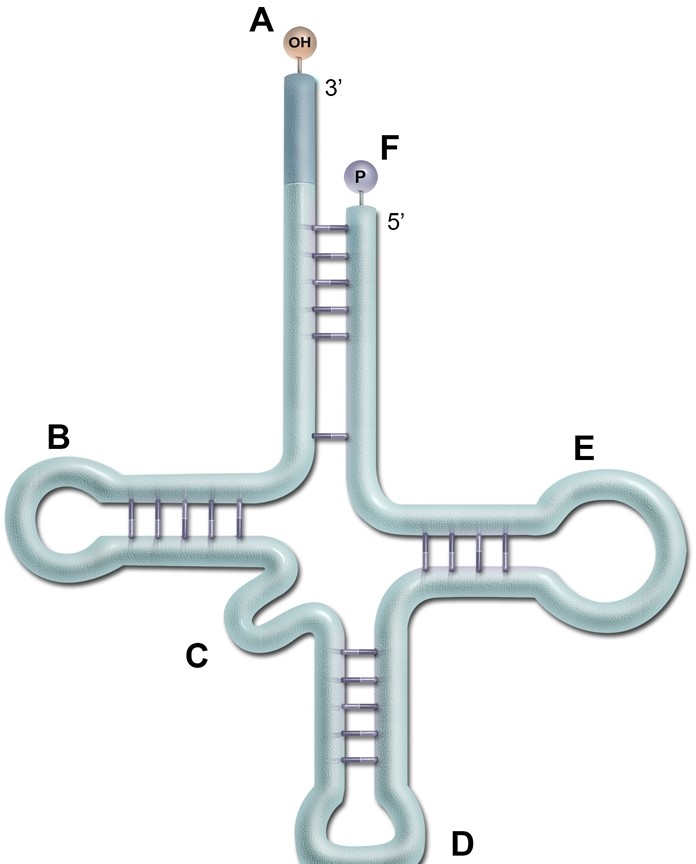
(Multiple Choice)
4.8/5 (72)
(72) A genetic researcher is comparing the DNA replication process of prokaryotic and eukaryotic cells. In an experiment, Escherichia coli and human cells are cultured in separate media containing tagged nucleotides and their rates of DNA replication are determined. Although the eukaryotic genome is significantly larger and more complex than that of the prokaryote, eukaryotic DNA replication still occurs in a timely manner. Which of the following features of eukaryotic replication best explains this observation?
(Multiple Choice)
4.9/5 (87)
(87) A 54-year-old man comes to the physician with recent-onset mild headaches and left leg weakness. The lesions seen on physical examination are shown in the image below. 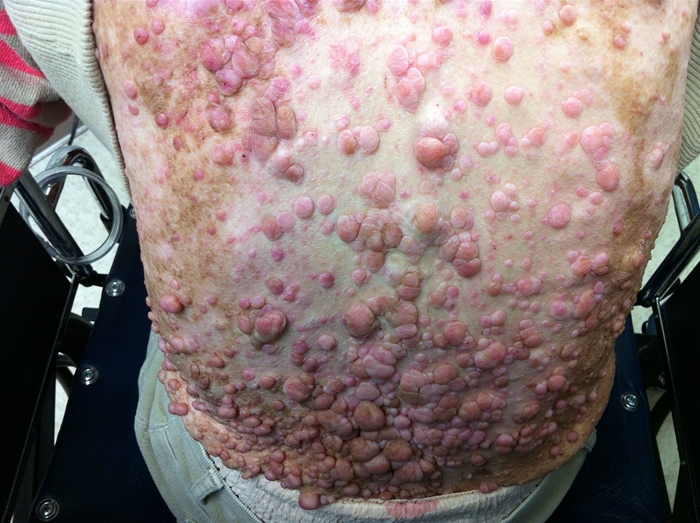 Which of the following inheritance patterns is this patient's disorder most likely to exhibit?
 (Multiple Choice)
4.9/5 (77)
(77) A 24-year-old woman comes to the office after discovering a new mole on her right leg. She is worried that it might be skin cancer as she has used tanning beds several times a year since age 18. Physical examination shows a 5-mm brown, oval macule on her anterior thigh with a homogeneous coloration and discrete borders. The lesion appears darker than her other moles. A biopsy of the lesion shows normal-appearing nevus cells clustered in the epidermis, and she is diagnosed with a benign acquired melanocytic nevus. During histologic analysis, her epithelial cells are each found to contain a condensed body composed of heavily methylated DNA at the periphery of the nucleus. This region of DNA is most likely associated with which of the following genetic findings?
(Multiple Choice)
4.8/5 (98)
(98) A 22-year-old woman presents to clinic for a medical check-up. She has been diagnosed with Turner's syndrome. Cardiovascular examination reveals no abnormalities of the heart or aorta. She asks about her chances of having a baby. Which of the following methods could be used to achieve pregnancy in this patient?
(Multiple Choice)
4.9/5 (79)
(79) A 67-year-old man comes to the office due to dark urine, pale-appearing stools, and progressive yellowing of his eyes over the last few weeks. He also reports unintentional weight loss, but has had no night sweats, abdominal pain, bloody stools, or vomiting. He has no chronic medical conditions and takes no medication. Vital signs are within normal limits. Scleral icterus is present. The neck is supple. No lymphadenopathy or skin abnormalities are present. There is no hepatosplenomegaly. Laboratory results are as follows: 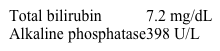 CT scan of the abdomen reveals a pancreatic mass compressing the common bile duct and the pancreatic duct. This patient's disease process is most likely caused by a mutation affecting which of the following genes?
 (Multiple Choice)
4.9/5 (86)
(86) A 2-month-old boy is brought to the emergency department due to progressively worsening "floppiness" and poor feeding. The infant was born in Eastern Europe via an uncomplicated vaginal delivery to a 38-year-old woman and then immigrated to the United States with his family. The parents describe the infant as a "good baby" who rarely cries and sleeps through the night but has lately been difficult to rouse for breastfeeding. Stools have also decreased to every other day and are small and pellet-like. Physical examination shows a hypotonic infant with a large anterior fontanelle, large tongue, and a reducible umbilical hernia. He has low tone and is unable to hold his head erect on his own. No other abnormalities are seen. Which of the following is the most likely cause of this patient's condition?
(Multiple Choice)
4.9/5 (97)
(97) A 19-year-old woman is evaluated for new onset generalized tonic-clonic seizures. For the past several years, she has also been having erratic jerks of her arms and legs, and intermittent muscle weakness. The girl has multiple family members with similar symptoms. Neurological examination reveals decreased sensation in the lower extremities and a broad-based gait. Skeletal muscle biopsy shows ragged, red-appearing muscle fibers. Further analysis reveals that the patient's symptoms are due to a mutation affecting extranuclear DNA. Which of the following pedigrees is most likely to represent this patient's family history? (The arrow points to the patient.)
(Multiple Choice)
4.8/5 (79)
(79) A young couple has undergone a successful in vitro fertilization procedure. The father has cystic fibrosis and the mother has a sister with cystic fibrosis. The father as well as the mother's sister are both known to have ΔF508 mutations, but the mother's carrier status is unknown. Before making the decision to conceive, the couple underwent extensive genetic counseling regarding the potential risks of having a child with cystic fibrosis. The family pedigree is diagrammed below with the unborn child marked by the red arrow. 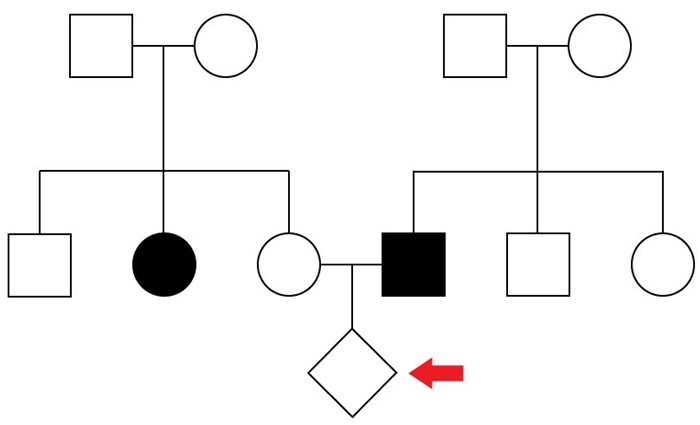 What is the probability that the unborn child will have cystic fibrosis?
 (Multiple Choice)
5.0/5 (95)
(95) 
Filters
- Essay(0)
- Multiple Choice(0)
- Short Answer(0)
- True False(0)
- Matching(0)