



 Chat with AI
Exam 6: Genetics

Exam 1: Anatomy291 Questions
Exam 2: Behavioral science240 Questions
Exam 3: Biochemistry156 Questions
Exam 4: Biostatistics117 Questions
Exam 5: Embryology52 Questions
Exam 6: Genetics103 Questions
Exam 7: Histology24 Questions
Exam 8: Immunology129 Questions
Exam 9: Microbiology336 Questions
Exam 10: Pathology816 Questions
Exam 11: Pathophysiology464 Questions
Exam 12: Pharmacology538 Questions
Exam 13: Physiology272 Questions
Select questions type


A 23-year-old man is being evaluated for myoclonic epilepsy of recent onset. The episodes are short-lived and triggered by startle. Physical examination reveals proximal muscle weakness. Gomori trichrome stain of a muscle biopsy specimen shows muscle fibers with a blotchy red appearance. No family history is available because the patient is adopted. What is the probability that this patient's one offspring will inherit the disease?
(Multiple Choice)
4.7/5  (74)
(74) A 14-year-old boy with chronic anemia is being evaluated after experiencing several episodes of chest, back, and extremity pain. Peripheral blood smear shows sickle-shaped red cells. Genetic testing reveals that the patient is homozygous for a point mutation in the beta-globin gene, resulting in a glutamic acid to valine substitution at position 6. Sequencing of the beta-globin gene would most likely reveal which of the following changes? (The genetic code is shown in the figure below.) 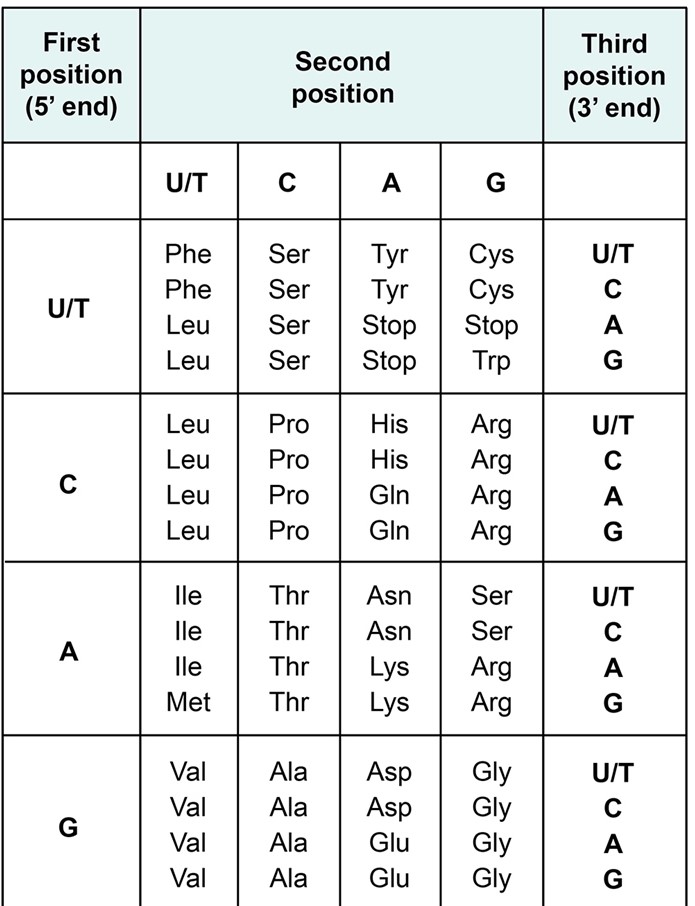
(Multiple Choice)
4.8/5 (85)
(85) A 12-year-old boy with mild intellectual disability is brought to the office by his adoptive parents for a routine physical examination. The parents say that the boy is adjusting well to a new school that has increased resources for children with learning disabilities. The patient was adopted as an infant and the birth family's history is unknown. His immunizations are up to date, and he has no allergies. Review of the patient's medical records is notable for cytogenetic studies that showed a small gap near the tip of the long arm of the X chromosome. Which of the following findings are likely to be present on this patient's physical examination?
(Multiple Choice)
4.8/5 (93)
(93) A 33-year old primigravida comes to the office to discuss results of prenatal testing. The patient is at 12 weeks gestation based on her last menstrual period. She has been taking prenatal vitamins inconsistently due to pregnancy-related nausea. Maternal alpha-fetoprotein level is reduced, and an ultrasound reveals increased nuchal translucency. Chorionic villous sampling shows a fetal karyotype of 47, XX, +21. The fetus is at greatest risk of developing which of the following conditions?
(Multiple Choice)
4.8/5 (79)
(79) A 25-year-old nulligravid woman comes with her husband to the clinic for preconception genetic counseling. She has oculocutaneous albinism due to a homozygous OCA2 gene mutation within the region of chromosome 15q12-q13. Examination shows pale hypopigmented skin with blonde hair. Eye examination shows faint brown irises. Her husband is 26 years old and has oculocutaneous albinism due to a biallelic TYR gene mutation at position 11q14.3. Examination of the husband shows complete absence of pigmentation in the skin, hair, and irises. The couple asks about their chance of having a child with oculocutaneous albinism and are told that the chance is 0%. Which of the following is the best explanation for this?
(Multiple Choice)
4.7/5 (75)
(75) A 15-year-old patient is referred to the physician by a teacher who is concerned about the patient's learning abilities and behavior. The patient's reading and writing skills are significantly impaired compared to other classmates, and the patient often misbehaves in class despite receiving numerous detentions. Neuropsychological assessment shows mild intellectual disability. Cytogenetic studies show a karyotype containing 47 chromosomes. Which of the following findings are most likely to be present on further evaluation?
(Multiple Choice)
4.8/5 (73)
(73) A 4-year-old boy is brought to the office due to a progressively worsening cough for the past 2 days that is productive of yellow sputum. A year ago, he was found to have bilateral lower-lobe pulmonary infiltrates on chest x-ray and was diagnosed with pneumonia. The patient has since had 2 additional episodes of pneumonia, each requiring antibiotics for improvement of symptoms. His current chest x-ray again reveals bilateral lower lobe infiltrates. Further testing shows a high chloride content in his sweat. Which of the following abnormalities is most likely to be seen in this patient?
(Multiple Choice)
4.8/5 (86)
(86) A 1-hour-old girl born to a 40-year-old woman is brought to the nursery for evaluation. The pregnancy and delivery were uncomplicated. Physical examination shows mid-face hypoplasia with a flat nasal bridge, up-slanting palpebral fissures, a small mouth, and a single palmar crease bilaterally. Cardiac auscultation reveals a blowing holosystolic murmur heard best along the sternal border. Which of the following abnormalities is most likely to be present in this patient?
(Multiple Choice)
4.9/5 (80)
(80) A 40-year-old woman, gravida 5, para 0, aborta 4, at 12 weeks gestation comes to the emergency department due to vaginal bleeding, midline pelvic pain, and severe nausea and vomiting. She has a history of 4 prior first trimester losses. Pelvic examination shows a 16-week-sized uterus. Speculum examination reveals dark red blood in the vagina. A β-hCG level is >100,000 mIU/mL, and an ultrasound shows no fetus and a uterine cavity filled with multiple small cysts. The patient undergoes dilation and curettage in the operating room, and a friable mass of tissue consisting of many thin-walled cysts is evacuated from her uterus. Examination of the tissue would most likely show which of the following karyotypes?
(Multiple Choice)
4.9/5 (67)
(67) A healthy couple, who recently emigrated from Eastern Europe, bring their 3-year-old son to the office for evaluation of an eczematous rash. On examination, the child also shows signs of intellectual disability and gait abnormality and has a musty body odor. What is the likelihood that this couple's next child will be affected with the same disease?
(Multiple Choice)
4.8/5 (82)
(82) A 16-year-old girl with a history of anemia since childhood is evaluated for a genetic abnormality after several members of her family are also found to be anemic. It is determined that she has a point mutation in the β globin gene, which has resulted in the substitution of guanine (G) with cytosine (C) in the mRNA sequence shown below (+1 position indicates start codon).  Which of the following cellular processes is most likely impaired due to this patient's gene mutation?
 (Multiple Choice)
4.8/5 (76)
(76) A pharmaceutical researcher develops a therapy to treat a protein misfolding disorder. Specifically, a mutation in this disorder leads to abnormal protein folding and subsequent intracellular degradation of the protein before it can reach the cell membrane. With the new combination drug therapy, the first drug corrects the processing and trafficking of the protein, enabling it to reach the cell surface membrane. Once the protein has reached the cell surface, its function is enhanced by the second drug. This therapy is most likely to be helpful in which of the following conditions?
(Multiple Choice)
4.7/5 (80)
(80) A study is undertaken to map the HLA-DQ loci in a population with a high incidence of celiac sprue. High-resolution HLA typing of the DQA1 and DQB1 loci is performed using polymerase chain reaction sequencing. The frequency of the DQA1*0501-DQB1*0201 haplotype, strongly implicated in autoimmunity, is found to be 0.2. However, in the same population, the frequency of the DQA1*0501 allele is 0.3 and the frequency of the DQB1*0201 allele is 0.2. Which of the following best explains the observed DQA1*0501-DQB1*0201 haplotype frequency in this population?
(Multiple Choice)
4.8/5 (78)
(78) A 1-day-old infant in the newborn nursery is found to have a harsh, holosystolic murmur on physical examination. The neonate was born at 39 weeks gestation to a 36-year-old woman who opted to defer prenatal screening. Review of medical records shows no family history of genetic or chromosomal disorders. The infant's vital signs are appropriate for his age. The rest of the physical examination shows a flat facial profile, protruding tongue, and small ears. Which of the following most likely occurred prior to conception?
(Multiple Choice)
4.9/5 (84)
(84) A 26-year-old woman comes to the office for follow-up. The patient and her husband want to have a child, and she inquires about the risk of certain genetic conditions, including cystic fibrosis (CF). The patient is from a small city with a stable Caucasian population, where the carrier frequency for CF is 1/30 Caucasian individuals. Her husband is from a nearby community, where CF carrier frequency in individuals of Asian descent is 1/100. Both the patient, who is Caucasian, and her husband, who is of Asian descent, are healthy. What is the probability that a child born to a mother from the Caucasian community and a father from the Asian community will have the disease?
(Multiple Choice)
5.0/5 (67)
(67) A pharmaceutical corporation investigating new therapeutic agents for treatment of Burkitt lymphoma synthesizes a double-stranded RNA molecule that is 21 base pairs in length. The RNA molecule has a base pair sequence that is complementary to a region of mRNA encoding c-Myc. Introduction of the RNA molecule into tumor cells results in a significant reduction in cell growth. Western blot analysis of equivalent numbers of treated and untreated cells is shown below. 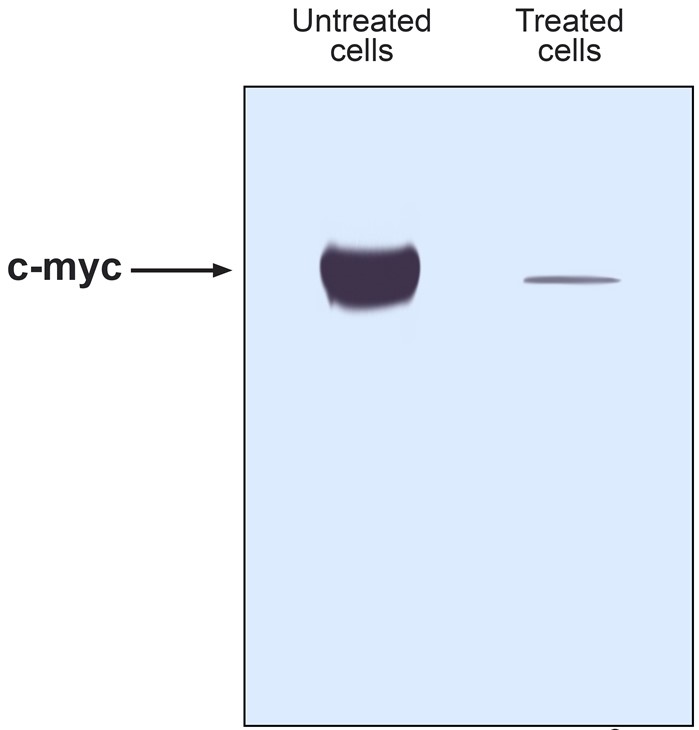 Which of the following processes was most likely directly interrupted in the cells exposed to the RNA molecule?
 (Multiple Choice)
4.9/5 (84)
(84) A pharmaceutical researcher develops a new drug that affects bacterial protein synthesis. In an experiment, Escherichia coli is exposed to the drug and serially cultured in media containing tagged nucleotides and amino acids. It is found that the drug inhibits molecules that recognize the highlighted codon in the bacterial mRNA fragment shown in the image below.  Which of the following molecules is the most likely target of this drug?
 (Multiple Choice)
4.8/5 (71)
(71) An infant born to a 26-year-old woman is evaluated shortly after delivery. Birth weight and length are at the 10th and 15th percentiles, respectively. Vital signs are normal. Physical examination shows a protruding tongue, excessive skin at the nape of the neck, and upslanting palpebral fissures. The startle reflex is symmetric and weak. Cardiac auscultation reveals a harsh, III/VI systolic murmur heard best over the lower left sternal border. The patient has normal external female genitalia. Review of maternal medical records shows a past history of 2 spontaneous abortions in the last 3 years. Echocardiography confirms the presence of a ventricular septal defect. Which of the following karyotypes is most likely to be found in this infant?
(Multiple Choice)
4.9/5 (84)
(84) An 18-year-old man comes to the urgent care clinic due to painful erythema affecting his extremities, trunk, and face. He is vacationing in Florida and spent 5 hours at a Gulf coast beach earlier in the day. The patient did not apply any sunscreen as it was cloudy. The physician explains that cloud cover does not afford a high degree of protection against the sun, especially with prolonged exposure in highly reflective environments like the beach. He is advised to wear protective clothing and apply sunscreen to prevent recurrence. Which of the following is most likely to happen within the patient's skin cells as a result of his exposure?
(Multiple Choice)
4.8/5 (78)
(78) A 26-year-old woman comes to the office with her husband for genetic counseling. She is pregnant with their second child, whose gender is unknown. Both parents are asymptomatic, but their firstborn 3-year-old son has recurrent episodes of anemia, jaundice, and painful swelling of the hands and feet. A blood sample is obtained from the boy, and hemoglobin electrophoresis is performed at alkaline pH. The results are shown in the image below. 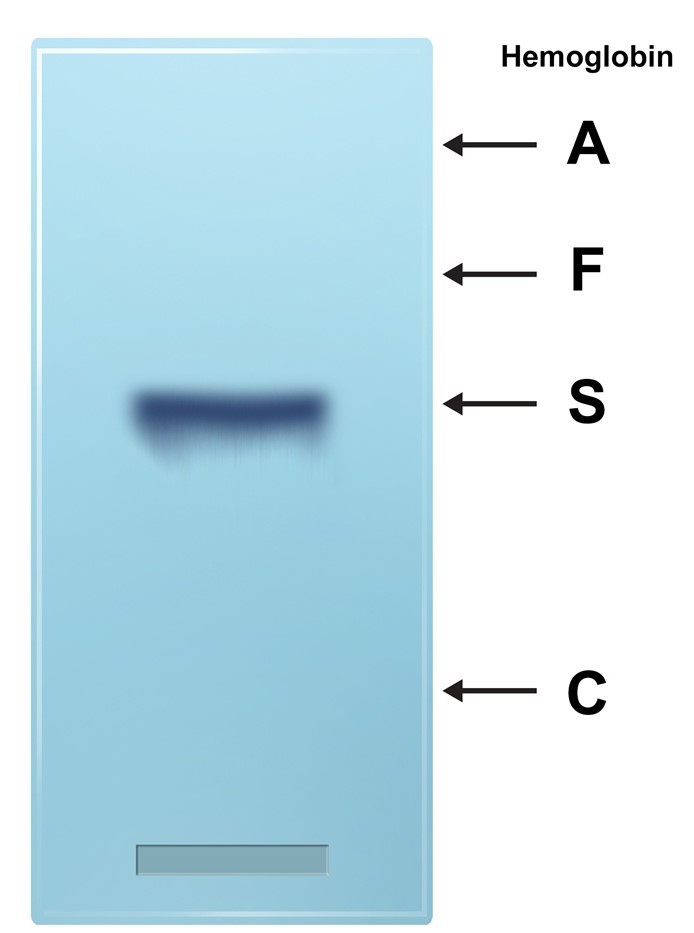 What is the probability that the unborn child will inherit one or more mutant alleles from the parents?
 (Multiple Choice)
4.9/5 (84)
(84) 
Filters
- Essay(0)
- Multiple Choice(0)
- Short Answer(0)
- True False(0)
- Matching(0)