



 Chat with AI
Exam 6: Genetics

Exam 1: Anatomy291 Questions
Exam 2: Behavioral science240 Questions
Exam 3: Biochemistry156 Questions
Exam 4: Biostatistics117 Questions
Exam 5: Embryology52 Questions
Exam 6: Genetics103 Questions
Exam 7: Histology24 Questions
Exam 8: Immunology129 Questions
Exam 9: Microbiology336 Questions
Exam 10: Pathology816 Questions
Exam 11: Pathophysiology464 Questions
Exam 12: Pharmacology538 Questions
Exam 13: Physiology272 Questions
Select questions type


Studies conducted following an influenza epidemic that affected the inhabitants of several countries determine that the cause is an antigenically novel virus strain carrying the animal-strain hemagglutinin and neuraminidase surface molecules. Further analysis reveals that reassortment of the genetic materials occurred during coinfection with human influenza virus and swine influenza virus, leading to the development of some progeny that contain genetic materials from both viruses. Which of the following viruses can undergo a similar process?
(Multiple Choice)
4.9/5  (78)
(78) A 34-year-old woman comes to the office due to dysuria. The patient has a history of recurrent urinary tract infections. A urine sample is collected and sent for culture. Gram-negative bacteria isolated from the urine are found to form pink colonies on lactose-containing MacConkey agar. Several days later, bacterial isolates from a second urine sample are found to form white colonies when plated on the same type of medium. Genetic analysis shows that the more recent isolates have a single nucleotide deletion within the lac operon DNA sequence. This genomic change is most consistent with which of the following?
(Multiple Choice)
4.8/5 (71)
(71) A 22-year-old woman, who recently relocated, comes to the office for a new patient visit. She has mild intellectual disability and has completed a high school level of education. The patient has no major health problems but reports persistent swelling of the hands and feet. Menarche occurred at age 13, and she has regular menstrual cycles. Physical examination shows short stature and a webbed neck. Karyotype analysis performed on peripheral leukocytes shows that 40% of the cells have a 45,X genotype and that the remaining 60% contain a 46,XX genotype. Which of the following is the most likely cause of this patient's condition?
(Multiple Choice)
4.9/5 (81)
(81) A patient is suspected of having an inherited disorder. Pedigree analysis shows the following pattern: 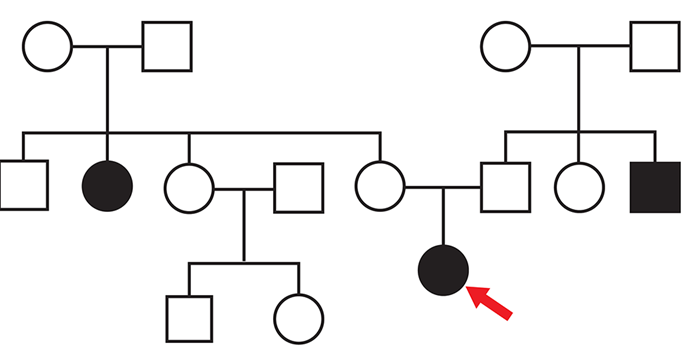 This patient most likely has which of the following conditions?
 (Multiple Choice)
5.0/5 (83)
(83) A research scientist purifies DNA polymerase III from Escherichia coli extract. When the enzyme is incubated in a mixture containing DNA templates, RNA primer oligonucleotides, and tagged deoxynucleotides, she finds that the enzyme possesses 3' to 5' exonuclease activity. Which of the following enzymatic actions was most likely observed during the experiment?
(Multiple Choice)
4.9/5 (76)
(76) A 35-year-old woman, gravida 1, para 0, comes to the office to discuss abnormal laboratory results. The patient is at 18 weeks gestation based on her last menstrual period. She drank wine during the first trimester, as she initially did not realize she was pregnant. The patient is otherwise healthy with no medical problems. She takes prenatal vitamins and no other medications. Her immunizations are up-to-date. Results of the quadruple screen performed yesterday are as follows: 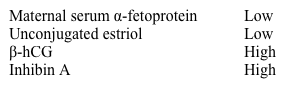 An ultrasound is scheduled to confirm the patient's gestational age and evaluate for fetal anomalies. Which of the following conditions is the most likely cause of this patient's analyte pattern?
 (Multiple Choice)
5.0/5 (69)
(69) Molecular biologists are investigating the functional significance of non-coding RNA molecules. During an experiment, they isolate large complexes containing both protein and RNA from exocrine pancreatic cells. The complexes are found both freely floating in the cytoplasm and bound to the endoplasmic reticulum. The RNA found within these complexes is primarily synthesized at which of the following intracellular sites? 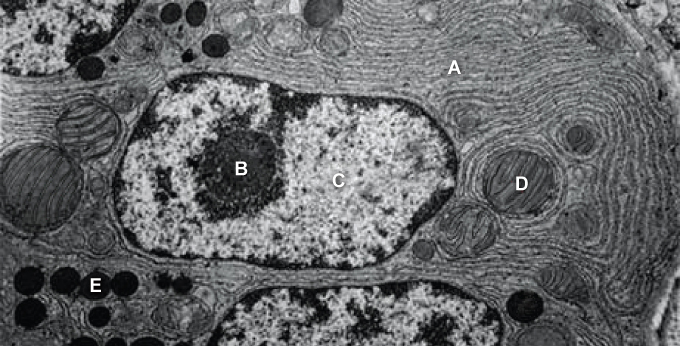
(Multiple Choice)
4.9/5 (74)
(74) A pharmaceutical researcher performs preclinical testing on a novel chemotherapeutic drug. When rat embryos are exposed to this drug during an early stage of organogenesis, they develop severe skeletal malformations. Further genetic analysis reveals that the drug causes mutations in numerous homeobox genes containing highly conserved 180 base pair DNA sequences. The genes affected by this drug most likely code for which of the following proteins?
(Multiple Choice)
4.7/5 (73)
(73) A 15-year-old girl is brought to the physician for evaluation of primary amenorrhea. Her mother is concerned because her other daughters had menarche before age 13. Vital signs are normal. The patient is at the 5th percentile for height and 20th percentile for weight. Examination shows a high arched palate and Tanner stage I breasts with inverted and widely spaced nipples. Further evaluation would most likely show which of the following?
(Multiple Choice)
4.9/5 (70)
(70) A 13-year-old boy with growth retardation, microcephaly, sun-sensitive skin rash, and recurrent infections is being evaluated for a possible inherited genetic defect. The patient is the second-born child of a first cousin marriage. His parents and siblings are healthy, but 2 of his maternal cousins have similar signs and symptoms. Genetic analysis of the patient reveals a defect in the BLM gene that codes for DNA helicase. Which of the following is the most likely site of action of this enzyme in the DNA replication fork shown below? 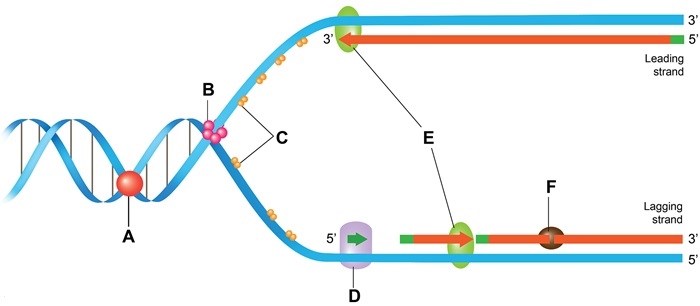
(Multiple Choice)
4.9/5 (75)
(75) A 7-year-old boy is admitted to the hospital after his adoptive parents brought him to the emergency department due to fatigue and pallor. Laboratory evaluation reveals pancytopenia with an absolute neutrophil count consistent with severe neutropenia. Bone marrow examination reveals signs of aplastic anemia, and subsequent genetic testing reveals a congenital genomic defect in DNA repair leading to chromosomal instability. A bone marrow transplant is required for treatment. The patient's only living relatives are an identical twin brother and older sister who were both adopted by the same parents. He also has stored umbilical stem cells that were harvested after birth. Which of the following is the best bone marrow transplantation method for this patient?
(Multiple Choice)
4.8/5 (77)
(77) A 46-year-old woman is evaluated for a 2-month history of progressive abdominal distension, vague abdominal discomfort, and a bloating sensation. Physical examination shows moderate ascites. Laboratory evaluation reveals markedly elevated CA-125 and imaging studies show an ovarian mass. Molecular analysis of the malignant cells in ascitic fluid is performed, and these cells are found to have high telomerase activity. This enzyme promotes cell growth and malignancy by directly causing which of the following actions?
(Multiple Choice)
4.8/5 (87)
(87) A 5-year-old girl is brought to the office by her mother because she is concerned that her daughter "sunburns too easily." The mother says the patient's skin becomes red and scaly with only minimal sun exposure. She first noticed the problem when her daughter was 7 months old during a trip to the beach. The mother has since avoided exposing her child to excess sunlight, but finds it difficult now that the patient has begun kindergarten. Physical examination shows thin and hyperpigmented skin. She also has a few nevi on her hands that have been enlarging rapidly. This patient's disorder is most likely due to a primary defect involving which of the following processes?
(Multiple Choice)
4.8/5 (76)
(76) A primigravid woman at 22 weeks gestation comes to the office with her partner to discuss a cleft lip and palate identified on prenatal ultrasound. The father requests a paternity test of the fetus because no one on his side of the family has ever had a cleft lip or palate. During your discussion with the family, you explain to them that children with cleft lip and palate often have no family history of the condition because it is most commonly due to which of the following?
(Multiple Choice)
4.7/5 (65)
(65) A pharmaceutical researcher is evaluating a nuclear enzyme inhibitor for the treatment of an inherited disorder. During an experiment, he extracts and purifies nuclear enzymes from skin cells of an affected patient. One of these enzymes is found to catalyze the methylation of cytosine residues in DNA using S-adenosyl-methionine (SAM) as the methyl donor. This enzyme most likely plays a crucial role in which of the following genetic processes?
(Multiple Choice)
4.9/5 (81)
(81) A researcher is studying the expression pattern of a particular gene. Messenger RNA is isolated from several tissues, subjected to electrophoresis, blotted, and probed with radiolabeled DNA containing sequences from exon 4 from that gene. An x-ray film is then placed over the blotting membrane, with the results of the autoradiogram shown below: 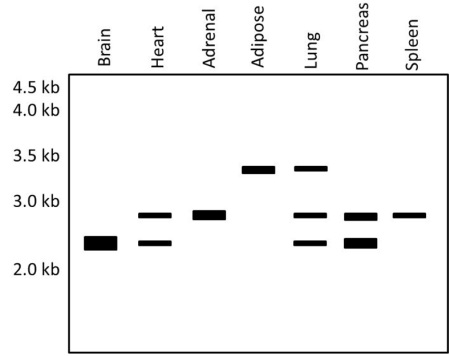 Which of the following best explains the autoradiogram findings in the different tissues?
 (Multiple Choice)
4.8/5 (68)
(68) A boy is admitted to the neonatal intensive care unit shortly after being born to a 28-year-old woman who had poor prenatal care. His temperature is 37.2 C (99 F), blood pressure is 70/30 mm Hg, pulse is 128/min, and respirations are 40/min. Pulse oximetry shows 85% on room air. Physical examination is significant for orbital hypertelorism, a submucous cleft palate, and bifid uvula. An echocardiogram reveals right ventricular hypertrophy, pulmonary stenosis with ventricular septal defect, and overriding aorta. The patient's diagnosis is eventually confirmed by fluorescence in situ hybridization. These findings are most consistent with which of the following mechanisms?
(Multiple Choice)
4.8/5 (82)
(82) A 56-year-old man comes to the office due to difficulty swallowing for the past several months. He has the most trouble with solid foods and says, "They seem to get stuck in my throat if I don't chew a lot." The patient has no chest pain or heartburn and has lost 4.5 kg (10 lb) in the last 3 months. He has been an avid hunter for many years and frequently cures the meat he eats with sodium nitrite. Physical examination is unremarkable. Endoscopy shows an ulcerated mass in the distal third of the esophagus, and biopsy samples are obtained from the mass and adjacent normal mucosa. Analysis of the samples shows accelerated cytosine deamination of chromosomal DNA in both normal and malignant epithelial cells. This damage is most likely to be repaired through which of the following enzymatic sequences?
(Multiple Choice)
4.9/5 (85)
(85) The patient's genetic defect has resulted in decreased β globin chain synthesis. Which of the following is most likely to be seen on laboratory testing?
(Multiple Choice)
4.9/5 (94)
(94) A 16-year-old boy with mild intellectual disability is brought to the office to be evaluated for attention deficit-hyperactivity disorder. The parents state that he has always been impulsive and inattentive and that teachers are concerned about his inattentiveness and poor grades. Review of medical records shows a history of gross motor and speech delay for which he received physical and speech therapies during childhood. On physical examination, the boy has a long and narrow face, a prominent mandible, and large testes. There is hyperlaxity of his finger and thumb joints. Which of the following is the most likely diagnosis in this patient?
(Multiple Choice)
4.8/5 (96)
(96) 
Filters
- Essay(0)
- Multiple Choice(0)
- Short Answer(0)
- True False(0)
- Matching(0)