



 Chat with AI
Exam 6: Genetics

Exam 1: Anatomy291 Questions
Exam 2: Behavioral science240 Questions
Exam 3: Biochemistry156 Questions
Exam 4: Biostatistics117 Questions
Exam 5: Embryology52 Questions
Exam 6: Genetics103 Questions
Exam 7: Histology24 Questions
Exam 8: Immunology129 Questions
Exam 9: Microbiology336 Questions
Exam 10: Pathology816 Questions
Exam 11: Pathophysiology464 Questions
Exam 12: Pharmacology538 Questions
Exam 13: Physiology272 Questions
Select questions type


A 43-year-old man is evaluated for progressive neuropsychiatric symptoms. A year ago, he began feeling depressed and having hallucinations. Five months later, he developed intermittent paresthesias and progressively worsening choreiform movements, myoclonus, and ataxia. These symptoms have not improved despite multiple hospitalizations; an extensive workup has been unrevealing. The patient is a slaughterhouse worker with extensive exposure to bovine offal. As part of the evaluation for prion disease, a tissue sample digested with protease is processed via gel electrophoresis and transferred to filter paper. Antibodies to a specific prion protein are added to the filter. Next, a marked protein that combines with the antibody-protein complex is used to determine whether the test is positive. Which of the following best describes this test?
(Multiple Choice)
4.9/5  (71)
(71) A 6-year-old girl with chronic anemia requiring repeated blood transfusions is undergoing genetic testing. The patient's mother and older sibling have a history of mild anemia. Her peripheral blood smear shows hypochromic, microcytic red blood cells, and hemoglobin electrophoresis reveals a predominance of hemoglobins F and A2. Sequencing of the β-globin gene is performed using the patient's erythroblast DNA. A schematic representation of the gene and its transcribed RNA is shown in the image below.  The base sequence indicated by the bold red arrow is responsible for which of the following functions?
 (Multiple Choice)
4.9/5 (85)
(85) An infant born to a 34-year-old woman has a flat facial profile, prominent epicanthal folds, and a holosystolic murmur heard loudest at the left sternal border. Karyotype analysis is consistent with trisomy 21. Maternal and paternal karyotypes are normal. A restriction fragment length polymorphism (RFLP) analysis is conducted to determine the parental origin of the extra chromosome. DNA samples from the child, mother, and father are obtained and the DNA is fragmented with a restriction enzyme. The fragments are then sorted by size using the Southern blot technique. Labeling is done using a probe that binds to a specific DNA sequence close to the centromere of chromosome 21. RFLP analysis for the child, mother, and father is shown below. 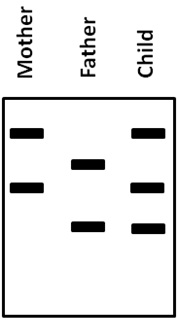 In which of the following meiosis events did the nondisjunction most likely occur?
 (Multiple Choice)
4.9/5 (71)
(71) A 60-year-old man comes to the office due to dark, rusty-colored urine for the last 2 weeks. He reports no pain, urinary frequency, or urgency. The patient has no chronic medical conditions and takes no medications. He smoked a half pack of cigarettes daily for 10 years but quit 30 years ago. His father had hypertension and his mother has Alzheimer dementia. Urinalysis shows a large number of red blood cells. Renal ultrasound reveals a mass in the right kidney. Cytologic evaluation of the mass shows malignant cells with a chromosome 3p deletion. The deletion most likely involves which of the following genes?
(Multiple Choice)
4.7/5 (77)
(77) A 10-year-old boy is brought to the emergency department for new swelling in his right leg. He has a history of lens dislocation and intellectual disability. Physical examination demonstrates moderate, pitting edema from his right calf to his right thigh and a normal left lower extremity. In addition, the patient has a caved-in appearing chest wall. He has no family members with similar conditions. Ultrasound reveals a deep venous thrombosis in his right femoral vein. Further genetic testing reveals a single missense mutation in the gene coding for cystathionine beta-synthase enzyme. Which of the following is the most likely explanation for this patient's genetic defect affecting multiple tissues?
(Multiple Choice)
4.9/5 (85)
(85) A 14-year-old boy experiences severe, prolonged bleeding following a tooth extraction. He also has a history of multiple episodes of painful joint swelling following minor trauma. His parents have no bleeding problems. Evaluation shows that the patient has an inherited disorder and that one of his parents is a genetic carrier. His older sister, who does not have this condition, is pregnant. She does not know the sex of her child. She asks about the risk that her child will be affected. Which of the following is the best estimate that this child will have the disease?
(Multiple Choice)
4.8/5 (88)
(88) A 6-year-old boy is brought to the office due to a persistent facial ulcer for the past 2 months. His mother reports that the patient has extreme sensitivity to sunlight and has developed freckles on his face, neck, and limbs since infancy. On physical examination, the skin in sun-exposed areas is dry and rough with numerous freckles and erythematous macules. There is an ulcerated plaque on the left face; a biopsy reveals squamous cell carcinoma. Further testing leads to a diagnosis of xeroderma pigmentosum. A defect in which of the following enzymes is most likely causing this patient's condition?
(Multiple Choice)
4.8/5 (85)
(85) In an experiment, erythrocyte precursor cells are incubated in a medium containing radiolabeled cysteine. These radiolabeled cysteine residues are attached to their appropriate tRNAs by the enzyme aminoacyl-tRNA synthetase. The bound cysteine residues are then chemically modified to form alanine. The end product of this reaction is a tRNA molecule that contains the cysteine anticodon but is mischarged with alanine. Which of the following is most likely to occur to this alanine residue during polypeptide synthesis of alpha-hemoglobin?
(Multiple Choice)
4.9/5 (74)
(74) Pharmacologic researchers develop a novel alkylating chemotherapeutic agent against glioblastoma multiforme. They find that malignant cells with methylation of the promoter region for the O6-methylguanine-DNA methyltransferase (MGMT) gene are more susceptible to this drug than cells without methylation. Which of the following is the most likely function of the protein encoded by the gene?
(Multiple Choice)
4.9/5 (72)
(72) A healthy 31-year-old woman comes to the office as she and her husband desire a second child. The husband is infertile and the patient's son, who was conceived via donor insemination, was recently diagnosed with glycogen storage disease type II (Pompe disease). This rare autosomal recessive disease is known to affect 1 in 40,000 of the general population. Genetic testing confirms that the patient is a carrier for the disease. A different sperm donor is selected with no personal or family history of Pompe disease; however, his carrier status is unknown. What is the probability of the patient having an affected child with the new sperm donor?
(Multiple Choice)
4.8/5 (71)
(71) A 3-year-old boy is being evaluated for recurrent respiratory infections. The patient's family immigrated to the United States 5 months after his birth. Since then, the boy has experienced multiple episodes of pneumonia and bronchitis, and has developed a persistent cough and failure to thrive. His older brother has no medical issues. A genetic test is performed and reveals a mutation in an exon of a gene that codes for a transmembrane chloride channel. The abnormal mRNA is isolated from cultured epithelial cells, and its complementary DNA is synthesized. Amplified cDNA samples from both the patient and his healthy sibling are analyzed using gel electrophoresis and compared to DNA fragments of known size to determine base pair length. The results are shown below. 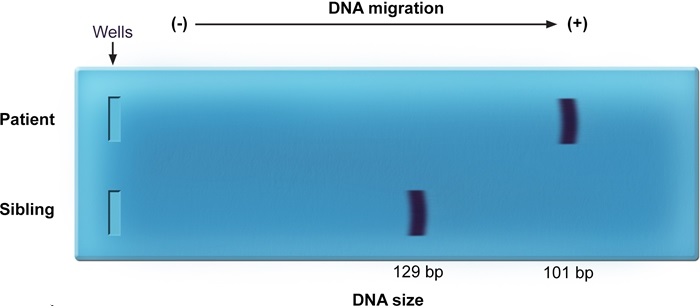 Which of the following is most likely responsible for this patient's condition?
 (Multiple Choice)
4.8/5 (81)
(81) A cell biologist is studying the role of ribonucleoproteins in normal cellular function. He prepares a cell extract using a specific cell type obtained from a 73-year-old man. Ribonucleoproteins are separated and purified from the cell extract for structural and functional analyses. These cells are found to express higher amounts of a particular protein in comparison to other cell types. This protein has reverse transcriptase activity that functions to add TTAGGG repeats to the 3' end of chromosomes. Which of the following cell types was most likely studied in this experiment?
(Multiple Choice)
4.9/5 (69)
(69) A 35-year-old woman, gravida 1 para 0, at 20 weeks gestation comes to the office for a routine prenatal visit and fetal anatomy ultrasound. The ultrasound reveals several abnormalities. An amniocentesis is performed and a fetal karyotype analysis is ordered; the results are shown in the image below: 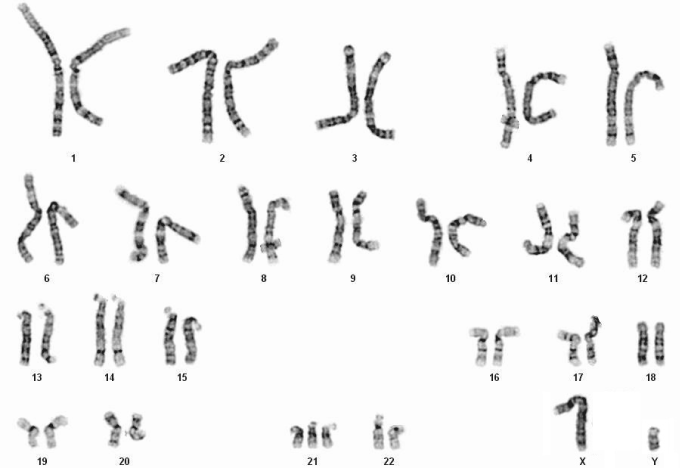 This fetus is at greatest risk for developing which of the following conditions after birth?
 (Multiple Choice)
4.7/5 (76)
(76) An autopsy was performed on a 17-year-old girl after a fatal motor vehicle collision. Her ovaries appear small and underdeveloped on gross examination. Light microscopic examination shows ovaries primarily composed of connective tissue with no follicles. Which of the additional abnormalities is most likely to be found on postmortem examination?
(Multiple Choice)
4.9/5 (80)
(80) An 8-year-old boy of Ashkenazi Jewish ancestry is brought to the office after developing reduced sensitivity to pain, impaired tear formation, and orthostatic hypotension. Familial dysautonomia is suspected due to the patient's symptoms and heritage. This disorder is caused by loss of function of the IKAP protein, which is essential for development and survival of sensory and autonomic neurons. IKAP gene sequencing reveals a single nucleotide substitution that causes a guanine residue to be replaced by adenine at the highlighted position in the normal gene sequence shown below. Exon sequences are represented by capital letters and introns by lowercase letters. 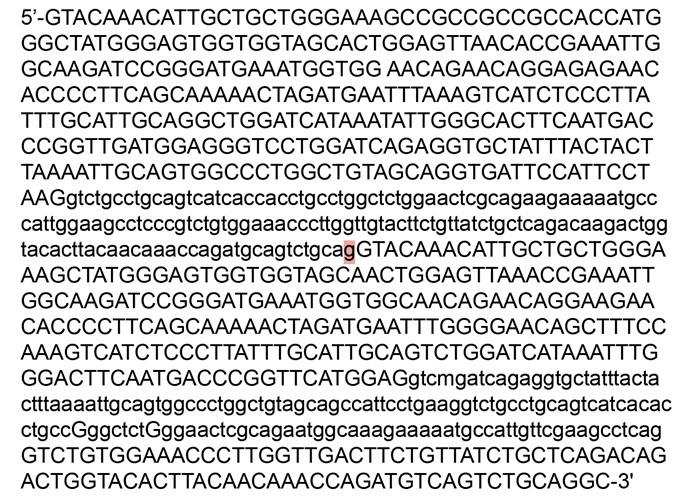 Which of the following is the most likely effect of this mutation?
 (Multiple Choice)
4.8/5 (76)
(76) A 32-year-old woman comes to the office due to worry that she will go bald. Her father had a receding hairline with apical baldness beginning at age 20 and was completely bald by age 35. The patient's paternal grandmother and multiple other relatives on her paternal side also had early-onset baldness, but her father's siblings and the maternal side of her family have had no problems with unusual hair loss. Physical examination shows mild thinning of hair at the temporal areas, with an otherwise normal hairline, thickness, and coloration. There is no excess hair growth on her face or trunk, and she has a normal female pattern of pubic hair growth. Palpation of the thyroid is normal. Which of the following is the most likely inheritance pattern of the hair loss in this patient's family?
(Multiple Choice)
4.8/5 (84)
(84) A newborn girl is evaluated in the nursery after an uncomplicated spontaneous vaginal delivery to a 29-year-old primigravida. The mother declined prenatal testing and ultrasound examination during the pregnancy. Her pregnancy was otherwise uneventful, and she took prenatal vitamins throughout. Examination of the neonate shows a posterior neck mass and bilateral nonpitting edema of the hands and feet. Femoral pulses are diminished. Neck ultrasound reveals a mass composed of cystic spaces separated by connective tissue. Which of the following is the most likely underlying mechanism responsible for this patient's condition?
(Multiple Choice)
4.8/5 (69)
(69) A mutation in a non-coding DNA sequence is believed to affect expression of the gene coding for a specific fetal enzyme. Liver and bone marrow cells from the fetus and his parents are obtained. Which of the following is the best method to determine if this gene is being transcribed in cultures of the isolated cells?
(Multiple Choice)
4.9/5 (68)
(68) A 25-year-old man experiences severe intolerance to certain medications. On 2 occasions, his reactions to various drugs have necessitated hospital admission. His family pedigree with respect to this condition is shown below, with the red arrow indicating his position within the family. 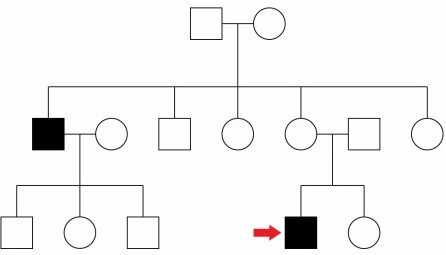 Assuming that the genetic condition demonstrates complete penetrance and is rare in the general population, which of the following inheritance patterns is most likely?
 (Multiple Choice)
4.8/5 (82)
(82) In an experiment, cultured fibroblasts are mechanically lysed, and the membrane lipids and cellular proteins are chemically removed to isolate nucleic acids. The cellular extract containing the purified nucleic acids is incubated along with short sequences of repeated deoxythymidine residues fixed to latex beads. The solution is washed several times to remove unbound molecules. Which of the following types of nucleic acid is most likely to bind the strongest to the latex beads in this experiment?
(Multiple Choice)
4.7/5 (76)
(76) 
Filters
- Essay(0)
- Multiple Choice(0)
- Short Answer(0)
- True False(0)
- Matching(0)