Multiple Choice
A 3-year-old boy is being evaluated for recurrent respiratory infections. The patient's family immigrated to the United States 5 months after his birth. Since then, the boy has experienced multiple episodes of pneumonia and bronchitis, and has developed a persistent cough and failure to thrive. His older brother has no medical issues. A genetic test is performed and reveals a mutation in an exon of a gene that codes for a transmembrane chloride channel. The abnormal mRNA is isolated from cultured epithelial cells, and its complementary DNA is synthesized. Amplified cDNA samples from both the patient and his healthy sibling are analyzed using gel electrophoresis and compared to DNA fragments of known size to determine base pair length. The results are shown below. 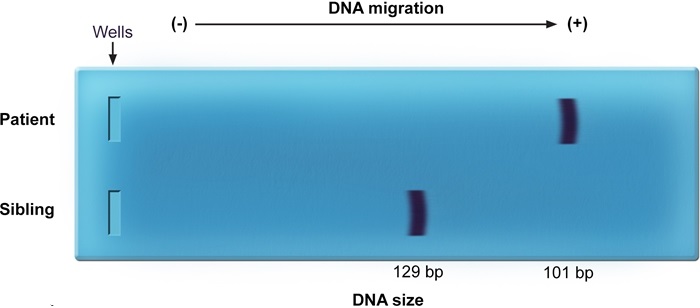 Which of the following is most likely responsible for this patient's condition?
A) Frameshift mutation
B) In-frame deletion
C) Missense mutation
D) Nonsense mutation
E) Silent mutation
F) Trinucleotide expansion
Correct Answer:

Verified
Correct Answer:
Verified
Q66: A 14-year-old boy experiences severe, prolonged bleeding
Q67: A 6-year-old boy is brought to the
Q68: In an experiment, erythrocyte precursor cells are
Q69: Pharmacologic researchers develop a novel alkylating chemotherapeutic
Q70: A healthy 31-year-old woman comes to the
Q72: A cell biologist is studying the role
Q73: A 35-year-old woman, gravida 1 para 0,
Q74: An autopsy was performed on a 17-year-old
Q75: An 8-year-old boy of Ashkenazi Jewish ancestry
Q76: A 32-year-old woman comes to the office