Multiple Choice
A 26-year-old woman is being evaluated for a possible inherited disorder. She has a 6-year history of generalized tonic-clonic seizures, and a year ago, she had partial loss of vision due to an occipital infarction. Her mother has chronic intermittent muscle weakness and lactic acidosis, and her maternal uncle has hemiplegia. Skeletal muscle biopsy of the patient shows ragged-appearing muscle fibers. After further evaluation, all the affected family members are found to suffer from the same inherited disease. Pedigree analysis is shown in the image below. 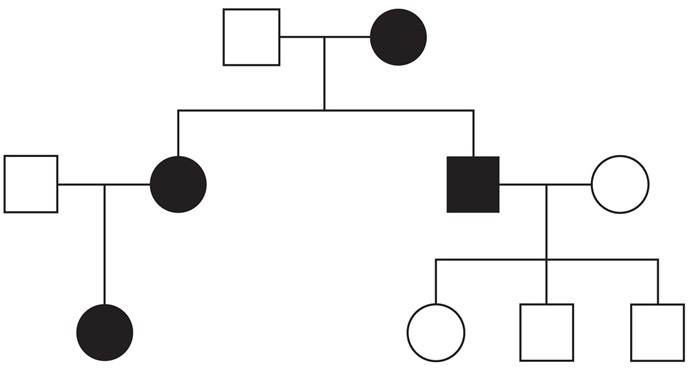 Which of the following is the most likely explanation for the variability of clinical manifestations in the affected family members?
A) Anticipation
B) Heteroplasmy
C) Incomplete penetrance
D) Mosaicism
E) Uniparental disomy
Correct Answer:

Verified
Correct Answer:
Verified
Q8: An 18-year-old woman comes to the office
Q9: A 14-year-old girl is brought to the
Q10: A 23-year-old asymptomatic male participates in clinical
Q11: Geneticists are studying a malfunctioning protein that
Q12: A 41-year-old man with trisomy 21 is
Q14: A series of experiments is being conducted
Q15: A 3-year-old boy is brought to the
Q16: A researcher is studying the Fas receptor
Q17: A researcher develops 2 functional mRNA sequences
Q18: A genetic study performed on a 10-year-old