



 Chat with AI
Exam 1: Anatomy

Exam 1: Anatomy291 Questions
Exam 2: Behavioral science240 Questions
Exam 3: Biochemistry156 Questions
Exam 4: Biostatistics117 Questions
Exam 5: Embryology52 Questions
Exam 6: Genetics103 Questions
Exam 7: Histology24 Questions
Exam 8: Immunology129 Questions
Exam 9: Microbiology336 Questions
Exam 10: Pathology816 Questions
Exam 11: Pathophysiology464 Questions
Exam 12: Pharmacology538 Questions
Exam 13: Physiology272 Questions
Select questions type


A 36-year-old man is rushed to the emergency department after sudden onset of shortness of breath and difficulty swallowing. He has visited the emergency department several times before due to food and skin allergies. The patient is unconscious on arrival. Examination shows excessive accessory respiratory muscle use and edematous swelling of the face, lips, and tongue. There is also scattered urticaria over the upper body. Attempts at intubation are unsuccessful due to massive soft tissue edema involving the pharynx. A decision is made to perform an emergency cricothyrotomy. The incisions made during this procedure will most likely pass through which of the following structures?
(Multiple Choice)
5.0/5  (73)
(73) A 62-year-old woman comes to the office for follow-up a month after undergoing left mastectomy and axillary lymph node dissection for invasive ductal carcinoma. Today, the patient feels well overall but reports continued burning and aching in her left upper arm, despite physical therapy. Examination of the left chest wall shows a healing incision without erythema and mild but appropriate edema of the left chest wall and axillary soft tissues. Sensation is diminished in the medial upper arm, near the axilla. Shoulder range of motion is normal, and the rest of the physical examination is unremarkable. Injury to which of the following nerves is most likely responsible for this patient's symptoms?
(Multiple Choice)
4.9/5 (77)
(77) A 29-year-old woman, gravida 2 para 2, comes to the emergency department with fever, crampy abdominal pain, and right flank pain 8 days after an uncomplicated vaginal delivery. Temperature is 38.3 C (101 F) and blood pressure is 110/60 mm Hg. Physical examination shows tenderness in the right lower quadrant and flank. The patient is hospitalized and started on intravenous antibiotics for presumed postpartum endometritis, but her fever persists. Urine and blood cultures show no bacterial growth. CT scan of the abdomen and pelvis reveals right ovarian vein thrombosis. If this patient remains untreated, she is at risk for extension of the thrombus into which of the following vessels?
(Multiple Choice)
4.8/5 (83)
(83) A 75-year-old man is brought to the emergency department after he was found unresponsive at home. The patient has a history of poorly controlled hypertension. Blood pressure is 240/120 mm Hg and pulse is 104 /min. He has extensor posturing and pinpoint pupils. CT scan of the head without contrast reveals an acute pontine hemorrhage with associated mass effect. The patient dies several hours later. Autopsy reveals disruption of all pigmented neurons in the posterior rostral pons at the lateral floor of the fourth ventricle. These neurons normally produce which of the following?
(Multiple Choice)
5.0/5 (85)
(85) A 45-year-old man comes to clinic due to frequent episodes of palpitations accompanied by dizziness, fatigue, and shortness of breath. Prolonged ECG monitoring identifies episodes of atrial fibrillation associated with a rapid ventricular response rate. A radiofrequency ablation procedure is planned. The access site is the right femoral vein. The ablation catheter is advanced to the left atrium where radiofrequency energy is used to eliminate an ectopic focus of abnormal electrical activity. During the procedure, the catheter most likely passes through which of the following structures?
(Multiple Choice)
4.9/5 (79)
(79) A 20-year-old man is evaluated in the clinic for right arm weakness and numbness. He is a competitive baseball pitcher and says that he played a lot more innings than usual last week because his team made the playoffs. Since then, the patient has had difficulty using the right arm, particularly when lifting objects. He has no known history of head, neck, or upper extremity trauma. On physical examination, there is diminished strength on right elbow flexion and an absent biceps reflex. This patient is most likely to have sensory loss over which of the following areas?
(Multiple Choice)
4.8/5 (82)
(82) A 24-year-old primigravid patient at 38 weeks gestation undergoes vaginal delivery of healthy twins after a prolonged labor course. Shortly after the placenta is delivered, profuse vaginal bleeding and a boggy uterus are noted on examination. Uterine massage and uterotonic medications fail to stop the bleeding. The patient is taken to the operating room for a laparotomy. Control of this patient's bleeding can best be achieved through bilateral ligation of which of the following arteries?
(Multiple Choice)
4.8/5 (79)
(79) A 71-year-old man comes to the emergency department due to several episodes of bright red blood per rectum. His recent colonoscopy revealed numerous colonic diverticula. Laboratory studies on admission are notable for a hemoglobin of 8.2 g/dL with an unremarkable coagulation profile. An abdominal angiogram shows active bleeding from the sigmoid colon. Catheter embolization is planned via the femoral artery. During the procedure, the arterial catheter is most likely to proceed in which of the following orders?
(Multiple Choice)
4.8/5 (78)
(78) A 32-year-old man comes to the hospital due to 1 week of progressive shortness of breath and cough. He also reports sharp right-sided chest pain that is worsened by deep inspiration. Examination reveals decreased tactile fremitus, dullness on percussion, and decreased breath sounds over the right lower lung. Chest x-ray shows consolidation of the right lower lobe and a right-sided effusion. A thoracentesis is performed, during which the needle is inserted along the upper border of the 10th rib at the right midaxillary line. Which of the following structures is most at risk of being injured as a result of the intervention?
(Multiple Choice)
4.9/5 (84)
(84) A 34-year-old woman comes to the physician complaining of easy fatigability. She lives alone and works as an accountant. Her menstrual cycles are regular and her last menstrual period was 2 weeks ago. She does not smoke or consume alcohol. Her blood pressure is 150/90 mm Hg and pulse is 82/min. During her physical examination, she sits up from the supine position without using her hands. Which of the following muscles contributes most to the described movement?
(Multiple Choice)
4.9/5 (90)
(90) A 19-year-old man is brought to the emergency department after he punched through a plate glass window with his right arm. Initially there was profuse bleeding, but it stopped after direct pressure was maintained by emergency medical personnel. A deep laceration is present at the proximal aspect of the right cubital fossa, just lateral to the medial epicondyle. Examination reveals absent sensation in the lateral palm and the palmar surfaces of the first 3½ fingers, inability to flex the proximal interphalangeal joints, and inability to pronate the forearm. Additional injury to which of the following structures was most likely responsible for this patient's bleeding?
(Multiple Choice)
4.8/5 (86)
(86) A 39-year-old woman is brought to the emergency department after an end-to-end motor vehicle collision. She was a restrained passenger and denies hitting her head or losing consciousness but has had abdominal pain and nausea since the accident. The patient's blood pressure is 115/55 mm Hg and pulse is 96/min and regular. On examination, she has ecchymosis over the area of the seat belt and abdominal tenderness. CT scan of the abdomen reveals a retroperitoneal hematoma. This patient most likely experienced which of the following injuries?
(Multiple Choice)
4.9/5 (88)
(88) A 38-year-old man is brought to the office for evaluation of behavioral changes. His wife says the patient has had frequent outbursts of anger, depressive mood, and insomnia. The patient recently lost his job as a machine operator because of lack of focus and poor memory. Over the past several years, he also has had involuntary, jerky, nonpurposeful movements of the extremities and face that have progressively worsened. These abnormal movements are present while he is awake but not during sleep. His 55-year-old mother has similar abnormal body movements and is at a nursing home with dementia. Which of the following labeled regions of a normal brain is most likely to be affected by this patient's disease process? 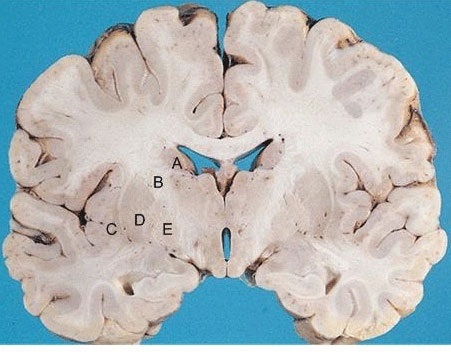
(Multiple Choice)
4.8/5 (79)
(79) A 57-year-old man is brought to the emergency department following a generalized tonic-clonic seizure. His wife reports that he has no history of seizures. However, she says that he has been complaining of intermittent headaches, memory loss, and problems with his vision for the past 2 weeks. Brain imaging shows a solitary mass within the right temporal lobe. Which of the following visual field defects is most likely present in this patient?
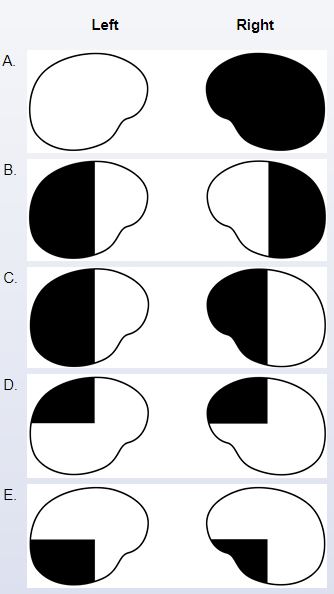
(Multiple Choice)
4.8/5 (81)
(81) A 49-year-old woman comes to the office due to muscle weakness. For the past 3 months, the patient has had worsening weakness in her right hand. She has also been tripping. The patient experiences twitching and cramping in her arms and legs. She has no sensory deficits. On examination, there is increased tone and fasciculations in the lower extremity muscles. Atrophy of the interosseus muscles of the right hand and the bilateral intrinsic muscles of the feet is present. When the physician taps on the chin while the mouth is slightly open, the jaw jerks upward briskly. Which of the following cranial nerves mediate this reflex?
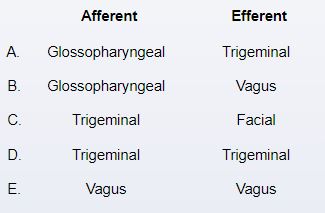
(Multiple Choice)
4.7/5 (73)
(73) A 66-year-old man hospitalized 3 days ago for left lower lobe pneumonia is evaluated for persistent fever. He has been receiving the appropriate intravenous antibiotics as determined by antibiotic susceptibility testing of his sputum cultures. The patient has a history of diabetes mellitus and hypertension. His temperature is 38 C (100.4 F) and pulse is 87/min. Examination shows dullness to percussion and decreased breath sounds over the left lower lung. Imaging studies reveal a loculated, left-sided pleural effusion. A tube is placed to drain the fluid via an incision at the 5th intercostal space in the midaxillary line. Which of the following muscles is most likely to be dissected during the procedure?
(Multiple Choice)
4.8/5 (85)
(85) A 55-year-old man is being evaluated for a 4-week history of right shoulder pain. The pain worsens when actively abducting the shoulder or when lying on the shoulder at night. The patient also has weakness with abduction and external rotation of the right shoulder. He has attempted treatment with over-the-counter analgesics with limited relief. MRI of the shoulder shows a partial rotator cuff tear, and the patient is scheduled for surgical repair. Immediately before the surgery, he receives anesthesia with an injection between the right anterior and middle scalene muscles in order to block the C3 through C7 nerve roots of the cervical and brachial plexuses. Which of the following muscles is most likely to be paralyzed due to the anesthesia?
(Multiple Choice)
4.8/5 (69)
(69) A 65-year-old man is brought to the emergency department after he suddenly became unresponsive at home. On arrival, paramedics found him pulseless with ventricular fibrillation. After 10 minutes of cardiopulmonary resuscitation, the patient regains spontaneous circulation. In the hospital, he is intubated and placed on mechanical ventilation. His vitals remain stable. A therapeutic hypothermia protocol is initiated. After 72 hours following rewarming, he remains comatose with fixed and dilated pupils. There is no direct or consensual pupillary response to light. MRI of the brain reveals diffuse loss of grey-white matter differentiation with sulcal effacement. Damage to which of the following areas of the brain is the most likely cause of this patient's pupillary findings?
(Multiple Choice)
5.0/5 (82)
(82) A 68-year-old woman is evaluated for right lower extremity weakness while hospitalized. The patient was admitted after sustaining a right femoral neck fracture and underwent total hip arthroplasty. Her operative course was uncomplicated, but the patient experienced right leg weakness postoperatively. Since the surgery, she has had difficulty with physical therapy and reports numbness of the right leg. The patient's other medical conditions include hypertension, type 2 diabetes mellitus, a prior transient ischemic attack, and osteoarthritis. Right lower extremity examination shows weakness in dorsiflexion, plantar flexion, and knee flexion. Hip flexion and knee extension are normal. Sensation to light touch is decreased on the dorsum of the right foot and posterolateral aspect of the right calf. Ankle reflex is absent on the right. Which of the following is the most likely cause of this patient's current findings?
(Multiple Choice)
4.8/5 (70)
(70) A 22-year-old man is brought to the emergency department after a bar fight during which he received a knife wound to his neck. The patient is in moderate distress but is alert and can follow commands. Vital signs are stable. Neurologic examination shows right-sided hemiplegia. Loss of proprioception and vibratory sensation is present below the C8 dermatome on the right side. On the left side, there is loss of pain and temperature sensation below the T2 dermatome. MRI of this patient's spine will most likely reveal which of the following?
(Multiple Choice)
4.9/5 (77)
(77) 
Filters
- Essay(0)
- Multiple Choice(0)
- Short Answer(0)
- True False(0)
- Matching(0)