



 Chat with AI
Exam 1: Anatomy

Exam 1: Anatomy291 Questions
Exam 2: Behavioral science240 Questions
Exam 3: Biochemistry156 Questions
Exam 4: Biostatistics117 Questions
Exam 5: Embryology52 Questions
Exam 6: Genetics103 Questions
Exam 7: Histology24 Questions
Exam 8: Immunology129 Questions
Exam 9: Microbiology336 Questions
Exam 10: Pathology816 Questions
Exam 11: Pathophysiology464 Questions
Exam 12: Pharmacology538 Questions
Exam 13: Physiology272 Questions
Select questions type


A 65-year-old woman comes to the emergency department due to nausea, vomiting, and abdominal pain that began about 6 hours ago. She has also had vague pelvic pain over the last few months but says her pain has never been this severe. Temperature is 38.4 C (101 F), blood pressure is 141/90 mm Hg, pulse is 92/min, and respirations are 18/min. Physical examination shows a moderately distended abdomen. There is a tender bulge below the inguinal ligament, lateral to the pubic tubercle. The overlying skin is erythematous. Which of the following structures is most likely immediately lateral to the bulge?
(Multiple Choice)
4.9/5  (78)
(78) A 35-year-old woman with a history of migraines is evaluated due to a recent increase in headache frequency and severity. She has had no focal weakness, sensory loss, vision changes, or seizures. The patient has no other medical conditions and takes sumatriptan as needed. She does not use tobacco, alcohol, or illicit drugs. Physical examination shows no focal neurological deficits. Neuroimaging reveals a small aneurysm arising from the segment of right internal carotid artery within the cavernous sinus. If this patient's aneurysm continues to expand, which of the following findings is most likely to be observed?
(Multiple Choice)
4.7/5 (93)
(93) A 65-year-old man comes to the emergency department due to sudden-onset headache. The patient has had no recent falls or head trauma. Medical history includes hypertension and lung adenocarcinoma with abdominal metastasis. Initial noncontrast CT scan of the head reveals a small temporal lobe hemorrhage. Over the next 24 hours, the patient becomes progressively obtunded and develops generalized tonic-clonic seizures. Blood pressure is 190/96 mm Hg, pulse is 38/min, and respirations are 10/min with brief episodes of apnea. A repeat noncontrast CT scan of the head reveals acute hemorrhage expansion with brain herniation. Which of the following findings is most likely to be observed on this patient's repeat neurologic examination?
(Multiple Choice)
4.8/5 (80)
(80) A 46-year-old man comes to the emergency department due to severe anal pain. He has a history of chronic constipation and on several occasions has noticed streaks of blood on the tissue paper after wiping. He has no abdominal pain, nausea, vomiting, or weight loss and has no family history of malignancy. His temperature is 36.7 C (98 F). On examination, there are several large, purplish-blue sacs bulging into the anal canal, one of which originates below the dentate line and is extremely tender. Excision of the tender lesion under local anesthesia is planned. The anesthetic agent most likely blocks sensory impulses carried by which of the following structures?
(Multiple Choice)
4.9/5 (76)
(76) A 34-year-old man is evaluated in the emergency department due to difficulty walking. He was installing new shingles on his roof when he fell to the ground and sustained a puncture injury to his right leg. On physical examination, the right foot is dorsiflexed and everted. The patient is unable to stand on his tiptoes. Muscular strength at the knee and hip appear intact. Pedal and tibial pulses are +2 and symmetric. X-rays of his right leg are negative for fracture. This patient is most likely to have sensory loss over which of the following areas?
(Multiple Choice)
4.9/5 (78)
(78) A 68-year-old man with a history of permanent atrial fibrillation comes to the office for follow-up. He has been having symptoms due to ineffective ventricular rate control despite aggressive medical therapy. On examination, the patient's heart rate is 125/min and irregular. ECG shows atrial fibrillation with rapid ventricular response. A catheter-based radiofrequency ablation of the atrioventricular node with placement of a permanent ventricular pacemaker is planned. The ablation tip should be positioned at which of the following locations?
(Multiple Choice)
4.9/5 (79)
(79) A 62-year-old, right-handed man is evaluated for an episode of left leg weakness that spontaneously resolved within 30 minutes of onset. The patient also has had transient vision loss in the right eye. Medical history is significant for hypertension and diabetes mellitus. Evaluation reveals an atherosclerotic plaque in the extracranial portion of the supplying artery. During percutaneous stenting of the lesion, the vascular catheter is inserted into the right common femoral artery and gradually advanced to the level of the aortic arch. Which of the following is the most likely path of the catheter before stenting of the culprit lesion can be performed?
(Multiple Choice)
4.8/5 (69)
(69) A 25-year-old woman comes to the office due to right ear pain that has worsened over the past 2 months. The pain is dull and constant and waxes and wanes. It is worse when she chews hard foods such as steak or almonds. In addition to ear pain, her ear feels stuffy and has some ringing. The patient grinds her teeth at night and previously wore a dental guard, but it broke several months ago. Ear examination is normal. Which of the following nerves is most likely responsible for this patient's ear pain?
(Multiple Choice)
4.8/5 (63)
(63) A 12-year-old boy is being evaluated for worsening headaches for the past several months. He also has had paresthesia, weakness, and stiffness of the extremities. MRI of the brain reveals an expansile mass in the lower pons, as shown in the image below: 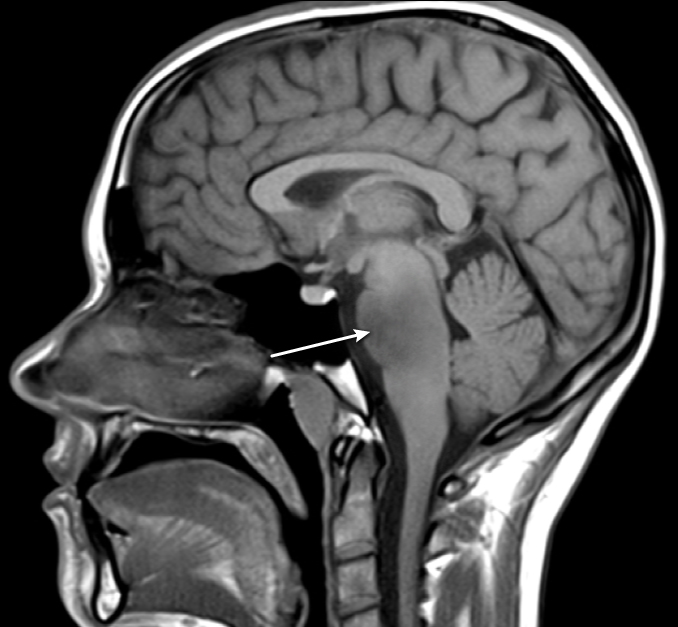 Which of the following is most likely to be observed in this patient due to direct involvement of nerve nuclei by the brain lesion?
 (Multiple Choice)
4.7/5 (77)
(77) A 3-year-old boy is rushed to the emergency department after he is found underwater in the bathtub. His parents say the patient was left alone for 5 minutes. On physical examination, he does not respond to painful stimuli and is pulseless and not breathing. Cardiac rhythm is asystole and spontaneously returns after several minutes of resuscitation. While performing endotracheal intubation, stimulation of the posterior pharyngeal wall with laryngoscope elicits no soft palate movements or gagging. This patient's findings during intubation most likely indicate dysfunction of which of the following neural structures?
(Multiple Choice)
4.9/5 (80)
(80) A 54-year-old Caucasian male dies from a progressive neurological disorder. A brain section of the patient is shown below. 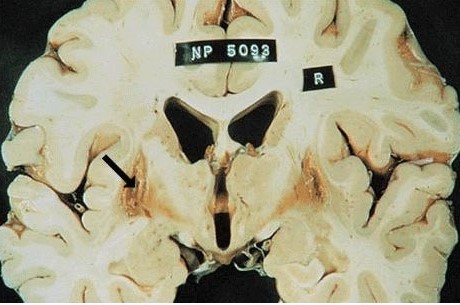 Which of the following corresponds to the structure with cystic degeneration (black arrow)?
 (Multiple Choice)
4.9/5 (83)
(83) A 52-year-old man comes to the office due to right shoulder pain. He is an avid golfer but has been unable to play for the past 3 months due to the pain. Lately, it has started to interfere with his daily activities, such as getting dressed. An MRI shows thickening and calcification of the supraspinatus tendon. Which of the following shoulder actions is most likely to provoke pain in this patient?
(Multiple Choice)
4.8/5 (80)
(80) A 46-year-old man comes to the office with left upper limb weakness and numbness. He has had chronic neck pain since being involved in a motor vehicle collision 4 years ago. He has no other medical problems. Neurological evaluation reveals that the tendon reflex shown in the image below is absent. Reflexes in the right upper extremity and both lower extremities are normal. 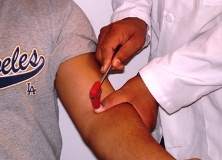 Imaging studies reveal degenerative changes in the spine causing mild spinal cord compression. Which of the following spinal segments is most likely affected in this patient?
 (Multiple Choice)
4.8/5 (78)
(78) A 40-year-old nulligravida woman comes to the office with a 2-month history of worsening right pelvic pain. She experiences the pain daily, and its intensity does not vary during her menstrual cycle. In addition, the patient's waist size has increased despite a decreased appetite. Pelvic examination shows an irregularly shaped, fixed adnexal mass. One week later, she undergoes surgery to remove a large ovarian neoplasm. Within the true pelvis, the surgeon can most likely palpate the right ureter immediately anterior to which of the following structures?
(Multiple Choice)
4.7/5 (79)
(79) A 43-year-old man comes to the office due to difficulty walking. The patient was seen at an outpatient clinic 2 days ago and received a right-sided deep intramuscular injection. He had no trouble walking at the time of the appointment but started having problems later that day. The patient has no history of trauma or pain at the injection site. Physical examination is negative for local erythema and swelling, and the patient has full strength against resistance on knee flexion and ankle plantar flexion bilaterally. When the patient is asked to walk across the room, his left hip drops every time he raises his left foot. Which of the following locations is the most likely site of this patient's intramuscular injection?
(Multiple Choice)
4.9/5 (74)
(74) A 48-year-old man comes to the hospital after a day of high-grade fever, progressive headache, and double vision. The patient has been having purulent nasal drainage and frontal headache for the past several days. He has a history of type 2 diabetes mellitus. His temperature is 38.9 C (102 F), blood pressure is 110/70 mm Hg, and pulse is 94/min. Physical examination shows ptosis, mydriasis, mild proptosis, and loss of the corneal reflex of the right eye. Visual acuity is normal in both eyes, but the patient is unable to move the right eye in any direction. There is decreased sensation in the right upper face. Which of the following structures is most likely involved in this patient's presentation?
(Multiple Choice)
4.8/5 (65)
(65) A 73-year-old woman is brought to the emergency department due to right hip pain. The patient was getting out of the shower when she slipped and fell directly on her right hip. She now has pain and swelling over the lateral aspect of her hip and cannot walk without assistance. Vital signs are within normal limits. Bilateral pedal pulses are normal, and sensation is intact. X-ray of the right hip is shown below. 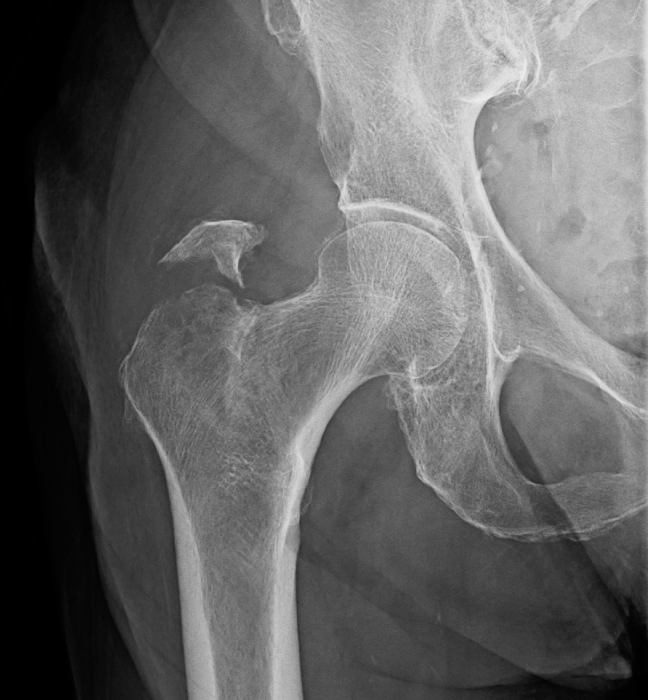 Examination of this patient will most likely show impaired function of which of the following muscles?
 (Multiple Choice)
4.9/5 (69)
(69) A 32-year-old woman comes to the office due to a 2-day history of worsening headache and double vision. The patient reports no chronic medical conditions but has had nasal discharge for the past several days. Physical examination shows weakness of the muscle shown on the below CT scan: 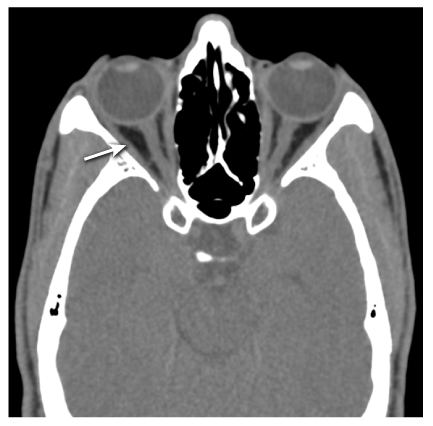 Purulent discharge from the sphenoethmoidal recess of the nasal cavity is also noted. Involvement of which of the following nerves best explains this patient's ocular findings?
 (Multiple Choice)
5.0/5 (64)
(64) An 18-year-old man comes to the clinic due to hematuria and intermittent left flank pain of several months duration. He has no history of trauma or sexually transmitted diseases and no associated fever or dysuria. Examination reveals a soft abdomen with normal bowel sounds and no localized tenderness. Urinalysis confirms 3+ blood but no white blood cells, crystals, or organisms. Contrast-enhanced CT scan shows no abnormalities in the ureters or kidneys but does reveal compression of the left renal vein between the superior mesenteric artery and the aorta. Which of the following is most likely to develop due to the vascular abnormality seen in this patient?
(Multiple Choice)
4.9/5 (82)
(82) A 12-year-old boy is brought to the emergency department by his mother due to right hand clumsiness. Several hours ago he attempted to climb a tree with a friend but lost his balance and fell from a branch. The boy tried to break the fall by grabbing the tree branch with his right hand. He landed safely on his feet with no head injury or loss of consciousness. On physical examination, he has difficulty performing fine finger movements with the right hand. Which of the following structures is most likely injured in this patient?
(Multiple Choice)
4.9/5 (77)
(77) 
Filters
- Essay(0)
- Multiple Choice(0)
- Short Answer(0)
- True False(0)
- Matching(0)