



 Chat with AI
Exam 1: Anatomy

Exam 1: Anatomy291 Questions
Exam 2: Behavioral science240 Questions
Exam 3: Biochemistry156 Questions
Exam 4: Biostatistics117 Questions
Exam 5: Embryology52 Questions
Exam 6: Genetics103 Questions
Exam 7: Histology24 Questions
Exam 8: Immunology129 Questions
Exam 9: Microbiology336 Questions
Exam 10: Pathology816 Questions
Exam 11: Pathophysiology464 Questions
Exam 12: Pharmacology538 Questions
Exam 13: Physiology272 Questions
Select questions type


A 24-year-old, previously healthy woman comes to the emergency department due to hematemesis. The patient was binge drinking when she became very nauseated and began vomiting repeatedly. She reports vomiting approximately a cupful of bright red blood during the most recent episode. Blood pressure is 136/78 mm Hg and pulse is 96/min. Physical examination shows mild epigastric tenderness. Endoscopy reveals a longitudinal mucosal laceration in the distal esophagus with active bleeding. Endoscopic treatment is performed, but the bleeding recurs. Angiography with transarterial embolization of the bleeding vessel is planned. A distal branch of which of the following blood vessels is most likely to be embolized during this patient's procedure?
(Multiple Choice)
4.8/5  (57)
(57) A 3-year-old girl is brought to the emergency department due to worsening fever and lethargy. Her parents report that she has had recurrent upper respiratory illness and recently had been irritable and pulling at her ears. She has also been eating poorly and vomiting, and has progressively become more lethargic. The patient has no chronic medical conditions and has received all recommended vaccinations. While being evaluated in the emergency department, she has a generalized tonic-clonic seizure. CT scan of the head shows a solitary 2-cm, ring-enhancing lesion in the left lateral temporal lobe. The pathogen responsible for this patient's current condition most likely gained access to the brain from which of the following structures?
(Multiple Choice)
4.7/5 (79)
(79) A 54-year-old man is brought to the emergency department by his wife after he develops difficulty speaking. When asked about the onset of his symptoms, the patient slowly responds with "I... weak... morning..." and becomes very frustrated. His wife says that he was able to grasp a pen without any problem while completing medical release forms, but had trouble signing his name. On examination, he is able to state his first name but with difficulty, and correctly points to different body parts on command. He also has mild weakness involving his right arm and face. This patient's speech difficulties are most likely caused by a lesion affecting which of the following brain areas? 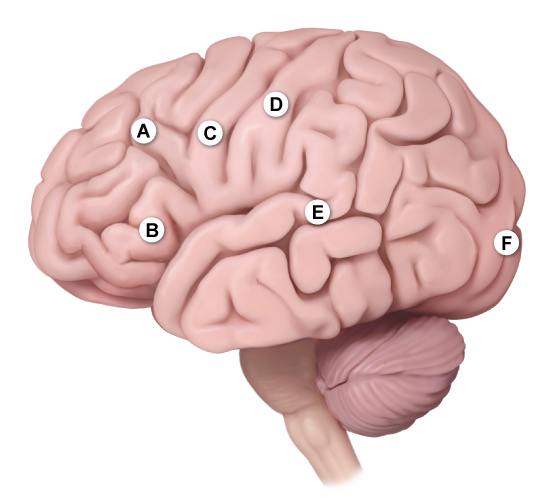
(Multiple Choice)
4.9/5 (82)
(82) A 65-year-old man comes to the emergency department due to acute-onset slurred speech. He also has right-sided weakness but denies any trauma, headache, or loss of consciousness. His medical problems include hypertension and type 2 diabetes mellitus. The patient has smoked 1 pack of cigarettes daily for 20 years. Neurologic examination shows right-sided lower facial droop with sparing of the forehead muscles. Motor strength is 3/5 on the right and 5/5 on the left with a Babinski response on the right. There is also dysmetria and dysdiadochokinesia involving his right upper and lower extremities. MRI of the brain reveals an acute lacunar infarct in the brainstem, as shown in the image below. 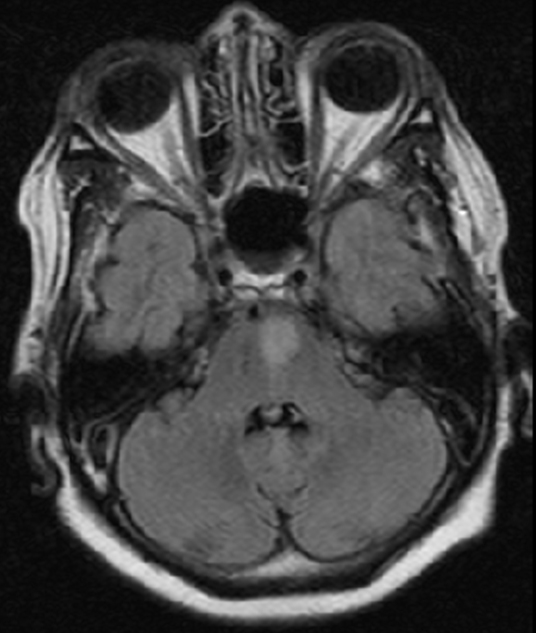 Which of the following cranial nerves exits the brainstem closest to the level affected by this patient's stroke?
 (Multiple Choice)
4.9/5 (71)
(71) A 78-year-old woman is hospitalized due to acute myocardial infarction. The patient had been having intermittent chest pain for 3 days and came to the hospital when the pain became unremitting. She has type 2 diabetes mellitus, but her medical follow-up has been poor. On the third day of hospitalization, the patient has sudden-onset shortness of breath due to pulmonary edema. Echocardiography confirms severe mitral regurgitation. She is taken immediately to surgery, which reveals rupture of the posteromedial papillary muscle. This patient's finding typically suggests compromised blood flow through which of the following coronary arteries?
(Multiple Choice)
4.9/5 (90)
(90) A 19-year-old man comes to the emergency department after being stabbed in the right arm during a fight. The patient has no chronic medical conditions. Vital signs are within normal limits. Examination of the right upper extremity shows a 4-cm laceration oriented transversely over the volar (flexor) surface of the proximal forearm. The patient is taken to the operating room for surgical repair. While exploring the wound, a nerve that courses between the flexor digitorum superficialis and profundus muscles is found to be transected. Which of the following movements is most likely to be impaired in this patient?
(Multiple Choice)
4.9/5 (79)
(79) A 63-year-old postmenopausal woman comes to the office due to right-sided lower abdominal pain for the last 5 months. The patient has had no changes in bowel or bladder habits, no increase in abdominal girth or bloating, and no early satiety. Physical examination shows a soft abdomen with slight tenderness to palpation over the right lower quadrant. On pelvic examination, the uterus is small and the right adnexa is enlarged. Transvaginal ultrasound shows a normal uterus; a unilateral, 3.5-cm, complex ovarian mass with cystic and solid components; and no free fluid in the pelvis. Surgery is planned to remove the right ovary, including the mass. To avoid excessive bleeding, which of the following structures should be ligated during the oophorectomy?
(Multiple Choice)
4.9/5 (79)
(79) A 72-year-old man comes to the emergency department due to left-sided weakness and speech difficulty upon awakening this morning. Medical history includes hypertension and persistent atrial fibrillation. His anticoagulant medication was stopped 6 months ago after an episode of gastrointestinal bleeding. Blood pressure is 160/90 mm Hg and pulse is 88/min and irregular. Examination shows mild dysarthria, left lower facial weakness, and left hemiparesis. CT scan of the head shows no evidence of intracranial bleeding. Transthoracic echocardiogram shows left atrial enlargement, normal left ventricular systolic function, and mild mitral regurgitation. The patient's symptoms are determined to be caused by a thromboembolic event. Which of the following is the most likely source of the thrombus?
(Multiple Choice)
4.8/5 (86)
(86) A 62-year-old man comes to the office with right arm clumsiness. Physical examination reveals motor weakness involving the right arm and leg. The patient's speech is slurred, and there is drooping of the right lower face. On passive flexion of the right arm, there is initial resistance followed by a sudden release of tension as flexion is continued. A lesion affecting which of the following brain structures is most likely responsible for this patient's condition? 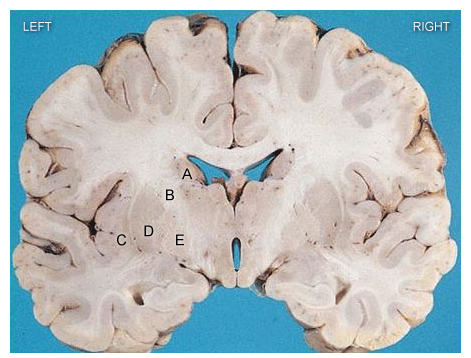
(Multiple Choice)
4.9/5 (75)
(75) A 59-year-old man comes to the office for evaluation of a facial skin lesion. The lesion is a mole-like spot that has been on the patient's face for the past several months and has slowly enlarged. He reports no pain or bleeding from the lesion. Family medical history is positive for skin cancer. Physical examination findings are shown in the exhibit.
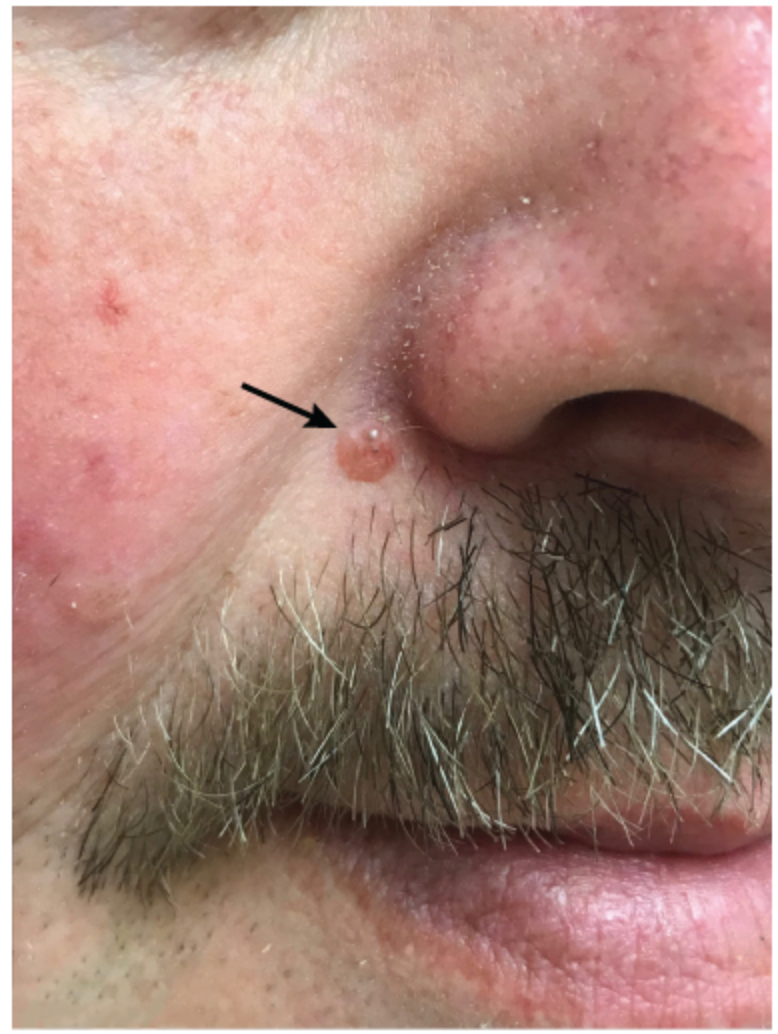 Biopsy of the lesion with a local nerve block for anesthesia is planned. Which of the following injection sites is most likely to provide adequate anesthesia for the procedure?
 (Multiple Choice)
4.8/5 (75)
(75) A 54-year-old man comes to the office due to several months of heartburn, acid regurgitation, and dysphagia. He has taken antacids and over-the-counter medications without relief. Medical history includes hypertension and hyperlipidemia. The patient does not use tobacco, alcohol, or illicit drugs. Vital signs are within normal limits. BMI is 32 kg/m2. Physical examination is unremarkable. Upright chest x-ray shows an opacity with an air-fluid level behind the heart. A subsequent barium swallow reveals the proximal stomach herniating through the esophageal hiatus. Which of the following pathophysiological changes most likely contributed to this patient's current condition?
(Multiple Choice)
4.7/5 (85)
(85) A 65-year-old man with a history of coronary artery disease comes to the physician complaining of progressive exertional shortness of breath, fatigue, and lower extremity swelling. His medical history is significant for a myocardial infarction 5 years ago and an electronic pacemaker implanted 2 years ago. His chest x-ray is shown below. A segment of one of the leads is highlighted (arrow). 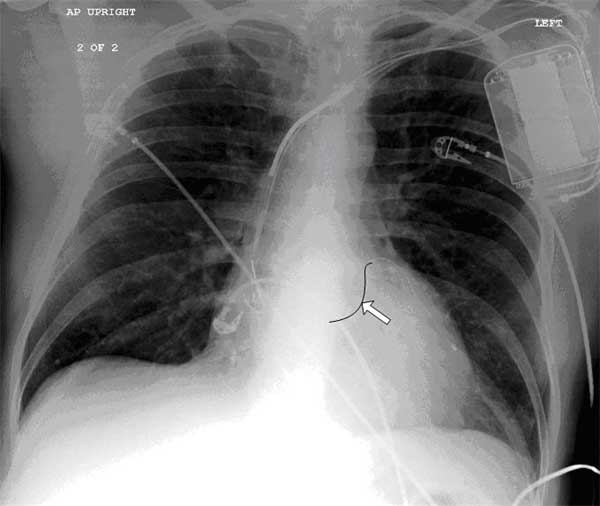 The highlighted segment most likely lies within which of the following structures?
 (Multiple Choice)
4.7/5 (85)
(85) A 6-year-old girl is brought to the emergency department after falling from a chair onto her outstretched right arm. Physical examination shows swelling of the right elbow and tenderness to palpation over the distal humerus. Radial pulses are full and symmetric bilaterally. The patient is unable to cooperate with neurologic examination of the right hand due to significant pain. A peripheral intravenous line is placed, and analgesics are administered for pain control. X-rays show a supracondylar humeral fracture with anterolateral displacement of the proximal fracture fragment. Which of the following structures is most likely to be injured in this patient?
(Multiple Choice)
4.9/5 (84)
(84) A 47-year-old morbidly obese woman comes to the physician seeking advice regarding weight loss. She has tried diet and exercise a number of times without success. Her other medical problems include type 2 diabetes mellitus and obstructive sleep apnea. Her body mass index is 43 kg/m2. After a discussion about available surgical options, she expresses interest in the adjustable gastric band, an inflatable silicone device that is placed around the cardiac part of the stomach. In order to encircle the stomach, the band must pass through which of the following structures?
(Multiple Choice)
4.8/5 (79)
(79) A 34-year-old man develops excessive thirst and frequent urination while being hospitalized for multiple injuries following a motorcycle collision. His urinary osmolality after 4 hours of water restriction is 250 mOsm/L and increases to 700 mOsm/L after administration of antidiuretic hormone. The patient is started on an appropriate medication, and his symptoms promptly resolve. Over the next 2 years, multiple attempts are made to wean the patient off the medication, but his symptoms would always return, necessitating the resumption of treatment. The permanence of this patient's condition is best explained by traumatic damage to which of the following structures?
(Multiple Choice)
4.8/5 (81)
(81) A 45-year-old woman is evaluated for numbness and painful tingling of the right hand. The symptoms began 2 months ago and are especially prominent after she plays tennis. On examination, there is diminished sensation in the lateral palm, thenar eminence, and palmar aspect of the first 3½ digits of the right hand. This patient most likely has an injury involving a nerve that courses between which of the following structures?
(Multiple Choice)
4.9/5 (89)
(89) A 71-year-old man comes to the emergency department due to sudden-onset vision loss in his left eye for one hour. He has a history of coronary artery disease, hypertension, and type 2 diabetes mellitus. Blood pressure is 145/80 mm Hg and pulse is 72/min. On examination, the patient can see only hand motions through the left eye. Funduscopic evaluation of the eye shows a cherry-red spot in the macula with surrounding retinal whitening. Cranial nerve examination is otherwise unremarkable. There is a left-sided neck bruit on cardiovascular examination. Which of the following is the most likely path of the embolus causing this patient's symptoms?
(Multiple Choice)
4.9/5 (76)
(76) A 54-year-old woman comes to the emergency department due to a hand injury after a fall. The patient slipped in the bathroom and fell backwards onto her extended right hand. She was able to get up but has had right wrist pain and finger numbness since the fall. Medical history is notable for obesity, hypertension, and type 2 diabetes mellitus. On examination of her right hand, there is decreased sensation in the palmar aspect of her first three digits and a small bump is noted just below the palm. Lunate dislocation causing median nerve compression is suspected. Which of the following marked bones on a normal x-ray is most likely dislocated in this patient? 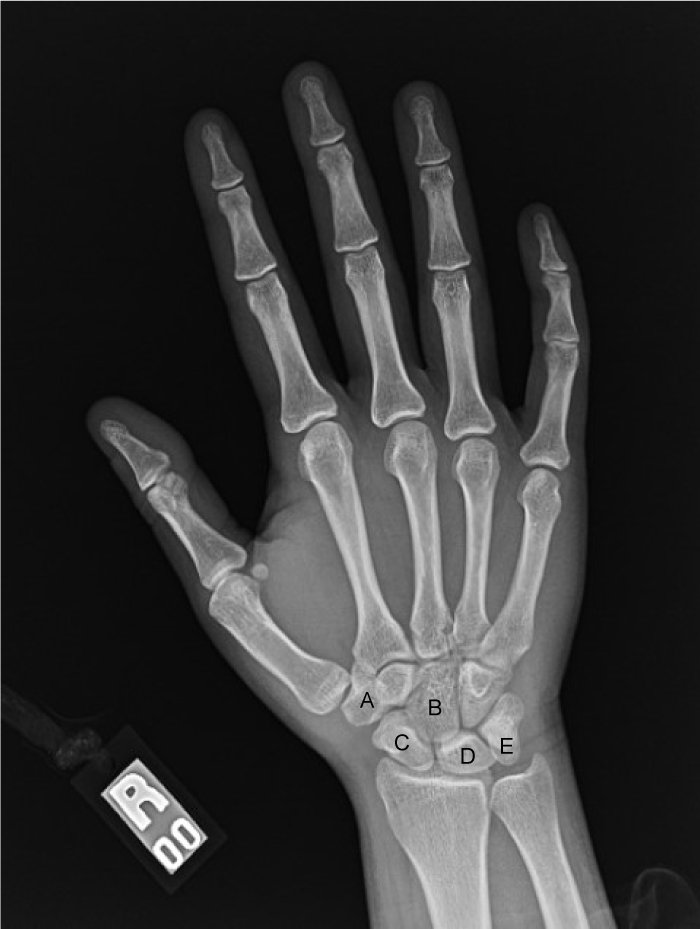
(Multiple Choice)
4.9/5 (93)
(93) A 64-year-old woman with history of lung cancer comes to the office due to persistent chest pain. The patient has squamous cell carcinoma of the right upper lobe that has invaded the pleura and the 4th and 5th ribs. She has had severe right sided chest pain that is exacerbated by movement or cough. The patient was given an opioid analgesic but could not take them at the prescribed dose due to excessive sedation. Physical examination shows tenderness to palpation of the right chest wall. A nerve block procedure is planned to control the pain by injecting a local anesthetic agent in the vicinity of the involved neural structure. Which of the following is the most appropriate treatment target?
(Multiple Choice)
4.8/5 (87)
(87) A 30-year-old woman comes to the emergency department after a seizure. The patient reports pain on the left side of her face and is unable to fully open or close her mouth. She is drooling. On examination, the jaw deviates to the right and the left mandibular condyle is very prominent with a palpable depression posterior to it. The patient is diagnosed with an anterior dislocation of the left temporomandibular joint. The jaw is most likely maintained in a dislocated position due to continued spasm of which of the following muscles?
(Multiple Choice)
4.8/5 (84)
(84) 
Filters
- Essay(0)
- Multiple Choice(0)
- Short Answer(0)
- True False(0)
- Matching(0)