



 Chat with AI
Exam 1: Anatomy

Exam 1: Anatomy291 Questions
Exam 2: Behavioral science240 Questions
Exam 3: Biochemistry156 Questions
Exam 4: Biostatistics117 Questions
Exam 5: Embryology52 Questions
Exam 6: Genetics103 Questions
Exam 7: Histology24 Questions
Exam 8: Immunology129 Questions
Exam 9: Microbiology336 Questions
Exam 10: Pathology816 Questions
Exam 11: Pathophysiology464 Questions
Exam 12: Pharmacology538 Questions
Exam 13: Physiology272 Questions
Select questions type


A 58-year-old man is being evaluated for constipation and weight loss over the last several months. During the past 2 weeks, he has had several episodes of rectal bleeding. The patient has never had a screening colonoscopy. Examination shows a soft and nontender abdomen without masses or organomegaly. Digital rectal examination reveals a firm palpable mass in the rectal vault. Flexible rectosigmoidoscopy shows a large ulcerative mass in the middle third of the rectum extending to the rectosigmoid junction. He undergoes surgical resection of the rectosigmoid colon. Frozen section analysis reveals clear margins of the colon specimen with metastases in the pararectal lymph nodes. Which of the following lymph node groups should be sampled in this patient for further assessment of metastatic disease?
(Multiple Choice)
4.9/5  (86)
(86) A 2-week-old boy is brought to the office for his first newborn evaluation. The boy has had persistent swelling of his left scrotum, but there has been no noticeable discomfort. Review of birth records indicates that the patient was born at 37 weeks gestation after an uncomplicated vaginal delivery. He has been breastfeeding well with normal voiding and stooling. Physical examination shows bilateral descended testicles with an enlarged, fluctuant left hemi-scrotum that transilluminates brightly. No inguinal or abdominal masses are present. The most likely cause of this patient's condition is a swelling in which of the following locations?
(Multiple Choice)
4.9/5 (80)
(80) A 46-year-old woman is brought by ambulance to the emergency department following a ground-level fall at home. She slipped while getting out of the shower and hit her left knee on the tile floor. The patient developed severe left knee pain and swelling and is unable to ambulate. Examination shows a contusion and soft tissue swelling at the knee with a large knee effusion. X-ray of the knee is shown in the image below: 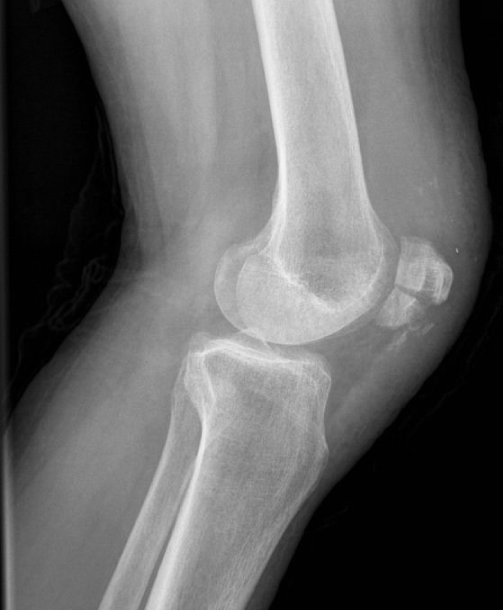 Which of the following examination findings would most likely be seen in this patient?
 (Multiple Choice)
4.8/5 (82)
(82) A 47-year-old man comes to the office due to dysphagia. The patient says that it feels like food has been getting stuck in his throat over the last month. He has changed his diet to accommodate his symptoms and now consumes only liquid foods. The patient has a long history of postprandial heartburn that sometimes awakens him from sleep. He has treated his heartburn with over-the-counter antacids but usually only has partial relief. A thoracic CT image near the level of the aortic arch is shown below. This patient's symptoms are most likely related to pathology involving which of the following structures? 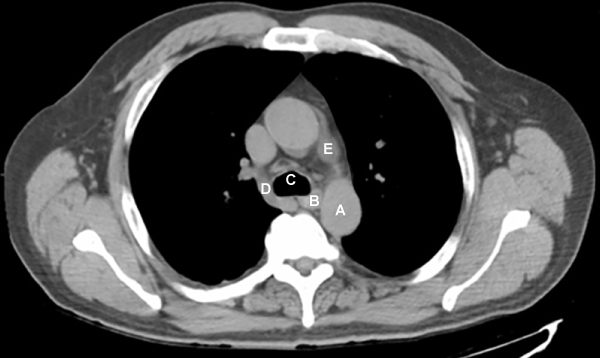
(Multiple Choice)
4.7/5 (78)
(78) A 53-year-old man comes to the office with a dull ache in his right shoulder. The pain is worse with movement and often interferes with his sleep. The patient cannot recall any traumatic events prior to the start of the pain but did experience increased discomfort after helping his daughter move into her college dorm room a week ago. His past medical history includes dyslipidemia and hypertension, for which he takes the appropriate medications. Physical examination reveals localized tenderness just below the acromion. The physician asks the patient to abduct his arms 90 degrees to the side and flex them 30 degrees forward with his thumbs pointing to the floor. She then applies downward force to his arms. This maneuver elicits pain in the patient's right shoulder and reveals right-sided weakness as compared to the left side. A tendon of which of the following muscles is most likely injured in this patient?
(Multiple Choice)
4.8/5 (70)
(70) A 30-year-old man is evaluated for 6 months of persistent pain in his right buttock and posterior thigh. He is a construction worker and has difficulty lifting heavy objects or climbing stairs. He has no history of back injury and no associated back pain. Past medical history is unremarkable. The patient does not use tobacco and drinks only moderate quantities of alcohol. On examination, the patient develops pain with forced adduction of the flexed thigh and internal rotation of the extended thigh against resistance. Further evaluation reveals possible entrapment of the sciatic nerve in the greater sciatic foramen. Which of the following structures passes through the foramen and occupies most of its volume?
(Multiple Choice)
4.8/5 (81)
(81) A 65-year-old man with a history of hypertension, type 2 diabetes mellitus, and tobacco smoking comes to the office reporting mild back pain. Abdominal examination reveals a bruit, but no pulsatile mass is palpated. Femoral and pedal pulses are symmetric. The patient is sent for ultrasound and is found to have a large infrarenal abdominal aortic aneurysm. Open aneurysm repair is performed. During the procedure, the inferior mesenteric artery is ligated, the diseased portion of the aorta is dissected, and a graft is placed from below the renal arteries to the bifurcation of the aorta. Collateral circulation from which of the following vessels is most likely responsible for preventing ischemia of the descending colon?
(Multiple Choice)
4.9/5 (79)
(79) A 36-year-old construction worker comes to the emergency department after falling 3 meters (~10 ft) from a ladder. The patient braced his fall with outstretched hands and experienced severe pain in the left wrist immediately on impacting the ground. On examination, the left wrist is swollen, with no lacerations. A strong radial pulse is present, and the fingers are well perfused. There is a palpable mass just proximal to the left palm. X-ray of the left wrist reveals a lunate dislocation without evidence of a distal radius fracture, as seen in the exhibit.
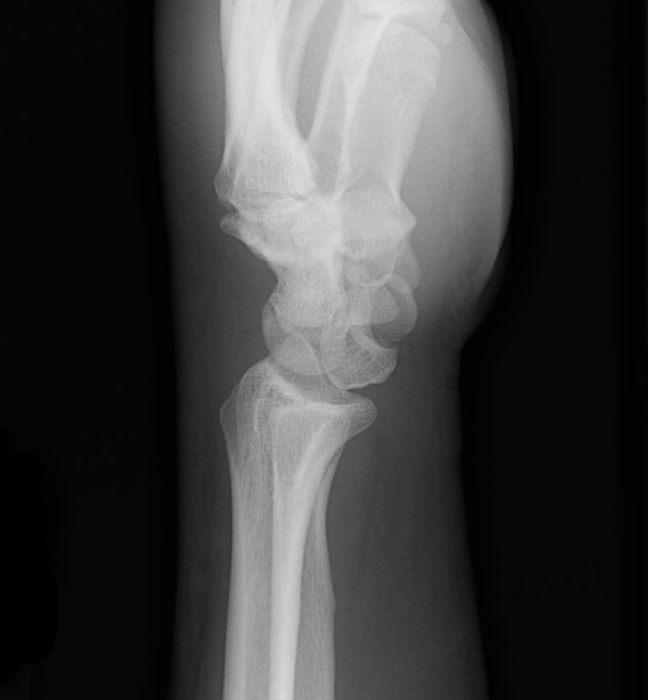 The patient is at greatest risk for impairment of which of the following hand functions?
 (Multiple Choice)
4.9/5 (70)
(70) A 6-year-old girl with cerebral palsy undergoes selective dorsal rhizotomy surgery. The patient was born prematurely with a very low birth weight and had experienced periventricular cerebral white matter injury. During the procedure, dorsal rootlets of lumbosacral spinal nerves are selectively severed, as shown in the image below: 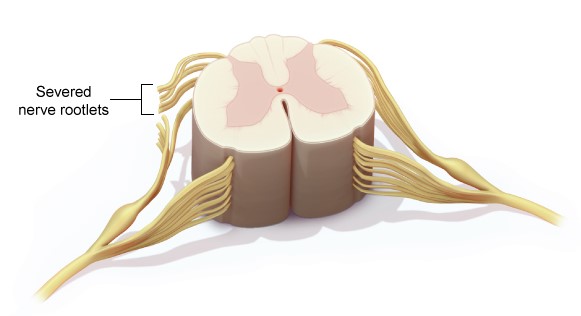 Which of the following is the most likely effect of this intervention in this patient's lower extremities?
 (Multiple Choice)
4.8/5 (91)
(91) A 56-year-old man is evaluated in the clinic due to worsening lower extremity pain and weakness. The patient has had hematuria and intermittent burning on urination for the past year. He has no history of pelvic trauma or surgery. The patient has smoked a pack of cigarettes daily for the past 35 years. His urine culture is negative for bacterial growth. Urine cytology and cystoscopy confirm the diagnosis of transitional cell carcinoma. Abdominal CT shows an advanced bladder tumor compressing a nerve that passes through the obturator canal. Which of the following actions would most likely be impaired in this patient?
(Multiple Choice)
5.0/5 (70)
(70) A 26-year-old previously healthy man is brought to the emergency department after a motor vehicle collision. The patient was driving while wearing a seatbelt when his car was hit on the left side by another vehicle. He has since had persistent left shoulder pain. He also has nausea and hiccups. The patient's blood pressure is 90/60 mm Hg and pulse is 115/min. On examination, he has a bruise on the left lower chest wall with tenderness to palpation along the area. Chest auscultation reveals normal heart sounds and bilaterally equal breath sounds. He has a rigid and tender abdomen. Which of the following is the most likely diagnosis?
(Multiple Choice)
4.9/5 (69)
(69) A 3-month-old boy is brought to the office for follow-up due to a unilateral cleft lip and palate. The patient has been doing well feeding with specialized bottle nipples and is gaining weight. As part of his multidisciplinary care, the parents are told that he will need to be monitored for ear infections and hearing loss. This is because the patient most likely has dysfunction of which of the following muscles?
(Multiple Choice)
4.9/5 (96)
(96) A 35-year-old previously healthy man is evaluated for several episodes of syncope in the past 6 weeks. Physical examination is unremarkable. Echocardiogram shows no structural heart defect. An electrophysiologic study is performed during which catheters are passed into the patient's right and left atrium to record atrial electric potentials. Cardiac monitor currently shows normal sinus rhythm. Which of the following is the most likely earliest site of electric activation?
(Multiple Choice)
4.8/5 (102)
(102) A 45-year-old man with a history of end-stage renal disease undergoes renal allograft transplantation. The donor kidney and proximal ureter are transplanted in the right iliac fossa, with implantation of the ureter into the patient's bladder. Six days following surgery, the donor kidney appears to be functioning well, but the patient develops fever and right lower quadrant abdominal pain. Imaging studies reveal a large pelvic fluid collection. Exploratory laparotomy is performed and discovers urinary leakage, with significant ischemia and necrosis of the transplanted ureter immediately adjacent to the site of implantation into the bladder. The proximal portion of the ureter appears normal. The healthy segment of this patient's transplanted ureter is most likely receiving blood from which of the following arteries?
(Multiple Choice)
4.7/5 (85)
(85) A 66-year-old man is undergoing a procedure to control chronic throat pain due to Eagle syndrome, a condition frequently caused by a misshapen or elongated styloid process. During the procedure, the styloid process is trimmed surgically. However, the left glossopharyngeal nerve is accidentally transected. Which of the following is most likely to be seen as a result of this patient's nerve injury?
(Multiple Choice)
4.9/5 (69)
(69) A 59-year-old man comes to the office due to diplopia and a drooping right eyelid. His symptoms began a day earlier and have since worsened. Physical examination shows a dilated right pupil that is nonreactive to both light and accommodation. There is vertical and horizontal diplopia. When the patient is asked to stare straight ahead, the right eye is directed inferiorly and laterally with respect to the left eye. MRI of the brain reveals an aneurysm involving the right posterior communicating artery. Which of the following muscles is most likely to remain functionally intact in this patient?
(Multiple Choice)
4.9/5 (82)
(82) A 64-year-old woman comes to the office for evaluation of a vulvar lesion. The patient has had a vulvar plaque for the past year that has slowly increased in size. She underwent menopause at age 52 and has a 30-year smoking history. Vital signs are normal. Physical examination shows a 1-cm nonfriable, white plaque on the right labia majora. The remainder of the physical examination is normal. A biopsy of the lesion is performed and shows squamous cell carcinoma. A sentinel lymph node biopsy is planned for cancer staging. This procedure should target which of the following lymph nodes?
(Multiple Choice)
4.9/5 (73)
(73) A 57-year-old man comes to the office due to unrefreshing sleep. He feels tired during the day and occasionally has to nap during his lunch hours. According to his wife, the patient snores loudly during sleep and frequently gasps for breath. He also has severe claustrophobia. Past medical history is significant for hypertension. The patient takes no sedative medications and is a lifetime nonsmoker. Blood pressure is 156/94 mm Hg and BMI is 30 kg/m2. Physical examination is significant for a bulky tongue and crowded, narrow oropharynx. Electrical stimulation of which of the following nerves may improve the pathophysiologic cause of this patient's symptoms?
(Multiple Choice)
4.8/5 (89)
(89) A 15-year-old boy comes to the office due to right arm numbness. He plays on his high school baseball team and has been intensively practicing his pitching for an upcoming game. For the past several weeks, the patient has had fluctuating tingling and numbness involving the right shoulder, arm, and hand. He also has recently developed dull pain in the right little finger and hand. The symptoms worsen with overhead activities and when throwing a baseball. The patient has no medical problems other than being told that he has an extra rib. On examination, there is right-sided weakness of the intrinsic hand muscles. Which of the following muscles is most likely contributing to this patient's condition?
(Multiple Choice)
4.9/5 (82)
(82) A 23-year-old athlete comes to the office with right knee pain after playing basketball. A coronal MRI of his knee viewed from the posterior aspect is shown below. 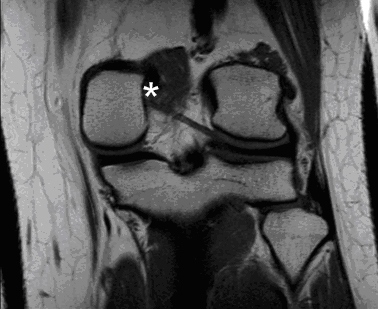 The asterisk marks the attachment site of which of the following ligaments?
 (Multiple Choice)
4.8/5 (95)
(95) 
Filters
- Essay(0)
- Multiple Choice(0)
- Short Answer(0)
- True False(0)
- Matching(0)