



 Chat with AI
Exam 1: Anatomy

Exam 1: Anatomy291 Questions
Exam 2: Behavioral science240 Questions
Exam 3: Biochemistry156 Questions
Exam 4: Biostatistics117 Questions
Exam 5: Embryology52 Questions
Exam 6: Genetics103 Questions
Exam 7: Histology24 Questions
Exam 8: Immunology129 Questions
Exam 9: Microbiology336 Questions
Exam 10: Pathology816 Questions
Exam 11: Pathophysiology464 Questions
Exam 12: Pharmacology538 Questions
Exam 13: Physiology272 Questions
Select questions type


A 58-year-old man undergoes operative repair of a descending thoracic aortic aneurysm. There are no intraoperative complications, but postoperatively the patient is found to have new-onset neurologic deficits. Imaging of the brain is normal, but MRI of the lower thoracic spinal cord reveals ischemic infarct of the areas shown in the exhibit below: 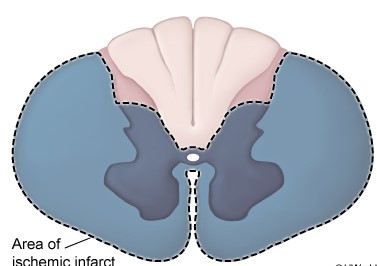 Lower extremity examination of this patient is most likely to show which of the following neurologic findings?
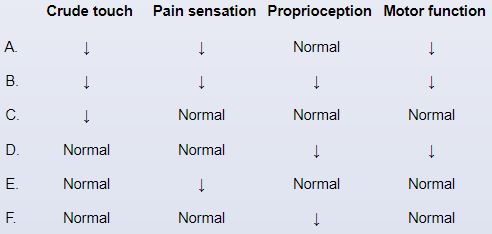
Lower extremity examination of this patient is most likely to show which of the following neurologic findings?
(Multiple Choice)
4.9/5  (77)
(77) A 43-year-old woman comes to the office due to acute back pain after dragging a heavy box. The pain is located in her lower back and radiates down the right posterior thigh to the foot. The patient describes the pain as "shooting" and grades it 8/10 in intensity. She has no bowel or bladder symptoms. The patient has tried over-the-counter analgesics with limited symptomatic relief. Vital signs are within normal limits. On physical examination, straight leg raise testing is positive on the right. Right hip extension is weaker when compared to the left. Knee jerk reflexes are 2+ and bilaterally symmetric, but the right ankle jerk reflex is absent. Which of the following nerve roots is most likely affected in this patient?
(Multiple Choice)
4.8/5 (79)
(79) A 64-year-old smoker is evaluated for nagging right shoulder pain that radiates to the ipsilateral arm. The patient also has weakness in the right upper extremity. His symptoms started 2 months ago and have worsened progressively. On neurologic examination, the patient is awake, alert, oriented, and follows commands. He has partial right-sided ptosis with fully intact extraocular movements. His pupils are asymmetric in dim light with 2 mm on the right and 4 mm on the left, but both are reactive to light. The pupils become more symmetric in bright light. The right upper extremity has 3/5 strength and absent deep tendon reflexes. This patient's autonomic dysfunction is most likely a result of a lesion involving which of the following?
(Multiple Choice)
4.7/5 (73)
(73) A 27-year-old woman, gravida 1 para 0, with gestational diabetes mellitus comes to the hospital at 38 weeks gestation for evaluation of abdominal pain. The patient is scheduled for an elective cesarean section at 39 weeks as a recent ultrasound revealed that the estimated fetal weight is 5200 g (11 lb 4 oz). Examination reveals that the patient is in active labor and the fetus is in breech presentation; an urgent cesarean section is performed. During the surgery, the rectus abdominus muscle is split vertically, but space appears to be limited. In anticipation of a large-for-gestational-age baby, a decision is made to transect the rectus abdominis muscle. If the rectus abdominis muscle is incised laterally, which of the following structures is at greatest risk of injury?
(Multiple Choice)
4.9/5 (85)
(85) A 28-year-old woman comes to the office due to right hand tremors for the past several weeks. The patient has difficulty performing daily activities and feels embarrassed in social gatherings. She has a history of the remitting-relapsing form of multiple sclerosis. There is no family history of tremors. On physical examination, no abnormal hand movement is observed at rest. When the patient is instructed to touch an object on the table, a coarse tremor is observed that gradually increases as the hand moves closer to its target. Dysfunction of which of the following structures is the most likely cause of this patient's tremor?
(Multiple Choice)
4.8/5 (73)
(73) A 20-month old girl is brought to the emergency department for difficulty breathing. The patient has had rhinorrhea and nasal congestion for the past 2 days. She developed a cough and noisy breathing this evening. Medical history is otherwise negative. She is growing well, meeting milestones, and up-to-date on immunizations. On examination, the patient has suprasternal and intercostal retractions, inspiratory stridor, and a barking cough. Inflammation and edema of which of the following sites is most likely causing this patient's stridor? 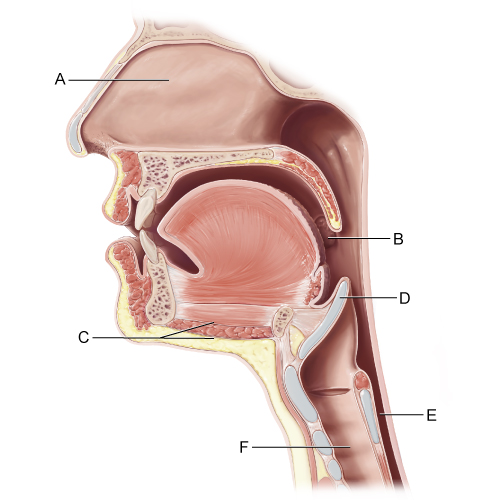
(Multiple Choice)
4.9/5 (87)
(87) A 60-year-old man comes to the office due to difficulties in tasting food. He says, "All food now tastes bland," and he is unable to enjoy different flavors during meals. Two months ago, the patient had a traumatic brain injury after a head-on motor vehicle collision. He was in a coma for several days and, after regaining consciousness, began having severe headaches and impaired taste. The headaches have improved, but he continues to have difficulty tasting food. The patient has no visual concerns, slurred speech, trouble swallowing, vertigo, or extremity weakness or numbness. He is a truck driver and has a history of heavy tobacco use for many years. Vital signs are within normal limits. Physical examination shows no focal motor deficits. Which of the following is the most likely cause of this patient's current symptoms?
(Multiple Choice)
4.8/5 (82)
(82) A 64-year-old man comes to the emergency department after an episode of hematemesis. He also reports dark stools and abdominal pain for the past several days. The patient has a history of chronic pancreatitis. Abdominal examination shows epigastric tenderness to palpation. Rectal examination is notable for black, guaiac-positive feces. Upper gastrointestinal endoscopy reveals a bleeding spot within a cluster of enlarged tortuous veins in the gastric fundus. The rest of the stomach and esophagus appears normal. Increased pressure in which of the following vascular structures is the most likely cause of this patient's condition?
(Multiple Choice)
4.8/5 (91)
(91) A 33-year-old man comes to the office due to trouble swallowing and a chronic sore throat. He has no chronic medical conditions and does not use tobacco or alcohol. Physical examination shows an enlarged, ulcerated right tonsil. Biopsy of the ulcerated lesion reveals infiltrating nests of moderately differentiated squamous cells. Immunohistochemistry is positive for p16, suggesting that the tumor is likely due to human papilloma virus. Further imaging studies for cancer staging are planned. This patient's tumor is most likely to spread first to which of the following locations?
(Multiple Choice)
4.9/5 (74)
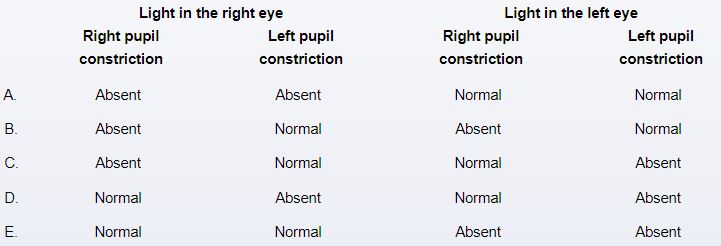
(74) A 23-year-old woman has an acute attack of optic neuritis. She has a history of relapsing-remitting multiple sclerosis. An MRI of her brain reveals an area of demyelination involving the right optic nerve. Which of the following is most likely to be found on examination of both eyes?
(Multiple Choice)
4.8/5 (77)
(77) A 64-year-old woman is evaluated for episodic urinary incontinence. Urodynamic studies reveal an overactive bladder. Symptoms persist after behavioral interventions, and the patient is unable to tolerate medical treatment. Low-amplitude electrical stimulation therapy that helps modulate neural control of the urinary bladder muscle, urethral sphincter, and pelvic muscles is planned. A stimulating electrode is most likely to be placed close to which of the following structures during this procedure?
(Multiple Choice)
4.9/5 (74)
(74) 
Filters
- Essay(0)
- Multiple Choice(0)
- Short Answer(0)
- True False(0)
- Matching(0)