



 Chat with AI
Exam 1: Anatomy

Exam 1: Anatomy291 Questions
Exam 2: Behavioral science240 Questions
Exam 3: Biochemistry156 Questions
Exam 4: Biostatistics117 Questions
Exam 5: Embryology52 Questions
Exam 6: Genetics103 Questions
Exam 7: Histology24 Questions
Exam 8: Immunology129 Questions
Exam 9: Microbiology336 Questions
Exam 10: Pathology816 Questions
Exam 11: Pathophysiology464 Questions
Exam 12: Pharmacology538 Questions
Exam 13: Physiology272 Questions
Select questions type


A 46-year-old man experiences burning pain in his left thigh and leg. The next day, he notices groups of erythematous, tender, fluid-filled vesicles in the painful region. The lesions gradually crust over the next several days as shown in the exhibit.
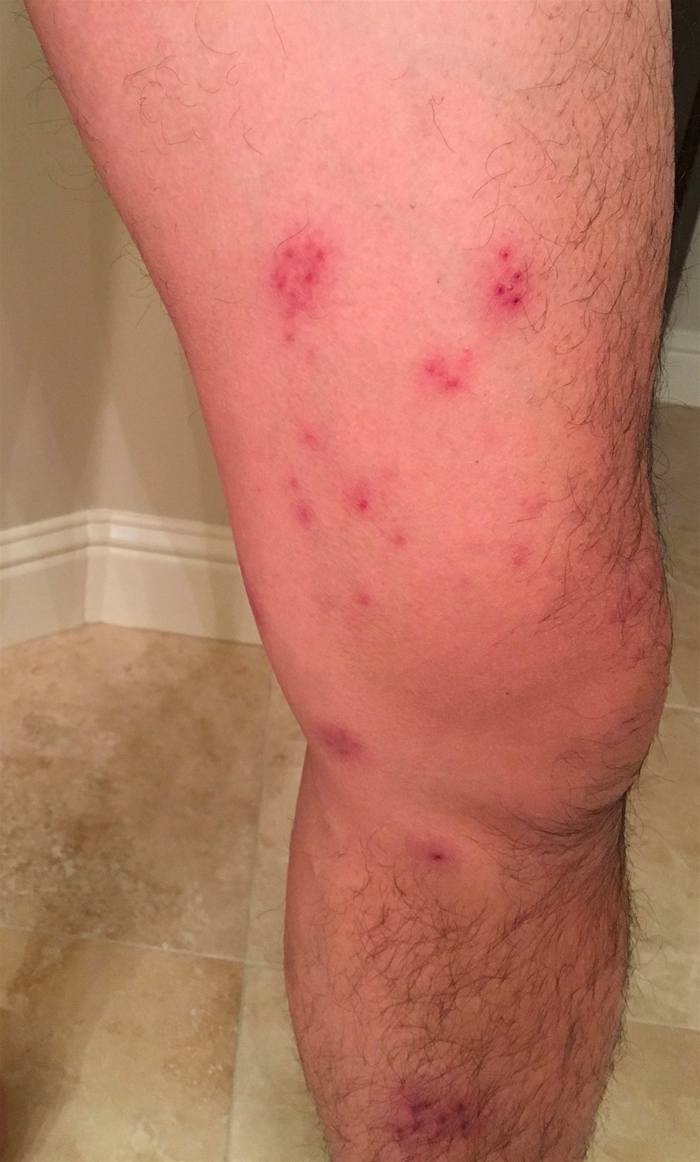 Which of the following dermatomes are most likely involved in this patient's disease process?
 (Multiple Choice)
4.9/5  (75)
(75) A 15-year-old boy comes to the office due to right ear itching and discomfort for the past several days. He has no fever or hearing loss but has noted scant drainage of thin, whitish fluid. The patient has been taking swimming lessons at a local gym. On examination, there is no redness around the ear, but gentle traction of the pinna elicits pain. During inspection of the external auditory canal, a speculum is inserted into the meatus in close contact with its posterior wall, causing the patient to suddenly become lightheaded and faint. He recovers spontaneously within a few minutes with no residual confusion. Which of the following nerves was most likely irritated during the procedure?
(Multiple Choice)
4.9/5 (87)
(87) An 18-year-old soccer player is evaluated for difficulty ambulating and right thigh pain. He has no other medical conditions and takes no medications. On examination, active and passive hip flexion and knee extension are impaired. Extension, abduction, and adduction at the hip are intact and knee flexion is also intact. Which of the following muscles is most likely injured in this patient?
(Multiple Choice)
4.9/5 (81)
(81) A 69-year-old hospitalized woman is evaluated for new-onset weakness of the right foot. The patient has a history of chronic hip pain due to osteoarthritis and underwent left total hip arthroplasty under general anesthesia while in the right lateral decubitus position 2 days ago. Since the surgery, she has had difficulty moving her right foot. Other medical conditions include lumbar spinal stenosis, hypertension, type 2 diabetes mellitus, and a small ischemic stroke with no residual deficit. On examination of the right lower extremity, the patient is unable to dorsiflex or evert the foot or extend the toes. Sensation is decreased over the dorsum of the right foot. The rest of the neurologic examination of the right lower extremity is normal. Injury to which of the following structures is the most likely cause of this patient's current symptoms?
(Multiple Choice)
4.9/5 (87)
(87) A 68-year-old woman comes to the emergency department due to pain in the left upper arm after a fall from standing height. Medical history is significant for hypothyroidism and hypertension. Physical examination shows bruising of the shoulder. Left arm movement is limited due to pain. Plain radiographs reveal a nondisplaced left humerus fracture at the anatomical neck. This patient is at greatest risk for which of the following complications?
(Multiple Choice)
4.9/5 (73)
(73) A 68-year-old woman comes to the emergency department due to a 2-day history of crampy abdominal pain and vomiting. The patient has had no hematemesis, melena, or hematochezia. She has a history of hypertension, type 2 diabetes mellitus, and coronary artery disease. Several months ago, the patient had an episode of acute calculous cholecystitis that was managed non-operatively. Physical examination shows a distended, tympanic abdomen with high-pitched bowel sounds. Abdominal x-ray reveals air in the gallbladder and biliary tree. This patient's gallstone has most likely lodged in which of the following sites?
(Multiple Choice)
4.9/5 (79)
(79) A 62-year-old man comes to the office reporting double vision. He first noticed mild difficulty focusing his eyes about 3 weeks ago, and his symptoms have progressively worsened. The patient's other medical problems include metastatic prostate cancer. On neurologic examination, he is unable to adduct his left eye, and stimulation of the left cornea does not elicit a corneal reflex. A lesion involving which of the following anatomical structures is most likely responsible for this patient's symptoms?
(Multiple Choice)
4.9/5 (84)
(84) A 61-year-old woman comes to the office due to skin dimpling on the right breast. She first noticed the skin changes 3 months ago while on vacation and is concerned that they have not resolved. The patient does not use tobacco, alcohol, or illicit drugs. She exercises regularly and takes a daily multivitamin. Her last menstrual period was 8 years ago. Physical examination shows a prominent, nontender skin retraction without discoloration or swelling of the right breast. There is also a 6-cm irregular, immobile, firm mass in the right upper outer quadrant of the breast. The left breast appears normal. This patient's skin findings are likely due to malignant infiltration of which of the following structures?
(Multiple Choice)
4.7/5 (83)
(83) A 52-year-old man comes to the office for a painless mass in his right groin. He noticed the mass several weeks ago, and it has slowly enlarged. The patient has a history of HIV, for which he takes antiretroviral therapy. He has not had any new sexual partners recently. Temperature is 37.1 C (98.8 F). On examination, several enlarged, hard lymph nodes are palpated in the right inguinal area inferior to the inguinal ligament. An excisional biopsy is performed, and histopathology shows malignant cells. The malignant cells found in this patient most likely originated from which of the following sites?
(Multiple Choice)
5.0/5 (82)
(82) A 23-year-old woman is brought to the emergency department with a chest wound. She was in her house during a severe thunderstorm when a large tree branch fell through a window. The window was shattered and large fragments of wood and glass struck the patient. She did not lose consciousness, but her family found her bleeding profusely and rushed her to the hospital. Blood pressure is 80/50 mm Hg and pulse is 130/min. The patient appears to be in severe distress. Physical examination shows a deep penetrating wound in the fourth intercostal space along the left sternal border. Smaller lacerations are noted across the face and forearms. Which of the following structures is most likely injured in this patient?
(Multiple Choice)
4.8/5 (89)
(89) A 65-year-old man with a history of hypertension is brought to the hospital due to sudden-onset vertigo and dizziness that started an hour ago. On physical examination, there is ptosis and pupillary constriction in the left eye. Extraocular movements are normal in both eyes. Pain and temperature sensations are decreased over the left side of the face, and the direct corneal reflex is absent on the left. Pain and temperature are also decreased over the right side of the body. Muscle strength is 5/5 in all 4 extremities with normal deep tendon reflexes. Which of the following is the most likely cause of this patient's asymmetrical pupils?
(Multiple Choice)
4.7/5 (79)
(79) A 51-year-old woman comes to the office because it feels like the right side of her face has been getting heavier for the past 12 hours. Medical history is significant for type 2 diabetes mellitus. Physical examination reveals asymmetry of her face when she smiles, puffs out her cheeks, raises her eyebrows, and tries to close her eyes tightly. There is also effacement of the right nasolabial fold, and her lips are drawn toward the left side. The remainder of the neurologic examination is normal. Which of the following additional findings is most likely associated with this patient's condition?
(Multiple Choice)
4.7/5 (86)
(86) A 23-year-old previously healthy man is brought to the emergency department after a stab injury. His friends report that they were "walking down the street minding our own business when a guy jumped out in front of us from behind a dumpster and stabbed him in the chest." They were able to disarm the man after this single attack, and the man then ran off into an alley. The patient is conscious but in distress. Physical examination shows a laterally directed anterior chest wall stab wound at the fifth intercostal space along the left midclavicular line. Which of the following structures is most likely to have been injured in this patient?
(Multiple Choice)
4.8/5 (83)
(83) A 75-year-old man is brought to the emergency department due to acute-onset profuse vomiting of large amounts of bright red blood. He has had intermittent, dull epigastric pain for the last 3 months. Medical history is significant for chronic obstructive pulmonary disease with multiple exacerbations and lumbar spinal stenosis. The patient has smoked 1 pack of cigarettes daily for 40 years. Blood pressure is 70/40 mm Hg and pulse is 120/min. Examination shows epigastric tenderness. The patient dies an hour after admission despite resuscitation efforts. Autopsy shows a deep peptic ulcer localized proximally on the lesser curvature of the stomach. The ulcer most likely penetrated which of the following arteries?
(Multiple Choice)
4.8/5 (74)
(74) A 68-year-old woman is brought to the emergency department with severe right hip pain after a fall. She tripped on a rug and fell against a wall and then to the floor, landing on her right hip. The patient has a history of depression and polymyalgia rheumatica. Medications include sertraline and low-dose prednisone. She also has a 40-pack-year smoking history. Blood pressure is 145/85 mm Hg and pulse is 96/min. The patient appears to be in significant pain. She is unable to move the right hip, and the right leg appears shorter than the left. A pelvic x-ray is shown in the image below: 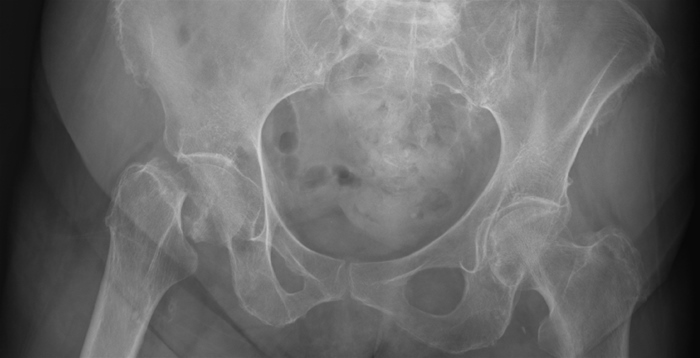 Injury involving which of the following arteries is most likely to lead to osteonecrosis in this patient?
 (Multiple Choice)
4.8/5 (76)
(76) A 58-year-old man comes to the office due to worsening right upper extremity weakness over the past 4 weeks. The patient frequently travels for work and has had difficulty carrying heavy bags and getting luggage into or out of the overhead bins. He also has had neck and shoulder pain for the past several months, which he attributes to stress. The patient reports no trauma, and medical history is significant for hypertension. Physical examination shows weakness of shoulder abduction and loss of the biceps reflex on the right side. Pinprick sensation is decreased over the right lateral arm and forearm. Which of the following pathologic processes is most likely underlying this patient's current symptoms?
(Multiple Choice)
4.8/5 (83)
(83) A 28-year-old man comes to the emergency department with a 3-day history of increasing chest tightness and intermittent sharp chest pains. He also reports mild dyspnea, especially on exertion. The patient has no prior chronic medical conditions but had an upper respiratory illness a week ago that resolved without treatment. ECG reveals sinus tachycardia and low voltage QRS complexes that vary in the amplitude from beat to beat. Which of the following is the most likely chest x-ray finding in this patient?
(Multiple Choice)
4.8/5 (72)
(72) A 35-year-old woman comes to the office due to solid food dysphagia for the past several months. The patient has a sensation of food getting stuck in the mid-thorax, but has no pain or reflux. She also has palpitations and dyspnea on exertion. The patient immigrated to the United States from India 1 year ago, and was treated in her home country for rheumatic heart disease. Barium esophagram demonstrates extrinsic compression on the mid-esophagus. Enlargement of which of the following is most likely causing this patient's dysphagia?
(Multiple Choice)
4.9/5 (87)
(87) A 10-minute-old boy is being evaluated in the delivery room. The patient was born at term to a 30-year-old primigravida woman. Pregnancy was unremarkable, but labor was complicated by recurrent late decelerations necessitating vacuum assistance for vaginal delivery. Apgar scores were 6 and 8 at 1 and 5 minutes, respectively. Temperature is 37 C (98.6 F), pulse is 170/min, and respirations are 40/min. Scalp examination shows large, fluctuant swelling at the occiput that extends bilaterally to the ears, superiorly toward the crown, and inferiorly into the nape of the neck. This patient's hemorrhage is most likely located between which of the following structures?
(Multiple Choice)
4.8/5 (73)
(73) A 28-year-old woman, gravida 1 para 1, is seen in the clinic a week after spontaneous vaginal delivery. The delivery was performed under epidural analgesia and complicated by a prolonged second stage of labor. Since delivery, the patient has had frequent episodes of fecal incontinence, as well as mild perineal pain that is relieved by ibuprofen and opioid analgesics. She reports no other medical conditions, and her pregnancy was otherwise uncomplicated. On examination, a healing perineal laceration shows no signs of infection. Digital anorectal examination reveals decreased anal sphincter tone and loss of the anal wink reflex. Bilateral lower extremity reflexes are 2+ with normal tone. Which of the following is the most likely cause of this patient's fecal incontinence?
(Multiple Choice)
4.9/5 (81)
(81) 
Filters
- Essay(0)
- Multiple Choice(0)
- Short Answer(0)
- True False(0)
- Matching(0)