



 Chat with AI
Exam 1: Anatomy

Exam 1: Anatomy291 Questions
Exam 2: Behavioral science240 Questions
Exam 3: Biochemistry156 Questions
Exam 4: Biostatistics117 Questions
Exam 5: Embryology52 Questions
Exam 6: Genetics103 Questions
Exam 7: Histology24 Questions
Exam 8: Immunology129 Questions
Exam 9: Microbiology336 Questions
Exam 10: Pathology816 Questions
Exam 11: Pathophysiology464 Questions
Exam 12: Pharmacology538 Questions
Exam 13: Physiology272 Questions
Select questions type


A 52-year-old man comes to the office after his wife noted that his eyes appeared different. The patient reports no symptoms. Medical history is significant for hypertension and type 2 diabetes mellitus. He has smoked 1.5 packs of cigarettes daily for 25 years. Blood pressure is 140/86 mm Hg and pulse is 84/min. On physical examination, the right pupil is 3 mm and the left pupil is 5 mm. When the light in the examination room is dimmed, the anisocoria increases. Which of the following is the most likely location of the lesion?
(Multiple Choice)
4.9/5  (88)
(88) A 48-year-old woman comes to the office with a 6-month history of involuntary passage of a few drops of urine when sneezing or coughing. She has recently been leaking even more urine with minimal activity, which has been embarrassing and has caused her to limit her social activities. The patient has no weakness, numbness, or fecal incontinence. She has a history of hypertension and type 2 diabetes mellitus. She does not use tobacco, alcohol, or illicit drugs. She is married and has 4 children. Her supine blood pressure is 126/82 mm Hg and her upright blood pressure is 120/80 mm Hg. External genitalia examination shows leakage of a small amount of urine from the urethra when the patient is asked to cough. Neurological examination is within normal limits. Which of the following is the most likely cause of her condition?
(Multiple Choice)
4.8/5 (71)
(71) A 46-year-old man comes to the office due to right shoulder pain. The pain started 2 months ago after the patient began working at a new warehouse where he frequently moves heavy boxes. He has been taking over-the-counter analgesics and has continued to work. Past medical history is not significant. On physical examination, external rotation of the right shoulder against resistance is painful, but there is no weakness. MRI reveals near complete tear of the right infraspinatus muscle. The absence of weakness in this patient is best explained by compensatory hypertrophy of which of the following muscles?
(Multiple Choice)
4.7/5 (83)
(83) A 34-year-old man is evaluated in the clinic due to difficulty walking over the past 2 weeks. His symptoms have resulted in several recent falls, but he has had no head trauma or loss of consciousness. He has never had these symptoms before. The patient is frustrated as he cannot carry out his duties as a mailman. He has a history of crack cocaine use in the distant past but no current illicit drug use. The patient is in a monogamous relationship but previously had numerous sexual partners. The physician asks him to stand with his feet close together, arms to the sides, and eyes closed. This maneuver most likely tests for abnormalities in which of the following?
(Multiple Choice)
4.9/5 (80)
(80) A 65-year-old man comes to the office with a 4-month history of persistent left ear pain that is slowly worsening. He is also having some difficulty swallowing. The patient has no chronic medical conditions but has smoked 1 pack of cigarettes per day for the last 46 years. On examination, the external auditory canal is patent and the tympanic membrane is clear with no middle ear effusion. There is an enlarged lymph node in the left anterior neck. Flexible fiberoptic laryngoscopy reveals an ulcerative mass on the posterior pharyngeal wall of the hypopharynx. Involvement of which of the following nerves is most likely responsible for this patient's ear pain?
(Multiple Choice)
4.8/5 (87)
(87) A 6-year-old boy is brought to the emergency department by his parents due to persistent nasal bleeding. The boy picks his nose frequently and has had several nosebleeds in the past, all of which stopped spontaneously after pinching the nose. The parents say that they have been pinching the nasal alae for over 30 minutes while the boy leans forward. Family history is negative for bleeding disorders. The patient takes no medications and has no allergies. Examination shows continuous blood trickle from his right nostril. Silver nitrate cautery is performed and the bleeding stops. Cautery was most likely applied to which of the following locations in this patient's nasal cavity?
(Multiple Choice)
4.9/5 (77)
(77) A 23-year-old-man is brought to the emergency department after he was stabbed in the right upper quadrant of the abdomen. His blood pressure is 70/42 mm Hg, pulse is 135/min, and respirations are 26/min; pulse oximetry shows oxygen saturation of 95% on room air. Physical examination shows a stab wound 2 cm inferior to the right costal margin. The patient's abdomen is firm and distended. Focused assessment with sonography for trauma (FAST) is positive for blood in the right upper quadrant. He is taken for immediate laparotomy, and approximately 1 liter of blood is evacuated from the peritoneal cavity. Brisk, nonpulsatile bleeding is seen emanating from behind the liver. The surgeon occludes the hepatoduodenal ligament, but the patient continues to hemorrhage. Which of the following structures is the most likely source of this patient's bleeding?
(Multiple Choice)
4.8/5 (73)
(73) A 63-year-old woman comes to the office for evaluation of chronic constipation. For the past 8 months, the patient has had increased straining with bowel movements but no abdominal pain or rectal bleeding. She has 2 children, both delivered via forceps-assisted vaginal delivery. BMI is 31 kg/m2. On digital rectal examination, there are no masses and rectal tone is normal; pelvic examination shows a visible bulge into the vagina with straining. Sensation around the perineum is intact. Fecal occult blood testing is negative. Which of the following is the most likely cause of this patient's symptoms?
(Multiple Choice)
4.7/5 (75)
(75) A 13-year-old girl is admitted for fever, cough, and malaise for the past two days. She has no history of sick contacts and all her immunizations are up to date. Her leukocyte count is 21,000/mm3 with 7% band forms. Upright chest x-ray findings are shown in the image below: 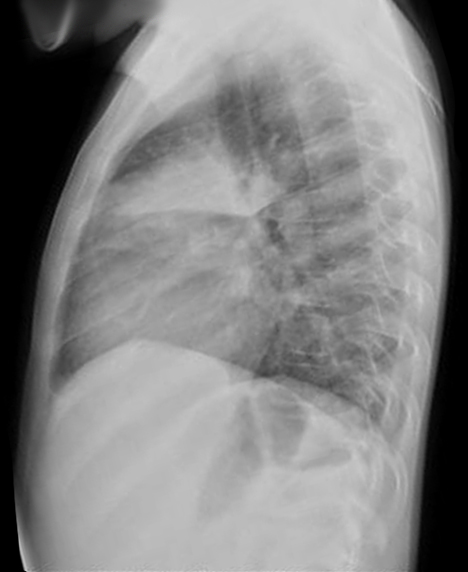 Which of the following is the most likely location of the pathologic process in this patient?
 (Multiple Choice)
4.8/5 (73)
(73) A 56-year-old woman is evaluated for fatigue and dyspnea on exertion. Past medical history includes hypertension and systemic sclerosis. Blood pressure is 135/80 mm Hg and pulse is 68/min. Cardiac examination reveals loud second heart sounds with no murmurs. Lungs are clear to auscultation. Further evaluation with a catheterization procedure is performed, during which a balloon-tipped catheter is advanced into the pulmonary artery. A branch of the pulmonary artery is occluded by the balloon, and the pressure beyond the point of occlusion is measured. The pressure reading from the procedure most likely corresponds to which of the following pressures?
(Multiple Choice)
5.0/5 (62)
(62) A 63-year-old man comes to the emergency department due to pain and swelling of the right calf. He has a history of recurrent gastrointestinal hemorrhage and was discharged from the hospital 4 days ago following a prolonged admission for diverticular bleeding requiring multiple blood transfusions. Temperature is 36.7 C (98 F), blood pressure is 110/60 mm Hg, pulse is 92/min, and respirations are 18/min. Compression ultrasonography with Doppler reveals deep venous thrombosis in the right popliteal vein. A filter placement is planned to prevent embolization. A section of the patient's abdominal CT at the level of L2 is shown in the image below. The filter will most likely be placed in which of the following structures? 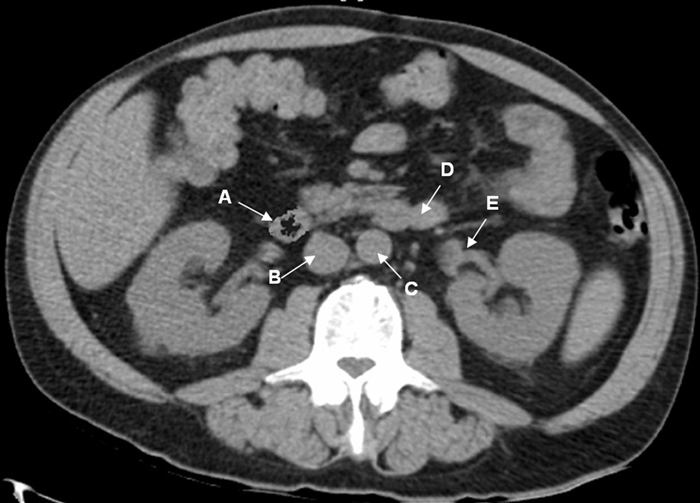
(Multiple Choice)
4.9/5 (78)
(78) A 54-year-old man comes to the office due to aching pain in his left neck and shoulder area for the past several months. He has also had numbness and weakness of the left hand. The patient recalls no major trauma and has no prior medical problems. He tried chiropractic and massage therapies, but the symptoms persisted. Left upper extremity examination shows decreased sensation in the palm and index and middle fingers along with weakness of left wrist extension. The left biceps and brachioradialis deep tendon reflexes are normal, but the triceps reflex is diminished. Right upper extremity examination is normal. A lesion affecting which of the following labeled sections of the brachial plexus is the most likely cause of this patient's neurologic findings? 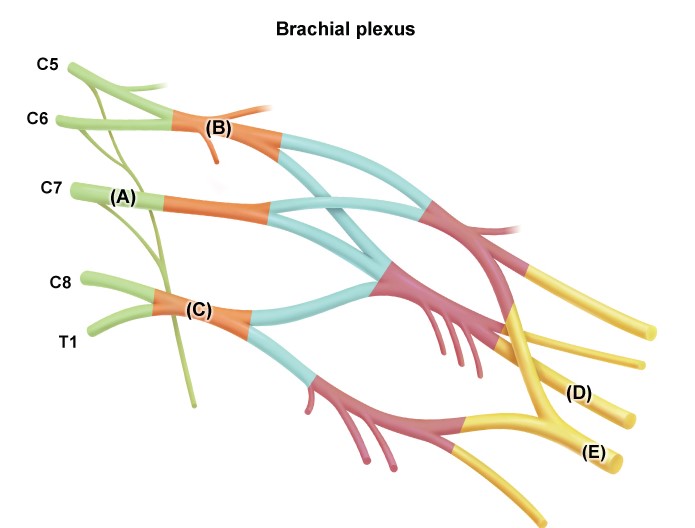
(Multiple Choice)
4.9/5 (66)
(66) A 64-year-old man comes to the emergency department due to left lower extremity weakness. The patient was asymptomatic when he went to bed the night before, but he has had difficulty standing after waking up today. He has had no headache, double vision, or back pain. Medical history is significant for hypertension, diabetes mellitus, and myocardial infarction. Temperature is 37 C (98.6 F), blood pressure is 140/90 mm Hg, and pulse is 110/min and irregularly irregular. Left lower extremity examination shows motor power is 0/5, deep tendon reflexes are 3+, and Babinski sign is present. Right lower extremity examination is normal. An abnormality in which of the following structures is the most likely cause of this patient's symptoms?
(Multiple Choice)
4.8/5 (82)
(82) A 26-year-old man comes to the emergency department due to fever, right flank pain, and difficulty walking for the past 3 days. A week ago, the patient was treated with cephalexin for bacterial folliculitis. He was diagnosed with type I diabetes mellitus 10 years ago and takes subcutaneous insulin. Temperature is 38.9° C (102° F). During the medical interview, the patient lies supine on the examination table with his right hip and knee flexed and the limb externally rotated. On physical examination, he resists passive extension of the limb due to worsening of the pain. This patient's pathological process most likely involves which of the following muscles?
(Multiple Choice)
4.7/5 (81)
(81) A 62-year-old man comes to the emergency department due to fever, productive cough, and dyspnea for the past several days. His symptoms are becoming progressively worse. The patient has underlying mild chronic obstructive pulmonary disease and has smoked a pack of cigarettes daily for the last 40 years. On examination, temperature is 38.3 C (100.9 F), pulse is 110/min, and respirations are 24/min. Auscultation of the right lung reveals bronchial breath sounds and crackles. Laboratory evaluation shows leukocytosis. Chest x-ray is shown below. 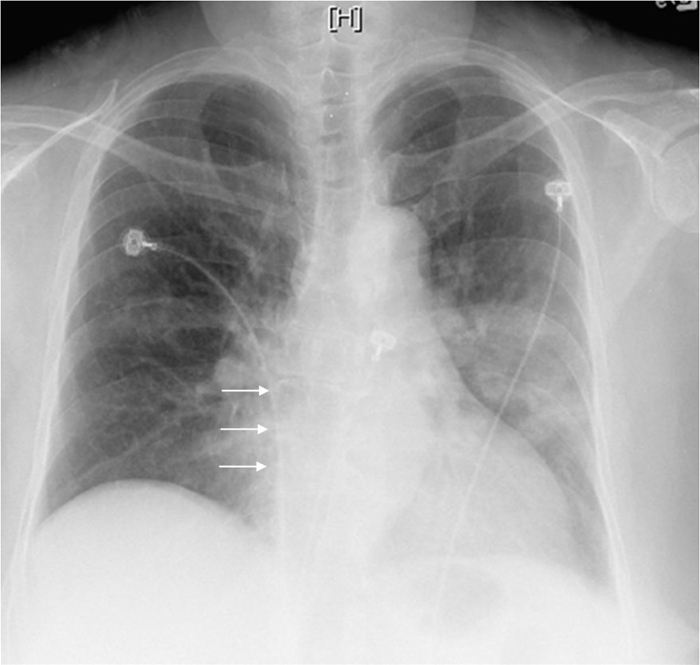 The mediastinal contour obscured by the lung consolidation on this patient's chest x-ray is primarily formed by which of the following structures?
 (Multiple Choice)
4.8/5 (81)
(81) A 28-year-old man experiences worsening tinnitus and hearing loss. MRI of the brain reveals bilateral vestibular schwannomas. Genetic testing confirms a diagnosis of neurofibromatosis type 2. Additional imaging reveals a small meningioma at the C5 spinal level impinging upon the medial portion of the dorsal columns. Which of the following is the most likely earliest clinical manifestation of this lesion?
(Multiple Choice)
4.8/5 (69)
(69) A 67-year-old woman with a known history of lung cancer comes to the office due to hoarseness and difficulty swallowing. She has no disturbances in vision or hearing. On examination, there is loss of the gag reflex on the left side; when the patient is prompted to say "ah," the uvula deviates to the right side. Her left shoulder is drooped and strength is reduced during left shoulder shrug testing. Chest x-ray shows a right lower lobe lung mass and several osteolytic rib lesions. MRI of the head also demonstrates multiple lesions consistent with metastasis. A lesion involving which of the following anatomical structures is most likely responsible for this patient's symptoms?
(Multiple Choice)
4.9/5 (95)
(95) A 25-year-old man fractures his right tibia in a motor vehicle accident. His right leg is fixed in a cast and he requires underarm crutches to ambulate. Two weeks later, he comes to the clinic with right upper-extremity weakness and numbness. He has no neck or arm pain. The patient is concerned because he is right handed and cannot perform his duties as an electrician. On neurologic examination, there is diminished strength on extension of the right wrist with an absent triceps reflex. Injury to which of the following nerves is most likely responsible for this patient's symptoms?
(Multiple Choice)
4.9/5 (75)
(75) A 62-year-old man comes to the physician due to intermittent groin pain. The pain is most severe when the patient lifts heavy loads and after a long day at his job as a construction worker. Physical examination shows a right-sided groin bulge directly above the inguinal ligament. The bulge increases in size when he bears down. An ultrasound reveals that the mass originates medial to the inferior epigastric vessels. This patient's condition is most likely caused by which of the following?
(Multiple Choice)
5.0/5 (78)
(78) A 23-year-old primigravida woman has a vaginal delivery of a 3600-g (7 lb 15 oz) infant after a protracted labor. The patient has had no pain medications or epidural analgesia during delivery. She sustains a second-degree perineal laceration, and repair is planned. Prior to administering local anesthesia, the physician palpates for distinct bony protrusions located on the posterolateral vaginal sidewalls; a firm band can be felt running medially and posteriorly from each of the bilateral bony protrusions. The anesthetic agent is injected around the bony prominence. Which of the following nerves is most likely blocked by this injection?
(Multiple Choice)
4.8/5 (77)
(77) 
Filters
- Essay(0)
- Multiple Choice(0)
- Short Answer(0)
- True False(0)
- Matching(0)