



 Chat with AI
Exam 1: Anatomy

Exam 1: Anatomy291 Questions
Exam 2: Behavioral science240 Questions
Exam 3: Biochemistry156 Questions
Exam 4: Biostatistics117 Questions
Exam 5: Embryology52 Questions
Exam 6: Genetics103 Questions
Exam 7: Histology24 Questions
Exam 8: Immunology129 Questions
Exam 9: Microbiology336 Questions
Exam 10: Pathology816 Questions
Exam 11: Pathophysiology464 Questions
Exam 12: Pharmacology538 Questions
Exam 13: Physiology272 Questions
Select questions type


A 54-year-old man is evaluated for episodic abdominal discomfort, bloating sensation, flatulence, and occasional diarrhea. He has no blood in the stool or weight loss. The patient has tried avoiding dairy products, but the symptoms did not improve. On examination, there is mild epigastric tenderness on deep palpation. Stool occult blood testing is positive. Histopathological evaluation of hyperemic mucosa seen during gastrointestinal endoscopy reveals hyperplasia of branched, tubular submucosal glands containing alkaline secretions. Which of the following areas is the most likely site of biopsy in this patient?
(Multiple Choice)
4.8/5  (88)
(88) A 42-year-old man comes to the office with rectal bleeding. He used to have occasional streaks of blood on the tissue after wiping, but for the past several days he has seen blood dripping into the toilet at the end of defecation. The patient reports chronic constipation and has to strain while having a bowel movement but has no rectal or abdominal pain. He works as a truck driver, and his diet consists mainly of hamburgers and French fries. Abdominal examination is unremarkable. There is no mass or tenderness on digital rectal examination, but anoscopy shows bulging purplish-blue mucosal lesions above the dentate line. Rubber band ligation of the lesions is most likely to involve which of the following?
(Multiple Choice)
4.8/5 (73)
(73) A 17-year-old boy is brought to the emergency department due to a lower extremity injury. The patient was playing football with his friends when he was tackled roughly and "felt something snap" in his right leg. He avoids bearing weight on the right foot. Examination shows a large contusion with point tenderness at the proximal lateral right leg. An x-ray of the leg is shown in the exhibit.
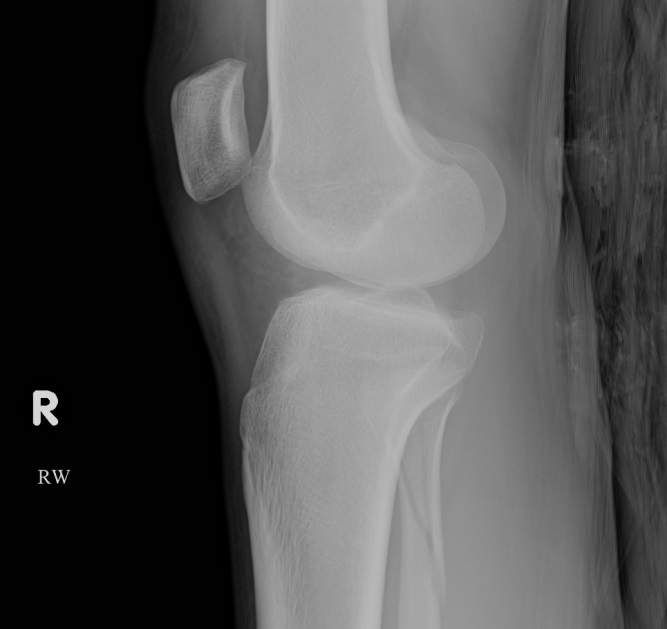 Which of the following would most likely be found on physical examination?
 (Multiple Choice)
4.8/5 (81)
(81) A 52-year-old man is brought to the emergency department for evaluation of fever, chills, and malaise. Cardiopulmonary examination reveals a new holosystolic heart murmur that radiates toward the axilla. Blood cultures are obtained, and the patient undergoes transesophageal echocardiography. The ultrasound probe is placed in the midesophagus facing anteriorly, and the cardiac chambers are interrogated. Which of the following chambers is closest to the probe?
(Multiple Choice)
4.9/5 (66)
(66) A 74-year-old man with metastatic lung cancer is brought to the emergency department due to sudden-onset severe headache, nausea, and vomiting. The patient was diagnosed with squamous cell lung cancer 4 months ago and was found to have metastasis to the right frontal lobe of the brain. He refused chemotherapy and radiation treatments and is receiving palliative care. Blood pressure is 142/86 mm Hg, pulse is 100/min, and respirations are 20/min. On examination, the patient is somnolent but wakes up to voice and follows instructions. Urgent CT scan of the head reveals hemorrhage within the tumor, causing significant surrounding edema; the right cingulate gyrus is seen herniating beneath the falx cerebri. Which of the following findings is most likely to be present in this patient given his neuroimaging results?
(Multiple Choice)
4.9/5 (80)
(80) A 53-year-old man is evaluated for right hand discomfort. A month ago, he started to intermittently experience a "pins and needles" sensation in his right hand that is worse at night. He has no neck pain or history of trauma to the right upper extremity. The patient has smoked a pack of cigarettes daily for 20 years and has worked as an accountant for the past 30 years. On physical examination, there is loss of sensation over the right fifth digit. There is no swelling, redness, or warmth of the hand. The patient is most likely to have weakness of which of the following movements?
(Multiple Choice)
4.8/5 (85)
(85) A 55-year-old man is brought to the emergency department due to shortness of breath, productive cough, and confusion. His wife mentions that last week he was diagnosed with the flu and his symptoms have progressively worsened. Temperature is 39.4 C (103 F), blood pressure is 80/50 mm Hg, pulse is 120/min, and respiratory rate is 22/min. Pulse oximetry shows 86% on room air. On physical examination, the patient is obtunded and in respiratory distress. He is intubated, given a 2-L bolus of normal saline, and started on broad spectrum antibiotics after blood cultures are obtained. A central line is placed to access a structure embryonically derived from the common cardinal veins. This structure is represented by which of the following labels shown in the chest CT scan below? 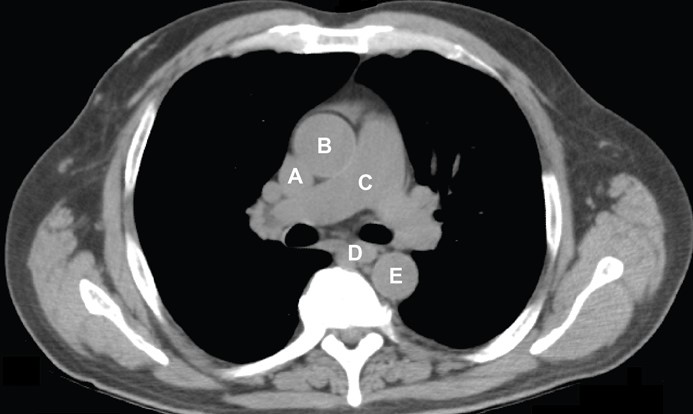
(Multiple Choice)
4.8/5 (89)
(89) A 21-year old man is brought to the emergency department due to head trauma sustained during a boxing match. During the fight, he had a brief loss of consciousness after a hard hit to the right side of his face. He has a headache and muffled hearing in his right ear. On examination, the patient is alert and oriented. Palpation of the head does not reveal any step-offs. Cervical spine examination is normal. Otoscopic examination reveals hemotympanum in the right ear. This patient is at greatest risk for injury involving which of the following cranial nerves?
(Multiple Choice)
4.8/5 (73)
(73) A 21-year-old man comes to the emergency department due to abdominal pain, nausea, and vomiting. The patient started having vague periumbilical pain in the morning. Over the next several hours, the pain became more severe, sharper, and localized to the right lower abdominal quadrant. Temperature is 38.3 C (100.9 F), blood pressure is 132/84 mm Hg, pulse is 102/min, and respirations are 12/min. Physical examination shows maximal tenderness in the right lower abdomen two-thirds of the distance from the umbilicus to the anterior superior iliac spine. Bowel sounds are decreased. Laboratory studies reveal a leukocyte count of 16,000/mm3. The change in this patient's pain characteristics is most likely explained by which of the following?
(Multiple Choice)
4.8/5 (76)
(76) A 36-year-old woman comes to the office due to firm, nontender swelling of her right cheek for the past 4 months. The patient has had no fever, runny nose, sore throat, or cough. She drinks a glass of wine with dinner on most nights but does not use tobacco. Physical examination shows fullness of the preauricular space on the right side. An MRI of the region identifies a 2.2-cm mass in the right parotid gland, and a follow-up core needle biopsy shows the lesion to be neoplastic. If left untreated, this patient is most likely to develop which of the following?
(Multiple Choice)
4.9/5 (81)
(81) A 65-year-old woman is brought to the emergency department due to abnormal behavior. The patient was in her usual state of health until 3 hours ago, when she suddenly became confused and kept asking repetitive questions. She has had no headache, abnormal motor activity, or focal weakness or numbness. Medical history is significant for hypertension and migraine. Blood pressure is 136/84 mm Hg and pulse is 80/min. On physical examination, the patient is awake and alert but keeps asking, "What happened?" She can state her date of birth and address correctly, recognizes her family members, and is aware of current events. The patient recalls 0 of 3 objects after several minutes and cannot retain the physician's name despite many repetitions. Speech is fluent without dysarthria or aphasia. Cranial nerve examination shows no abnormalities. Motor strength, reflexes, and sensation are normal throughout. Blood cell count and serum chemistry panel are within normal limits. Urine drug screen is negative. CT scan of the head shows no hemorrhage. Two hours later, the patient spontaneously returns to normal. Temporary dysfunction of which of the following neural structures best explains this patient's symptoms?
(Multiple Choice)
4.8/5 (82)
(82) A 29-year-old nulliparous woman comes to the emergency department due to right-sided pelvic pain. The pain is sharp and began suddenly while she was shoveling snow this morning. It is accompanied by nausea and is worse with movement. The patient's last menstrual period was 2 weeks ago. Temperature is 37.8 C (100 F), blood pressure is 100/60 mm Hg, and pulse is 92/min. Pelvic ultrasound reveals a normal-sized uterus and left ovary; there is a right adnexal mass measuring 6 cm with absent blood flow to the right ovary. Urine β-hCG is negative. The patient's condition most likely arises from obstructed blood flow through which of the following ligaments?
(Multiple Choice)
4.9/5 (80)
(80) A 55-year-old right-handed man comes to the emergency department due to persistent right arm tingling and numbness for the past several hours. The patient has no headache, muscle weakness, slurred speech, or difficulty ambulating. He has a history of hypertension, paroxysmal atrial fibrillation, and ischemic stroke without residual symptoms. Anticoagulation was discontinued 2 months ago after he developed a gastrointestinal hemorrhage. Blood pressure is 150/90 mm Hg, and pulse is 92/min and regular. While the patient is being evaluated, his right arm paresthesia spreads to the entire right side of the body and he develops right-sided convulsions, followed by a bilateral tonic-clonic seizure. Which of the structures in the left cerebral hemisphere is the most likely site of origin of this patient's seizure? 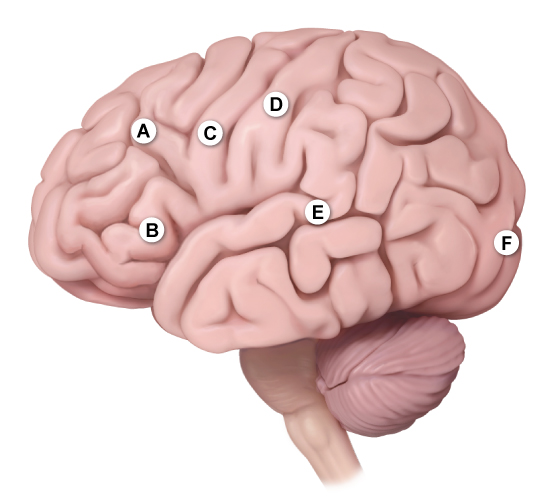
(Multiple Choice)
4.9/5 (87)
(87) A 65-year-old man comes to the emergency department due to severe lower abdominal pain and nausea. He also has not been able to urinate for the past 24 hours. The patient has a history of hypertension and benign prostatic hyperplasia. On examination, a large mass is palpable in the suprapubic area. Multiple attempts at urethral catheterization are unsuccessful, and an ultrasound-guided midline suprapubic cystostomy is planned. Besides the bladder wall, which of the following structures is most likely to be penetrated by the trocar and cannula during the procedure?
(Multiple Choice)
4.8/5 (82)
(82) A 70-year-old right-handed woman comes to the emergency department with left-sided visual loss that she noticed on awakening in the morning. She has no headache, slurred speech, difficulty swallowing, weakness, or difficulty walking. Her other medical problems include hypertension, atrial fibrillation, and hyperlipidemia. Blood pressure is 170/102 mm Hg and pulse is 90/min and irregular. On neurologic examination, she is alert and oriented to person, place, and time. Her speech is fluent, and she follows complex commands. Examination of her visual fields shows left homonymous hemianopia with macular sparing. There is decreased sensation over the left side of her body. The remainder of the neurologic examination is within normal limits. Non-contrast head CT demonstrates an area of focal parenchymal hypoattenuation, as shown in the image below. 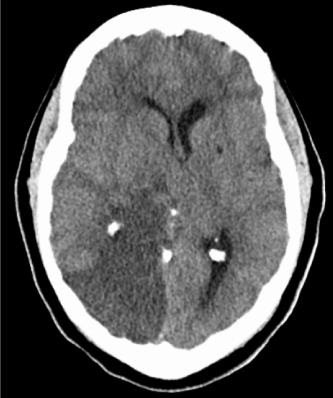 Which of the following cerebral arteries is most likely to be compromised in this patient?
 (Multiple Choice)
4.8/5 (76)
(76) A 51-year-old man is brought to the emergency department due to chest tightness that started 30 minutes prior to arrival. His chest discomfort is associated with shortness of breath and nausea. The patient was shoveling snow off his driveway when his symptoms began. He has a history of hypertension and type 2 diabetes mellitus. Initial ECG shows ST elevation in leads I and aVL. Cardiac enzymes are elevated. Emergent cardiac catheterization in this patient will most likely show occlusion of which of the following arteries?
(Multiple Choice)
4.9/5 (87)
(87) A 56-year-old man comes to the emergency department due to persistent left wrist pain. While walking his dog 5 hours ago, he fell forward onto the ground and landed on his outstretched hand. Examination shows mild left wrist swelling with preserved range of motion. There is point tenderness over the dorsolateral aspect of the wrist between the tendons of the extensor pollicis longus and extensor pollicis brevis. An x-ray of the left wrist is shown in the image below: 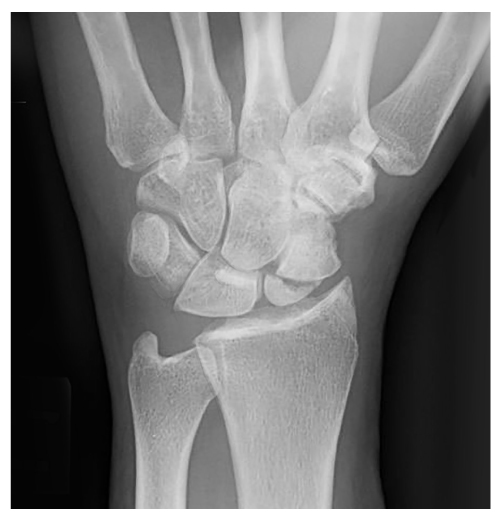 This patient is at greatest risk for developing which of the following complications?
 (Multiple Choice)
4.9/5 (76)
(76) A 47-year-old woman comes to the office due to fever, dysuria, and abdominal pain. She has had several episodes of urinary tract infections since her teens but no other medical problems. Physical examination reveals mild suprapubic discomfort. Urinalysis shows pyuria and many bacteria. A CT scan of the abdomen is obtained and is shown in the image below. 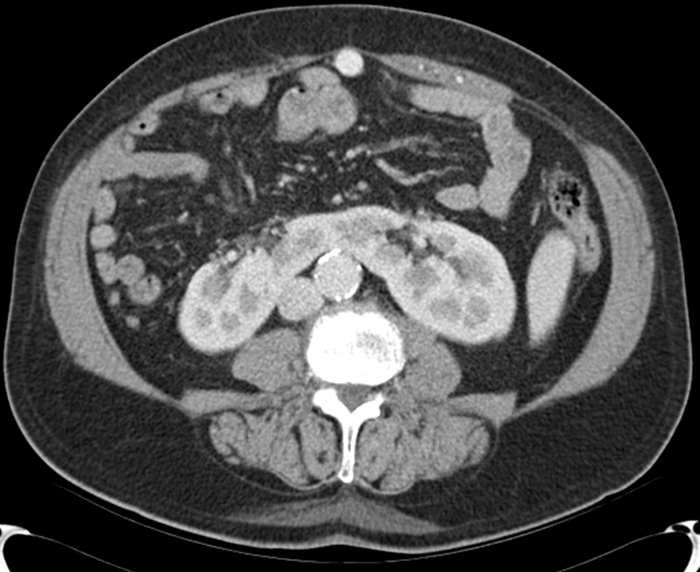 Which of the following most likely prevented the proper ascent of the anomalous organ seen on the CT scan?
 (Multiple Choice)
4.8/5 (85)
(85) A 66-year-old man comes to the hospital due to sudden-onset chest pain and dyspnea. The patient has a history of asthma and gastroesophageal reflux disease but says his current symptoms feel different than what he usually experiences. An ECG is consistent with ST-elevation myocardial infarction, and an emergent cardiac catheterization is performed. Evaluation of the left and right coronary arteries reveals left-dominant circulation. A stenotic region is identified in one of the coronary vessels just before the origin of the artery supplying the atrioventricular node. Which of the following arteries is most likely affected?
(Multiple Choice)
4.9/5 (79)
(79) A 62-year-old man comes to the emergency department due to acute-onset constipation. His last bowel movement was 4 days ago; before that time, his stools were always regular. Review of systems is positive for dry cough, increasing low back pain, a 9-kg (20-lb) weight loss in the past month, and increasing difficulty with urination. He has smoked 2 packs of cigarettes daily for 30 years. Vital signs are within normal limits. Point tenderness is elicited with palpation over the lower spine. Bilateral lower extremity weakness is present, and sensation is impaired in the perineal region. Chest x-ray reveals a right lung mass. Dysfunction of which of the following nerves best explains this patient's constipation?
(Multiple Choice)
5.0/5 (84)
(84) 
Filters
- Essay(0)
- Multiple Choice(0)
- Short Answer(0)
- True False(0)
- Matching(0)