Multiple Choice
A 42-year-old man is brought to the emergency department 1 hour after the onset of severe headache, nausea, vomiting, and confusion. The patient has primary (essential) hypertension and chronic kidney disease; he has been prescribed 2 antihypertensive agents but has been noncompliant with therapy. Temperature is 36.8 C (98.2 F) , blood pressure is 240/150 mm Hg, heart rate is 90/min, and respirations are 20/min. Ophthalmologic examination shows bilateral papilledema. The lungs are clear to auscultation. Cardiac examination reveals an S4 and no murmurs. Laboratory results are as follows: 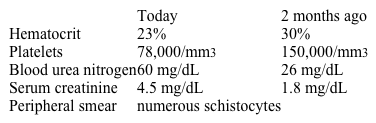 If renal biopsy is performed in this patient, which of the following pathologic findings is most likely to be found?
A) Fibrinoid necrosis of small arteriolar walls
B) Focal global glomerulosclerosis
C) Granulomatous inflammation of the media
D) Homogenous acellular thickening of arteriolar walls
E) Interstitial fibrosis and tubular atrophy
Correct Answer:

Verified
Correct Answer:
Verified
Q564: A 44-year-old man with a history of
Q565: A 55-year-old man is evaluated due to
Q566: A 25-year-old man comes to the office
Q567: A 28-year-old man is hospitalized following a
Q568: A 76-year-old man comes to the office
Q570: A 59-year-old man is being evaluated for
Q571: A 32-year-old man dies suddenly in his
Q572: A 19-year-old man comes to the office
Q573: A 29-year-old woman comes to the emergency
Q574: A 74-year-old woman comes to the emergency