



 Chat with AI
Exam 10: Pathology

Exam 1: Anatomy265 Questions
Exam 2: Behavioral Sciences178 Questions
Exam 3: Biochemistry102 Questions
Exam 4: Embryology59 Questions
Exam 5: Epidemiology, Biostatistics, and Medical Informatics94 Questions
Exam 6: Genetics88 Questions
Exam 7: Histology46 Questions
Exam 8: Immunology147 Questions
Exam 9: Microbiology and Virology330 Questions
Exam 10: Pathology817 Questions
Exam 11: Pharmacology and Toxicology509 Questions
Exam 12: Physiology339 Questions
Exam 13: Psychiatry and Psychotherapy23 Questions
Select questions type


A 23-year-old woman comes to the emergency department because of chest and epigastric pain that started just after vomiting 30 minutes ago. She does not take any medications and does not drink alcohol or smoke cigarettes. While in the emergency department, the patient experiences two episodes of forceful, bloody emesis. Her temperature is 99.1°F (37.3°C), pulse is 110/minute, and blood pressure is 105/60 mm Hg. Upper endoscopy shows a linear mucosal tear at the gastroesophageal junction. The process directly responsible for causing this patient's mucosal tear will most likely result in which of the following acid-base disturbances?
(Multiple Choice)
4.9/5  (86)
(86) After having a seizure at home, a 5-year-old girl is taken to the emergency department. The patient collapsed at the dinner table about an hour ago and developed full body shaking and urinary incontinence. Her mother claims that the girl has been suffering from a mild headache and fatigue for the past few days. The patient is sleepy and difficult to rouse during the examination. Vital signs are typical. The cardiopulmonary exam is unremarkable. The image below depicts a CT scan of the head: 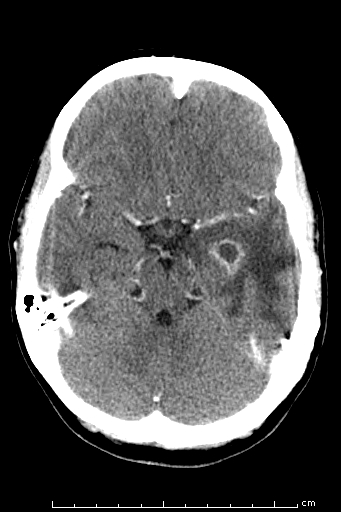 Which of the following historical details is most relevant in establishing this patient's diagnosis?
 (Multiple Choice)
4.9/5 (80)
(80) A 53-year-old man comes to the emergency department because of severe right-sided flank pain for 3 hours. The pain is colicky, radiates toward his right groin, and he describes it as 8/10 in intensity. He has vomited once. He has no history of similar episodes in the past. Last year, he was treated with naproxen for swelling and pain of his right toe. He has a history of hypertension. He drinks one to two beers on the weekends. Current medications include amlodipine. He appears uncomfortable. His temperature is 37.1°C (99.3°F), pulse is 101/min, and blood pressure is 130/90 mm Hg. Examination shows a soft, nontender abdomen and right costovertebral angle tenderness. An upright x-ray of the abdomen shows no abnormalities. A CT scan of the abdomen and pelvis shows a 7-mm stone in the proximal ureter and grade I hydronephrosis of the right kidney. Urinalysis in this patient would most likely reveal which of the following?
(Multiple Choice)
4.8/5 (84)
(84) A 45-year-old man comes to the office due to slowly progressive back and joint pain. In particular, his knee and ankle joints are stiff and painful when he walks. Over the past year, the patient has also experienced excessive sweating, and his ring and shoe sizes have increased. He has no prior medical issues and takes no medications. The patient does not use tobacco, alcohol, or illicit drugs. There is no significant family history. Physical examination shows coarse facial features with a prominent forehead, protruding jaw, and widely separated maxillary teeth. There is mild swelling and crepitus of the knees and ankles bilaterally. Which of the following is the most likely underlying cause of this patient's joint symptoms?
(Multiple Choice)
4.9/5 (81)
(81) A 16-year-old girl presented to the office complaining of recurrent abdominal pain that has been persistent for the past year. The pain typically starts at the beginning of each month and ends 3-4 days later. The pain is localized at the lower side of the abdomen. The patient did not have her menses, while her mother had it at the age of 13 years. On examination, the patient has an average BMI. Breast and pubic hair development are at tanner stage 5. The rectal examination has shown mass found anterior to the rectum. A pregnancy test is negative. Which of the following is the most likely diagnosis?
(Multiple Choice)
4.8/5 (76)
(76) A 44-year-old man comes to the emergency department with a 3-day history of fever, chills, malaise, dyspnea, and a cough productive of "greenish" sputum. The patient has no prior medical problems and has never been hospitalized. He has a 25-pack-year smoking history and drinks 4-5 beers a week. His temperature is 39.4 C (103 F), blood pressure is 130/80 mm Hg, pulse is 98/min, and respirations are 20/min. On examination, dullness to percussion, crackles, and higher clarity and intensity sound when he recites "toy-boat" are present at the right lung base. The remainder of the examination is normal. Chest x-ray shows a dense infiltrate occupying the entire right lower lobe. Which of the following is the most likely cause of these findings?
(Multiple Choice)
4.8/5 (77)
(77) A 32-year-old woman comes to her physician because of increasing back pain for the past 10 months. The pain is worse in the morning when she wakes up and improves with activity. She used to practice yoga, but stopped 5 months ago as bending forward became increasingly difficult. She has also had bilateral hip pain for the past 4 months. She has not had any change in urination. Examination shows the range of spinal flexion is limited. Flexion, abduction, and external rotation of bilateral hips produces pain. Which of the following is most likely to confirm the diagnosis?
(Multiple Choice)
4.8/5 (96)
(96) A 60-year-old man comes to the office for a significant increase in the size of his breasts. He has a history of obstructive urinary symptoms due to benign prostatic hyperplasia that were unrelieved with tamsulosin, and a new medication was prescribed at his last visit 8 months ago. Since starting the new medication, the patient has experienced gradual improvement in urinary hesitancy and strength of urinary stream. The patient reports no pain or changes in weight. Glandular tissue, approximately 2 cm in diameter, is palpated under the nipples and is mildly tender to palpation. There is no nipple discharge, breast asymmetry, or rash. This patient's breast findings are most likely due to which of the following drug effects?
(Multiple Choice)
4.9/5 (76)
(76) A 21-year-old woman is brought to the emergency department because of a 1-day history of acute abdominal pain and vomiting. She also has a 2-day history of fever, headache, and neck pain. She is confused and oriented only to place and person. Her temperature is 39.7°C (103.5°F), pulse is 148/min, blood pressure is 90/50 mm Hg, and respiratory rate is 28/min. Generalized hyperpigmentation is present and is most conspicuous over the face, neck, and dorsal surface of the hands. Urinalysis and chest x-ray are within normal limits. Finger-stick blood glucose is 60 mg/dL. A 1-L bolus of normal saline is rapidly infused, and high-flow intravenous fluids are continued. This patient also requires immediate treatment with which of the following medications?
(Multiple Choice)
4.7/5 (78)
(78) A 53-year-old man is brought to the emergency department by his wife for the evaluation of a progressively generalized headache that started suddenly 2 hours ago. He has not had any recent falls and was sitting in a chair when he lost consciousness. He has hypertension. Current medications include amlodipine, a daily multivitamin, and acetaminophen. Noncontrast CT scan of the head reveals diffuse hyperdensity in the subarachnoid space. CT angiography reveals a ruptured anterior communicating artery aneurysm. The patient is taken to the operating room for surgical clipping and transferred to the intensive care unit. Five days later, he has new-onset focal weakness of his left lower extremity. Repeat CT scan shows no significant changes. Which of the following is the most likely cause of this patient's neurological deterioration?
(Multiple Choice)
4.9/5 (91)
(91) A 4-hour-old male newborn has perioral discoloration for the past several minutes. Oxygen by nasal cannula does not improve the cyanosis. He was delivered by cesarean delivery at 37 weeks' gestation to a 38-year-old woman, gravida 3, para 2. Apgar scores were 8 and 9 at 1 and 5 minutes, respectively. Pulse oximetry shows an oxygen saturation of 85%. Cardiopulmonary examination shows a 2/6 holosystolic murmur along the lower left sternal border. The abdomen is soft and non-tender. Echocardiography shows pulmonary arteries arising from the posterior left ventricle, and the aorta rising anteriorly from the right ventricle. Definitive surgical correction of the main congenital abnormality is planned. Pending definitive repair, which of the following temporary measures would be most likely to improve this patient's condition?
(Multiple Choice)
4.8/5 (83)
(83) A 6-year-old boy is brought to the office due to frequent nighttime awakenings. Several times a week over the past month, he has come to his parents' bed around 3 AM, frequently crying, appearing frightened, and saying that he became lost in a crowd and couldn't find his parents. Although he is comforted by their reassurance, he refuses to return to his room and eventually falls back asleep in their bed. The boy is about to start first grade at a new school. He is healthy and developmental milestones are normal. Examination shows no abnormalities. The sleep stage associated with this child's frightening experience is characterized by which of the following?
(Multiple Choice)
4.9/5 (66)
(66) A 27-year-old woman visits the office for a routine health checkup. Neither the patient nor his or her family have a history of cancer. She has engaged in multiple sexual relationships and uses oral contraceptives to prevent pregnancy. The vital indicators are typical. It is typical to get a physical examination, including a pelvic exam. A squamous intraepithelial lesion that has tested positive for the human papillomavirus is discovered during a Pap test. A cervical biopsy is performed and reveals low-grade dysplasia. Which of the following features distinguishes this patient's lesion from cervical malignancy?
(Multiple Choice)
4.8/5 (78)
(78) A previously healthy 28-year-old lady arrives at the clinic for an assessment of a raised, pigmented skin lesion on her leg. The woman has had no itching or pain and has no idea how long she has had the lesion. She has used tanning beds in the past but denies excessive sun exposure. Her father was just diagnosed with skin cancer, so she is very concerned about the possibility of cancer. A skin examination reveals the nodule seen in the figure below. 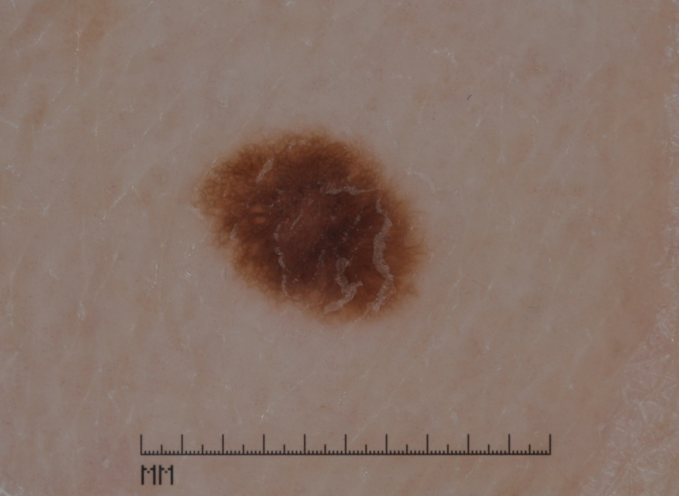 A biopsy of the lesion reveals nests of uniform round cells at the basal portion of the epidermis that extend into the underlying dermis. The cells contain inconspicuous nucleoli and show no mitotic activity. Which of the following is the most likely diagnosis?
 (Multiple Choice)
4.8/5 (82)
(82) A 65-year-old woman is brought to the hospital due to progressive dyspnea and dry cough for 2 weeks. The patient was diagnosed with right breast cancer and completed radiation therapy 6 weeks ago. Temperature is 37.3 C (99.1 F), blood pressure is 115/70 mm Hg, pulse is 92/min, and respirations are 20/min. Oxygen saturation is 94% on room air. Examination reveals inspiratory crackles over the right lung anteriorly; the lungs are otherwise clear to auscultation. Chest radiograph shows ground-glass opacities in the right lung where radiation was delivered. Laboratory studies reveal no significant changes. Acute radiation-induced lung injury is suspected. Histopathologic examination would most likely reveal formation of which of the following?
(Multiple Choice)
4.9/5 (85)
(85) A 48-year-old man who just relocated to the United States visits his doctor complaining of several skin problems. Physical examination reveals a few well-defined, hypopigmented lesions with decreased sensitivity on the skin of his lower limbs. Following confirmation of the leprosy diagnosis, the patient is subjected to further tests to assist determine the severity of his condition. A huge indurated nodule develops after an intradermal injection of heat-killed Mycobacterium leprae. Which of the following additional findings is most likely to be observed in the patient?
(Multiple Choice)
4.8/5 (84)
(84) A 4-year-old boy is brought to the physician because of a progressive headache and neck pain for 2 weeks. During this period, he has had multiple episodes of dizziness and tingling sensations in his arms and hands. His neck is supple. Neurological examination shows gait ataxia. Brain imaging shows caudal displacement of cerebellar tonsils. Which of the following is the most likely cause of this patient's condition?
(Multiple Choice)
4.7/5 (75)
(75) A 26-year-old women comes to the offfice due to worsening fatigue and weight loss. She has a history of primary hypothyroidism and she takes levothyroxine. Physical examination is normal. Blood pressure is 115/75 mmHg supine and 92/61 mmHg on standing. Laboratory tesets show mild anemia with increase eosinophil count and serum glucose is 60 mg/dl. On physical examination shows an increased pigmentation around the nipple areola and anal and vaginal mucous membranes. Which of the following additional findings are most likely to be seen?
(Multiple Choice)
5.0/5 (86)
(86) A 72-year-old woman is brought to the emergency department by her daughter because of left-sided weakness for 1 hour. She does not have headache or blurring of vision. She has hypertension, hypercholesterolemia, type 2 diabetes, and coronary artery disease. She has smoked one half-pack of cigarettes daily for 45 years. Her medications include atorvastatin, amlodipine, metformin, and aspirin. Her temperature is 37°C (98.6°F), pulse is 92/min and regular, and blood pressure is 168/90 mm Hg. Examination shows a left facial droop. A noncontrast head CT is normal. Brain MRI reveals an acute subcortical infarct in the right internal capsule. Six months later, which of the following findings is most likely to be observed in the affected pyramidal tracts of this patient?
(Multiple Choice)
4.8/5 (76)
(76) A 17-year-old girl is brought to the office for evaluation of a left foot mass. She noticed swelling on the top of her foot approximately 3 months ago but said that it did not bother her until she was teased about it in school. She has no other concerns. Examination shows a nontender, rounded mass on the dorsum of the foot that transilluminates with a penlight. An image of the mass is shown below: as shown in the exhibit. 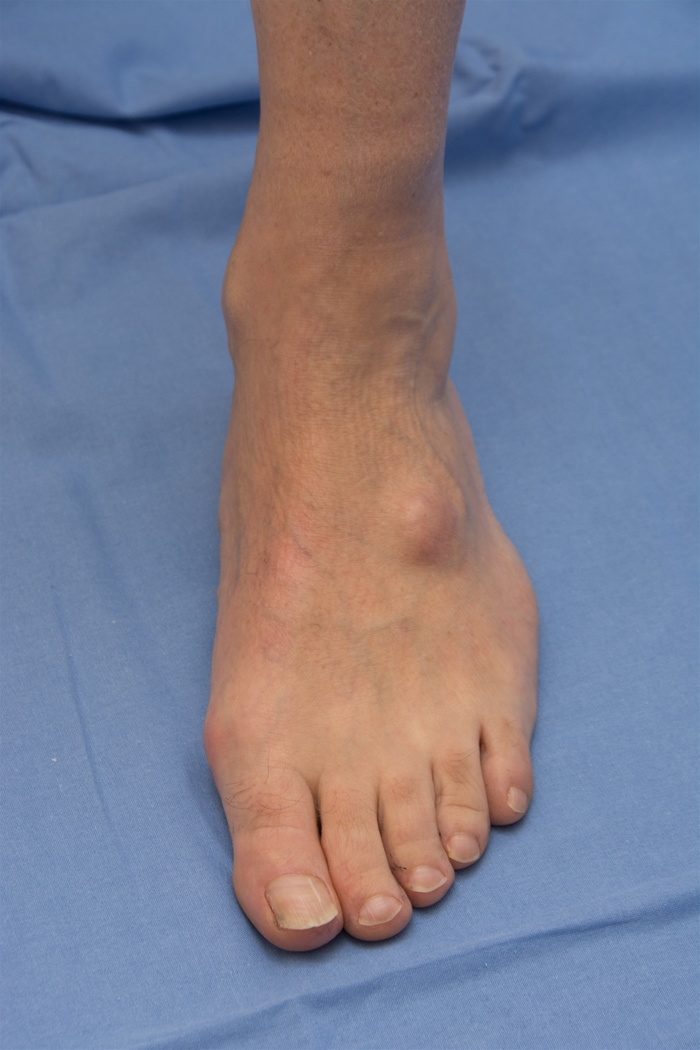 The lesion transilluminates when a penlight is applied to it. Without treatment, which of the following is most likely to occur in this patient?
 (Multiple Choice)
4.9/5 (64)
(64) 
Filters
- Essay(0)
- Multiple Choice(0)
- Short Answer(0)
- True False(0)
- Matching(0)