



 Chat with AI
Exam 10: Pathology

Exam 1: Anatomy265 Questions
Exam 2: Behavioral Sciences178 Questions
Exam 3: Biochemistry102 Questions
Exam 4: Embryology59 Questions
Exam 5: Epidemiology, Biostatistics, and Medical Informatics94 Questions
Exam 6: Genetics88 Questions
Exam 7: Histology46 Questions
Exam 8: Immunology147 Questions
Exam 9: Microbiology and Virology330 Questions
Exam 10: Pathology817 Questions
Exam 11: Pharmacology and Toxicology509 Questions
Exam 12: Physiology339 Questions
Exam 13: Psychiatry and Psychotherapy23 Questions
Select questions type


A 58-year-old man comes to the physician because of burning pain in his neck and arms for a year. He has also had paresthesias in his hands during this period. He has had increasing weakness in both hands during the past 3 months. He has type 2 diabetes mellitus, hypercholesterolemia, and hypertension. He was involved in a motor vehicle collision 3 years ago. Current medications include metformin, sitagliptin, enalapril, atorvastatin, and aspirin. Examination of the upper extremities shows decreased muscle strength, absent reflexes, and decreased hand grip with fasciculations bilaterally. Sensation to temperature and pain is absent over the chest and bilateral upper arms. Vibration and joint position sensations are present in the upper limbs. Cranial nerve examination shows no focal findings. Which of the following is the most likely cause of this patient's problems?

Free
(Multiple Choice)
4.8/5  (80)
(80) Correct Answer: Verified
F
A 44-year-old woman comes to the emergency department because of a sudden midsternal chest pain, shortness of breath, and cough with bloody sputum for the past 3 hours. Medical history is significant for hypertension, hyperlipidemia, and chronic kidney disease. he patient takes multiple medications and has no drug allergies. She returned from a trip to Europe 2 days ago. Blood pressure is 115/75 mm Hg and pulse is 105/min. The lungs are clear on auscultation. ECG shows sinus tachycardia. Ventilation/perfusion scanning is ordered. Which of the following findings would help confirm the suspected diagnosis in this patient?
Free
(Multiple Choice)
4.8/5 (76)
(76) Correct Answer:Verified
VerifiedC
A 37-year-old woman comes to the physician because of irregular menses and generalized fatigue for the past 4 months. Menses previously occurred at regular 25- to 29-day intervals and lasted for 5 days but now occur at 45- to 60-day intervals. She had a prolonged history of systemic lupus erythematosus treated with multiple medications and was recently evaluated for progressive muscle weakness. She is 155 cm (5 ft 1 in) tall and weighs 89 kg (196 lb); BMI is 37 kg/m2. Her temperature is 37°C (98.6°F), pulse is 90/min, and blood pressure is 146/100 mm Hg. Physical examination shows excessive fat accumulation in the abdomen and supraclavicular area. Coarse hair is present on the face, chest, and abdomen. Examination of this patient's adrenal glands is most likely to reveal which of the following findings?
Free
(Multiple Choice)
4.8/5 (89)
(89) Correct Answer:Verified
VerifiedB
A 67-year-old man is brought to the emergency department because of a severe headache and left-sided weakness and numbness for the past 2 hours. While in the emergency department, his symptoms gradually worsen and he develops a headache. Head CT reveals multiple, small lobar hemorrhages of varying ages in the occipital and parietal areas with a medium-size acute bleed in the left parietooccipital lobe. Two years ago, the patient developed sudden right arm weakness; neuroimaging at that time demonstrated a small left frontal lobe hemorrhage. He has no head trauma and does not use anticoagulants. This patient most likely suffers from which of the following?
(Multiple Choice)
4.8/5 (88)
(88) A 32-year-old white woman comes to the physician because of fatigue, lethargy, and swelling of the lower legs for 2 months. She reports recurrent episodes of pain in both wrists, her right knee, and her right ankle in the past year. She has recurrent oral ulcers. She has smoked one pack of cigarettes daily for 13 years and drinks one alcoholic beverage daily. Her temperature is 37.0°C (98.6°F), pulse is 92/min, and blood pressure is 115/75 mm Hg. Examination shows 2+ pretibial edema bilaterally and periorbital edema. There are erythematous patches with scaling on both cheeks. Twenty-four-hour urine protein excretion is 4.5 g. Serum antinuclear antibodies are present. Kidney biopsy shows glomerular capillary wall thickening with no increase in cellularity. When the sample is stained with methenamine silver, irregular spikes protruding from the glomerular basement membrane are seen. This patient most likely has which of the following conditions?
(Multiple Choice)
4.8/5 (76)
(76) A 40-year-old woman comes to the emergency department because of difficulty walking for the past 4 hours. She first noticed her symptoms after getting up this morning and she was dragging her right foot while walking. She feels tired. She has a history of chronic sinusitis. Six months ago, she was diagnosed with asthma. Current medications include an albuterol inhaler and inhaled corticosteroids. Her temperature is 38.9°C (102°F), pulse is 80/min, and her blood pressure is 140/90 mm Hg. Auscultation of her lungs shows diffuse wheezing over bilateral lung fields. Physical examination shows tender subcutaneous nodules on the extensor surfaces of the elbows. There are palpable, nonblanching erythematous lesions on both shins. Dorsiflexion of the right foot is impaired. Sensation to pinprick, light touch, and vibration is decreased over the ulnar aspect of the left forearm. Laboratory studies show: 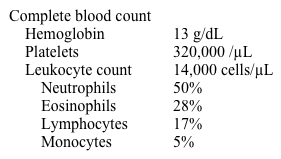 Serum antibodies against neutrophil myeloperoxidase are positive. This patient most likely has which of the following conditions?
 (Multiple Choice)
4.8/5 (79)
(79) A 36-year-old woman comes to the office due to frequent urination since an exacerbation of multiple sclerosis 2 months ago. Most of her symptoms, including dizziness, leg weakness, and numbness, have improved with corticosteroid treatment. However, she has continued difficulty holding urine, and on several occasions has passed a small amount of urine while trying to reach the bathroom. She has no urine leakage during coughing or sneezing. The patient has no other medical problems. On examination, the patient has mild spastic paraparesis with increased reflexes in the lower extremities; bilateral Babinski sign; and a thoracic sensory level to pain, temperature, and vibration. An MRI of the spine reveals a new demyelinating lesion in the mid-thoracic spinal cord. Which of the following abnormalities will most likely be found on this patient's urodynamic studies?
(Multiple Choice)
4.8/5 (80)
(80) A 36-year-old man arrives at the clinic with a 2-month history of a pruritic rash on his elbows and knees. Despite utilizing skin emollients, the patient's lesions have not improved. He also has a history of intermittent stomach pain, gas, and profuse oily stools. The cardiopulmonary exam is normal. The abdomen is nontender and soft. A papulovesicular skin rash with erosion and excoriations is seen on skin inspection. Which of the following is the most likely in this patient?
(Multiple Choice)
4.7/5 (77)
(77) A 22-year-old man is undergoing an uncomplicated laparoscopic appendectomy. Intraoperatively, there was approximately 100 mL of blood loss, his urine output was 100 mL, and 1 L of lactated Ringer solution was administered. His pain has been controlled with intravenous morphine. He was admitted to the hospital 3 days ago and has not eaten in 18 hours. He has no history of serious illness. He has experimented with intravenous illicit drugs. He drinks 3 beers and 2 glasses of whiskey daily during the week and more on the weekends with his college fraternity. He appears anxious. Which of the following symptoms or signs is most likely to appear earliest during this patient's hospitalization?
(Multiple Choice)
4.9/5 (90)
(90) The daughter of a 71-year-old woman brings her to the doctor. She claims that her mother attempted to return home after going shopping yesterday but was unsuccessful. Her mother "began to forget things, like where she left her keys" and "began to have trouble remembering the appropriate phrases" two years ago. Now that she is struggling to maintain her daily routines, she says that paying her bills is a waste of money. Previous medical history of the patient is unremarkable. Which of the following structures is most likely to exhibit atrophy on brain magnetic resonance imaging (MRI)? 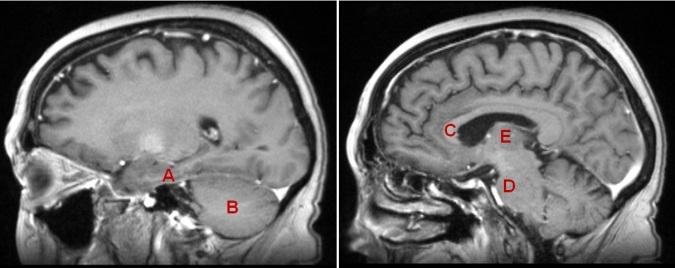
(Multiple Choice)
4.9/5 (68)
(68) A 62-year-old man is found dead in his apartment. An autopsy shows diffuse cerebral edema, laryngeal edema, and hyperinflated lungs. Which of the following is the most likely cause of death in this patient?
(Multiple Choice)
4.9/5 (73)
(73) A 48-year-old woman presented to the emergency department due to a fever of two days duration. The patient has fatigue, nausea, vomiting, and severe epigastric abdominal pain. She has had epigastric abdominal pain for the last 2 months. The patient has a previous medical history of chronic hypertension. On examination, the abdomen has generalized tenderness, rebound tenderness is positive. An upright chest x-ray is shown below. Which of the following is the cause of the patient's presentation?
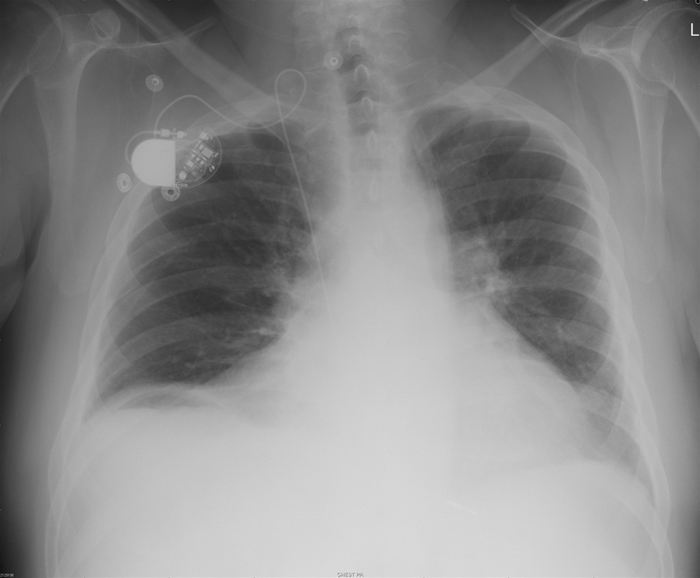
(Multiple Choice)
5.0/5 (73)
(73) A 64-year-old man is brought to the physician by his father. Over the past year, the patient has become progressively forgetful and withdrawn. He frequently has trouble remembering names of acquaintances, and has been requiring increasing amounts of assistance with getting dressed, cooking, and personal hygiene. He also has become increasingly paranoid and frequently talks out loudly. The patient has been unable to live independently for the past 2 years due to increasing forgetfulness and an inability to perform self-care. Vital signs are stable, and physical examination and laboratory evaluation are unremarkable. Which of the following is the most likely explanation for this patient's behavior?
(Multiple Choice)
4.7/5 (83)
(83) A 35-year-old guy visits the office to have a rash on his elbows evaluated. This rash has been bothering the patient periodically for several months, but it has recently grown more persistent and unpleasant. He's had slight itching but no discomfort, and he's tried a topical moisturizing lotion without success. The patient works at a home construction firm, installing tile flooring. He has no chronic medical concerns and does not use any drugs on a daily basis. The patient does not smoke, drink alcohol, or use illegal drugs. The vital indicators are within normal ranges. The rash on his elbow is seen here, and a similar rash can be seen on his other elbow. 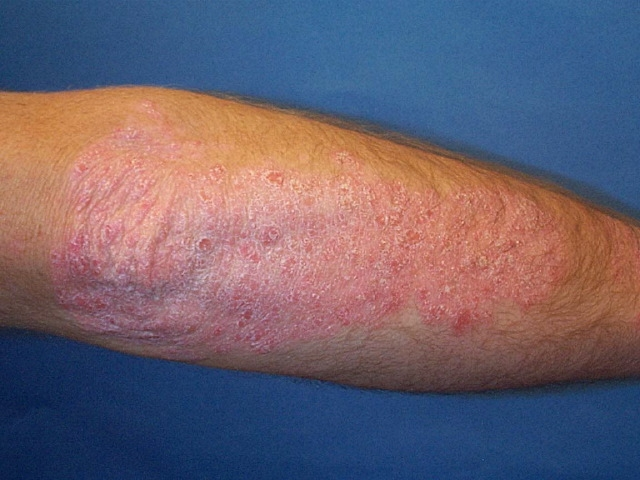 Which of the following histologic changes would be most likely if this patient's skin lesion were biopsied?
 (Multiple Choice)
4.9/5 (88)
(88) A 24-year-old man comes to the office due to nonproductive cough, subjective fevers, right-sided pleuritic chest pain, and increasing dyspnea for the past 4 weeks. He was empirically treated for pneumonia with levofloxacin at an urgent care center 2 weeks ago but has had no improvement. The patient is an exchange student from the Philippines. Temperature is 37.3 C (99.1 F), blood pressure is 118/66 mm Hg, pulse is 90/min, and respirations are 20/min. Physical examination is remarkable for decreased right-sided breath sounds. Chest x-ray shows a large, right-sided pleural effusion. Pleural fluid is drained, and a subsequent chest CT scan reveals right upper lobe infiltrate and calcified hilar adenopathy. This patient's pleural fluid analysis is most likely to demonstrate which of the following findings?
(Multiple Choice)
4.9/5 (75)
(75) A 52-year-old woman comes to the physician because of a 4-month history of progressive pain and stiffness of the fingers of her right hand that is worse at the end of the day. She works as a hairdresser and has to take frequent breaks to rest her hand. Over the past 2 weeks, she has been taking ibuprofen as needed for the joint pain . She drinks one to two beers daily and occasionally more on weekends. Her vital signs are within normal limits. Physical examination shows firm nodules over the distal interphalangeal joints bilaterally as shown in the image below. 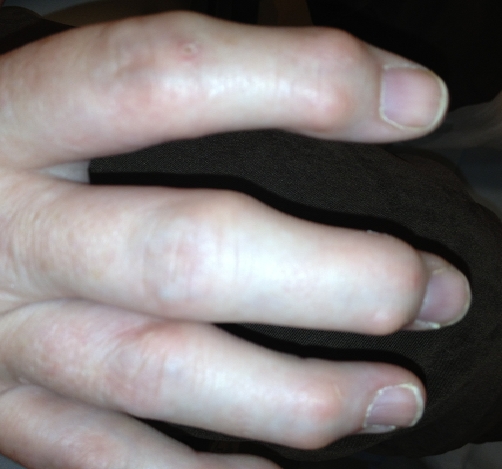 Which of the following is the most likely cause of this patient's symptoms?
 (Multiple Choice)
4.8/5 (97)
(97) A 19-year-old woman comes to the physician for evaluation due to abrupt lose her muscle control. She has had several similar episodes of transient generalized weakness over the past month, once during an argument with her mother and another time while watching her favorite comedy movie. She has also had excessive daytime sleepiness for 18 months despite 9 hours of sleep nightly and 2 daily naps. She has fallen asleep in class several times. She often sees intensely bright colors as she is falling asleep. During this time, she is often unable to move; this inability to move is very distressing to her. If measured, which of the following compounds is most likely to be abnormal in this patient's cerebrospinal fluid?
(Multiple Choice)
4.9/5 (76)
(76) A 55-year-old woman comes to the physician because of increased blurring of vision in both eyes for the past 4 months. She has tried using over-the-counter reading glasses, but they have not helped. She has a history of hypertension, type 2 diabetes mellitus, and chronic obstructive pulmonary disease. Current medications include lisinopril, insulin, metformin, and a fluticasone-vilanterol inhaler. Vital signs are within normal limits. Examination shows visual acuity of 20/70 in each eye. A photograph of the fundoscopic examination of the right eye shows scattered retinal microaneurysms, and new blood vessel formation. Which of the following contributed most to the pathogenesis of this patient's current ocular condition?
(Multiple Choice)
4.8/5 (76)
(76) A 32-year-old woman is brought to the physician by her husband, who is concerned about herabnormal behavior. Last week, she quit her job to start a clothing company. Since then, she has not slept more than 2 hours per night because she has been working on her business plans. Over this same period, she began hearing a voice telling her that she is " The God's of investment " and will need to sacrifice her life. She is not currently taking any medications and uses a copper intrauterine device for contraception. She appears unkempt and agitated while pacing up and down the room. She speaks very quickly about her business ideas, without pausing. She has no suicidal ideation or thoughts of self-harm. Which of the following is the most likely diagnosis in this patient?
(Multiple Choice)
4.9/5 (70)
(70) A 41-year-old woman comes to the office as a new patient. She recently moved to the area. She feels well. She has dyslipidemia treated with pravastatin. Her past three Pap smears have shown no abnormalities; the most recent Pap smear was 2 years ago. The patient has had prediabetes for the last 2 years. She is 155 cm (5 ft 1 in) tall and weighs 70 kg (154 lb); BMI is 29 kg/m2. Her pulse is 68/min and blood pressure is 129/78 mm Hg. Physical examination shows no abnormalities. Laboratory results show a fasting blood glucose of 157 mg/dL and serum creatinine of 0.7 mg/dL. Hemoglobin A1c is 7.4%. Urine assay shows no detectable albuminuria. Which of the following renal changes is most likely present in this patient at this time?
(Multiple Choice)
4.8/5 (78)
(78) 
Filters
- Essay(0)
- Multiple Choice(0)
- Short Answer(0)
- True False(0)
- Matching(0)