



 Chat with AI
Exam 10: Pathology

Exam 1: Anatomy265 Questions
Exam 2: Behavioral Sciences178 Questions
Exam 3: Biochemistry102 Questions
Exam 4: Embryology59 Questions
Exam 5: Epidemiology, Biostatistics, and Medical Informatics94 Questions
Exam 6: Genetics88 Questions
Exam 7: Histology46 Questions
Exam 8: Immunology147 Questions
Exam 9: Microbiology and Virology330 Questions
Exam 10: Pathology817 Questions
Exam 11: Pharmacology and Toxicology509 Questions
Exam 12: Physiology339 Questions
Exam 13: Psychiatry and Psychotherapy23 Questions
Select questions type


A 54-year-old man presents with an enlarged supraclavicular lymph node on the left side. On palpation, the node is painless and stony hard. The node biopsy reveals anaplastic cells that are keratin positive. Which of the following is the most likely origin of the cells detected on the biopsy?
(Multiple Choice)
4.9/5  (87)
(87) A 29-year-old lady visits the emergency room after experiencing a fever and headache for a week. During the evaluation, the patient suffers a widespread tonic-clonic seizure. These are the lab's findings: 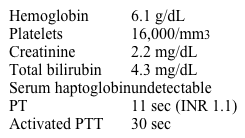 The exhibit displays a peripheral blood smear.
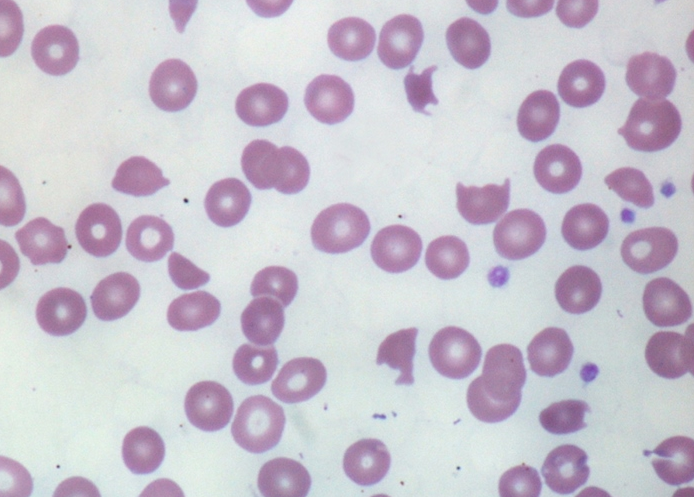 Which of the following is the condition of the patient most likely has an underlying cause?
The exhibit displays a peripheral blood smear. Which of the following is the condition of the patient most likely has an underlying cause? (Multiple Choice)
4.9/5 (69)
(69) A 30-year-old woman comes to the physician because of a history of episodic abdominal cramps, bloating, and flatulence. Two months ago she three days of nausea, vomiting, and diarrhea and she recovered without ay medications. The patient's symptoms are worse after drinking "too much milk." She doesn't smoke or drink alcohole. Physical examination is unremarkable. Initial laboratory evaluation, including serum chemistries, blood counts, stool cultures, and studies for ova and parasites, is negative. Which of the following is most likely decreased in this patient?
(Multiple Choice)
4.8/5 (95)
(95) A 56-year-old man passes away in the hospital from problems brought on by aspiration. Five days ago, the patient was hospitalized with right-sided weakness, sensory loss, and issues speaking and swallowing. The left frontoparietal region was hypodensified according to a CT scan. A slice of loose, spongy tissue from the aberrant brain region is taken for autopsy investigation. Below are histologic results following lipid staining. 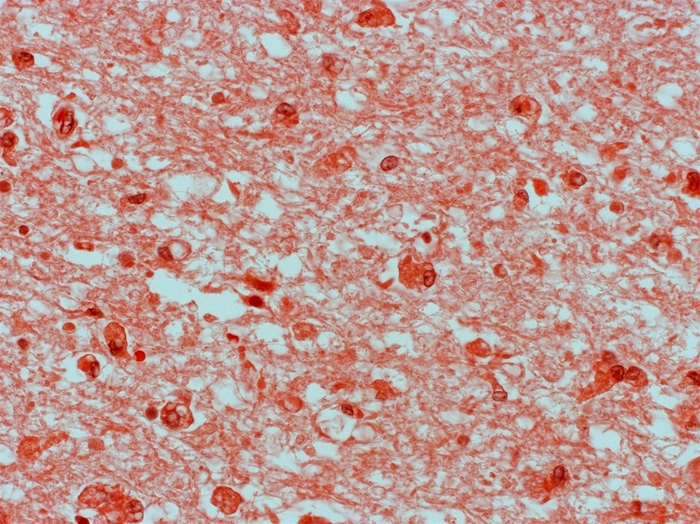 The cells most intensely stained in this patient's brain specimen represent which of the following cell types?
 (Multiple Choice)
4.9/5 (68)
(68) A 50-year-old man is going to have a colonoscopy done as part of a normal checkup for colorectal cancer. He doesn't have any constipation, obvious blood in his stool, abdominal pain, altered stool consistency, or unexpected weight loss. He has no known family members who have had colon cancer. The surgery is straightforward, however a little mucosal lesion (less than 1 cm) is discovered in the patient's sigmoid colon. The image below shows the histology of the biopsy-found lesion. 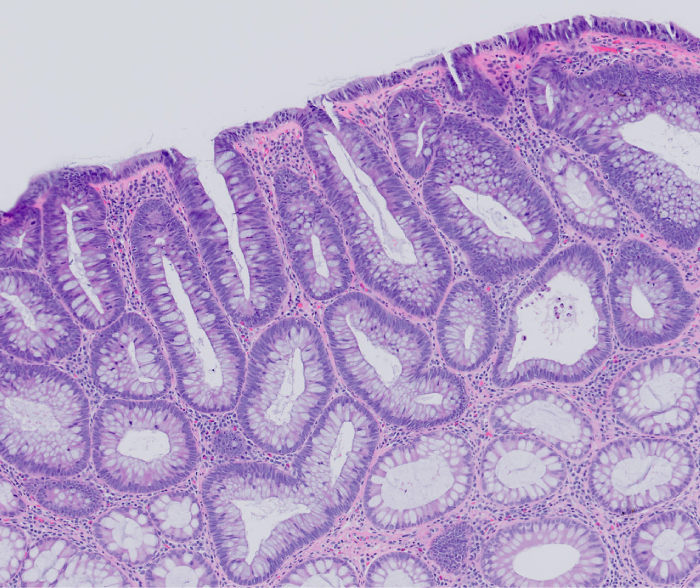 The pathogenesis of this patient's lesion most likely began with a mutation involving which of the following genes?
 (Multiple Choice)
5.0/5 (76)
(76) A 66-year-old man comes to the office for a routine visit. He has a history of hypertension and osteoarthritis. The patient has smoked a pack of cigarettes daily for 40 years and occasionally drinks 1 or 2 glasses of wine but does not use illicit drugs. Blood pressure is 142/82 mm Hg and pulse is 80/min. Cardiopulmonary examination is normal. There is a pulsating, central abdominal mass on physical examination. Which of the following pathologic conditions is the most likely underlying cause of this patient's abnormal findings?
(Multiple Choice)
4.9/5 (83)
(83) A 14-year-old boy is brought to the physician by his mother. She is concerned because although tall, her son looks much younger than his peers and shows no signs of "masculinity." On physical examination, the boy has poorly developed secondary sexual characteristics. He is unable to distinguish smells but has good visual acuity. Which of the following pathways is most likely defective in this patient? 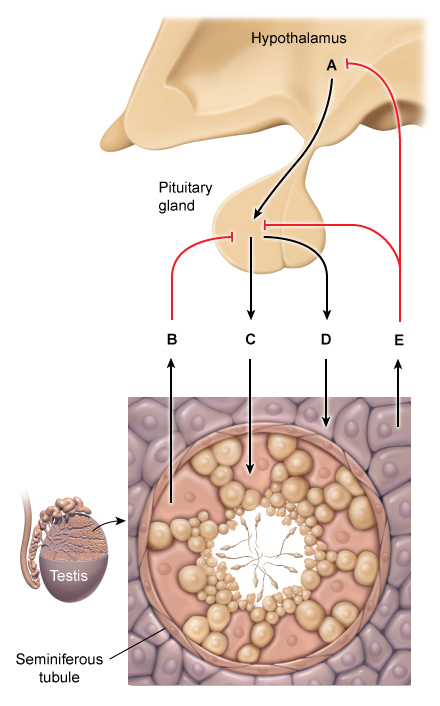
(Multiple Choice)
4.8/5 (83)
(83) A 38-year-old lady with lower abdominal discomfort visits the emergency room. For the previous three days, the patient felt some moderate, cramping abdomen pain, but today it persisted. Occasionally, she has had vaginal bleeding. The patient's last period was 8 weeks ago, and she has a history of irregular menstruation. A left adnexal lump is seen on physical examination. The patient had surgery, and the illustration below shows the resected specimen: 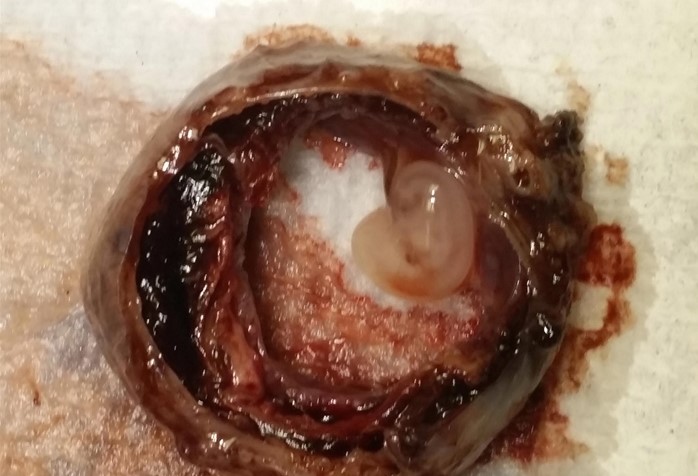 Which of the following risk factors is most strongly associated with this patient's condition?
 (Multiple Choice)
4.8/5 (73)
(73) A 52-year-old woman comes to the hospital because of progressive weakness and dyspnea. She does not have chest pain, or a history of recent illness. She is in temporarly visit of her son and she forgot to bring her medications. She has smoked two packs of cigarettes daily for 25 years. She appears fatigued. Examination shows drooping of the upper eyelids. There is diminished motor strength in the upper extremities. Sensation and reflexes are intact. Arterial blood gas obtained on room air shows pH 7.32; PaCO2 is 52 mm Hg, PaO2 is 72 mm Hg, and HCO3 is 26 mEq/L. Bedside spirometry demonstrates decreased forced vital capacity. A pathologic process involving which of the following structures is the most likely cause of this patient's shortness of breath?
(Multiple Choice)
4.8/5 (92)
(92) Twenty minutes after delivery by lower segment cesarean section at 38 weeks' gestation, a 4630-g (10-lb 3-oz) male newborn has respiratory distress. Apgar scores were 7 and 8 at 1 and 5 minutes, respectively. The newborn's temperature is 36.9°C (98.4°F), pulse is 155/min; and respirations are 72/min. Pulse hree hours after delivery, circumoral cyanosis was noted after the infant was breastfed. Pulse oximetry readings were 98% in the right hand and 83% in the left foot. On physical examination, the patient has subcostal retractions and grunting. Cardiac examination reveals a 2/6 systolic murmur at the left lower sternal border. Femoral pulses are strong bilaterally. Which of the following is the most likely cause of this infant's cyanosis?
(Multiple Choice)
4.9/5 (72)
(72) A 53-year-old woman arrives at the clinic with a skin rash. She has experienced a pruritic rash involving the rear thighs that has worsened during the previous three weeks. The patient just started a weight-loss exercise program and has been using a topical analgesic lotion to her thighs and buttocks after her workouts. Her medical history is ordinary, and she does not smoke, drink alcohol, or use illegal drugs. An erythematous rash with blisters, ulcers, and weeping drainage affecting the posterior thighs bilaterally, as illustrated in the figure below, is discovered on physical examination. 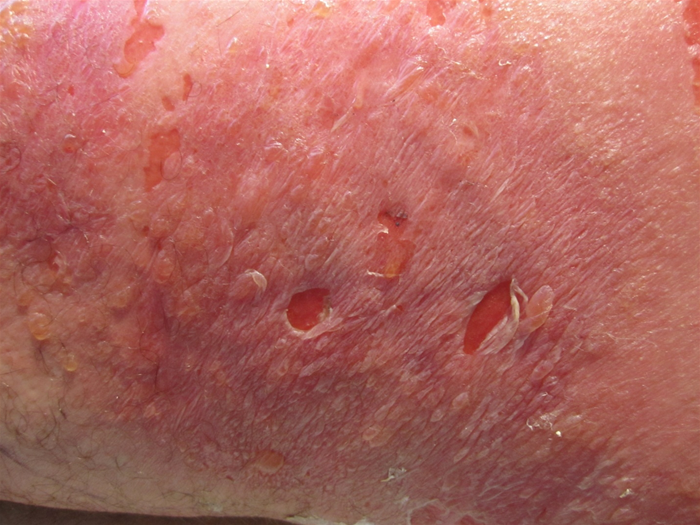 Which of the following is the most likely finding on skin biopsy?
 (Multiple Choice)
4.8/5 (82)
(82) A 66-year-old man comes to the physician because of a 3-week history of shortness of breath with exertion. He has hypertension, hyperlipidemia, and type 2 diabetes mellitus. Current medications include aspirin, losartan, simvastatin, and insulin. His temperature is 37.1°C (98.8°F), pulse is 74/min, and blood pressure is 150/84 mm Hg. Pulse oximetry on room air shows an oxygen saturation of 96%. Physical examination shows bilateral lower extremity edema and distended neck veins. Cardiac auscultation findings over the apex are given below. This patient's auscultatory findings most likely reflect which of the following?
(Multiple Choice)
4.8/5 (64)
(64) A 37-year-old man arrives to the workplace with a rash. He has had multiple tiny lesions on his hands for several months. The lesions cause minor irritation and bleed somewhat when accidentally struck against furniture or a wall. The results of the examination are depicted in the display.  Which of the following is the most likely diagnosis?
 (Multiple Choice)
4.8/5 (101)
(101) A 66-year-old man comes to the emergency department due to increasing shortness of breath over the past 5 days. The patient reports feeling dyspneic while lying flat and has been sleeping upright in his recliner. On physical examination, jugular venous distension is present. Heart sounds are normal. Decreased breath sounds and dullness to percussion can be heard at the bilateral bases. Pitting edema is present in the bilateral lower extremities. Chest x-ray shows cardiomegaly and bilateral pleural effusions. Serum protein is 6 g/dL and serum lactate dehydrogenase (LDH) is 60 U/L. Which of the following sets of pleural fluid findings is most likely to be seen in this patient? 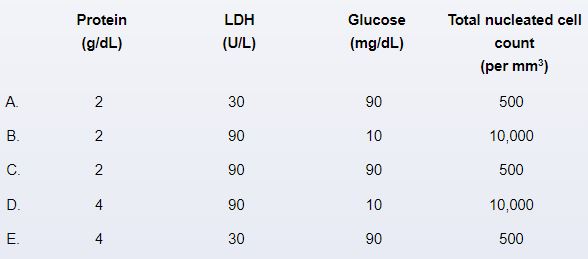
(Multiple Choice)
4.9/5 (71)
(71) A 62-year-old man comes to the physician because of worsening involuntary movements of both arms for the past 7 months. He reports that certain daily activities have become more difficult to perform. His father had a similar condition that was treated with medications. The patient appears anxious. Vital signs are within normal limits. Examination shows a low-amplitude tremor bilaterally when the arms are outstretched. The tremor worsens when he is asked to drink a glass of water. Muscle strength and tone are normal bilaterally. Deep tendon reflexes are 2+ bilaterally. Mental status examination shows no abnormalities. His speech is normal in rate and rhythm. Which of the following additional factors is most likely to be present in this patient's medical history?
(Multiple Choice)
4.7/5 (72)
(72) A 35-year-old man comes to the physician because of a 4-month history of intermittent headaches. They have been getting progressively worse and no longer respond to ibuprofen. He also reports vision problems while driving. The patient has no prior medical conditions and takes no medications. He does not use tobacco, alcohol, or illicit drugs. Physical examination reveals deficits in the bilateral temporal visual fields. Extraocular movements are bilaterally intact, and the remainder of the neurological examination shows no abnormalities. Which of the following additional findings is most likely to be present in this patient?
(Multiple Choice)
4.8/5 (74)
(74) The right upper lobe of a 71-year-old man who has smoked for a long time has a fresh, 4-cm-long, uneven, spiculated, spherical mass. A CT-guided biopsy is carried out. The exhibit displays a follow-up chest x-ray taken following the surgery. Which of the following findings would a physical examination of the right lung most likely reveal? 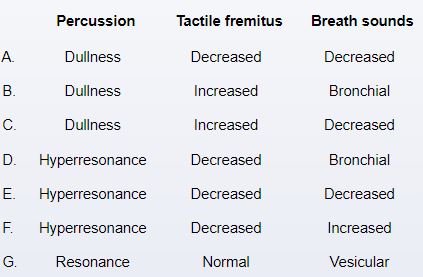
(Multiple Choice)
4.8/5 (90)
(90) A 58-year-old woman presented to the office complaining of a right breast lump. The patient noticed the lump during showering last week. It is associated with skin dimpling, which has been persistent. The patient does not have significant past medical or surgical history. She does not smoke and does not drink alcohol. On examination, an irregular, immobile mass with a hard texture of around 7-cm is felt in the lateral upper quadrant of the right breast. Non-tender skin dimpling is sound at the center of the mass. The patient's skin manifestation is due to the mass infiltration of which of the following structures?
(Multiple Choice)
4.7/5 (58)
(58) A 64-year-old man comes to the office because of difficulty swallowing due to mouth ulcer. He also reports a swelling in his neck which increase in size during over the past 7 months. He has a long history of using chewing tobacco. On examination, there is an ulcerative lesion in the left floor of mouth. There is also a firm, palpable, nontender left submandibular mass. Biopsy of the submandibular mass is shown in the exhibit. 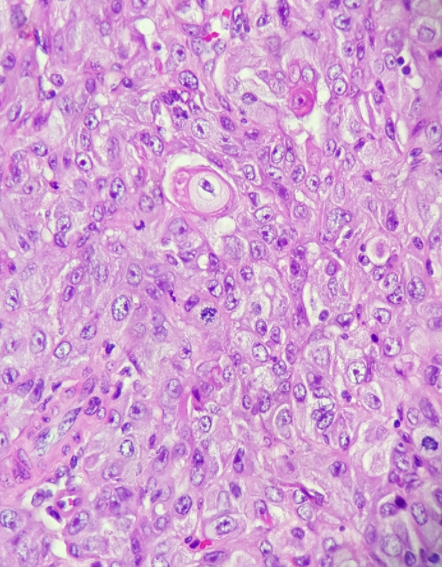 Which of the following is the most likely route of spread from the floor of mouth to the submandibular mass?
 (Multiple Choice)
4.9/5 (83)
(83) A 42-year-old woman is being evaluated because of urinary leakage over the several months. She reports involuntarily losing small amounts of urine after experiencing a sudden need to void. She has difficulty making it to the bathroom in time, these episodes occur almost every day and are very embarrassing. She has a history of multiple sclerosis. These symptoms have persisted despite 4 months of bladder training and weight loss, and reducing soda and coffee intake. Physical examination shows no abnormalities. A urinalysis is within normal limits.Her postvoid residual volume is low. 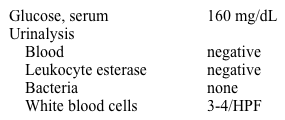 Which of the following is the most likely explanation for her urinary symptoms?
 (Multiple Choice)
4.8/5 (71)
(71) 
Filters
- Essay(0)
- Multiple Choice(0)
- Short Answer(0)
- True False(0)
- Matching(0)