



 Chat with AI
Exam 11: Pharmacology and Toxicology

Exam 1: Anatomy265 Questions
Exam 2: Behavioral Sciences178 Questions
Exam 3: Biochemistry102 Questions
Exam 4: Embryology59 Questions
Exam 5: Epidemiology, Biostatistics, and Medical Informatics94 Questions
Exam 6: Genetics88 Questions
Exam 7: Histology46 Questions
Exam 8: Immunology147 Questions
Exam 9: Microbiology and Virology330 Questions
Exam 10: Pathology817 Questions
Exam 11: Pharmacology and Toxicology509 Questions
Exam 12: Physiology339 Questions
Exam 13: Psychiatry and Psychotherapy23 Questions
Select questions type


A 40-year-old man with HIV comes to the physician for a routine follow-up examination. He has been nonadherent with his antiretroviral medication regimen for several years. He appears chronically ill and fatigued. CD4+ T-lymphocyte count is 205/mm3. HIV genotypic analysis is performed. The viral isolates are found to have a mutation in the variable (V3) region of the env gene, which makes the virus capable of infecting T cells with a specific surface receptor, but infection of macrophages is inefficient. Which of the following antiretroviral medications is most likely to be ineffective in this patient?

Free
(Multiple Choice)
4.9/5  (77)
(77) Correct Answer: Verified
D
A 25-year-old man comes to the physician's office due to left knee swelling and pain. He has 3-week history of fatigue and a rash. The patient reports going camping last month but denies having been bitten by a tick. His past medical history is significant for penicillin allergy . His pulse is 54/min and blood pressure is 110/72. Physical examination reveals multiple circular red rings with central clearings on the right arm and chest. There is a normal range of motion in all joints and 5/5 strength bilaterally in the upper and lower extremities. Which of the following might have prevented this patient's knee condition?
Free
(Multiple Choice)
4.9/5 (78)
(78) Correct Answer:Verified
VerifiedB
A 65-year-old woman is being evaluated in the office for routine follow up. she She has a history of diabetes mellitus, hyperlipidemia, seizure disorder, and gastroesophageal reflux disease. She is concerned about osteoprosis that affect postmenoposue women. The patient walks for 60 minutes on most days and has no problems with balance or falling. The patient underwent menopause at age 52. She has smoked a pack of cigarettes daily for 24 years but does not drink alcohol. Weight is 56 kg (123.5 lb). Long-term use of which of the following medications may increase this patient's risk of osteoporosis ?
Free
(Multiple Choice)
4.9/5 (94)
(94) Correct Answer:Verified
VerifiedF
A 56-year-old man comes to the office for follow up. He has a history of severe depression seeks. His depression has been treated with phenelzine since diagnosis, he reports that he cannot tolerate the side effect of the drug and asks to switch it to a new medication. A sertraline is prescribed. The physician told the patient to stop taking phenelzine at least 2 weeks before starting the new drug . Which of the following processes occurs during this washout interval to allow sertraline therapy to be initiated safely?
(Multiple Choice)
4.7/5 (77)
(77) A study is being carried out to determine the effect of parathyroid hormone (PTH) on bone remodeling. Half of the study participants receive intermittent PTH injections, while the other half receive a continuous PTH infusion. The findings show that intermittent PTH injections have different effects on bone metabolism than continuous infusion. . Which of the following is most likely to be the predominant bone effect with intermittent injections?
(Multiple Choice)
4.8/5 (73)
(73) A 55-year-old woman comes to the physician because of a 5-month history of insomnia. She has difficulty initiating sleep, and her sleep onset latency is normally about 1 hour. The patient's other medical problems include hypertension . He takes lisinopril regularly as prescribed. She avoids consuming alcohol and caffeine before bedtime and has begun to exercise every other afternoon. She also does not watch TV or use her phone shortly before she goes to bed. In addition to nonpharmacologic interventions for insomnia, short-term pharmacologic therapy is being considered. Which of the following medications has the lowest risk of causing adverse effects in this patient?
(Multiple Choice)
4.9/5 (77)
(77) A new medication for the treatment of cardiac arrhythmias has been developed. The drug has a high affinity for both activated and inactivated sodium channels but a low affinity for resting sodium channels. An experiment is designed to keep sodium channels inactive for an extended period of time while they are exposed to the new drug. The speed of the drug's dissociation from the sodium channels is recorded and shown below after allowing the sodium channels to return to their resting state. For comparison, the dissociation curve for quinidine is provided. 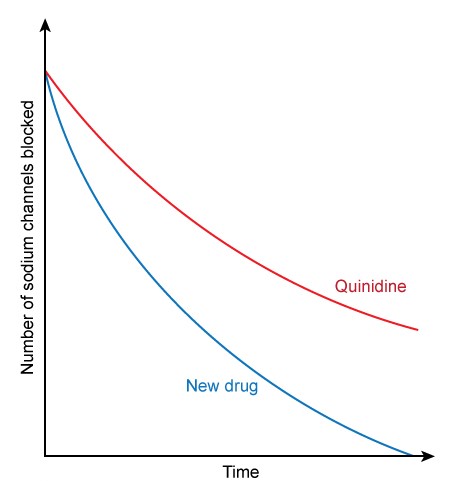 The pharmacologic action of the new drug is most similar to which of the following drugs?
 (Multiple Choice)
4.7/5 (86)
(86) An 8-year-old boy is brought to the emergency department 3 hours after having a 2-minute episode of violent, jerky movements of his arms at school. He was sweating profusely during the episode and lost consciousness. . When asked about any other abnormal behaviors, she says that her son often stares into space and does not respond to questions during these episodes. There is no family history of serious illness. His temperature is 37.0°C (98.6°F), pulse is 98/min, and blood pressure is 94/54 mm Hg. Physical and neurologic examinations show no abnormalities. A complete blood count and serum concentrations of glucose, electrolytes, calcium, and creatinine are within the reference range. Which of the following agents is the best long-term treatment for this patient?
(Multiple Choice)
4.9/5 (91)
(91) A 55-year-old man comes to the physician for a follow-up examination. One month ago, he underwent a right-sided kidney transplantation due to severe polycystic kidney disease. Following the procedure, he was started on transplant rejection prophylaxis. He has had 5-6 bowel movements per day of loose stool and occasional vomiting. He appears pale. Temperature is 37.0°C (98.6°F), pulse is 80/min, and blood pressure is 155/90 mm Hg. Physical examination shows no abnormalities. he is given a medication that inhibits the conversion of inosine monophosphate to guanosine monophosphate primarily in lymphocytes, causing reduced proliferation of activated lymphocytes. Which of the following is the most likely underlying cause of this patient's laboratory findings?
(Multiple Choice)
4.8/5 (95)
(95) Due to confusion and lethargy, a 64-year-old woman is brought to the emergency department. When her husband left for work in the morning, she was asymptomatic, but when he returned home, she was weak and disoriented. The patient has type 2 diabetes mellitus and hypertension, both of which require multiple medications. She does not use tobacco, alcohol, or illicit drugs. The temperature is 37 ° C. (98.6 F), the blood pressure is 140/70 mm Hg, the pulse rate is 74 beats per minute, and the respirations rate is 18 beats per minute. The patient is somnolent on physical examination but withdraws all extremities due to pain. Serum C-peptide levels in the blood are elevated, according to laboratory results. If her current condition is due to an antidiabetic drug, which of the following is the most likely culprit agent?
(Multiple Choice)
4.8/5 (76)
(76) A 67-year-old woman is admitted to the hospital because of a 2-day history of fever, headache, jaw pain, and decreased vision in the right eye. Her temperature is 38.1°C (100.6°F). Examination shows normal muscle strength in bilateral upper and lower extremities; range of motion of the shoulder and hip is mildly limited by pain. Her erythrocyte sedimentation rate is 84 mm per hour. Which of the following is the most appropriate treatment for this patient's condition?
(Multiple Choice)
4.8/5 (84)
(84) A 18-year-old male with acne visits the office. The patient has had minor facial acne for the previous three years, which has responded effectively to topical medications. His acne has gotten worse and spread to his neck and torso since he began college two months ago. It has gotten worse despite using topical medications. The guy practices outside for several hours three days a week because he is a baseball player for the university team. Additionally, he spends many hours each week swimming in an indoor pool. The patient has followed a dairy-free, low-glycemic-index diet since beginning college. Physical examination shows severe, nodulocystic acne on the face, neck, chest, and back. Which of the following most likely caused this patient's worsening acne?
(Multiple Choice)
4.9/5 (83)
(83) A 62-year-old man comes to the physician because of a 3-month history of intermittent retrosternal chest pain and tightness on exertion. He has type 2 diabetes mellitus and hypertension. Current medications include insulin and enalapril. Vital signs are within normal limits. His troponin level is within the reference range. The patient is prescribed a medication that is metabolized to S-nitrosothiols in the vascular smooth muscle cells, and he reports rapid and significant symptom relief. Which of the following components of the cardiovascular system is most susceptible to the medication prescribed to this patient?
(Multiple Choice)
4.7/5 (79)
(79) A 45-year-old man arrives at the clinic with recurrent palpitations, chest discomfort, and shortness of breath. He was diagnosed with paroxysmal atrial fibrillation a year ago and was treated with rate control with a beta blocker. For hypertension and obesity, previous medical history is also important. An echocardiogram reveals left atrial enlargement, normal left ventricular ejection fraction, and no evidence of valvular disease. Holter monitoring over 24 hours reveals bursts of atrial fibrillation associated with the patient's symptoms. To maintain normal sinus rhythm, he is started on dofetilide. This medication exerts its main effect on which portion of the action potential curve? 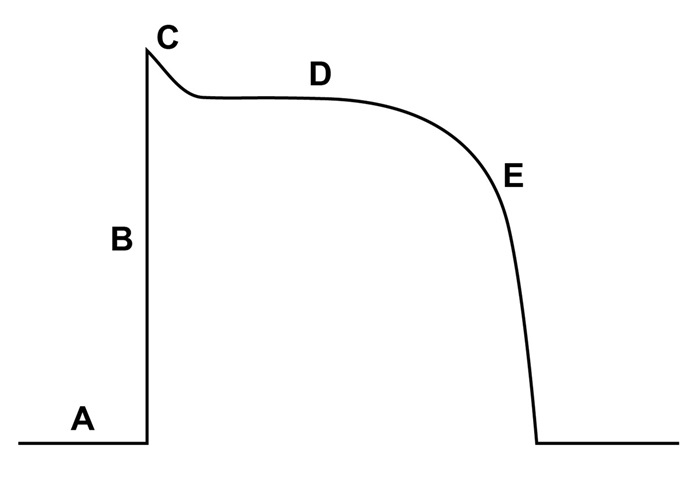
(Multiple Choice)
4.9/5 (86)
(86) A 21-year-old college student comes to the emergency department because of a 2-day history of vomiting and epigastric pain that radiates to the back. He drinks 1-2 beers on the weekends and occasionally smokes marijuana. The patient appears distressed and is diaphoretic. Physical examination shows abdominal distention with tenderness to palpation in the epigastrium. There is no guarding or rebound tenderness. Skin examination shows several clusters of yellow plaques over the trunk and extensor surfaces of the extremities. Laboratory studies show normal hepatic and pancreatic enzyme levels, but the patient again has a severely elevated triglyceride level. The physician prescribes the appropriate medications and explains that the patient is likely to experience skin flushing and warmth after taking the pills. Which of the following is the primary agent mediating these side effects?
(Multiple Choice)
4.7/5 (77)
(77) When testing a novel drug's bioavailability, researchers inject it intravenously (IV) into a volunteer and track changes in the drug's plasma concentrations. The identical amount of the medication is given orally (PO) to the volunteer after it has entirely left their bloodstream, and this time the researchers evaluate the drug's plasma concentrations over time. The resulting data are presented on the graph below. 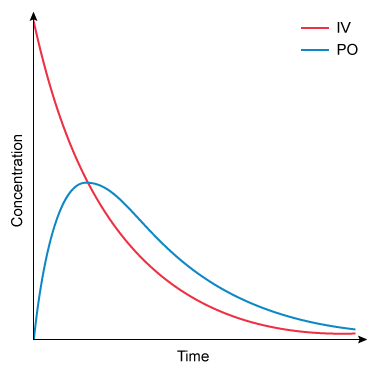 Which of the following is the best determinant of oral bioavailability of this drug?
 (Multiple Choice)
4.7/5 (71)
(71) A 29-year-old man comes to the physician for a follow-up examination. He has fatigued and low-grade fever for several days. He also has had muscle aches and severe joint pain in his elbows, wrists, and knees for the past 10 days. Three months ago, he was diagnosed with pulmonary tuberculosis and started on antituberculosis therapy. He has no current respiratory symptoms apart from pleuritic chest pain. The patient has no other significant past medical or family history. His examination is unremarkable. Laboratory results are as follows: 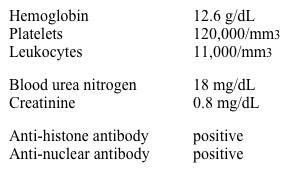 An abnormality in which of the following metabolic processes most likely underlies this patient's current condition?
 (Multiple Choice)
4.7/5 (85)
(85) A 28-year-old man comes into the office to talk about his hair loss. He has hair loss, primarily around the temples, that began gradually three years ago. The patient is concerned because several members of his family had gone nearly completely bald by their late 30s. He otherwise appears to be in good health, with normal muscle strength, libido, and erectile function. The patient is married with two children and works as a charter pilot. A physical examination reveals moderate hair thinning in the anterior scalp, temporal region, and vertex. To treat hair loss, an oral medication is prescribed. After the initiation of therapy, which of the following changes would most likely occur in this patient? 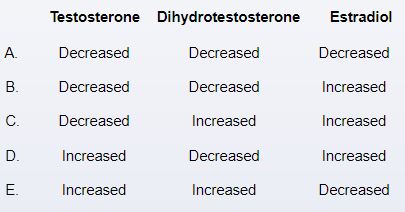
(Multiple Choice)
4.8/5 (68)
(68) 64-year-old woman with osteoarthritis is brought to the hospital because of a 2-day history of nausea and vomiting. Over the past few weeks, she has been taking acetaminophen frequently for worsening knee pain. Examination shows scleral icterus and tender hepatomegaly. She appears confused. Pupils are normal in size and reactive to light. Neurologic examination shows no abnormalities Laboratory results are as follows: 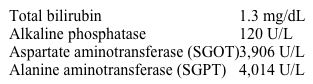 Which of the following is the most likely underlying mechanism of drug toxicity in this patient?
 (Multiple Choice)
5.0/5 (86)
(86) An investigator is studying the effect of a new drug on gastric mucosa cells. She finds that under physiologic conditions, the new drug acts as a competitive antagonist of a G-protein coupled receptor that is located on the cell membrane of parietal cells. Activation of this type of receptor increases the intracellular concentration of cyclic adenosine monophosphate. The mechanism of action of the new drug is most similar to that of which of the following?
(Multiple Choice)
4.8/5 (90)
(90) 
Filters
- Essay(0)
- Multiple Choice(0)
- Short Answer(0)
- True False(0)
- Matching(0)