



 Chat with AI
Exam 6: Genetics

Exam 1: Anatomy265 Questions
Exam 2: Behavioral Sciences178 Questions
Exam 3: Biochemistry102 Questions
Exam 4: Embryology59 Questions
Exam 5: Epidemiology, Biostatistics, and Medical Informatics94 Questions
Exam 6: Genetics88 Questions
Exam 7: Histology46 Questions
Exam 8: Immunology147 Questions
Exam 9: Microbiology and Virology330 Questions
Exam 10: Pathology817 Questions
Exam 11: Pharmacology and Toxicology509 Questions
Exam 12: Physiology339 Questions
Exam 13: Psychiatry and Psychotherapy23 Questions
Select questions type


A 24-year-old African American woman comes to the office with her husband for prenatal counseling. She has a 3-year-old child with sickle cell anemia from a previous marriage, and the child's father died in a car accident. The patient remarried last year and is interested in having more children. She and her new husband do not have sickle cell anemia, and the patient's husband has no other children. However, the patient and her husband are worried that their future children could have sickle cell anemia. A urine pregnancy test is negative. Which of the following is the best initial test that can be offered to this couple?

Free
(Multiple Choice)
4.9/5  (76)
(76) Correct Answer: Verified
D
A 12-year-old boy with mild intellectual disability is brought to the office by his adoptive parents for a routine physical examination. The parents say that the boy is adjusting well to a new school that has increased resources for children with learning disabilities. The patient was adopted as an infant and the birth family's history is unknown. His immunizations are up to date, and he has no allergies. Review of the patient's medical records is notable for cytogenetic studies that showed a small gap near the tip of the long arm of the X chromosome. Which of the following findings are likely to be present on this patient's physical examination?
Free
(Multiple Choice)
4.9/5 (69)
(69) Correct Answer:Verified
VerifiedB
An Ashkenazi Jewish 8-year-old kid is brought to the clinic after experiencing decreased pain sensitivity, poor tear formation, and orthostatic hypotension. Because of the patient's symptoms and family history, familial dysautonomia is suspected. The loss of function of the IKAP protein, which is required for the growth and survival of sensory and autonomic neurons, causes this illness. In the typical gene sequence given below, a single nucleotide substitution causes a guanine residue to be replaced by adenine at the highlighted location. Exon sequences are represented by capital letters, whereas intron sequences are represented by lowercase letters. 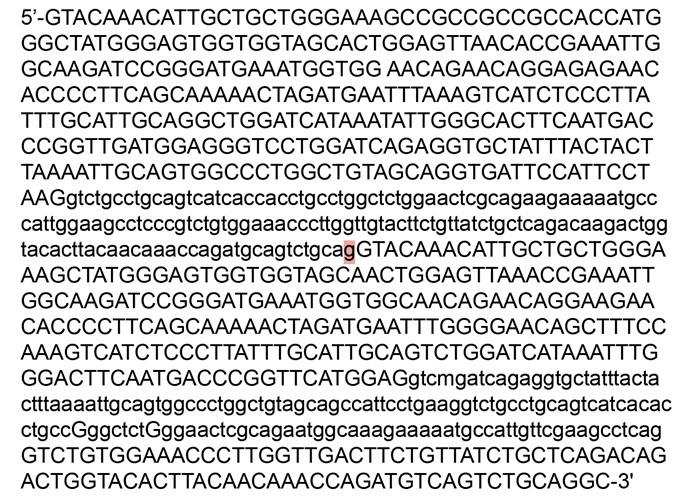 Which of the following is the most likely effect of this mutation?
Free
(Multiple Choice)
4.7/5 (82)
(82) Correct Answer:Verified
VerifiedC
A 10-year-old boy is brought to the emergency department for new swelling in his right leg. He has a history of lens dislocation and intellectual disability. Physical examination demonstrates moderate, pitting edema from his right calf to his right thigh and a normal left lower extremity. In addition, the patient has a caved-in appearing chest wall. He has no family members with similar conditions. Ultrasound reveals a deep venous thrombosis in his right femoral vein. Further genetic testing reveals a single missense mutation in the gene coding for cystathionine beta-synthase enzyme. Which of the following is the most likely explanation for this patient's genetic defect affecting multiple tissues?
(Multiple Choice)
4.9/5 (80)
(80) A 23-year-old man is being evaluated for myoclonic epilepsy of recent onset. The episodes are short-lived and triggered by startle. Physical examination reveals proximal muscle weakness. Gomori trichrome stain of a muscle biopsy specimen shows muscle fibers with a blotchy red appearance. No family history is available because the patient is adopted. What is the probability that this patient's one offspring will inherit the disease?
(Multiple Choice)
4.9/5 (81)
(81) A 4-year-old boy is brought to the office due to a progressively worsening cough for the past 2 days that is productive of yellow sputum. A year ago, he was found to have bilateral lower-lobe pulmonary infiltrates on chest x-ray and was diagnosed with pneumonia. The patient has since had 2 additional episodes of pneumonia, each requiring antibiotics for improvement of symptoms. His current chest x-ray again reveals bilateral lower lobe infiltrates. Further testing shows a high chloride content in his sweat. Which of the following abnormalities is most likely to be seen in this patient?
(Multiple Choice)
4.8/5 (86)
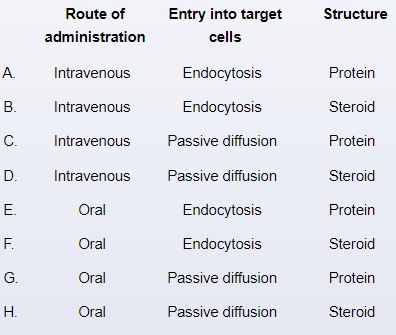
(86) A 9-year-old boy is brought to the office by his mother for evaluation of diffuse bone pain in his left leg. He is below the 5th percentile for height and at the 10th percentile for weight. Physical examination shows tenderness to palpation of the left distal femur. There is hepatosplenomegaly. An x-ray of right femur shows generalized trabecular thinning and several osteolytic bone lesions. Laboratory results show anemia and thrombocytopenia. A bone marrow aspirate shows mononuclear cells filled with lipid that appear like wrinkled silk due to the accumulation of glycolipids within lysosomes. The patient is prescribed enzyme replacement therapy. Which of the following sets of pharmacologic properties best characterizes the administered medication?
(Multiple Choice)
4.7/5 (70)
(70) A 45-year-old man comes to the physician because of involuntary movements and behavioral disturbance. He has frequent, jerky, irregular movements of his upper extremities that have progressively worsened over the past month. His family and friends also say that he has become increasingly irritable over the past year. Genetic testing shows a mutation affecting the huntingtin protein that causes transcriptional repression of a number of other genes. Which of the following mechanisms is most likely responsible for the decreased gene expression seen in this patient?
(Multiple Choice)
4.9/5 (80)
(80) A 54-year-old man visits his doctor complaining of new onset minor headaches and left leg weakness. The lesions discovered during a physical examination are depicted in the figure below.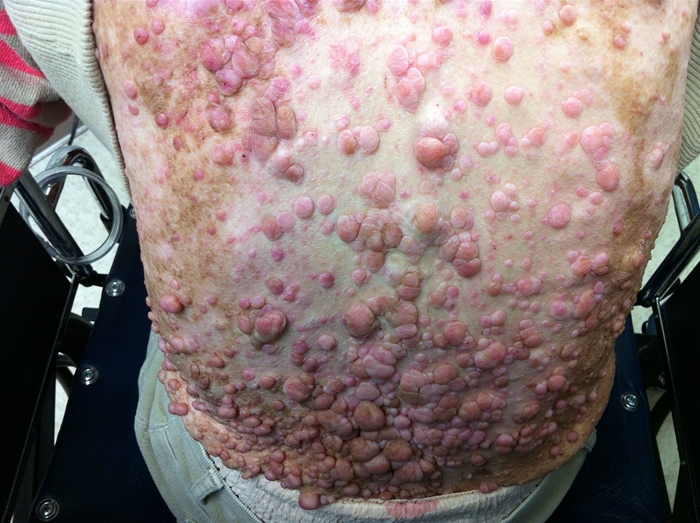 Which of the following inheritance patterns is most likely to be present in this patient's disorder?
 (Multiple Choice)
4.8/5 (80)
(80) A newborn is examined immediately after an induced vaginal delivery for fetal growth retardation. On visual inspection, the infant has low-set ears, a small mandible, and a prominent occiput. The neonate has a weak cry and increased tone of the extremities, including clenched hands with second and fifth digits on top of the third and fourth digits. Cardiac auscultation reveals a harsh, IV/VI holosystolic murmur heard best at the left sternal border. The infant is transferred to the neonatal intensive care unit for further workup and management. Which of the following is the most likely chromosomal abnormality in this infant?
(Multiple Choice)
4.8/5 (81)
(81) A healthy 31-year-old woman arrives to the office because she and her husband want to have a second child. The patient's spouse is infertile, and her baby, conceived through donor insemination, was just diagnosed with glycogen storage disorder type II (Pompe disease). This uncommon autosomal recessive condition affects 1 in 40,000 people in the general population. Genetic testing validates the patient's status as a disease carrier. A sperm donor with no personal or family history of Pompe disease is chosen; nonetheless, his carrier status is unclear. What is the likelihood that the patient will have an afflicted kid with the new sperm donor?
(Multiple Choice)
4.8/5 (80)
(80) A 15-year-old patient is referred to the physician by a teacher who is concerned about the patient's learning abilities and behavior. The patient's reading and writing skills are significantly impaired compared to other classmates, and the patient often misbehaves in class despite receiving numerous detentions. Neuropsychological assessment shows mild intellectual disability. Cytogenetic studies show a karyotype containing 47 chromosomes. Which of the following findings are most likely to be present on further evaluation?
(Multiple Choice)
5.0/5 (75)
(75) A 3-year-old boy is brought to the office for follow-up on intellectual disability and speech delay. Review of his developmental screening questionnaire shows that the boy does not imitate his parents' activities, have a social smile, or show interest in other children. The patient has 8-10 words in his vocabulary and does not combine them into 2-word phrases. There is also concern that his verbal comprehension is poor, and a subsequent audiological evaluation was normal. The boy is up to date on all vaccinations and has no other significant medical history. Laboratory testing shows 226 CGG trinucleotide repeats in a gene located on the X chromosome. Which of the following is the most likely cause of this patient's clinical condition?
(Multiple Choice)
4.9/5 (91)
(91) A series of experiments is being conducted to determine the structure and function of different types of bacterial RNA. Cultures of Staphylococcus aureus are exposed to chemicals that lyse the bacterial cells, and the RNA molecules are then extracted. A specific RNA consisting of 90 nucleotides is purified for further analysis. It is found to contain high amounts of chemically modified bases such as dihydrouridine, pseudouridine, and ribothymidine, and its secondary structure arises from base pairing within the chain. Which of the following is the most likely composition of the 3'-end of this molecule?
(Multiple Choice)
4.8/5 (85)
(85) A 59-year-old woman comes to the physician because of worsening shortness of breath for the past two weeks. Physical examination shows decreased breath sounds at both lung bases. The abdomen is distended and there is shifting dullness with a positive fluid wave. Ultrasound of the abdomen shows a large collection of peritoneal fluid and a hypoechoic mass involving the left ovary. Molecular analysis of the malignant cells in ascitic fluid is performed, and these cells are found to have high telomerase activity. This enzyme promotes cell growth and malignancy by directly causing which of the following actions?
(Multiple Choice)
4.7/5 (79)
(79) Foreign antigen recognition at the cell surface by cytotoxic T-lymphocytes stimulates a response that results in rapid cell death. Which of the following act as effectors of this response?
(Multiple Choice)
4.9/5 (71)
(71) A 13-year-old boy with growth retardation, microcephaly, sun sensitivity, and recurring infections is being examined for a hereditary genetic abnormality. The patient is the second kid born from a first cousin marriage. His parents and siblings are all OK, however two of his maternal relatives are experiencing identical indications and symptoms. The patient's genetic investigation indicates a deficiency in the BLM gene, which codes for DNA helicase. Which of the following is the enzyme's most likely place of action in the DNA replication fork depicted below? 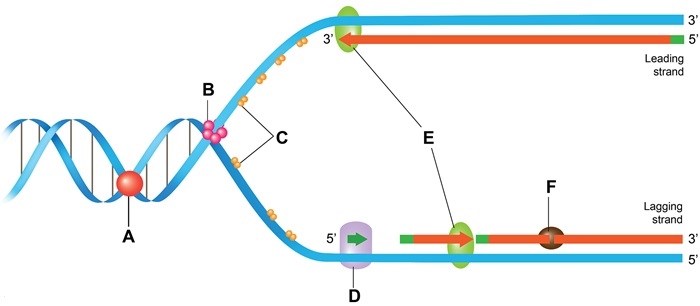
(Multiple Choice)
4.9/5 (79)
(79) A 32-year-old man is recovering from extensive burns. Fibroblasts near the site of injury actively synthesize precursor mRNA to be used as templates for protein synthesis. After transcription, extensive processing of the precursor RNA occurs to form the finalized mRNA sequence. The finalized mRNA then exits the nucleus and undergoes translation by ribosome complexes before being degraded. Which of the following steps involving the processing and handling of mRNA occurs only within the cytoplasm of cells?
(Multiple Choice)
4.8/5 (90)
(90) A 26-year-old woman comes to the office for follow-up. The patient and her husband want to have a child, and she inquires about the risk of certain genetic conditions, including cystic fibrosis (CF). The patient is from a small city with a stable Caucasian population, where the carrier frequency for CF is 1/30 Caucasian individuals. Her husband is from a nearby community, where CF carrier frequency in individuals of Asian descent is 1/100. Both the patient, who is Caucasian, and her husband, who is of Asian descent, are healthy. What is the probability that a child born to a mother from the Caucasian community and a father from the Asian community will have the disease?
(Multiple Choice)
4.9/5 (76)
(76) Studies conducted following an influenza epidemic that affected the inhabitants of several countries determine that the cause is an antigenically novel virus strain carrying the animal-strain hemagglutinin and neuraminidase surface molecules. Further analysis reveals that reassortment of the genetic materials occurred during coinfection with human influenza virus and swine influenza virus, leading to the development of some progeny that contain genetic materials from both viruses. Which of the following viruses can undergo a similar process?
(Multiple Choice)
4.9/5 (74)
(74) 
Filters
- Essay(0)
- Multiple Choice(0)
- Short Answer(0)
- True False(0)
- Matching(0)