



 Chat with AI
Exam 6: Genetics

Exam 1: Anatomy265 Questions
Exam 2: Behavioral Sciences178 Questions
Exam 3: Biochemistry102 Questions
Exam 4: Embryology59 Questions
Exam 5: Epidemiology, Biostatistics, and Medical Informatics94 Questions
Exam 6: Genetics88 Questions
Exam 7: Histology46 Questions
Exam 8: Immunology147 Questions
Exam 9: Microbiology and Virology330 Questions
Exam 10: Pathology817 Questions
Exam 11: Pharmacology and Toxicology509 Questions
Exam 12: Physiology339 Questions
Exam 13: Psychiatry and Psychotherapy23 Questions
Select questions type


A 6-year-old boy is brought to the office due to a persistent facial ulcer for the past 2 months. His mother reports that the patient has extreme sensitivity to sunlight and has developed freckles on his face, neck, and limbs since infancy. On physical examination, the skin in sun-exposed areas is dry and rough with numerous freckles and erythematous macules. There is an ulcerated plaque on the left face; a biopsy reveals squamous cell carcinoma. Further testing leads to a diagnosis of xeroderma pigmentosum. A defect in which of the following enzymes is most likely causing this patient's condition?
(Multiple Choice)
4.7/5  (74)
(74) A primigravid lady in her 22nd week of pregnancy visits the clinic with her spouse to address a cleft lip and palate seen on prenatal ultrasound. The father seeks a fetal paternity test since no one on his father's side of the family has ever had a cleft lip or palate. You explain to the family during your conversation that children with cleft lip and palate generally have no family history of the issue since it is most usually caused by which of the following?
(Multiple Choice)
4.8/5 (77)
(77) A 67-year-old man has been discovered dead in his house. The reason of death is unknown; he had a history of hypertension and had a myocardial infarction a year before. An autopsy is carried out. A physical examination of the heart reveals white scarring and left ventricle enlargement. Below are histologic results from a portion of the left ventricle. 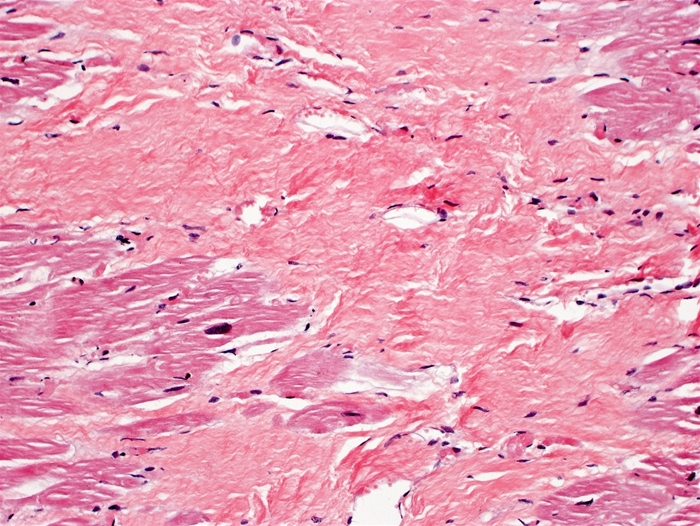 The type of collagen seen in the autopsy sample is most likely to be extensively found in which of the following normal body tissues?
 (Multiple Choice)
4.9/5 (88)
(88) A healthy couple, who recently emigrated from Eastern Europe, bring their 3-year-old son to the office for evaluation of an eczematous rash. On examination, the child also shows signs of intellectual disability and gait abnormality and has a musty body odor. What is the likelihood that this couple's next child will be affected with the same disease?
(Multiple Choice)
4.7/5 (93)
(93) A 16-year-old boy is brought to the physician by his mother for a well-child examination. He recently stopped attending his swim classes. The patient is at the 97th percentile for height and the 50th percentile for weight. Examination shows decreased facial hair, bilateral breast enlargement, and long extremities. Genital examination shows scant pubic hair, small testes, and a normal-sized penis. Further evaluation will most likely show which of the following sets of findings in this patient? 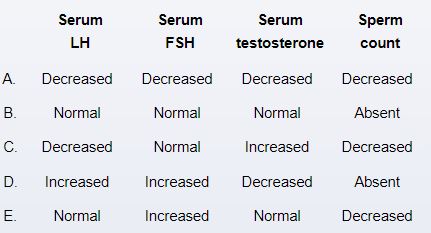
(Multiple Choice)
4.9/5 (78)
(78) A study is undertaken to map the HLA-DQ loci in a population with a high incidence of celiac sprue. High-resolution HLA typing of the DQA1 and DQB1 loci is performed using polymerase chain reaction sequencing. The frequency of the DQA1*0501-DQB1*0201 haplotype, strongly implicated in autoimmunity, is found to be 0.2. However, in the same population, the frequency of the DQA1*0501 allele is 0.3 and the frequency of the DQB1*0201 allele is 0.2. Which of the following best explains the observed DQA1*0501-DQB1*0201 haplotype frequency in this population?
(Multiple Choice)
4.9/5 (77)
(77) A 26-year-old woman and her spouse visit the office for genetic counseling. She is expecting their second kid, the gender of which is unknown. Both parents are asymptomatic, but their 3-year-old boy suffers from anemia, jaundice, and severe swelling of the hands and feet on a regular basis. A blood sample is taken from the youngster, and hemoglobin electrophoresis at alkaline pH is done. The outcomes are depicted in the graphic below. 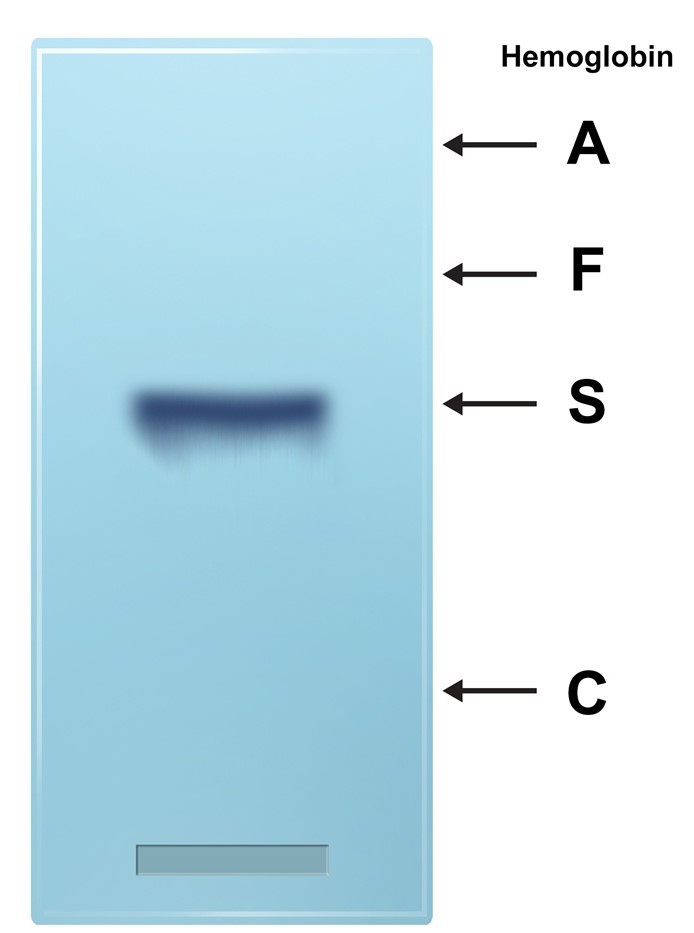 What is the probability that the unborn child will inherit one or more mutant alleles from the parents?
 (Multiple Choice)
4.7/5 (95)
(95) A researcher develops 2 functional mRNA sequences composed of CUC and CUU trinucleotide repeats, respectively. He subsequently incubates these mRNAs in a solution containing functional ribosomes and tRNAs charged with the appropriate amino acids. After several hours, it is found that both mRNA sequences produce polypeptide chains containing leucine repeats. This observed finding is due to which of the following genetic principles?
(Multiple Choice)
4.8/5 (79)
(79) A 24-year-old woman arrives at the office with a fresh mole on her right leg. She is concerned that it is skin cancer because she has used tanning beds many times a year since she was 18. Physical examination reveals a 5-mm dark, round macule with homogenous hue and distinct boundaries on her front thigh. The lesion is deeper in color than the other moles. She is diagnosed with a benign acquired melanocytic nevus after a biopsy of the lesion reveals normal-appearing nevus cells grouped in the epidermis. During histologic examination, her epithelial cells are discovered to have a condensed body composed of extensively methylated DNA near the nucleus's periphery. This region of DNA is most likely associated with which of the following genetic findings?
(Multiple Choice)
4.9/5 (76)
(76) A 5-year-old girl is brought to the office by her mother because she is concerned that her daughter "sunburns too easily." The mother says the patient's skin becomes red and scaly with only minimal sun exposure. She first noticed the problem when her daughter was 7 months old during a trip to the beach. The mother has since avoided exposing her child to excess sunlight, but finds it difficult now that the patient has begun kindergarten. Physical examination shows thin and hyperpigmented skin. She also has a few nevi on her hands that have been enlarging rapidly. This patient's disorder is most likely due to a primary defect involving which of the following processes?
(Multiple Choice)
4.8/5 (60)
(60) A 12-year-old boy is evaluated in the clinic due to excessive bleeding following a tooth extraction. The patient also develops large bruises after only minor injury but has had no major bleeding episodes in the past. His maternal uncle died from an intracranial hemorrhage. Laboratory testing reveals decreased coagulation factor VIII activity levels. A referral is made to a clinical geneticist, who suspects that the patient has a deletion mutation in the enhancer sequence of the factor VIII gene. This mutation has resulted in decreased transcription of factor VIII by RNA polymerase II. Which of the following is the most accurate statement regarding the abnormal genetic sequence in this patient?
(Multiple Choice)
4.8/5 (70)
(70) A boy is admitted to the neonatal intensive care unit shortly after being born to a 28-year-old woman who had poor prenatal care. His temperature is 37.2 C (99 F), blood pressure is 70/30 mm Hg, pulse is 128/min, and respirations are 40/min. Pulse oximetry shows 85% on room air. Physical examination is significant for orbital hypertelorism, a submucous cleft palate, and bifid uvula. An echocardiogram reveals right ventricular hypertrophy, pulmonary stenosis with ventricular septal defect, and overriding aorta. The patient's diagnosis is eventually confirmed by fluorescence in situ hybridization. These findings are most consistent with which of the following mechanisms?
(Multiple Choice)
4.9/5 (77)
(77) A 35-year-old woman, gravida 1 para 0, arrives at the office for a regular prenatal appointment and fetal anatomy ultrasound at 20 weeks gestation. Several anomalies are discovered during the ultrasonography. A fetal karyotype analysis is ordered, and the findings are presented in the graphic below: 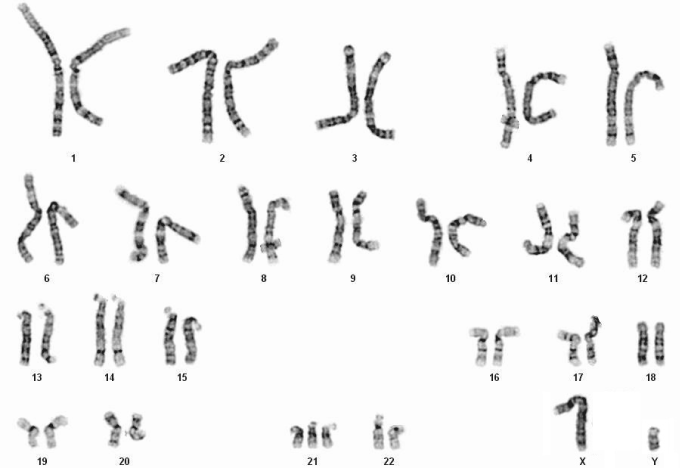 This fetus is at greatest risk for developing which of the following conditions after birth?
 (Multiple Choice)
4.8/5 (75)
(75) An hereditary disease is suspected in a patient. The following trend emerges from pedigree analysis: 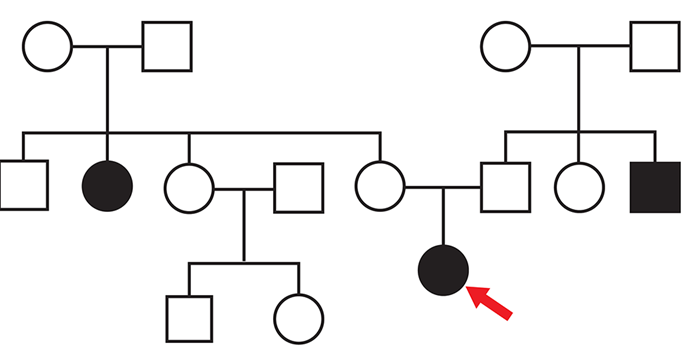 This patient most likely has which of the following conditions?
 (Multiple Choice)
4.8/5 (78)
(78) A 12-year-old girl is brought to the doctor by her parents, who are concerned about her lack of interest in school sports. She stepped off the field in the middle of a recent tournament, complaining about discomfort in her legs. There are no additional medical issues or drugs that the patient is taking. Her vaccinations are up to date. Physical examination reveals pulsatile vessels inside the intercostal gaps as well as decreased femoral pulses in comparison to brachial pulses. Which of the following disorders is most likely related with this patient's symptoms?
(Multiple Choice)
4.9/5 (76)
(76) A 16-year-old girl with a history of anemia since childhood is evaluated for a genetic abnormality after several members of her family are also found to be anemic. It is determined that she has a point mutation in the beta globin gene, which has resulted in the substitution of guanine (G) with cytosine (C) in the mRNA sequence shown below (+1 position indicates start codon).  Which of the following cellular processes is most likely impaired due to this patient's gene mutation?
 (Multiple Choice)
4.9/5 (73)
(73) In an experiment, erythrocyte precursor cells are incubated in a medium containing radiolabeled cysteine. These radiolabeled cysteine residues are attached to their appropriate tRNAs by the enzyme aminoacyl-tRNA synthetase. The bound cysteine residues are then chemically modified to form alanine. The end product of this reaction is a tRNA molecule that contains the cysteine anticodon but is mischarged with alanine. Which of the following is most likely to occur to this alanine residue during polypeptide synthesis of alpha-hemoglobin?
(Multiple Choice)
4.9/5 (84)
(84) A 23-year-old asymptomatic male participates in clinical research and is found to be homozygous for the apolipoprotein E-4 allele. In the future, this patient is most likely to suffer from which of the following?
(Multiple Choice)
4.9/5 (74)
(74) A 33-year old primigravida comes to the office to discuss results of prenatal testing. The patient is at 12 weeks gestation based on her last menstrual period. She has been taking prenatal vitamins inconsistently due to pregnancy-related nausea. Maternal alpha-fetoprotein level is reduced, and an ultrasound reveals increased nuchal translucency. Chorionic villous sampling shows a fetal karyotype of 47, XX, +21. The fetus is at greatest risk of developing which of the following conditions?
(Multiple Choice)
4.7/5 (85)
(85) A young couple has successfully undergone in vitro fertilization. The father has cystic fibrosis, and the mother has a sibling who also has the disease. Both the father and the mother's sister have F508 mutations, but the mother's carrier status is unclear. Before deciding to have a child, the couple received thorough genetic counseling on the dangers of having a kid with cystic fibrosis. The unborn kid is indicated by the red arrow in the family tree below. 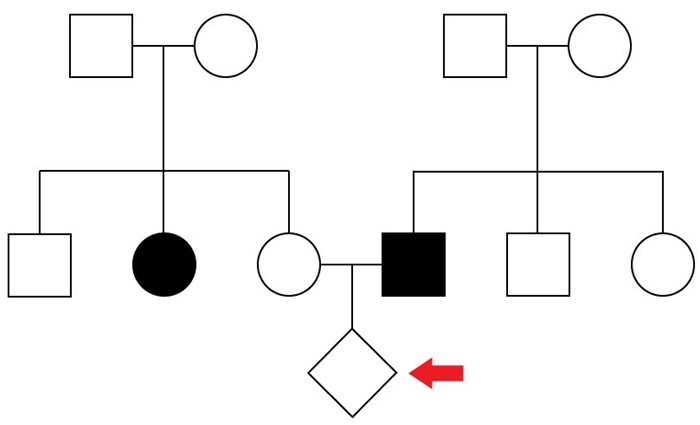 What is the probability that the unborn child will have cystic fibrosis?
 (Multiple Choice)
4.7/5 (83)
(83) 
Filters
- Essay(0)
- Multiple Choice(0)
- Short Answer(0)
- True False(0)
- Matching(0)