



 Chat with AI
Exam 9: Microbiology and Virology

Exam 1: Anatomy265 Questions
Exam 2: Behavioral Sciences178 Questions
Exam 3: Biochemistry102 Questions
Exam 4: Embryology59 Questions
Exam 5: Epidemiology, Biostatistics, and Medical Informatics94 Questions
Exam 6: Genetics88 Questions
Exam 7: Histology46 Questions
Exam 8: Immunology147 Questions
Exam 9: Microbiology and Virology330 Questions
Exam 10: Pathology817 Questions
Exam 11: Pharmacology and Toxicology509 Questions
Exam 12: Physiology339 Questions
Exam 13: Psychiatry and Psychotherapy23 Questions
Select questions type


A 20-year-old woman comes to the office due to dysuria, urgency and frequency. This symptoms started 2 days ago. She denied any fever or chills. She has recurrent episodes of cystitis and one epiosde of acute pyelonephritis over the past eight months. The symptoms tend to occur a few days following sexual intercourse. The patient has no other medical problems and takes no medications. Urinalysis reveals positive nitrites, positive leukocyte esterase, 50 white blood cells/hpf, and many bacteria. There is no costovertebral angle tenderness. Which of the following pathogens is most likely responsible for this patient's symptoms?

Free
(Multiple Choice)
4.9/5  (77)
(77) Correct Answer: Verified
C
A 22-year-old woman comes to the emergency department with a 2-day history of abdominal pain and diarrhea. She has had about 8 voluminous stools per day, some of which were bloody. She went to an international food festival 3 days ago. Her temperature is 39.5°C (103.1°F), pulse is 90/min, and blood pressure is 110/65 mm Hg. Examination shows a tender abdomen, increased bowel sounds, and dry mucous membranes. Stool examinations of these patients yield oxidase-positive, curved, highly motile, gram-negative rods. Which of the following patient populations do they have a high risk to be infected by this illness?
Free
(Multiple Choice)
4.8/5 (72)
(72) Correct Answer:Verified
VerifiedB
A 36-year-old man is brought to the emergency department because of right upper abdominal pain and anorexia that began 3 days ago. The pain is nonradiating and has no alleviating or exacerbating factors. He does not have nausea or vomiting. The patient lives in Ohaio and has no history of international travel. His temperature is 38.8°C (101.8°F), pulse is 85/min, respirations are 14/min, and blood pressure is 120/75 mm Hg. Lungs are clear to auscultation. He has tenderness to palpation in the right upper quadrant. Laboratory studies show elevated aspartate and alanine aminotransferases. Imaging studies reveal a fluid-filled cavity within the right lobe of the liver. Which of the following microorganism/route combinations is most likely to be the cause of this patient's infection?
Free
(Multiple Choice)
4.8/5 (84)
(84) Correct Answer:Verified
VerifiedD
A 23-year-old woman comes to the office for routine health check up. She was treated for mycoplasma pneumoniae before 8 weeks. At that time, labroratoy tests showed mild anemia and an elevated serum lactate dehydrogenase level. She is doing well with resolved all symptoms. The patient has no other medical problems and takes no medications. On lung examination shows no abnormalities. Labroratoy tests show resolved her anemia. Which of the following best explains the resolution of this patient's anemia?
(Multiple Choice)
4.9/5 (79)
(79) A 17-year-old boy comes to the emergency department because of a 3-day history of pain in his left wrist. That morning the pain increased and he started to have chills and malaise. Last week he had self-resolving left knee pain. He is otherwise healthy and has not had any trauma to the wrist. He recently returned from a camping trip to Minnesota. He is sexually active with one female partner, who uses a diaphragm for contraception. His temperature is 38.7°C (101.7°F). Examination shows several painless violaceous vesiculopustular lesions on the dorsum of both wrists and hands; two lesions are present on the left palm. There is swelling and erythema of the left wrist with severe tenderness to palpation and passive movement. Gram-negative bacteria isolated from this patient's blood produce an enzyme that splits the IgA molecule at the hinge region. Which of the following is likely to be the most important role of this bacterial enzyme in the course of the infection?
(Multiple Choice)
4.9/5 (82)
(82) A 65-year-old man with second- and third-degree burns covering more than 25% of his entire body surface area is brought to the intensive care unit. His wounds are cleansed and debrided, and intravenous fluids and painkillers are provided. The patient gets a fever after 7 days, and his leukocyte count climbs to 16,000 cells/L. The burns on his left leg are surrounded by warmth, erythema, and induration. The photograph below shows a Gram stain of his injured tissue. 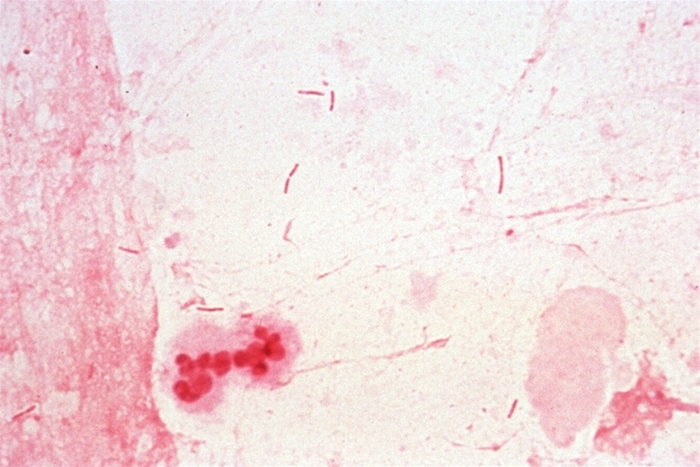 Culture on MacConkey agar grows oxidase-positive colonies that do not ferment lactose. Which of the following is the best initial treatment for this patient?
 (Multiple Choice)
4.8/5 (75)
(75) A 41-year-old woman comes to the emergency department due to 2 days of severe shortness of breath, high fevers, cough, and myalgias. The patient is a businesswoman who works in the poultry industry. She recently returned from a trip to China, where she visited several factories in different parts of the country. Her temperature is 39.1 C (102.4 F). The patient is in respiratory distress, and crackles and diffuse wheezes are present on pulmonary examination. Laboratory results show that she contracted an orthomyxovirus that was responsible for an upper respiratory infection epidemic in China. Transmission of the virus was originally thought to occur only through contact with poultry, but during the outbreak, sustained human-to-human transmission was observed. Which of the following is most likely responsible for the infectivity of this virus in humans?
(Multiple Choice)
4.8/5 (79)
(79) An infant is evaluated at the office after developing prominent oral thrush, interstitial pneumonia, and severe lymphopenia during the first year of life. The patient was born full-term to a 25-year-old woman who received no prenatal care and has substance use disorder with intravenous drug use. She breastfed her son for the first month but then switched to formula feedings. The mother is currently unwilling to undergo any kind of testing. She tells the health care provider, "Just take care of my son." Which of the following prenatal interventions would have most likely prevented this infant's condition?
(Multiple Choice)
4.9/5 (75)
(75) A 35-year-old man develops diffuse abdominal pain and nonbloody, watery diarrhea. He has 4 bowel movements per day but no nausea or vomiting. He was admitted for open reduction and internal fixation of a displaced fracture of the left humerus. The surgery and immediate postoperative course were uncomplicated. He appears ill. His temperature is 38.5°C (101.3°F), pulse is 95/min, respirations are 19/min, and blood pressure is 110/70 mm Hg. The lower abdomen is tender with guarding but without distention. His hemoglobin concentration is 13.5 g/dL and leukocyte count is 21,000/mm3. Stool analysis is pending. A CT scan of the abdomen with contrast shows a thickened edematous colon with trapping of contrast material between haustral folds. Which of the following pathogens is most likely responsible for this patient's current condition?
(Multiple Choice)
4.9/5 (69)
(69) A 46-year-old man arrives at the emergency department after experiencing increased blurry vision, trouble swallowing, and dry mouth throughout the previous hour. He also experiences nausea and stomach discomfort, but no headache or fever. The patient has no past medical history and is not on any drugs. He smokes one pack of cigarettes every day but does not use alcohol or illegal substances. The patient hasn't traveled recently, although he did go to a community gathering yesterday and tried home-canned dishes. A physical examination reveals bilateral ptosis and a slow pupillary response. Which of the following neuromuscular transmission processes is most likely to be impaired in this patient? 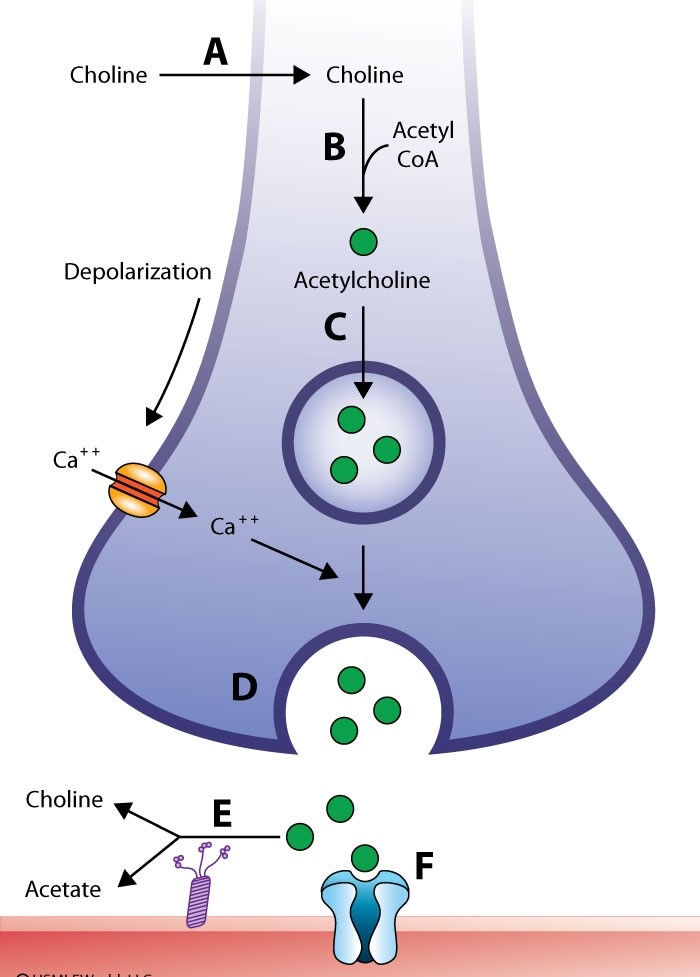
(Multiple Choice)
4.9/5 (86)
(86) A 22-year-old woman is sent to the emergency room after experiencing a day of fever, headaches, nausea, vomiting, and myalgias that began abruptly last night. The patient was drowsy, difficult to awaken, and disoriented this morning. She is an exchange student who arrived in the United States three months ago with no medical history. The temperature is 39.4 degrees Celsius (102.9 degrees Fahrenheit), the blood pressure is 100/60 mm Hg, the pulse is 112/min, and the respirations are 18 /minute. The physical examination reveals nuchal stiffness. The picture depicts the results of a skin examination. 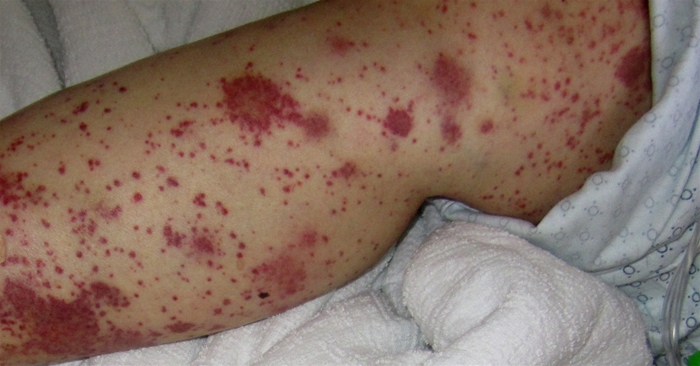 Leukocyte count is elevated, and lumbar puncture with cerebrospinal fluid Gram stain establishes the diagnosis. Which of the following is the primary component of the vaccine that could have prevented this patient's current condition?
 (Multiple Choice)
4.7/5 (80)
(80) A previously healthy 23-year-old man comes to the office due to abrupt-onset high fever, myalgia, and swelling in his left groin after a recent camping trip in northern California. He appears acutely ill. Physical examination shows tender, left-sided inguinal lymphadenopathy and an enlarged, tender lymph node in the right axilla that is draining bloody necrotic material. Microscopic examination of a lymph node aspirate shows gram-negative coccobacilli with bipolar staining and a safety-pin appearance. This patient's condition is most likely caused by an organism with which of the following reservoirs?
(Multiple Choice)
4.8/5 (77)
(77) A 45-year-old man comes to the urgent care clinic because of fever, severe headache, myalgia, and pleuritic chest pain. He has had these symptoms for several days. Physical examination shows fever and mild tachycardia. Lung auscultation reveals mild crackles. Radiographic examination is consistent with segmental pulmonary infiltrates. The patient fails to respond to empiric antibacterial antibiotic therapy. Microscopic examination of lung tissue obtained from this patient shows spherules packed with endospores. This patient's history is most likely to reveal which of the following?
(Multiple Choice)
4.8/5 (84)
(84) A 34-year-old man comes to the office due to a painless penile ulcer, which he first noticed 3 days ago. He had unprotected sexual intercourse with a new partner a few weeks ago. The patient has no significant medical history and takes no medications. Temperature is 37.1 C (98.8 F). Examination reveals a 2-cm nontender ulcer close to the glans penis with a raised, indurated margin and a clean base. There are no surrounding lesions or vesicles. There are several bilateral enlarged inguinal lymph nodes, which are firm, nontender, and rubbery. Physical examination is otherwise unremarkable. Rapid plasma reagin and HIV testing are negative. Infection with which of the following is the most likely cause of this patient's symptoms?
(Multiple Choice)
4.9/5 (86)
(86) A 28-year-old Marine comes to the veterans' administration outpatient clinic because of a 3-week history of pain on urination. The patient says that the pain has gotten gradually worse and that he has noticed a reddish hue in his urine, especially when he is almost done urinating. He returned from a deployment to Egypt 3 months ago, where he spent 6 months on a mission on the Nile. He has no personal history of serious illness. His father died of metastatic prostate cancer at 82 years of age. He has smoked one pack of cigarettes daily and does not drink alcohol. Vital signs are within normal limits. Physical examination shows no abnormalities. Urine dipstick shows 2+ blood, and urine microscopy shows parasitic eggs with a prominent terminal spine. Which of the following animals is the most likely source of this patient's infection?
(Multiple Choice)
4.9/5 (75)
(75) A previously healthy 8-week-old infant is brought to the emergency department because of fever, fatigue, and difficulty breathing for one day. She has been feeding poorly since yesterday. She has also had nasal congestion for 2 day. She was born by uncomplicated vaginal delivery at 40 weeks' gestation. The patient has been treated with acetaminophen for the last 24 hours, and vitamin D drops since birth. She appears irritable, pale, and lethargic. She is at the 25th percentile for both length and weight; she had the same percentiles at birth. Her temperature is 38.2°C (100.7°F) and respirations are 64/min. Pulse oximetry on room air shows an oxygen saturation of 92%. Physical examination shows moderate subcostal retractions. Wheezing is heard on auscultation of the chest. Her hemoglobin concentration is 10.5 g/dL, leukocyte count is 13,000/mm3, and platelet count is 345,000/mm3. Which of the following pathogens is most likely causing this patient's condition?
(Multiple Choice)
4.9/5 (73)
(73) A 26-year-old man is brought to the emergency department because of abdominal pain, nausea, and vomiting for the past 1 hour. The patient has not had diarrhea or fever. Two hours ago, he ate a sandwich ,potato salad and coleslaw during summer cookout in a park,. He has no history of serious illness and takes no medications. He appears ill. His temperature is 37.6°C (99.6°F), pulse is 80/min, and blood pressure is 122/68 mm Hg. Pulse oximetry on room air shows an oxygen saturation of 98%. Cardiac examination shows no abnormalities. The lungs are clear to auscultation. Abdominal examination shows diffuse mild tenderness with no rigidity, rebound, or guarding. His symptoms quickly resolve with supportive care. Which of the following strategies would have been most effective in preventing this patient's illness?
(Multiple Choice)
4.8/5 (81)
(81) A 40-year-old woman is evaluated for neck pain that has gradually worsened over the past several months. The patient reports a pulling sensation in her neck that causes difficulty in keeping her head straight. She has had no trauma and has no other medical conditions. Physical examination shows a spastic and thickened sternocleidomastoid muscle causing head tilt. The patient is diagnosed with idiopathic torticollis. She is treated with injections of a bacterial product into the affected muscle, with significant relief of her symptoms. The substance administered to this patient is derived from bacteria that most likely demonstrate which of the following characteristics?
(Multiple Choice)
4.9/5 (92)
(92) A 29-year-old woman comes to the physician because of high-grade fever, headache, and muscle pain. She recently returned from a 3-month trip to India, where she was working with an NGO to build houses in rural areas. The patient had similar symptoms during her first month abroad that improved after several days of treatment. She has no history of a serious illness. Her temperature is 39.3°C (102.7°F), pulse is 102/min, respirations are 22/min, and blood pressure is 112/78 mm Hg. Physical examination shows mild jaundice and hepatosplenomegaly. Laboratory results reveal anemia and elevated indirect bilirubin levelsHer hemoglobin concentration is 10 g/dL. A peripheral blood smear shows fragmented erythrocytes and occasional ring-shaped inclusion bodies within RBCs. This patient's current symptoms are most likely due to reactivation of a dormant infection from which of the following sources?
(Multiple Choice)
4.8/5 (96)
(96) A 63-year-old woman comes to the office during the winter due to shortness of breath and cough productive of thick, green sputum for the past 2 days. The patient has chronic obstructive pulmonary disease and mild dyspnea on exertion at baseline. The dyspnea has worsened over the past several days, and she is now also short of breath at rest. Other medical conditions include hypertension, gastroesophageal reflux, and seasonal allergies. She has been using her albuterol rescue inhaler more frequently than usual. The patient says she has cut down to 4 or 5 cigarettes per day and is trying to quit. Pulse oximetry shows 91% on room air. She appears to be in mild respiratory distress. Lung examination demonstrates diffuse bilateral wheezes. Chest x-ray reveals hyperinflation. Which of the following triggers is most likely responsible for the worsening of this patient's symptoms?
(Multiple Choice)
4.8/5 (79)
(79) 
Filters
- Essay(0)
- Multiple Choice(0)
- Short Answer(0)
- True False(0)
- Matching(0)