



 Chat with AI
Exam 9: Microbiology and Virology

Exam 1: Anatomy265 Questions
Exam 2: Behavioral Sciences178 Questions
Exam 3: Biochemistry102 Questions
Exam 4: Embryology59 Questions
Exam 5: Epidemiology, Biostatistics, and Medical Informatics94 Questions
Exam 6: Genetics88 Questions
Exam 7: Histology46 Questions
Exam 8: Immunology147 Questions
Exam 9: Microbiology and Virology330 Questions
Exam 10: Pathology817 Questions
Exam 11: Pharmacology and Toxicology509 Questions
Exam 12: Physiology339 Questions
Exam 13: Psychiatry and Psychotherapy23 Questions
Select questions type


A 44-year-old man is brought to the emergency department by his wife because of confusion that began a few hours ago. Earlier in the day, he complained of a severe headache and nausea. On physical examination, his temperature is 38.3 C (101 F) and nuchal rigidity is present. Lumbar puncture and cerebrospinal fluid (CSF) examination show: 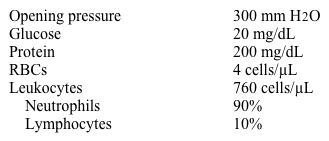 Gram stain of the CSF would most likely reveal which of the following?
 (Multiple Choice)
4.9/5  (89)
(89) Several residents of a long-term care facility develop febrile illness within a short period of time. Symptoms include fever, nonproductive cough, myalgia, rigors, dyspnea, and diarrhea. Organisms found in induced sputum samples stain poorly with Gram stain but are visualized easily using silver stain. Urine testing for bacterial antigens is positive in most of the affected individuals. Which of the following is the most likely source of this outbreak?
(Multiple Choice)
4.8/5 (87)
(87) A 31-year-old man comes to the office due to a week of fever, night sweats, sore throat, malaise, and extreme fatigue. He has no prior medical conditions and takes no medications. The patient has had multiple sexual partners over his lifetime and uses condoms inconsistently. Temperature is 38 C (100.4 F), blood pressure is 110/80 mm Hg, pulse is 92/min, and respirations are 20/min. Physical examination shows multiple shallow ulcers on the oropharyngeal mucosa, and the tonsils are enlarged and hyperemic. Cervical and axillary lymphadenopathy is present, and there is a generalized, erythematous, maculopapular skin rash. HIV testing shows the following results: 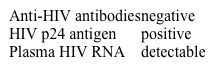 Which of the following best explains this patient's laboratory findings?
 (Multiple Choice)
4.9/5 (77)
(77) A 32-year-old man comes to the physician because of fever and painful swelling in his right axilla for 5 days. He feels tired and reports a loss of appetite. He works in a garden center during weekdays and at a pet shop that sells various pet mammals and fish during the weekends. His temperature is 38°C (100.4°F), pulse is 95/min, and blood pressure is 131/85 mm Hg. Physical examination shows tender, erythematous, and fluctuant right axillary lymph node swelling with oozing purulent discharge. Several scratch marks are seen on the right arm. The organism responsible for the lymphadenopathy is also associated with which of the following conditions?
(Multiple Choice)
4.9/5 (88)
(88) Researchers are studying mechanisms of human infection by animal viruses. The investigators induce random mutations in the genome of an avian influenza virus that is unable to infect humans but is structurally similar to human influenza A virus. A mutated isolate is found to be able to infect human upper respiratory tract epithelial cells. Alteration in which of the following viral components most likely enabled this novel strain to cause cross-species infection?
(Multiple Choice)
4.8/5 (65)
(65) A 60-year-old woman visits her doctor after experiencing generalized itching for 10 days. Her hands developed a rash, which swiftly extended to her wrists, arms, and axillae. She has trouble sleeping and suffers from severe itching in certain locations. She works in a day care center, particularly caring for children aged 2 to 5. The patient has no additional medical issues and is not on any long-term drugs. Vital indicators are typical. Her body mass index (BMI) is 24 kg/m2. As seen in the figure below, skin examination reveals tiny erythematous papules on the palms with excoriations, scattered vesicles, and pustules on the finger webs, palms, and wrist creases. She has identical lesions in both axillary skin folds. The rest of the exam is within normal parameters. 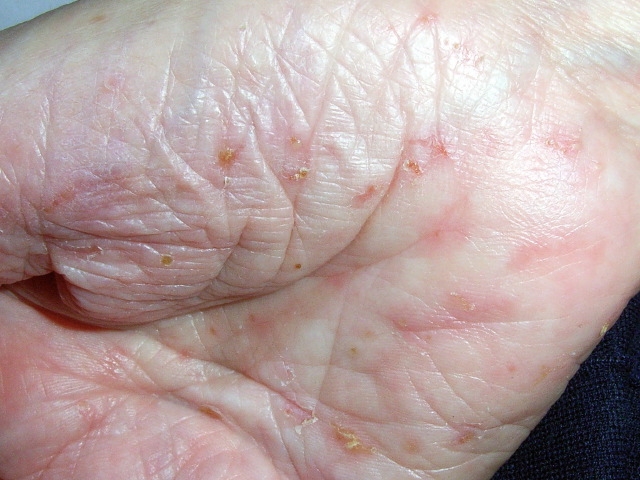 Which of the following is the most likely finding on skin sampling of this patient's lesions?
 (Multiple Choice)
4.7/5 (72)
(72) A 55-year-old man comes to the physician because of weight loss and increased urinary frequency for the past month. He has also noticed blood in the urine, usually towards the end of voiding. He returned from a deployment to Egypt , where he spent 2 years on a mission on the Nile. He has smoked one pack of cigarettes daily for 35 years. Physical examination shows a palpable liver edge and splenomegaly. His hemoglobin concentration is 9.5 mg/dL. A urine dipstick is strongly positive for blood. A CT scan of the pelvis shows bladder wall thickening and fibrosis. Microscopic examination of a biopsy specimen of the bladder obtained during cystoscopy shows squamous cell carcinoma. Which of the following is the most likely underlying cause of this patient's symptoms?
(Multiple Choice)
4.8/5 (88)
(88) A 13-year-old boy is brought to the physician because of a nonpruritic, painless rash on his face for 5 days. His development is adequate for his age and immunizations are up-to-date. He appears healthy and well-nourished. His temperature is 37.0°C (98.6°F) and pulse is 90/min. Examination shows a nontender rash just inferior to the lower lip. A wound culture is taken, and Gram stain shows gram-positive cocci in chains. Which of the following symptoms would be most likely to develop as a potential complication of this patient's infection?
(Multiple Choice)
4.8/5 (65)
(65) A 61-year-old man arrives at the office with a severe rash on his face that has been there for three days. There are no additional medical issues or drugs that the patient is taking. He's a retired teacher who lives with his wife. The display depicts the results of a skin examination.  The remainder of the physical examination shows no abnormalities. Which of the following events most likely immediately preceded the appearance of skin rash in this patient?
 (Multiple Choice)
5.0/5 (80)
(80) A 7-year-old boy is brought to the physician because of a 3-day history of fever, headache, earache, and sore throat that is worse when swallowing. He has not had a runny nose or cough. His immunizations are up-to-date. He is at the 75th percentile for height and the 50th percentile for weight. His temperature is 38.9°C (102°F), pulse is 136/min, and respirations are 28/min. Examination of the oral cavity reveals a bright red tongue with prominent papillae, a red uvula, and an enlarged right tonsil covered by a whitish membrane. The deep cervical lymph nodes are enlarged and tender. Which of the following complications is most likely to develop in this patient?
(Multiple Choice)
5.0/5 (86)
(86) An 8-year-old boy is brought to the physician because of a 7-day history of a progressively worsening cough. The cough occurs in spells and consists of around 5-10 coughs in succession. After each spell, he takes a deep, noisy breath. He has vomited occasionally following a bout of coughing. He had a runny nose for 1 week before the cough started. His immunization records are unavailable. He lives in an apartment with his father, mother, and 2-week-old sister. The mother was given a Tdap vaccination 11 years ago. The father's vaccination records are unavailable. His temperature is 37.8°C (100.0°F). Examination shows no abnormalities. His leukocyte count is 42,000/mm3. Testing of respiratory secretions shows gram-negative coccobacilli. Which of the following is most likely involved in the pathogenesis of this patient's symptoms?
(Multiple Choice)
4.8/5 (83)
(83) A 24-year-old man comes to the physician with painful blisters on the shaft of his penis. The lesions erupted 2 days ago. The patient has had 5 lifetime sexual partners and is currently sexually active with one female partner; he uses condoms inconsistently. Examination shows multiple vesicular lesions on the penis, and Tzanck smear is positive for multinucleated giant cells. HIV testing is negative. The patient has had several similar episodes every year for the past 2 years but had been too embarrassed to seek treatment until now. Which of the following would most likely have prevented recurrence of this patient's condition?
(Multiple Choice)
4.9/5 (72)
(72) A 38-year-old lady visits the office to have a skin lesion evaluated. It began as a pink papule on her right arm and has grown in size over the course of many weeks. The lesion is not itchy or unpleasant, and it has not been linked to fever or other systemic symptoms. The patient recently returned from a trip to Costa Rica. During her trip, she slept at a beach resort and went on a jungle trek. The results of the skin examination are displayed below. A biopsy of the lesion reveals round-oval protozoa with rod-shaped kinetoplasts that are intracellular. Which of the following is most likely to have contributed to this patient's present condition? 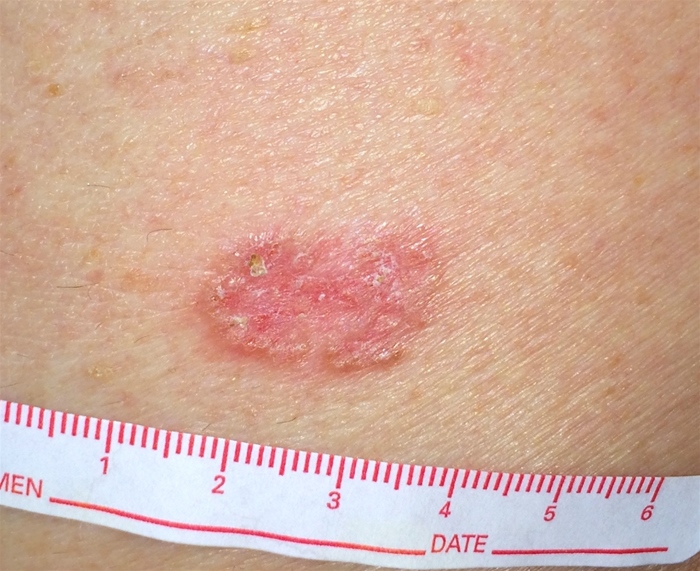
(Multiple Choice)
4.9/5 (80)
(80) A 34-year-old woman comes to the office for evaluation of recurrent transient pulmonary infiltrates. The patient has a history of bronchial asthma and has had several exacerbations over the past few years, particularly during the winter months. She is currently asymptomatic. She has no other medical problems and has never traveled outside the United States. Her medications include albuterol as needed and medium-dose inhaled glucocorticoids. Temperature is 37.1 C (98.8 F). Physical examination is unremarkable. Complete blood count shows eosinophilia. A chest CT scan reveals proximal bronchiectasis. This patient's condition is most likely related to colonization with which of the following?
(Multiple Choice)
4.8/5 (70)
(70) Due to alcohol intoxication, a 62-year-old man is brought to the emergency room from a homeless shelter. There are no additional symptoms or a history of serious medical issues in the patient. The discoveries in the exhibit are revealed via examination of the scalp. 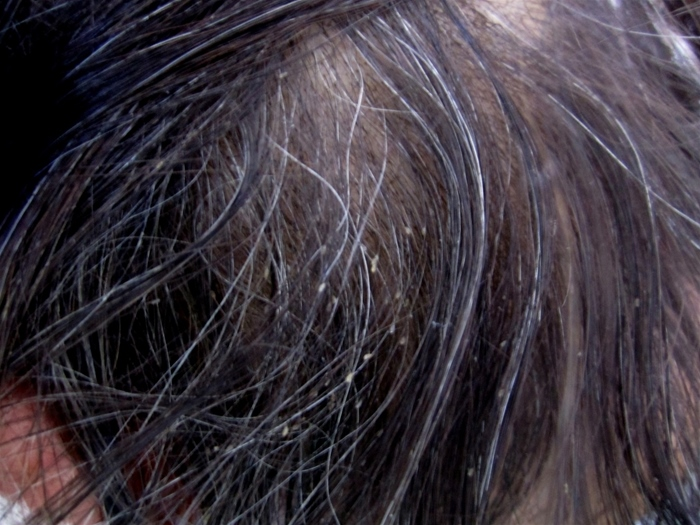 Which of the following organisms is most likely responsible for this patient's condition?
 (Multiple Choice)
4.8/5 (76)
(76) A 30-year-old man comes to the physician because of a 4-month history of increasing shortness of breath on exertion, dry cough, and fatigue. His wife was diagnosed with an active tuberculosis and started on a 4-drug combination therapy and she has an episode of red staining of her contact lenses and red urine. Pulmonary examination shows diffuse crackles bilaterally. An x-ray of the chest shows well-defined calcification of the rims of hilar lymph nodes and scattered nodules in both upper lung fields. Mycobacterium tuberculosis is isloated from his sputum and shows resistance to several antimycobacterial agents. Which of the following best explains the bacterial resistance to the drug responsible for this patient's wife red staining presentation?
(Multiple Choice)
4.9/5 (75)
(75) A previously healthy 2-year-old boy is brought to the emergency department because of a 2-day history of fever and pain in the left lower extremity. His mother says that he has refused to walk for the past two days and has had a poor appetite. He returned from a weekend camping trip about a month ago. Further medical history reveals that his parents refused to have the vaccination. He is at the 80th percentile for height and 70th percentile for weight. He appears ill. His temperature is 39.3°C (102.7°F), pulse is 115/min, respirations are 19/min, and blood pressure is 95/50 mm Hg. Synovial fluid aspiration shows shows cloudy synovial fluid. Gram stain of the aspirate reveals pleomorphic, gram-negative coccobacilli. Cultures performed on a blood agar plate supplemented with a disk containing hematin and nicotinamide adenine dinucleotide (NAD+) grow colonies only near the disk. The organism responsible for this patient's condition most likely produces which of the following virulence factors?
(Multiple Choice)
4.8/5 (79)
(79) A 32-year-old Caucasian male presents with low grade fever, cough and generalized malaise. The patient has otherwise been healthy and has no significant medical history. His past surgical history includes tonsillectomy and tympanostomy tube placement at the age of 8. Careful questioning reveals that the patient recently came back from an "outdoor adventure" trip in the Great Lakes, and began feeling sick only after returning. Microscopic examination of a KOH preparation of an exudate specimen reveals a large yeast cell with a single bud. When incubated in a specific medium at 75.2ºF (24ºC), a multicellular structure with branching, tubular cells grows. The patient is most likely infected with which of the following:
(Multiple Choice)
4.9/5 (83)
(83) A 52-year-old woman is brought to the emergency department 20 minutes after having a generalized tonic-clonic seizure. Medical history is remarkable for HIV infection. Her medications include dolutegravir, lamivudine, and tenofovir, which she uses inconsistently. She appears lethargic and confused. Neurological examination shows no abnormalities. There is generalized lymphadenopathy. Laboratory studies show a CD4+ count of 89 cells/L (N > 500). A CT scan of the head with contrast shows multiple ring-enhancing lesions in the basal ganglia and subcortical white matter. An India ink preparation of cerebrospinal fluid is negative. Which of the following is the most likely route of transmission of the infectious agent causing this patient's current condition?
(Multiple Choice)
5.0/5 (85)
(85) An epidemic of respiratory illnesses among military recruits is being investigated by health officials. A prolonged cough, a low-grade fever, and malaise were reported by fifteen recruits. Aside from the low-grade temperature, the physical examination was ordinary. Chest x-rays all revealed pulmonary infiltrates that were more severe than would have been predicted based on the patients' clinical state. Sputum samples were collected, and the culprit bacterium grew on a complicated acellular medium loaded with cholesterol. Which of the following organisms is most likely to be the source of the outbreak?
(Multiple Choice)
4.8/5 (73)
(73) 
Filters
- Essay(0)
- Multiple Choice(0)
- Short Answer(0)
- True False(0)
- Matching(0)