



 Chat with AI
Exam 9: Microbiology and Virology

Exam 1: Anatomy265 Questions
Exam 2: Behavioral Sciences178 Questions
Exam 3: Biochemistry102 Questions
Exam 4: Embryology59 Questions
Exam 5: Epidemiology, Biostatistics, and Medical Informatics94 Questions
Exam 6: Genetics88 Questions
Exam 7: Histology46 Questions
Exam 8: Immunology147 Questions
Exam 9: Microbiology and Virology330 Questions
Exam 10: Pathology817 Questions
Exam 11: Pharmacology and Toxicology509 Questions
Exam 12: Physiology339 Questions
Exam 13: Psychiatry and Psychotherapy23 Questions
Select questions type


An 8-year-old boy is brought to the physician because of a 7-day history of a progressively worsening cough. The cough occurs in spells and consists of around 5-10 coughs in succession. After each spell, he takes a deep, noisy breath. He has vomited occasionally following a bout of coughing. He had a runny nose for 1 week before the cough started. His immunization records are unavailable. He lives in an apartment with his father, mother, and 2-week-old sister. The mother was given a Tdap vaccination 11 years ago. The father's vaccination records are unavailable. His temperature is 37.8°C (100.0°F). Examination shows no abnormalities. His leukocyte count is 42,000/mm3. Which of the following is the most likely cause of this patient's symptoms?
(Multiple Choice)
4.8/5  (89)
(89) A 59-year-old woman is brought to the emergency department with fever, skin flushing, and an altered level of consciousness. Her blood pressure is 50/20 mmHg, and her heart rate is 120/min despite receiving IV fluids. If blood cultures are positive for E. coli, which of the following bacterial factors is most directly responsible for this patient's current condition?
(Multiple Choice)
4.8/5 (70)
(70) A 10-year-old girl is brought to the emergency department due to 2 days of fever, productive cough, and shortness of breath. Medical history is significant for recurrent lung infections and cystic fibrosis. Weight is at the 5th percentile. Temperature is 38.1 C (100.6 F), pulse is 104/min, and respirations are 30/min. Pulse oximetry is 86% on room air. Examination shows a thin girl with digital clubbing and a hyperexpanded chest. Diffuse wheezes and crackles are present bilaterally. The rest of the examination is unremarkable. Chest x-ray reveals hyperinflation, chronic interstitial changes, and an infiltrate in the right lower lobe. In addition to blood, chocolate, and MacConkey agar, this patient's sputum should also be cultured on which of the following media?
(Multiple Choice)
4.9/5 (79)
(79) A 56-year-old man is brought to the emergency department because of worsening confusion and weakness in his right arm and leg for 2 days. He has also had fever and headache that began 5 days ago. He has hypertension and type 2 diabetes mellitus. Current medications include metformin and lisinopril. His temperature is 39.3°C (102.7°F), pulse is 103/min, and blood pressure is 128/78 mm Hg. He is confused and agitated. He is not oriented to person, place, or time. Neurologic examination shows nuchal rigidity. Muscle strength is 3/5 on the right upper and lower extremity but normal on the left side. His speech is incoherent. Cerebrospinal fluid analysis reveals an elevated opening pressure with a hemorrhagic lymphocytic pleocytosis, increased protein, and normal glucose. MRI of the brain shows swelling of the temporal lobes. A drug that inhibits which of the following would be most effective in treating this patient's condition?
(Multiple Choice)
4.7/5 (75)
(75) A 25-year-old woman comes to the emergency department due to 2 days of abdominal pain and bloody diarrhea. A few days ago, she attended a church barbeque party. The patient lives alone and has no medical problems. She does not know if anyone else at the party developed similar symptoms. Her temperature is 37.1 C (98.8 F), blood pressure is 119/76 mm Hg, pulse is 92/min, and respirations are 16/min. There is abdominal tenderness with no rebound or guarding. Guaiac-positive bloody stools are detected on rectal examination. Stool cultures reveal an Escherichia coli strain that does not produce glucuronidase and does not ferment sorbitol on sorbitol-containing MacConkey agar. Which of the following best describes the mechanism of action of the toxin produced by these bacteria?
(Multiple Choice)
4.8/5 (83)
(83) A 19-year-old woman comes to the physician because of pelvic pain and vaginal discharge for the past 3 weeks. She has no history of serious medical illness and takes no medications. Her temperature is 39°C (102.2°F). Pelvic examination shows pain with movement of the cervix and mucopurulent cervical discharge. Culture of the discharge shows thin, elongated, gram-positive bacilli in an acute-angle branching pattern. Which of the following is the most appropriate pharmacotherapy for this patient?
(Multiple Choice)
4.8/5 (89)
(89) A 42-year-old man is sent to the emergency hospital after his family witnesses a widespread tonic-clonic seizure. He has no history of seizures, although he has had migraines for several weeks. The patient is employed in the construction industry. He has no prior international travel experience and has never owned a pet. Every day, he smokes a pack of cigarettes and consumes 3-4 cans of beer. A postictal condition, mouth thrush, and many enlarged cervical and inguinal lymph nodes are noteworthy on physical examination. The picture below is an MRI of his brain with contrast. 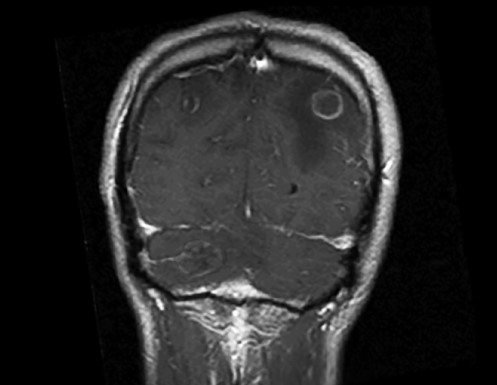 Which of the following is the most likely cause of this patient's symptoms?
 (Multiple Choice)
5.0/5 (77)
(77) A 27-year-old gravida 2, para 1 comes to the physician for her first antenatal visit. She has had an itchy rash all over her body for the past 3 days. It started on her face and gradually progressed downwards. She reports painless swelling of her knee joints and denies trauma. She had flu-like symptoms 3-4 days prior to the appearance of the rash. She delivered her first child vaginally without complications. She takes an iron supplement; her immunization records are unavailable. Examination shows a pink maculopapular rash over her body sparing her palms and soles. Postauricular lymphadenopathy is present. Knee joints are mildly swollen and range of motion is normal. Examination shows a uterus consistent with a 24-week gestation. The fetus is at highest risk for developing which of the following complications?
(Multiple Choice)
4.9/5 (84)
(84) A 32-year-old woman comes to the emergency department for a 2-week history of right upper quadrant abdominal pain. She has also been feeling tired and nauseous for the past 5 weeks. She has a history of depression and suicidal ideation. She is a social worker for an international charity foundation. She used intravenous illicit drugs in the past but quit 4 months ago. Her only medication is sertraline. Her temperature is 37.8°C (100.0°F), pulse is 100/min, and blood pressure is 128/76 mm Hg. She is alert and oriented. Scleral icterus is present. Abdominal examination shows tenderness to palpation in the right upper quadrant. The liver edge is palpated 3 cm below the right costal margin. There is no rebound tenderness or guarding. The abdomen is nondistended and the fluid wave test is negative. She is able to extend her arms with wrists in full extension and hold them steady without flapping. Laboratory studies show: 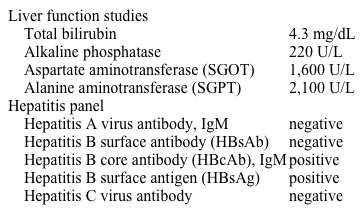 Which of the following is an essential step in the replication cycle of the virus infecting this patient?
 (Multiple Choice)
4.9/5 (77)
(77) A 23-year-old man comes to the hospital due to a one week history of fatigue, muscle ache, chills and fever that occurs every 2 days. He recently returned from a trip to Myanmar. Temperature is 38.6 C (101.5 F). Physical examination is otherwise unrevealing. . Laboratory studies show a hemoglobin of 9.7 g/dL. A blood smear with Giemsa staining demonstrates red blood cell inclusions. The patient is prescribed chloroquine and primaquine. The addition of primaquine to the treatment regimen is most likely to have which of the following effects?
(Multiple Choice)
4.9/5 (76)
(76) A 62-year-old man is brought to the emergency department with fatigue, dry cough, and shortness of breath for 3 days. He reports a mild fever and has also had 3 episodes of watery diarrhea earlier that morning. Last week, he attended a business meeting at a hotel and notes some of his coworkers have also become sick. He has a history of hypertension and hyperlipidemia. He takes atorvastatin, hydrochlorothiazide, and lisinopril. He appears in mild distress. His temperature is 38.9°C (102.1°F), pulse is 56/min, respirations are 16/min, and blood pressure is 150/85 mm Hg. Diffuse crackles are heard in the thorax. Examination shows a soft and nontender abdomen. Chest x-ray shows bilateral lower lobe interstitial infiltrates. Which of the following additional findings is most likely to be present in this patient?
(Multiple Choice)
4.9/5 (80)
(80) A 27-year-old man is sent to the hospital after suffering from a generalized tonic-clonic seizure one hour before. The patient does not have any chronic medical issues and does not use any medications. He moved to the United States from Nicaragua five years ago. The vital indicators are within normal ranges. A thorough neurologic evaluation indicates no anomalies. The picture below depicts a CT scan of the head. 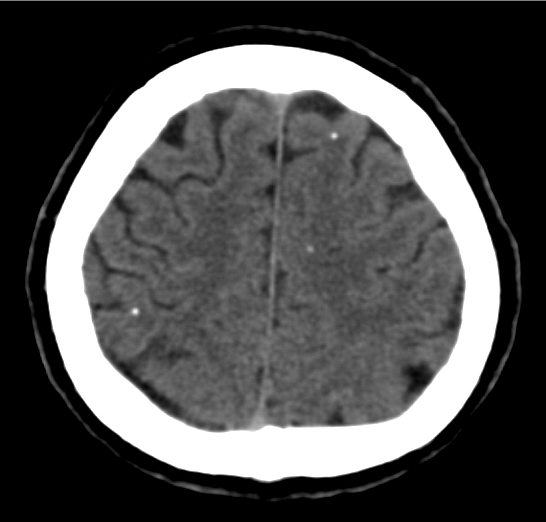 Complete blood count and cerebrospinal fluid evaluation are within normal limits. Which of the following is the most likely diagnosis?
 (Multiple Choice)
4.8/5 (89)
(89) A microbiologist is studying the structure and function of bacterial cell walls. In an experiment, group A streptococci are treated with chemicals to solubilize the cell wall. Various cell wall-associated proteins are subsequently extracted. Electron microscopic evaluation of a specific protein shows structural homology with mammalian tropomyosin and myosin. This protein acts as a virulence factor for certain species of the organism. Which of the following is the most likely function of this bacterial cell wall-associated protein?
(Multiple Choice)
4.8/5 (80)
(80) A 56-year-old man comes to the office due to several months of progressive neck swelling. He has also had intermittent epistaxis and headaches. The patient has no chronic medical conditions and takes no medications. He does not use tobacco, alcohol, or illicit drugs, and he emigrated to the United States from rural China 12 years ago. Physical examination shows several enlarged, firm, and nontender cervical lymph nodes. Nasopharyngeal evaluation reveals a mass arising from the pharyngeal recess. Histopathological examination of the mass shows undifferentiated malignant cells of epithelial origin. Further analysis of these cells is most likely to reveal the presence of nucleic acid sequences from which of the following viruses?
(Multiple Choice)
5.0/5 (68)
(68) A 64-year-old man comes to the office due to 2 days of dysuria, urinary frequency, and urgency. He recently underwent a cystoscopy for evaluation of hematuria. The patient has a history of hypertension, type 2 diabetes mellitus, and 30 pack-years of cigarette smoking. His temperature is 38.2 C (100.8 F). On examination, there is suprapubic tenderness on deep palpation but no costovertebral angle tenderness. Urinalysis findings are as follows: 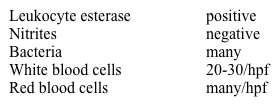 Midstream urine culture grows gram-positive cocci in chains with growth >100,000 colony-forming units/mL. The organism responsible for this patient's condition is most likely to demonstrate which of the following?
 (Multiple Choice)
4.8/5 (74)
(74) A 43-year-old HIV-positive lady arrives at the office with lesions on her vulvar and perineal regions that had been present for 4 weeks. On inspection, there are clusters of solid, glossy, spherical papules with center depression that are 2-6 mm in diameter. The picture below depicts a microscopic study of a lesion: 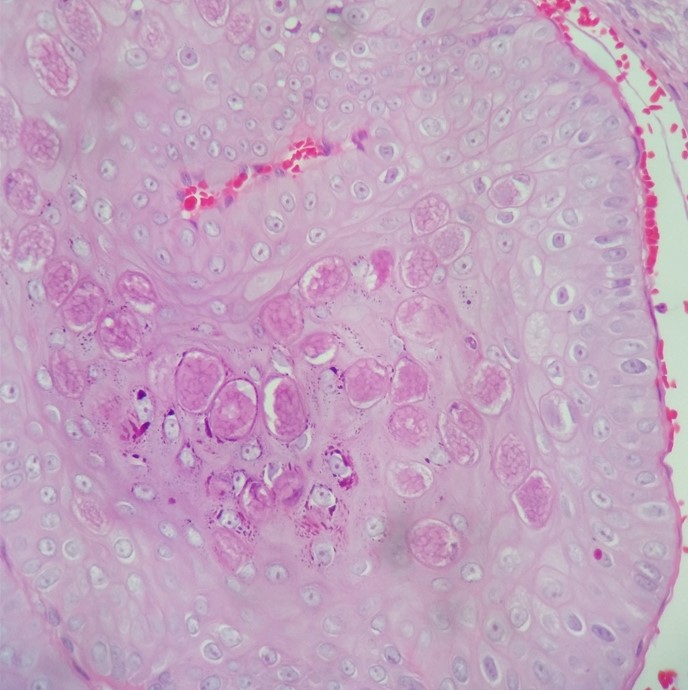 Which of the following is the most likely cause of this patient's presenting condition?
 (Multiple Choice)
4.9/5 (89)
(89) A 32-year-old man is being assessed after suffering from watery diarrhea for many weeks. He also experienced intermittent, crampy stomach pain and dropped 7 kg (15.4 lb) throughout this time. The patient has a history of HIV and was admitted to the hospital six months ago for Pneumocystis pneumonia. The patient is afebrile on physical examination, and the abdomen is soft and nontender, with no organomegaly. Stool leukocyte and occult blood tests are negative. Endoscopy is done, and a mucosal biopsy reveals an inflammatory infiltrate in the lamina propria as well as pathogens lining the epithelium, as seen in the exhibit. .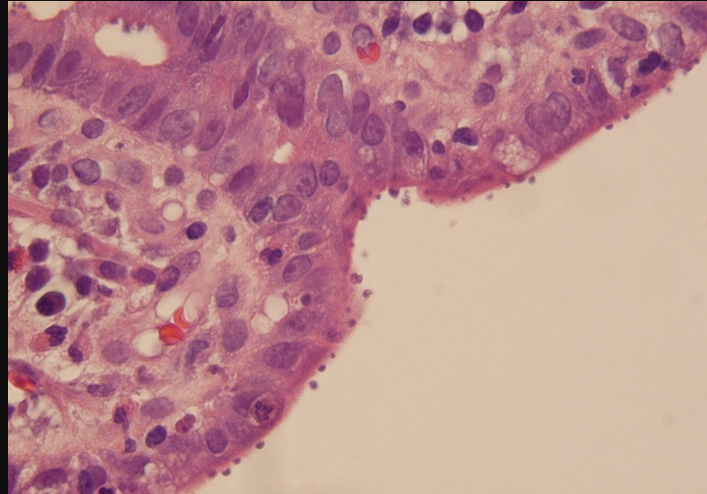 The organisms have a cystic appearance on modified acid-fast staining. Which of the following is the most likely cause of this patient's condition?
 (Multiple Choice)
4.9/5 (74)
(74) A 25-year-old man is brought to the emergency department because of a 6-day history of fever and chills. During this period, he has had generalized weakness, chest pain, and night sweats. He has a bicuspid aortic valve and recurrent migraine attacks. He has smoked one pack of cigarettes daily for 5 years. He does not drink alcohol. He has not used any illicit drugs . Current medications include propranolol and a multivitamin. He appears ill. His temperature is 39°C (102.2°F), pulse is 108/min, respirations are 14/min, and blood pressure is 150/50 mm Hg. On pulmonary examination, diffuse crackles are heard. A grade 3/6 high-pitched, early diastolic, decrescendo murmur is best heard along the left sternal border. An S3 gallop is heard. Three sets of blood cultures are sent to the laboratory and grow gram-positive cocci that synthesize dextrans from sucrose. The organism contributing to this patient's current condition is also associated with which of the following?
(Multiple Choice)
4.8/5 (68)
(68) A 36-year-old woman comes to the physician because of a 4-day history of fever, malaise, chills, and a cough productive of moderate amounts of yellow-colored sputum. Over the past 2 days, she has also had right-sided chest pain that is exacerbated by deep inspiration. Six months ago, she was diagnosed with a urinary tract infection and was treated with oral trimethoprim/sulfamethoxazole. She appears pale. Her temperature is 38.8°C (101.8°F), pulse is 92/min, respirations are 20/min, and blood pressure is 128/74 mm Hg. Pulse oximetry on room air shows an oxygen saturation of 99%. Examination shows pale conjunctivae. Crackles are heard at the right lung base. Chest x-ray reveals consolidation in the right upper lobe. Gram stain of the sputum shows numerous polymorphonuclear leukocytes and gram-positive cocci in pairs. When cultured on a blood agar plate under aerobic conditions, the bacterial colonies are surrounded by a zone of incomplete hemolysis. The organism responsible for this patient's condition is most likely to exhibit which of the following virulence features?
(Multiple Choice)
4.9/5 (85)
(85) A 23-year-old woman is brought to the emergency department due to 2 days of fever, productive cough, and shortness of breath. Medical history is significant for recurrent lung infections and cystic fibrosis. Temperature is 38.1 C (100.6 F), pulse is 104/min, and respirations are 22/min. Pulse oximetry is 86% on room air. Examination shows a thin woman with digital clubbing and a hyperexpanded chest. Diffuse wheezes and crackles are present bilaterally. The rest of the examination is unremarkable. Chest x-ray reveals hyperinflation, chronic interstitial changes, and dilated, thickened airways. Sputum culture from this patient is most likely to yield which of the following organisms?
(Multiple Choice)
4.7/5 (80)
(80) 
Filters
- Essay(0)
- Multiple Choice(0)
- Short Answer(0)
- True False(0)
- Matching(0)