



 Chat with AI
Exam 9: Microbiology and Virology

Exam 1: Anatomy265 Questions
Exam 2: Behavioral Sciences178 Questions
Exam 3: Biochemistry102 Questions
Exam 4: Embryology59 Questions
Exam 5: Epidemiology, Biostatistics, and Medical Informatics94 Questions
Exam 6: Genetics88 Questions
Exam 7: Histology46 Questions
Exam 8: Immunology147 Questions
Exam 9: Microbiology and Virology330 Questions
Exam 10: Pathology817 Questions
Exam 11: Pharmacology and Toxicology509 Questions
Exam 12: Physiology339 Questions
Exam 13: Psychiatry and Psychotherapy23 Questions
Select questions type


A 75-year-old man comes to the emergency department with fever, chills, dyspnea, and a productive cough. His symptoms began suddenly 2 days ago. He has been hospitalized on several occasions for exacerbations of chronic bronchitis. The patient has been advised to stop smoking but continues to smoke cigarettes. He drinks 6-10 beers daily. His temperature is 38.8°C (101.8°F), pulse is 110/min, respirations are 24/min, and blood pressure is 105/74 mm Hg. Pulse oximetry on room air shows an oxygen saturation of 92%. Examination reveals crackles over the right upper lung. Sputum microscopy reveals encapsulated gram-negative bacilli. The bacteria grow pink, mucoid colonies on MacConkey agar. Which of the following organisms is the most likely cause of this patient's condition?
(Multiple Choice)
4.9/5  (77)
(77) Researchers develop a novel drug to treat HIV infection. In an in vitro experiment, wild-type viral isolates are cultured with human CD4 T lymphocytes in the presence of the drug. Microscopic evaluation of these cells reveals no cytopathic changes, and no intracellular viral particles can be detected. Further analysis reveals that in the presence of the drug the virus attaches to the cellular membrane, but fusion of the viral and cell membranes does not occur. Which of the following is the most likely target of this medication?
(Multiple Choice)
4.8/5 (69)
(69) A 46-year-old woman comes to the office to be tested for HIV after one of her prior sexual partners found that he was HIV-positive. She feels healthy and has no symptoms. The patient has never had a sexually transmitted infection and has no chronic medical conditions. She has had several sexual partners in her lifetime and uses condoms inconsistently. Physical examination shows no abnormalities. HIV antigen/antibody immunoassay and a confirmatory HIV-1 antibody test are positive. Further studies reveal plasma HIV viral load is >250,000 copies/mL and CD4 lymphocyte count is 150 cells/mm3. After discussing the results and need for treatment, the patient agrees to start antiretroviral therapy. An additional medication to prevent opportunistic infections is also planned. This added treatment is most likely being used to prevent infection from which of the following pathogens?
(Multiple Choice)
4.9/5 (73)
(73) A 67-year-old man comes to the physician because of a 3-month history of increasing shortness of breath on exertion, dry cough, and fatigue. He has a history of silicosis that was diagnosed 10 years ago. He has a recent fevers and night sweats. He worked in a glass manufacturing factory for 15 years and retired 2 years ago. Pulmonary examination shows diffuse crackles with right upper lobe predominance. An x-ray of the chest shows diffuse, small nodules; hilar adenopathy with prominent calcifications; and a cavitary lung lesion in the right upper lobe.. A sputum sample is sent for appropriate staining and culture. This patient's increased susceptibility to the current infection is best explained by which of the following factors?
(Multiple Choice)
4.8/5 (85)
(85) A 16-year-old boy is hospitalized with recent-onset insomnia, headaches, periodic agitation, and dysphagia. He is a high school student interested in becoming a veterinarian. He owns a snake, fish, and parrot and, about 4 weeks ago, went on a field trip to study bats in a cave. The patient has no known medical problems and is not taking any medications. He does not consume alcohol and has never used illicit drugs. Physical examination shows a confused and combative patient with mydriasis and neck rigidity. Which of the following acts as an entry receptor for the causative agent of this patient's condition?
(Multiple Choice)
4.9/5 (76)
(76) A 34-year-old man, who is a military veteran, comes to the office because of a 2-day history of fever, headache, myalgias, and a lesion on his face. He first noticed a blister on his right cheek, which gradually progressed into a dark sore. He denies recent insect bites, rodent exposure, or animal bites or scratches, but he scratched his face on the ground during a combat exercise. One week ago, he returned from a 1-year deployment in Afghanistan where he worked as an infantry soldier. The patient's medical history is unremarkable. He appears ill and fatigued. His temperature is 38.3°C (101°F). Physical examination shows a 2-cm painless cutaneous ulcer over the right cheek that is surrounded by an edematous halo; the center of the lesion is necrotic. He has multiple abrasions on his face and elbows. There is cervical lymphadenopathy. Which of the following is the most likely bacterial virulence factor contributing to this patient's condition?
(Multiple Choice)
4.9/5 (73)
(73) A developing country's public health agency conducts an epidemiology research to determine the countrywide prevalence of upper respiratory infections among youngsters. The statistics suggest a significant prevalence of bacterial pharyngitis in children. According to current practice guidelines, a fast test should be conducted in children to detect the presence of bacterial antigens. If this test is negative, a throat culture is conducted, which is the gold standard for definite diagnosis. To save costs and avoid losing patients to follow-up, the department is contemplating suggesting penicillin as an empiric therapy for suspected bacterial pharyngitis. Which of the following would be expected to decrease after long-term implementation of this guideline?
(Multiple Choice)
4.9/5 (84)
(84) A 32-year-old woman with gravida 1 para 1 arrives at the clinic for vaginal discharge. The patient has no chronic medical issues and does not use any drugs on a regular basis. Her last menstruation was three weeks ago. The patient has recently started having sexual relations with a new partner and is using an intrauterine device for contraception. The figure below depicts the cytology of the discharge: 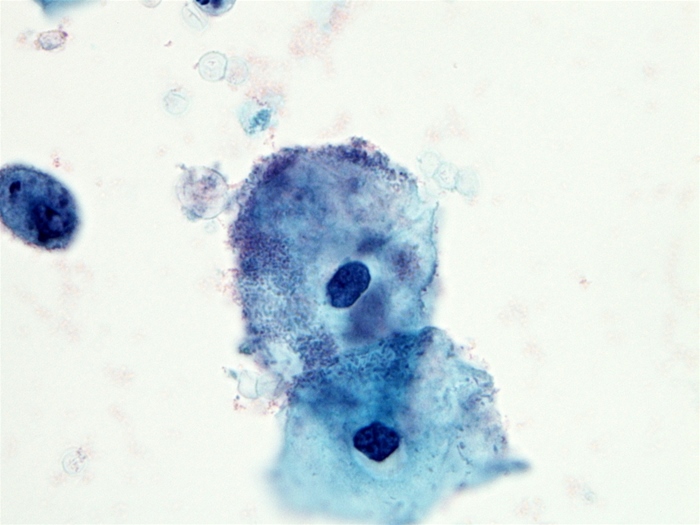 Which of the following best describes the predominant organism causing this patient's condition?
 (Multiple Choice)
4.9/5 (75)
(75) A 34-year-old man arrives at the office seeking medical attention. The patient just moved to the United States from Eastern Asia. He has no chronic medical issues, but has been experiencing occasional abdomen pain and episodic diarrhea for several months. He has also had dry coughing and throat discomfort on occasion. A physical examination reveals no anomalies. Strongyloides stercoralis IgG antibody testing is positive. Detection of which of the following is most suggestive of active infection by the pathogen in this patient?
(Multiple Choice)
4.9/5 (91)
(91) A 28-year-old primigravid woman at 31 weeks' gestation comes to the physician because of fever, myalgia, abdominal pain, nausea, and diarrhea for 3 days. Her pregnancy has been uncomplicated. Her only medication is a prenatal vitamin. Her temperature is 39.4°C (102.9°F). Physical examination shows diffuse abdominal pain. Blood cultures incubated at 4°C (39.2°F) grow a gram-positive, catalase-positive organism. Which of the following organisms is most likely responsible for this symptoms?
(Multiple Choice)
4.9/5 (85)
(85) A 28-year-old man arrives at the clinic with a rash on his lower extremities. Just before returning from a south Florida beach two days earlier, the patient observed a pruritic papule on the dorsum of his right foot. He strolled on the beach barefoot but has no recollection of any trauma. The redness and itching have gotten worse since he returned home. The patient has no additional medical issues and is not on any drugs. The results of the physical examination are displayed below. 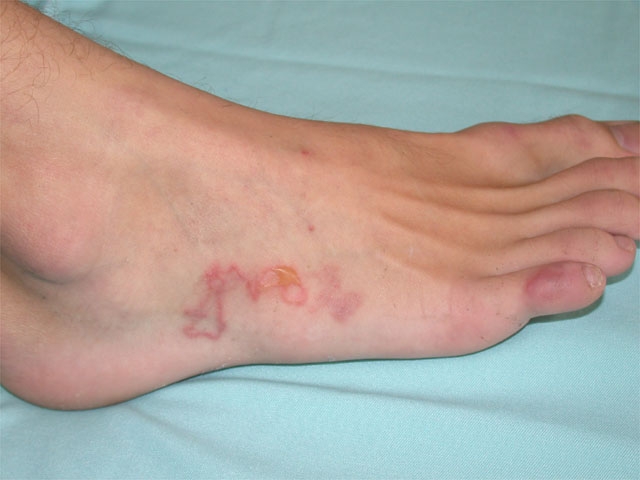 Which of the following is the most likely cause of this patient's current condition?
 (Multiple Choice)
4.8/5 (79)
(79) A 23-year-old man comes to the emergency department with fever, severe headache, and vomiting. He has not felt well for the past 2 weeks due to fatigue, intermittent low-grade fevers, and headaches. The patient is HIV positive and spent several months in prison 3 years ago. Temperature is 38.6 C (101.5 F). Neck stiffness is present on physical examination. A CT scan reveals no intracranial lesions. Cerebrospinal fluid analysis is notable for the following: 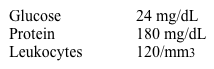 Cerebrospinal fluid cultures grow Mycobacterium tuberculosis with significantly decreased activity of intracellular catalase peroxidase. The isolates would most likely exhibit resistance to which of the following agents?
 (Multiple Choice)
4.9/5 (85)
(85) A 63-year-old woman comes to the office due to a new-onset cough, night sweats, and hemoptysis since last week. The patient grew up in Bangladesh and immigrated to the United States when she was 35 years old. Her only medical condition is polycystic kidney disease, for which she received a kidney transplant 8 months ago. Her temperature is 98°F (36.7°C), blood pressure is 122/75 mmHg, pulse is 85/min, and respirations are 16/min. On lung auscultation, inspiratory crackles are present. A chest radiograph is ordered and a new cavitary lesion is noted in the apical-posterior segment of her left upper lobe. Bacteria isolated from the lung tissue fail to decolorize with hydrochloric acid and alcohol after staining carbolfuchsin. Which of the following cell wall components is most likely responsible for this staining phenomenon?
(Multiple Choice)
4.9/5 (76)
(76) A 38-year-old man comes to the physician because of a 1-month history of fever and a cough productive of a moderate amount of yellowish sputum. He has had a 6-kg (13-lb) weight loss during this period. He emigrated from the Middle East around 2 years ago. His father died of lung cancer at the age of 54 years. He has smoked one pack of cigarettes daily for 18 years. His only medication is a daily multivitamin. He appears malnourished. Sputum cultures grow acid-fast bacilli that are susceptible to most antimycobacterial drugs in vitro. Isoniazid monotherapy in this patient would most likely result in:
(Multiple Choice)
4.8/5 (71)
(71) A 22-year-old man arrives at the office with skin problems. Three months ago, the patient discovered a nonpainful, nonpruritic skin lump on his right knee, which grew in size and quantity. He has no medical history and does not use any drugs. The patient is regularly outside for work and amusement. He has a sexual appetite. The presentation depicts the results of the physical examination. 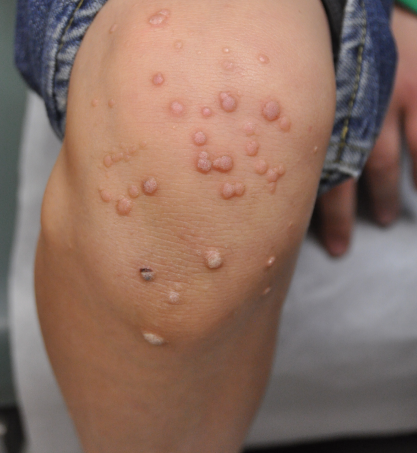 Which of the following microbial organisms is most likely responsible for this patient's current condition?
 (Multiple Choice)
5.0/5 (92)
(92) A 45-year-old woman comes to the emergency department because of abdominal cramping, vomiting, and watery diarrhea for the past 4 days. She prepares her own food and frequently tastes it while cooking. The patient appears lethargic. Her temperature is 38.8°C (101.8°F). Abdominal examination shows mild, diffuse tenderness. Bowel sounds are increased. Examination of the stool shows numerous leukocytes. Which of the following is the most likely pathogen?
(Multiple Choice)
4.9/5 (83)
(83) A 33-year-old man is being treated in the hospital for new-onset seizures. He has no notable medical history. Vital indicators are typical. A neurological examination reveals no anomalies. A 3-cm cystic lesion in the temporal lobe is seen by a CT scan of the head. The mass is removed, and the histopathology is depicted in the figure below: 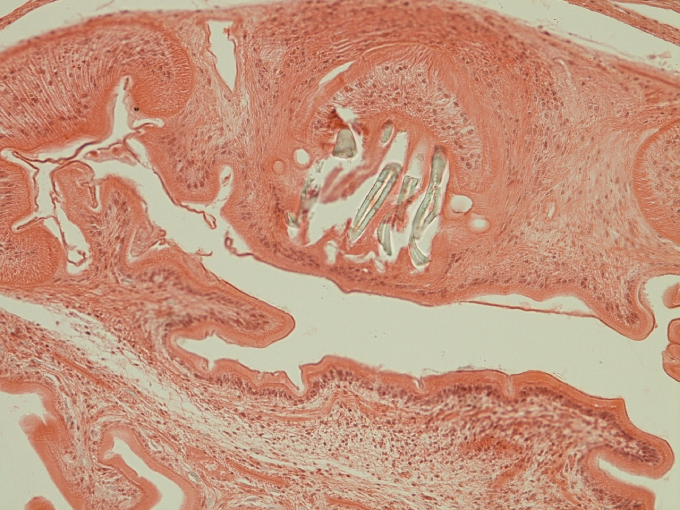 Which of the following is the most likely diagnosis?
 (Multiple Choice)
4.7/5 (64)
(64) A 2800-g (6-lb 3-oz) male newborn is born at 39 weeks' gestation to a 24-year-old woman, gravida 2, para 2, after uncomplicated labor and delivery. The mother did not receive prenatal care. She traveled to Brazil to visit relatives during the first trimester of her pregnancy. She has bipolar disorder treated with lithium. The newborn is at the 50th percentile for height, 25th percentile for weight, and 2nd percentile for head circumference. Neurologic examination shows spasticity of the upper and lower extremities. The wrists are fixed in flexion bilaterally. Deep tendon reflexes are 4+ and symmetric. Ophthalmoscopic examination shows focal pigmentary retinal mottling. Testing for otoacoustic emissions is negative. Which of the following viruses most likely caused this patient's in utero infection?
(Multiple Choice)
4.8/5 (88)
(88) A 4-year-old boy is brought to the office due to 3-day history of fever, cough, and a runny nose. The patient emigrated from Syria 2 weeks ago. He has not yet received any routine childhood vaccinations. Physical examination shows an ill-appearing, febrile child. Examination shows conjunctivitis of both eyes. There are multiple, 2-mm-sized, bluish-gray papules with an erythematous rim on the buccal mucosa and the soft palate Over the next several days, which of the following is most likely to develop?
(Multiple Choice)
4.9/5 (80)
(80) A 53-year-old woman comes to the physicianv because of a 2-day history of fever, chills, headache, and cough. She also reports malaise and generalized muscle aches. She works as a teacher at a local high school. She has a history of intermittent asthma, for which she takes albuterol as needed. She is worried about possibly becoming ill and cannot afford to miss work. Her temperature is 38.5°C (101.3°F), pulse is 58/min, and respirations are 12/min. Lung sounds are clear to auscultation. A nasopharyngeal swab is obtained. Naked viral particles are seen, and purified RNA molecules are extracted from these particles. Once introduced into human cells, the purified RNA molecules induce viral protein synthesis and viral genome replication. Which of the following is the most likely cause of this patient's symptoms?
(Multiple Choice)
4.8/5 (79)
(79) 
Filters
- Essay(0)
- Multiple Choice(0)
- Short Answer(0)
- True False(0)
- Matching(0)