



 Chat with AI
Exam 9: Microbiology and Virology

Exam 1: Anatomy265 Questions
Exam 2: Behavioral Sciences178 Questions
Exam 3: Biochemistry102 Questions
Exam 4: Embryology59 Questions
Exam 5: Epidemiology, Biostatistics, and Medical Informatics94 Questions
Exam 6: Genetics88 Questions
Exam 7: Histology46 Questions
Exam 8: Immunology147 Questions
Exam 9: Microbiology and Virology330 Questions
Exam 10: Pathology817 Questions
Exam 11: Pharmacology and Toxicology509 Questions
Exam 12: Physiology339 Questions
Exam 13: Psychiatry and Psychotherapy23 Questions
Select questions type


A 4-year-old boy is brought to the physician because of increased irritability, continual crying, and fever for 1 day. His mother has noticed that he refuses to lie down on his right side and keeps tugging at his right ear. One week ago, he had a runny nose that has since improved. He was born at term and has been otherwise healthy. He has been attending a daycare center for the past 5 months. His temperature is 38.4°C (101.1°F) and pulse is 144/min. Otoscopic examination of the right ear reveals a normal-appearing external canal and an erythematous tympanic membrane with purulent fluid pooling within the distal external canal. Which of the following organisms is the most likely cause of this patient's diagnosis?
(Multiple Choice)
4.7/5  (81)
(81) Seizures bring a 24-year-old man to the emergency department. He's had a growing fever, headache, and vomiting for two days. A physical examination reveals evidence of meningeal inflammation. Despite extensive medical care, the patient quickly goes unconscious and dies 48 hours later. An autopsy reveals clogged leptomeninges with fibrinopurulent exudate (not shown). Numerous ameba are seen in the exudate and brain tissue when examined under a microscope. Which of the following is the most likely pathogen entry route into the CNS? 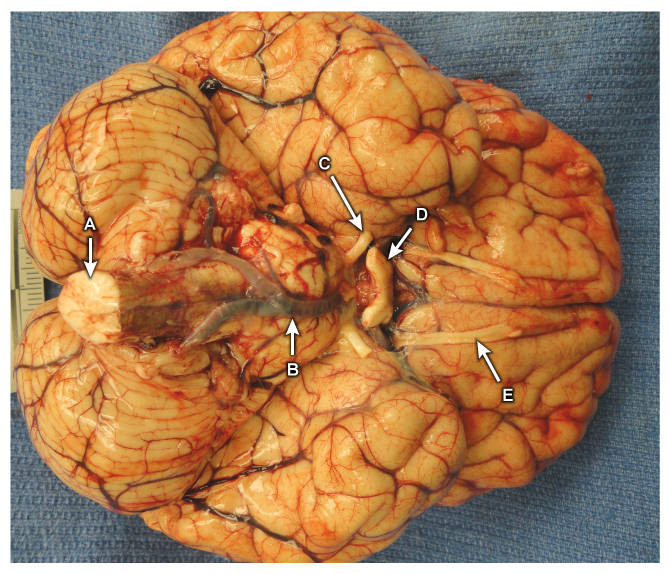
(Multiple Choice)
4.9/5 (90)
(90) A 32-year-old man, who is a military veteran, comes to the emergency department because of altered mental status. Two weeks ago, he returned from deployment for a peace-keeping mission in Taiwan. During his trip, he began developing high-grade fever, headaches, severe myalgias, and joint pains. He is sexually active and uses condoms inconsistently. His temperature is 38.7°C (101.7°F), pulse is 102/min, and blood pressure is 90/55 mm Hg.Examination shows a diffuse maculopapular rash, multiple purpuric lesions, and hepatomegaly. Laboratory studies show marked thrombocytopenia, leukopenia, and elevated liver aminotransferases. Which of the following is the most likely mechanism for this patient's current severe illness?
(Multiple Choice)
4.8/5 (77)
(77) A 53-year-old woman comes to the physician in February because of a 1-day history of fever, chills, headache, and dry cough. She also reports malaise and generalized muscle aches. She works as a teacher at a local high school, where there was recently an outbreak of influenza. She has a history of intermittent asthma, for which she takes albuterol as needed. She declined the influenza vaccine offered in the fall because her sister told her that a friend developed a flulike illness after receiving the vaccine. She is worried about possibly becoming ill and cannot afford to miss work. Her temperature is 38.5°C (101.3°F), pulse is 58/min, and respirations are 12/min. Physical examination shows watery nasal discharge, pharyngeal erythema, and clear lungs on auscultation. Droplet precautions are immediately instituted to prevent spread of the infection. Hand hygiene with an alcohol-based disinfectant following patient contact is also initiated. This patient's infecting pathogen is likely susceptible to the disinfectant due to the presence of which of the following characteristics?
(Multiple Choice)
4.9/5 (67)
(67) A previously healthy 24-year-old man comes to the physician because of a 4-day history of fever, headache, myalgias, and dyspnea. He appears ill and fatigued. His temperature is 39.5°C (103.1°F) pulse is 100/min, respirations are 11/min, and blood pressure is 136/86 mm Hg. Examination shows intact cranial nerves. . Lung examination reveals coarse crackles. Laboratory studies are as follows: 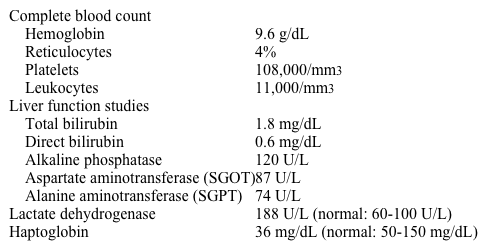 Chest x-ray reveals bilateral infiltrates. A peripheral blood smear shows normocytic, normochromic anemia with ring- and cross-shaped intraerythrocytic inclusions. The vector responsible for this patient's current condition can also transmit which of the following organisms?
 (Multiple Choice)
4.8/5 (77)
(77) A 23-year-old man arrives at the office with penile ulcers caused by unprotected sexual intercourse. Three subcentimeter sores on the penile shaft are discovered during a physical examination. A microscopic study of a scrape from the base of an ulcer reveals the following: 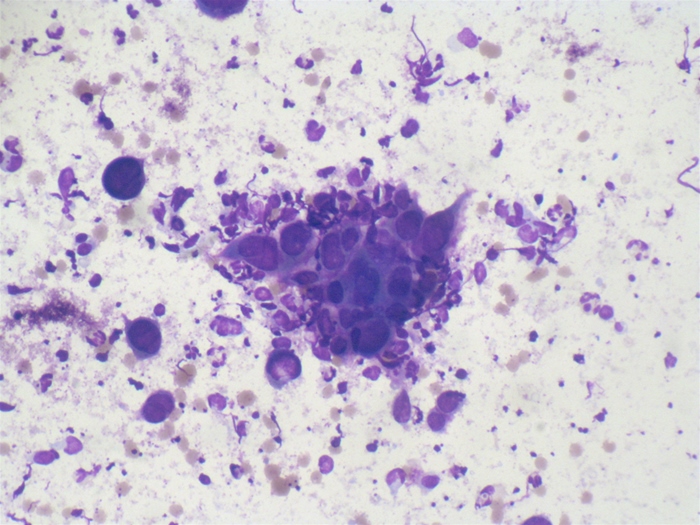 Which of the following medications is most appropriate for this patient?
 (Multiple Choice)
4.8/5 (83)
(83) A 3-year-old boy is brought to the emergency department with breathing difficulty and drooling that have worsened rapidly over the last 8 hours. He has no chronic medical conditions. Temperature is 39.4 C (102.9 F). Examination shows a toxic-appearing patient leaning forward while sitting on the bed; he has inspiratory stridor and suprasternal retractions. There are pooled oral secretions, and the patient is unable to swallow. Which of the following is the greatest risk factor for this patient's condition?
(Multiple Choice)
4.7/5 (96)
(96) A 24-year-old pregnant woman is found to have chronic viral hepatitis B on liver biopsy. The presence of which of the following serologic markers is most likely to increase the risk of vertical transmission of the virus?
(Multiple Choice)
4.9/5 (67)
(67) A 59-year-old nurse woman comes to the physician following an accidental needlestick in the operating room.. She feels well. She has systemic lupus erythematosus and hypertension. She does not drink alcohol. Her current medications include lisinopril and hydroxychloroquine. She appears malnourished. Her vital signs are within normal limits. Examination shows a soft, nontender abdomen. There is no ascites or hepatosplenomegaly. Serum studies show 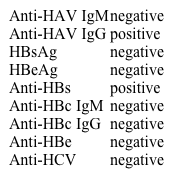 Which of the following statements is most likely to be true regarding the nurse's viral status?
 (Multiple Choice)
4.8/5 (76)
(76) A 35-year-old man comes to the emergency department with fever, chills, dyspnea, and a productive cough. His symptoms began suddenly 2 days ago. He smokes one pack of cigarettes daily. He is 181 cm (5 ft 11 in) tall and weighs 69 kg (152 lb); BMI is 21 kg/m2. He lives in Illinois and works as a carpenter. His temperature is 38.8°C (101.8°F), pulse is 110/min, respirations are 24/min, and blood pressure is 105/74 mm Hg. Pulse oximetry on room air shows an oxygen saturation of 92%. Leukocyte count is 14,000/mm3 with 80% neutrophils and 7% bands, hemoglobin is 13.6 g/dL, and platelets are 400,000/mm3. Serum levels of which of the following are most likely to be elevated in this patient?
(Multiple Choice)
4.9/5 (78)
(78) A 34-year-old man comes to the emergency department due to 2 weeks of slowly progressive global headache, malaise, and fevers. He has also had unintentional weight loss over the past several months. The patient has a history of injection drug use and was diagnosed with HIV 3 years ago. He has not been compliant with antiretroviral therapy. Temperature is 38.3 C (100.9 F). Examination shows white patches on the oropharyngeal mucosa and mild generalized lymphadenopathy. Brain imaging reveals no intracranial masses. Lumbar puncture reveals an elevated opening pressure, and cerebrospinal fluid analysis shows moderately increased protein concentration and pleocytosis. The latex agglutination test is positive for soluble polysaccharide antigen. Light microscopy of this patient's cerebrospinal fluid is most likely to reveal which of the following?
(Multiple Choice)
4.9/5 (101)
(101) A 29-year-old male is hospitalized with low-grade fever and high serum levels of alanine aminotransferase (ALT) and aspartate aminotransferase (AST). His serum is positive for HBsAg. You should inform the patient that the most likely outcome for his infection would be:
(Multiple Choice)
4.8/5 (67)
(67) A 6-year-old boy is brought to the emergency department due to confusion and lower extremity weakness. The symptoms began 2 days ago along with fever, headache, malaise, and myalgias. Today, the patient was noted to be confused and had difficulty ambulating due to left lower extremity weakness. he is visiting Texas for the summer and has never traveled outside the United States. Temperature is 38.3 C (101 F), blood pressure is 130/70 mm Hg, and pulse is 96/min. The patient is oriented to place and person only and has a coarse hand tremor. There is flaccid paralysis of the left lower extremity with preserved sensation. Cerebrospinal fluid analysis shows a leukocyte count of 200/mm3 with 20% neutrophils and 80% lymphocytes. Which of the following is the most likely pathogen responsible for this patient's condition?
(Multiple Choice)
4.8/5 (72)
(72) A 63-year-old man is brought to the emergency department because of fever and confusion that have progressively worsened over the past 3 days. He has neck stiffness. The patient's condition quickly deteriorates, and he dies in the hospital despite appropriate treatment. Autopsy of the brain shows a diffuse gelatinous exudate covering the base of the brain. Cut sections of the brain show marked ventriculomegaly and frontal lobe infarcts but no intraparenchymal mass lesions. Which of the following is the most likely diagnosis?
(Multiple Choice)
4.8/5 (81)
(81) A 46-year-old man who was a prisoner comes to the clinic because of 2-month history of productive cough, malaise. During this time, he also has had shortness of breath and a 6-kg (13-Ib) weight loss. Chest x-ray reveals a right upper lobe infiltrate. Acid-fast bacilli are present on sputum smear. The patient is started on combination therapy with isoniazid, ethambutol, rifampin, pyrazinamide, and pyridoxine. One month later, he returns to the office reporting blurring of vision. Examination shows bilateral central scotomas. Which of the following is most likely responsible for this patient's visual symptoms?
(Multiple Choice)
4.8/5 (90)
(90) A 45-year-old man comes to the physician because of a 3-week history of diarrhea and a 2.2-kg (5-lb) weight loss. During the past week, he has had six small bloody stools daily. He has HIV, gastroesophageal reflux disease, and hypertension. Current medications include chlorthalidone, omeprazole, emtricitabine, tenofovir, and efavirenz. He reports taking efavirenz irregularly. He is employed as a sales manager and regularly flies to South America. He is 175 cm (5 ft 9 in) tall and weighs 64 kg (143 lb); BMI is 22 kg/m2. His temperature is 38.1°C (100.6°F), pulse is 91/min, and blood pressure is 116/69 mm Hg. The abdomen is scaphoid. Bowel sounds are normal. His leukocyte count is 6000/mm3, erythrocyte sedimentation rate is 12 mm/h, and CD4+ T-lymphocyte count is 44/mm3. Colonoscopy shows areas of inflammation scattered throughout the colon with friability, granularity, and shallow linear ulcerations. The intervening mucosa between areas of inflammation appears normal. Biopsy from the ulcers reveals inflammatory infiltrate, mucosal necrosis, and enlarged endothelial cells with large, ovoid nuclei containing prominent basophilic deposits. Which of the following is the most likely cause of this patient's gastrointestinal symptoms?
(Multiple Choice)
4.8/5 (68)
(68) A 6-year-old boy is brought to the physician by his mother because of a 2-week history of fever and pain in his right thigh that is causing him to limp. She thinks he may have hurt himself during soccer practice. He has no history of rash or joint pain. His immunizations are up-to-date. The patient appears well. He is at the 40th percentile for height and 45th percentile for weight. His temperature is 38.2°C (100.8°F). Examination shows swelling, tenderness, warmth, and mild erythema over the right upper thigh; range of motion is limited by pain . His leukocyte count is 12,300/mm3 and erythrocyte sedimentation rate is 40 mm/h. An intravenous radiotracer that localizes to areas of increased osteoblastic activity is administered, and several images are obtained to find areas with atypical activity. Abnormally increased uptake of the radiotracer is most likely to be seen in which of the following areas?
(Multiple Choice)
4.9/5 (89)
(89) A 35-year-old man who had a kidney transplant a year ago arrives to the emergency room complaining of pleuritic chest discomfort and a cough. He has a low-grade fever, which is discovered. An infiltration in the lower lobe of the right lung is shown by a chest x-ray. Vancomycin, ceftriaxone, and azithromycin are given to the patient as broad-spectrum antibiotics. Despite these precautions, his condition deteriorates over the following few days. Bronchoscopy and bronchoalveolar lavage are carried out. On light microscopy, mucicarmine staining of his bronchoalveolar fluid reveals the following: 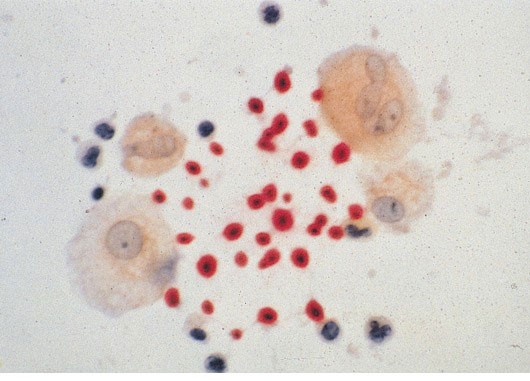 Which of the following is the most likely cause of this patient's condition?
 (Multiple Choice)
4.9/5 (79)
(79) After visiting overseas, a previously healthy 16-year-old acquired a nonproductive cough, dyspnea, and wheezing. The patient has no allergies and has not recently had upper respiratory sickness. After a few days, the symptoms went away on their own, but she soon developed stomach pain, anorexia, and nausea. The following picture depicts the findings of stool microscopy. 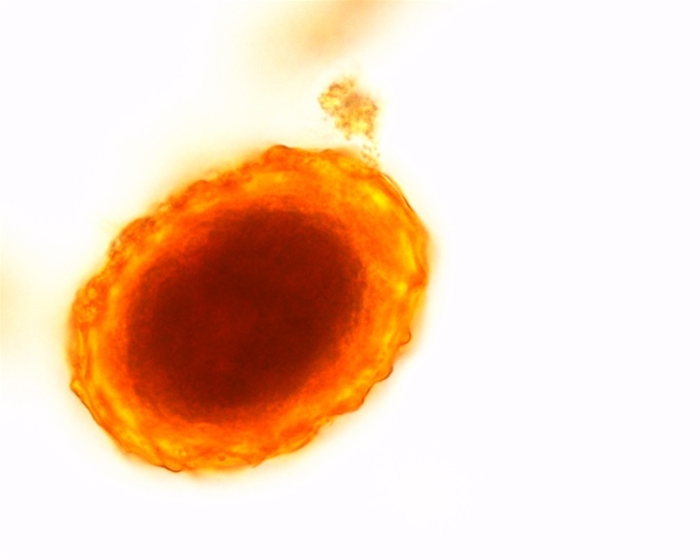 Which of the following was the most likely cause of this patient's pulmonary symptoms?
 (Multiple Choice)
4.8/5 (69)
(69) A 46-year-old woman comes to the physician because of a 3-day history of diarrhea, moderate abdominal pain, and weakness. Her symptoms began on the return flight from a 2-week yoga retreat in India, where she stayed at a resort. She was mildly nauseous as she boarded the flight, and diarrhea followed immediately after eating the in-flight meal. Since then, she has had up to five watery stools daily. She has a 1-year history of gastroesophageal reflux disease and is allergic to shellfish. Her only medication is ranitidine. She appears lethargic. Her temperature is 37.0°C (98.6°F), pulse is 70/min, and blood pressure is 115/72 mm Hg. Abdominal examination shows diffuse tenderness with no guarding or rebound. Bowel sounds are hyperactive. Which of the following is the most likely pathogen involved in producing this patient's gastrointestinal symptoms?
(Multiple Choice)
4.8/5 (74)
(74) 
Filters
- Essay(0)
- Multiple Choice(0)
- Short Answer(0)
- True False(0)
- Matching(0)