



 Chat with AI
Exam 9: Microbiology and Virology

Exam 1: Anatomy265 Questions
Exam 2: Behavioral Sciences178 Questions
Exam 3: Biochemistry102 Questions
Exam 4: Embryology59 Questions
Exam 5: Epidemiology, Biostatistics, and Medical Informatics94 Questions
Exam 6: Genetics88 Questions
Exam 7: Histology46 Questions
Exam 8: Immunology147 Questions
Exam 9: Microbiology and Virology330 Questions
Exam 10: Pathology817 Questions
Exam 11: Pharmacology and Toxicology509 Questions
Exam 12: Physiology339 Questions
Exam 13: Psychiatry and Psychotherapy23 Questions
Select questions type


A 58-year-old man comes to the emergency department with a 1-day history of fever, headache, and vomiting. He underwent kidney transplantation last year. His temperature is 39.4 C (103 F), blood pressure is 130/80 mm Hg, pulse is 98/min, and respirations are 16/min. Neck stiffness is present on physical examination. Cerebrospinal fluid (CSF) results are as follows: 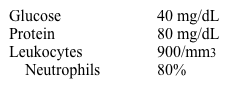 Gram-positive rods with tumbling motility at room temperature are seen on CSF microscopy. How was this patient's infection most likely transmitted?
 (Multiple Choice)
4.8/5  (83)
(83) A 56-year-old man comes to the emergency department because of a 4-day history of fever and shortness of breath. He has a history of COPD treated with inhaled albuterol. His temperature is 39.0°C (102.2°F), pulse is 95/min, respirations are 20/min, and blood pressure is 130/80 mm Hg. Cardiopulmonary examination shows decreased breath sounds and poor air movement over the left lung. Chest radiograph shows a moderate-sized loculated pleural effusion on the left side. Ultrasonography reveals multiple separate fluid pockets within the pleural space. Chest tube placement produces only a small amount of thick pus. Which of the following is the most likely underlying mechanism for this patient's pleural effusion?
(Multiple Choice)
4.7/5 (69)
(69) A previously healthy 24-year-old man comes to the physician because of a 4-day history of fever, headache, myalgias, and abdominal pain. He developed a new rash this morning. He returned from a backpacking trip in Arkansas. 5 days ago. He was camping outdoors, drank only filtered water, and used sunscreen. He is sexually active and uses condoms for contraception. He appears ill and fatigued. His temperature is 39.5°C (103.1°F). Physical examination shows conjunctival injection in both eyes without exudate or pus. There is a diffuse blanching, macular rash. Laboratory testing reveals leukopenia, thrombocytopenia, and elevated aminotransferase levels. Microscopic evaluation of the blood demonstrates mulberry-shaped, intracytoplasmic inclusions in monocytes. Which of the following is the most likely pathogen responsible for this patient's condition?
(Multiple Choice)
4.8/5 (80)
(80) A 65-year-old man comes to the hospital due to progressive fatigue and fever. He emigrated from Sri Lanka 2 years ago. His most recent examination 2 months ago included purified protein derivative (PPD) skin testing and showed an induration of 12 mm. He started isoniazid therapy with pyridoxine supplementation. On physical examination, there is mild abdominal discomfort. Laboratory studies are pending. Which of the following is the most likely cause of this patient's current symptoms?
(Multiple Choice)
4.9/5 (93)
(93) A 57-year-old man arrives at the clinic after experiencing a 2 month increasing cough and weight loss. He has a history of type 2 diabetes and chronic renal disease. He does not consume tobacco. The patient had a two-week trip to Denmark four months ago. He owns two cats and a bird. He works in a huge hotel's maintenance department, where he maintains the hot tub and swimming pools. The temperature is 38 degrees Celsius (100.4 ° Fahrenheit), the blood pressure is 140/100 mm Hg, the pulse rate is 88 beats per minute, and the respirations rate is 16 / minute. The patient stands at 190 cm (6 feet 3 inches). 22 kg/m2 is the BMI. The examination reveals cervical lymphadenopathy. The display depicts chest imaging. 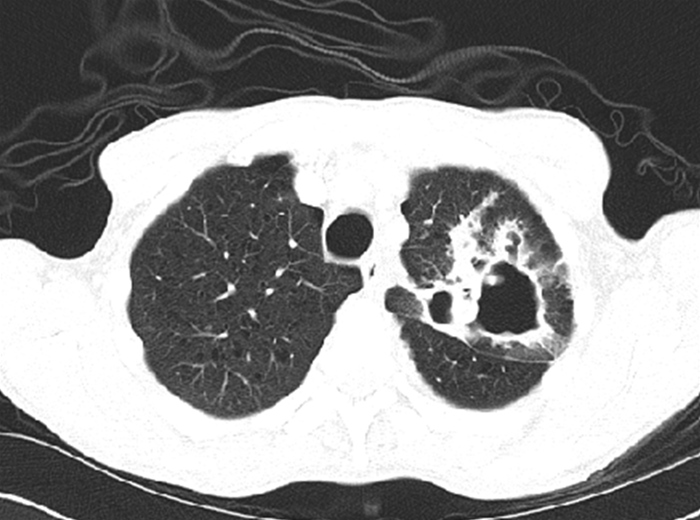 Hemoglobin A1c is 8.5% and serum creatinine is 3.8 mg/dL. Which of the following risk factors most likely contributed to this patient's current condition?
 (Multiple Choice)
4.7/5 (95)
(95) A 68-year-old man with percutaneous nephrostomy tubes is brought to the emergency department by his wife because of confusion. The wife says that he is "not his usual self" and responded with nonsensical phrases when she awoke him for breakfast. He has prostate cancer and receives leuprolide injections every 3 months. He appears uncomfortable and diaphoretic. He is oriented to person but not to place or time. His temperature is 36.8°C (98.2°F), pulse is 124/min, respirations are 22/min, and blood pressure is 76/50 mm Hg when supine. Pulse oximetry on room air shows an oxygen saturation of 96%. In the emergency department, a decision is made to insert a central venous catheter. In addition to sterile draping during the procedure, which of the following actions would be most likely to prevent intravascular catheter-related infections?
(Multiple Choice)
4.9/5 (79)
(79) A 27-year-old man comes to the physician because of a 3-week history of generalized fatigue, mild malaise, abdominal pain. He attended the state fair over a month ago, where he tried a number of regional foods, and wonders if it might have been caused by something he ate. He has also noticed a dark urine. He drinks one to two beers daily. He has had several episodes of unprotected sex with different female partners within the past year. He works as a nursing assistant in a rehabilitation facility. He appears tired. Examination shows mild scleral icterus. The liver is palpated 2-3 cm below the right costal margin and is tender.Labroratory tests show elevated liver function tests. Which of the following is most likely to be present in this patient?
(Multiple Choice)
5.0/5 (77)
(77) Five days after admission to the hospital for treatment of community-acquired pneumonia, a 76-year-old man develops watery diarrhea and cramping lower abdominal pain. Today, he has had three episodes of foul-smelling, nonbloody diarrhea without nausea or vomiting. He has hypertension and hyperlipidemia. His medications include lisinopril, atorvastatin, cefotaxime, and clarithromycin. His temperature is 37.5°C (99.5°F), pulse is 95/min, respirations are 16/min, and blood pressure is 140/85 mm Hg. Pulse oximetry on room air shows an oxygen saturation of 97%. Crackles are heard over the right lower lung base. Abdominal examination shows mild tenderness throughout the lower quadrants. Leukocyte count is 13,000/mm3. Stool analysis is pending. In addition to appropriate hand hygiene, which of the following equipment is necessary before examining this patient?
(Multiple Choice)
4.8/5 (80)
(80) A 72-year-old woman is brought to the emergency department with fever, myalgia, and cough for 3 days. She lives in an assisted living facility and several of her neighbors have had similar symptoms. She has hypertension treated with lisinopril. She has not been vaccinated against influenza. Her temperature is 38.9°C (102.2°F), pulse is 105/min, respirations are 22/min, and blood pressure is 112/62 mm Hg. On examination, there are crackles at the base of the left lung. Chest x-ray reveals a left lower-lobe consolidation. Microscopic analysis of a sputum sample shows gram-positive, lancet-shaped cocci in pairs. Which of the following characteristics are these bacteria likely to demonstrate?
(Multiple Choice)
4.9/5 (89)
(89) A 63-year-old man with non-Hodgkin lymphoma is brought to the emergency department because of fever and confusion that have progressively worsened over the past 3 days. He also has a 3-day history of loose stools. He returned from France 2 weeks ago where he stayed in the countryside and ate typical French cuisine His last chemotherapy cycle was 3 weeks ago. He is oriented to person but not to place or time. His temperature is 39.5°C (103.1°F), pulse is 110/min, and blood pressure is 100/60 mm Hg. cerebrospinal fluid (CSF) analysis showed gram-positive diplococci. He is given dexamethasone followed by systemic antibiotics. Adding dexamethasone most likely benefited from the use of this drug due to which of the following?
(Multiple Choice)
4.8/5 (76)
(76) 
Filters
- Essay(0)
- Multiple Choice(0)
- Short Answer(0)
- True False(0)
- Matching(0)