



 Chat with AI
Exam 9: Microbiology and Virology

Exam 1: Anatomy265 Questions
Exam 2: Behavioral Sciences178 Questions
Exam 3: Biochemistry102 Questions
Exam 4: Embryology59 Questions
Exam 5: Epidemiology, Biostatistics, and Medical Informatics94 Questions
Exam 6: Genetics88 Questions
Exam 7: Histology46 Questions
Exam 8: Immunology147 Questions
Exam 9: Microbiology and Virology330 Questions
Exam 10: Pathology817 Questions
Exam 11: Pharmacology and Toxicology509 Questions
Exam 12: Physiology339 Questions
Exam 13: Psychiatry and Psychotherapy23 Questions
Select questions type


A 24-year-old female presents to your office with burning urination, urgency and frequency. She is sexually active. Urine cultures show catalase-positive, gram-positive cocci. The organism responsible for this patient's symptoms is most likely to be:
(Multiple Choice)
4.9/5  (69)
(69) A 17-year-old girl comes to the physician with a 2-day history of painful vulvar lesions, generalized fatigue, and malaise. During this period, she has also had dysuria. She is sexually active with 2 male partners and uses condoms inconsistently. Her immunizations are up-to-date; she completed the vaccination course for human papillomavirus 2 months ago. Temperature is 38.1°C (100.6°F), pulse is 100/min, respirations are 12/min, and blood pressure is 110/70 mm Hg.Physical examination reveals bilateral inguinal lymphadenopathy and tender vesicular lesions covering the labia majora and perineum. Which of the following conditions will most likely result as a sequela of this patient's infection?
(Multiple Choice)
4.8/5 (99)
(99) A 17-year-old boy is hospitalized with recent-onset insomnia, headaches, periodic agitation, and dysphagia. He is a high school student interested in becoming a veterinarian. He owns a snake, fish, and parrot and, about 4 weeks ago, went on a field trip to study bats in a cave. The patient has no known medical problems and is not taking any medications. He does not consume alcohol and has never used illicit drugs. Despite hospitalization and treatment, he develops painful spasms, progressive paralysis, and coma and dies. Which of the following interventions would have most likely prevented this student from developing this illness?
(Multiple Choice)
4.9/5 (72)
(72) A 17-year-old girl comes to the emergency department with a 5-day history of severe abdominal pain, cramping, nausea, and vomiting. She also has pain with urination. She is sexually active with one male partner, and they use condoms inconsistently. She experienced a burning pain when she last had sexual intercourse 3 days ago. Menses occur at regular 28-day intervals and last 5 days. Her last menstrual period was 3 weeks ago. Her temperature is 38.5°C (101.3°F), pulse is 83/min, and blood pressure is 110/70 mm Hg. Physical examination shows abdominal tenderness in the lower quadrants. Pelvic examination shows cervical motion tenderness and purulent cervical discharge. Laboratory studies show 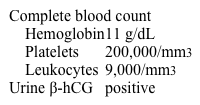 This patient's clinical presentation is most likely due to an infection with which of the following pathogens?
 (Multiple Choice)
4.9/5 (72)
(72) A 10-year-old boy is brought to the physician by his mother because of a 2-week history of fever and pain in his right thigh that is causing him to limp. He has no history of recent trauma other than minor scrapes to his knees and elbows while playing outside . His immunizations are up-to-date. The patient appears well. He is at the 40th percentile for height and 45th percentile for weight. His temperature is 38.2°C (100.8°F), pulse is 100/min, respirations are 18/min, and blood pressure is 110/70 mm Hg. Examination shows swelling, tenderness, warmth, and mild erythema over the right upper thigh; range of motion is limited by pain. He has a right-sided antalgic gait. His leukocyte count is 12,300/mm3 and erythrocyte sedimentation rate is 40 mm/h. X-rays of the hips and lower extremities are unremarkable. An MRI of the right lower extremity shows increased T2 and decreased T1 signals over the right femur with periosteal elevation, multiple osteolytic areas in the femoral metaphysis, and bone marrow edema. Which of the following organisms is most likely responsible for this patient's symptoms?
(Multiple Choice)
4.8/5 (79)
(79) A 65-year-old man arrives at the emergency department after experiencing hemoptysis early this morning. The patient believes he coughed up around 100 mL of blood. He had been in his typical condition of health and felt good before to this event, with no fevers, night sweats, or weight loss. Over the last three months, he has had bouts of blood-tinged sputum. For tuberculosis (TB) that was successfully treated some years ago, the patient's prior medical history is crucial. He smoked a pack of cigarettes every day for 45 years until quitting four years ago. A example CT scan cut, shown below, shows alterations consistent with past TB infection, including an aged left upper lobe. Compared to prior scans, the main difference is that the cavity now appears to be filled with a round mass. 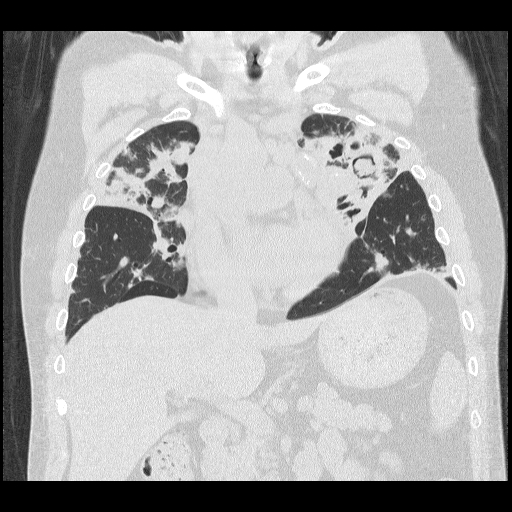 Which of the following best describes this patient's condition?
 (Multiple Choice)
4.9/5 (81)
(81) A 17-year-old boy comes to the emergency department because of a 3-day history of pain in his left wrist. That morning the pain increased and he started to have chills and malaise. Last week he had self-resolving left knee pain. He is otherwise healthy and has not had any trauma to the wrist. He recently returned from a camping trip to Minnesota. He is sexually active with one female partner, who uses a diaphragm for contraception. His temperature is 38.7°C (101.7°F). Examination shows several painless violaceous vesiculopustular lesions on the dorsum of both wrists and hands; two lesions are present on the left palm. There is swelling and erythema of the left wrist with severe tenderness to palpation and passive movement. Which of the following strategies would most likely have prevented this patient's current condition?
(Multiple Choice)
4.8/5 (66)
(66) A 47-year-old man arrives to the office with a high temperature, nocturnal sweats, and exhaustion. A thorough examination reveals that the patient has chronic myeloid leukemia. The patient is experiencing headaches, limited nasal discharge, and left eye issues while getting therapy for his cancer. Physical examination indicates paranasal sinus pain, as well as left-sided orbital edema and cellulitis. There is also mild proptosis and ptosis of the left eye. The picture below depicts a sinus mucosa biopsy: : 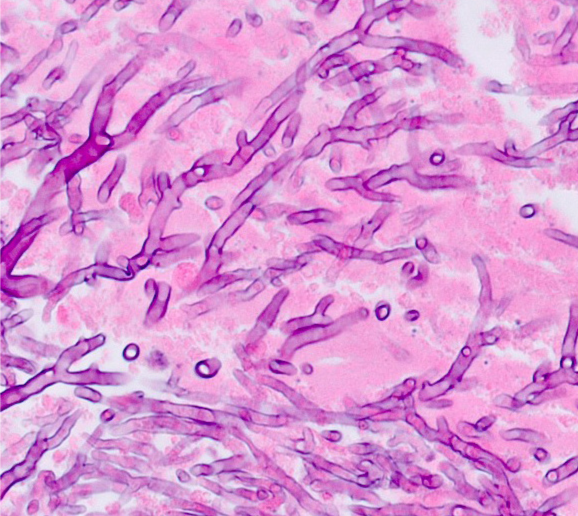 Which of the following is the most likely cause of this patient's condition?
 (Multiple Choice)
4.7/5 (75)
(75) A 47-year-old guy with a fever and weariness visits the emergency room. His antiretrovirals have not been taken consistently, and he has a history of HIV. Blood pressure is 110/70 mm Hg, his temperature is 38.3 C (100.9 F), his pulse is 104/min, and his respirations are 20/min. Hepatosplenomegaly and a number of erythematous papules are prominent physical examination findings. Pancytopenia is evident through laboratory tests. Testing for histoplasma antigen is successful. For the treatment of disseminated histoplasmosis, amphotericin B is administered intravenously. The patient experiences palpitations and weakness a day later. Frequent premature ventricular beats are seen on an ECG. If these new signs and symptoms are caused by drug toxicity, they are most likely related to which of the following?
(Multiple Choice)
4.8/5 (89)
(89) Microbiologists are investigating sugar metabolism in wild-type and mutant strains of Escherichia coli. Both strains are found to grow viable colonies on lactose-containing media. Each strain is then cultured on a new growth medium containing only glucose. Representative colonies of each strain from the new media undergo Western blot processing using a fluorescently labeled probe specific for Beta-galactosidase. Wild-type bacterial colonies are found to contain only trace quantities of Beta-galactosidase. However, the mutant colonies express significant amounts of Beta-galactosidase. Further analysis reveals that the variant strain contains a mutation that inhibits the binding of a certain protein to its regulatory sequence. In which of the following locations did this mutation most likely occur?
(Multiple Choice)
4.8/5 (70)
(70) A 26-year-old man is brought to the emergency department because of abdominal pain, nausea, and vomiting for the past 1 hour. The patient has not had diarrhea or fever. Two hours ago, he ate a sandwich and coleslaw from a deli. He has no history of serious illness and takes no medications. He works as a computer scientist. He appears ill. His temperature is 37.6°C (99.6°F), pulse is 80/min, and blood pressure is 122/68 mm Hg. Pulse oximetry on room air shows an oxygen saturation of 98%. Cardiac examination shows no abnormalities. The lungs are clear to auscultation. Abdominal examination shows diffuse mild tenderness with no rigidity, rebound, or guarding. Which of the following is the most likely cause of this patient's symptoms?
(Multiple Choice)
4.8/5 (83)
(83) A previously healthy 25-year-old man who is on active duty in the US Navy comes to the military urgent care clinic with fever, headache, reddening of the eyes, and muscle ache for the past 4 days. He has not had itching or eye discharge. He has been stationed in Hawaii for the past year. He has no travel history and none of his other colleagues have similar complaints. He received the hepatitis A vaccine 2 years ago. He is not in acute distress. His temperature is 38.5°C (101.3°F), pulse is 90/min, respirations are 16/min, and blood pressure is 110/70 mm Hg. Examination of the eyes shows diffusely erythematous conjunctiva bilaterally without an exudate. Bilateral calves are tender to palpation. The remainder of the physical examination is unremarkable. This patient most likely acquired the infection via which of the following?
(Multiple Choice)
4.8/5 (70)
(70) A virologist is researching acyclovir-resistant herpes simplex virus (HSV). Viral DNA analysis reveals a mutation in the thymidine kinase gene, resulting in a mutated enzyme that does not phosphorylate acyclovir to its active form. In an experiment, a resistant HSV type 2 strain containing this mutation is cultured in a cell line, and the cell culture is coinfected with a nonresistant HSV type 1 strain. It is found that some of the newly produced type 1 virions acquire resistance to acyclovir, and subsequent progeny continue to be resistant. Which of the following mechanisms best explains the observed findings?
(Multiple Choice)
4.8/5 (73)
(73) A 41-year-old man visits the emergency room after experiencing a low-grade fever for three weeks, a cough that is producing mucus, and a 4.5 kg (10 lb) weight loss. The patient consumes 10 to 12 beers daily. He seems cachectic upon physical inspection. There are noticeable clubbed fingers and poor dental health. Sputum that has a bad odor is expectorated and sent for Gram staining and culture. The picture below shows a chest CT scan: 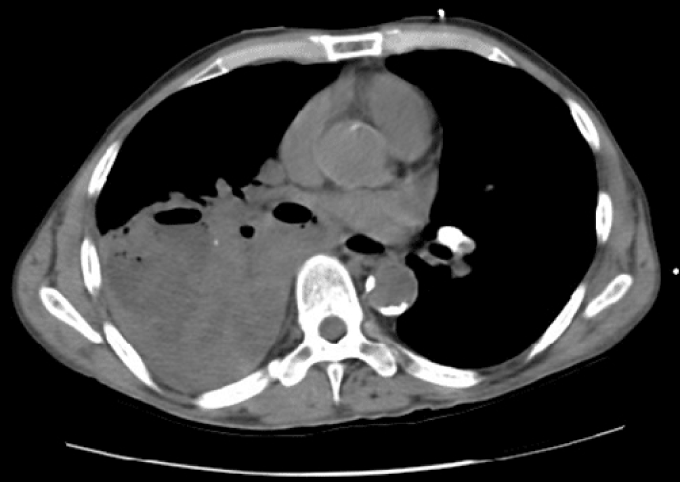 Empiric antimicrobial therapy should include coverage against which of the following pathogens?
 (Multiple Choice)
4.9/5 (104)
(104) A 15-year-old boy is evaluated for fever, headache, malaise, and cough 3 weeks after returning from summer camp. Lung auscultation is unremarkable. Chest x-ray reveals nodular infiltrates. The patient's blood samples are collected for analysis in anticoagulated tubes, which are transported submerged in ice; when taken out several minutes later, turbidity and clumping are noted. Warming the tube to body temperature leads to rapid dissolution of the clumps. Which of the following organisms is most likely responsible for this patient's condition?
(Multiple Choice)
4.8/5 (90)
(90) A 46-year-old man arrives at the office with skin lesions on his left arm that have appeared in the last few days. The lesions are not extremely unpleasant. The patient has never experienced identical symptoms before. He has no fevers and generally appears to be in good health. Previous medical history is unimportant. The patient is not on any drugs and does not have any allergies. The temperature is 37.1 degrees Celsius (98.8 F). The lesions are depicted in the following picture. 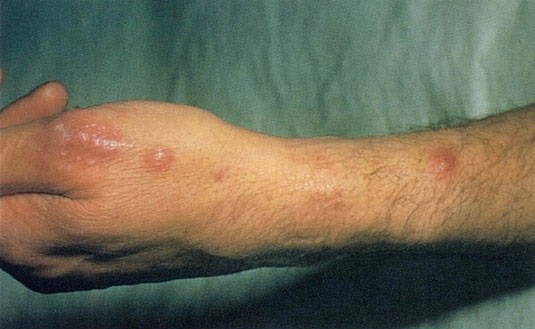 Following pathologic sampling, the lesions are determined to be fungal in etiology. Which of the following scenarios is most likely a component of this patient's history?
 (Multiple Choice)
4.8/5 (85)
(85) A 43-year-old man comes to the office due to fatigue and worsening pedal edema over the past several weeks. The patient was diagnosed with advanced HIV infection and started on antiretroviral therapy 3 months ago. He also has a history of hypertension. Physical examination shows bilateral lower extremity pitting edema. Serum creatinine is elevated and serum phosphorus is decreased compared to test results 3 months ago. Urinalysis reveals moderate proteinuria and glucosuria. Renal biopsy shows cytoplasmic vacuolization in the proximal tubules accompanied by loss of brush border and basement membrane denudation. Intracytoplasmic eosinophilic inclusions are also seen in the proximal tubules. There are no significant interstitial inflammatory infiltrates, and the glomeruli appear normal. Which of the following is the most likely diagnosis in this patient?
(Multiple Choice)
4.9/5 (72)
(72) A 54-year-old HIV-positive man arrives at the emergency room complaining of a nonproductive cough, low-grade fevers, and severe lethargy for the previous month. Over the same time frame, he has also shed 3.6 kg (8 lb). The patient does not routinely take antiretroviral medicine and has not seen his primary care physician in several months. Hepatosplenomegaly is discovered on physical examination. Pancytopenia and increased liver aminotransferases are seen in laboratory tests. The material is light microscopically examined after bone marrow aspiration. 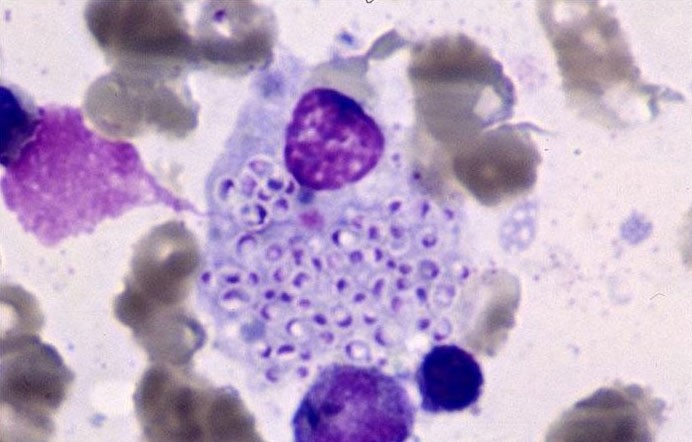 Which of the following is the most likely cause of this patient's current condition?
 (Multiple Choice)
4.9/5 (76)
(76) A 54-year-old woman is sent to the emergency room after having a widespread tonic-clonic seizure. During the preceding week, the patient experienced a fever, nocturnal sweats, lethargy, and a severe cough. She had a kidney transplant two years ago and is on immunosuppressive medicine. She is febrile and postictal on examination. There are sporadic lung crackles as well as typical heart sounds. The leukocyte count is high, and a chest x-ray shows patchy bronchopneumonia with numerous nodules. Multifocal abscesses are seen on brain imaging. As illustrated below, sputum Gram stain displays filamentous, branching gram-positive rods: 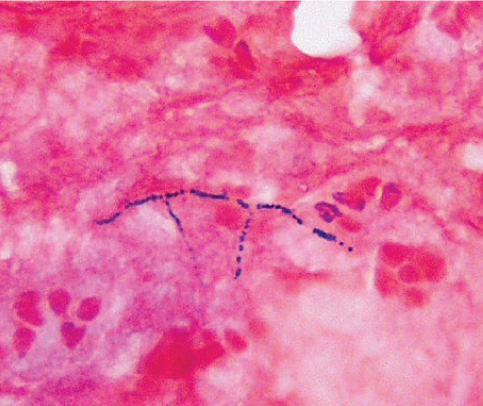 This pathogen is likely to demonstrate which of the following characteristics?
 (Multiple Choice)
4.8/5 (79)
(79) A 16-year-old boy is brought to the clinic by his mother for "pink eye." The patient reports that his friend had pink eye about 4 days ago, and he began experiencing some irritation and watery non-purulent discharge in his right eye 2 days prior. Today, he developed similar symptoms in his left eye. Bright lights exacerbate the eye irritation but he denies fever, chills, vision changes, eye pain, or periorbital swelling. His past medical history is unremarkable, and he denies being sexually active. Which of the following is the most likely cause of the outbreak?
(Multiple Choice)
4.8/5 (78)
(78) 
Filters
- Essay(0)
- Multiple Choice(0)
- Short Answer(0)
- True False(0)
- Matching(0)