



 Chat with AI
Exam 9: Microbiology and Virology

Exam 1: Anatomy265 Questions
Exam 2: Behavioral Sciences178 Questions
Exam 3: Biochemistry102 Questions
Exam 4: Embryology59 Questions
Exam 5: Epidemiology, Biostatistics, and Medical Informatics94 Questions
Exam 6: Genetics88 Questions
Exam 7: Histology46 Questions
Exam 8: Immunology147 Questions
Exam 9: Microbiology and Virology330 Questions
Exam 10: Pathology817 Questions
Exam 11: Pharmacology and Toxicology509 Questions
Exam 12: Physiology339 Questions
Exam 13: Psychiatry and Psychotherapy23 Questions
Select questions type


A previously healthy 24-year-old man comes to the physician because of a 4-day history of fever, headache, myalgias, and dyspnea. He appears ill and fatigued. His temperature is 39.5°C (103.1°F) pulse is 100/min, respirations are 11/min, and blood pressure is 136/86 mm Hg. Examination shows intact cranial nerves. . Lung examination reveals coarse crackles. Laboratory studies are as follows: 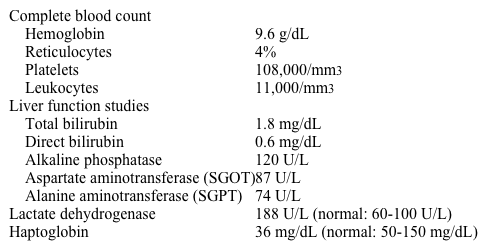 Chest x-ray reveals bilateral infiltrates. A peripheral blood smear shows normocytic, normochromic anemia with ring- and cross-shaped intraerythrocytic inclusions. The vector responsible for this patient's current condition can also transmit which of the following organisms?
 (Multiple Choice)
5.0/5  (101)
(101) A 55-year-old man comes to the physician because of a 2-week history of back pain. He has not sustained any recent trauma. He has a history of end-stage renal disease receiving intermittent hemodialysis. He appears well. Temperature is 37.5°C (99.5°F), pulse is 79/min, and blood pressure is 124/78 mm Hg. The patient also has hypertension and type 2 diabetes mellitus and was treated several weeks ago for staphylococcal bacteremia associated with the dialysis catheter. Her temperature is 38 C (100.4 F). On examination, he has tenderness over the upper lumbar vertebrae without overlying skin changes. The straight leg raise test is negative. Which of the following is the best next step in management of this patient?
(Multiple Choice)
4.9/5 (72)
(72) A 36-year-old woman comes to the physician because of a 4-day history of fever, malaise, chills, and a productive cough. She has no prior medical conditions but experienced an influenza-like illness during the previous week. Her temperature is 38.8°C (101.8°F), pulse is 92/min, respirations are 23/min, and blood pressure is 128/74 mm Hg. On physical examination, the patient is ill-appearing and lethargic. There are crackles over the right lower lung. Leukocyte count is 20,000 cells/mm3. Chest imaging reveals extensive parenchymal consolidation and cavitations suggestive of abscesses in the right middle and lower lobes. The patient is endotracheally intubated for mechanical ventilation due to worsening respiratory failure. Culture of the tracheal aspirate grows gram-positive cocci in clusters. Which of the following bacterial virulence factors most likely contributed to this patient's necrotizing infection?
(Multiple Choice)
4.9/5 (72)
(72) A 52-year-old woman comes to the physician because of progressively worsening shortness of breath on exertion and fatigue for the past 4 months. Two years ago, she came to the office with dysphagia and underwent an upper endoscopy, which showed a dilated esophagus. There is no family history of serious illness. She emigrated from Argentina 5 years ago. She has smoked one pack of cigarettes daily for 25 years. She does not drink alcohol or use illicit drugs. She is 160 cm (5 ft 3 in) tall and weighs 62 kg (137 lb); BMI is 24 kg/m2. Temperature is 37.1ºC (98.8ºF), pulse is 105/min, respirations are 15/min, and blood pressure is 110/62 mm Hg. Examination shows jugular venous distension. Cardiac examination discloses an S3 gallop and a displaced left ventricular impulse. The remainder of the examination shows no abnormalities. ECG shows left ventricular hypertrophy. Echocardiography shows right and left ventricular dilation and global hypokinesis. If this patient's symptoms are caused by an infection, which of the following organisms is the most likely cause?
(Multiple Choice)
4.7/5 (84)
(84) A 16-year-old boy is hospitalized with recent-onset insomnia, headaches, periodic agitation, and dysphagia. He is a high school student interested in becoming a veterinarian. He owns a snake, fish, and parrot and, about 4 weeks ago, went on a field trip to study bats in a cave. The patient has no known medical problems and is not taking any medications. He does not consume alcohol and has never used illicit drugs. Physical examination shows a confused and combative patient with mydriasis and neck rigidity. Which of the following acts as an entry receptor for the causative agent of this patient's condition?
(Multiple Choice)
4.7/5 (88)
(88) A 30-year-old woman comes to the physician because of a dry cough and chest discomfort for the past 3 days. During this period, the patient has had headaches, muscle aches, joint pain, fever, and chills. Ten days ago, she was hiking with her family in Mississippi. The patient has asthma that is treated with an albuterol inhaler. Her mother has a lung disease treated with methotrexate. The patient has smoked one pack of cigarettes daily for the past 10 years. Her temperature is 38°C (100.4°F). Physical examination shows slight wheezes throughout both lung fields. Chest imaging shows several small calcified nodules in both lungs and a calcified mediastinal lymph node. Urinalysis is positive for a polysaccharide antigen. Tuberculosis skin test shows a <5 mm induration at 48 hours. Which of the following is the most likely cause of the observed findings in this patient?
(Multiple Choice)
4.8/5 (80)
(80) A 24-year-old woman comes to the office due to 3 weeks of worsening throat pain and difficulty swallowing. She has no chronic medical problems but has had recurrent vulvovaginal candidiasis and bacterial folliculitis over the past year. The patient has also had an unintentional weight loss of 4.5-kg (10-lb) over the past 3 months. She is an exchange student from Senegal. Physical examination shows generalized lymphadenopathy and oropharyngeal thrush. Upper endoscopy confirms Candida esophagitis. HIV antigen/antibody immunoassay returns positive. Further testing shows a CD4 count of 180/mm3 but there is no detectable plasma HIV-1 RNA. Which of the following best explains the observed laboratory findings in this patient?
(Multiple Choice)
4.9/5 (65)
(65) A 2-month-old boy is brought to the clinic for irritability, poor feeding, and frequent vomiting. Weight is at the 15th percentile, and head circumference is at the 96th percentile. Lung sounds are clear throughout, and heart auscultation reveals no murmurs. The abdomen is soft and nondistended. There is hepatosplenomegaly. Diffusely reduced muscle tone is present in all extremities. Funduscopy reveals white-yellow chorioretinal lesions in both eyes. MRI of the brain shows enlarged ventricles and scattered intracranial calcifications. Which of the following is the most likely cause of this patient's condition?
(Multiple Choice)
4.9/5 (62)
(62) A 2900-g (6.4-lb) male newborn is delivered at term to a 29-year-old primigravid woman. His mother had no routine prenatal care. She reports that the pregnancy was uncomplicated apart from a 2-week episode of a low-grade fever and swollen lymph nodes during her early pregnancy. She has avoided all routine vaccinations because she believes that "natural immunity is better". The newborn is at the 35th percentile for height, 15th percentile for weight, and 90th percentile for head circumference. Fundoscopic examination shows inflammation of the choroid and the retina in both eyes. A CT scan of the head shows diffuse intracranial calcifications and mild ventriculomegaly.Which of the following maternal interventions would have been most effective in preventing this patient's condition?
(Multiple Choice)
4.8/5 (83)
(83) A 23-year-old man arrives to the emergency department after suffering from fever and malaise for 7 days. He has also experienced nausea and a loss of appetite. The patient has no substantial medical history, but he utilizes injectable medications on a daily basis and has had several sexual partners. The temperature is 38 degrees Celsius (100.4 F). Scleral icterus is discovered during a physical examination. 4 cm below the right costal border, a sensitive, smooth liver edge is perceptible. The appropriate treatment is started. The graph below depicts the evolution of this patient's hepatitis B serologic markers over time. 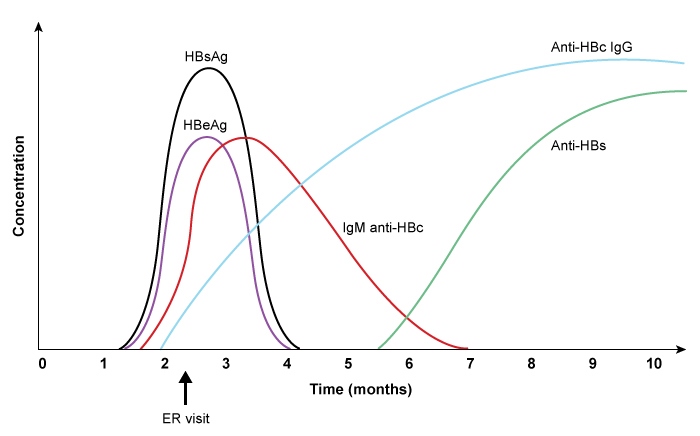 Which of the following best explains these observed findings?
 (Multiple Choice)
4.8/5 (74)
(74) A 6-year-old boy is brought to the emergency department because of fever, abdominal pain and diarrhea for the past 3 days. This morning he also had nausea and his stool had a dark red stool. The patient attends daycare and a few children there have developed diarrhea over the past week as well. His immunizations are up-to-date. His temperature is 38.0°C (100.4°F), pulse is 140/min, and blood pressure is 80/45 mm Hg. Examination shows dry mucous membranes. The abdomen is soft, and there is tenderness to palpation of the left lower quadrant with rebound. Which of the following is the most likely causal organism?
(Multiple Choice)
4.9/5 (75)
(75) A 45-year-old man comes to the physician because of a 3-week history of diarrhea and a 2.2-kg (5-lb) weight loss. He reports a several weeks of progressive fever, night sweats, and generalized weakness. . He has HIV, gastroesophageal reflux disease, and hypertension. Current medications include chlorthalidone, omeprazole, emtricitabine, tenofovir, and efavirenz. He reports taking efavirenz irregularly. He is employed as a sales manager and regularly flies to South America. Physical examination shows mucosal pallor, generalized lymphadenopathy, and hepatosplenomegaly. CD4+ T-lymphocyte count is 20/mm3. Nucleic acid amplification test of the sample for Mycobacterium tuberculosis is negative. Which of the following pathogens is the most likely cause of this patient's illness?
(Multiple Choice)
4.9/5 (68)
(68) A 22-year-old woman comes to the office for a routine prenatal visit. She is 16 weeks pregnant with her first child. Two months ago, she had a mononucleosis-like illness with fever, myalgia, and fatigue, and she was diagnosed with cytomegalovirus infection. The patient recovered with symptomatic treatment and is currently asymptomatic. Her other medical problems include episodic migraine headaches and benign choroidal nevus. She takes prenatal vitamins and does not use tobacco, alcohol, or illicit drugs. The patient has a family history of hypertension and glaucoma. Physical examination findings and prenatal ultrasound are unremarkable. This patient's unborn infant is at greatest risk for which of the following eye conditions?
(Multiple Choice)
4.9/5 (64)
(64) A 48-year-old man comes to the emergency department due to fever. He returned from a vacation in Southeast Asia a week ago and began having symptoms toward the end of his trip. He has also had headaches and abdominal discomfort; he initially had constipation but has had loose stools for the past several days. Temperature is 40 C (104 F), blood pressure is 114/68 mm Hg, and pulse is 62/min. No oropharyngeal lesions, cervical lymphadenopathy, or neck rigidity is present. Lungs are clear on auscultation, and heart sounds are normal. Physical examination reveals a faint, erythematous, macular skin rash over the trunk and abdomen. Blood culture grows non-lactose fermenting gram-negative rods. Which of the following best explains the prolonged and severe disease course from this pathogen compared to the patient's previous bacterial infection?
(Multiple Choice)
4.9/5 (84)
(84) A 28-year-old man arrives to the emergency department after experiencing headaches, fever, and spells of inattention for two weeks. The patient has Hodgkin lymphoma and is being treated with combined chemotherapy. The temperature is 38.2 C (100.8 F), the blood pressure is 138/84 mm Hg, and the pulse rate is 72 / minute. A lumbar puncture indicates an elevated opening pressure, whereas cerebrospinal fluid analysis reveals moderately raised protein levels and low glucose levels. The picture depicts light microscopy of cerebrospinal fluid. 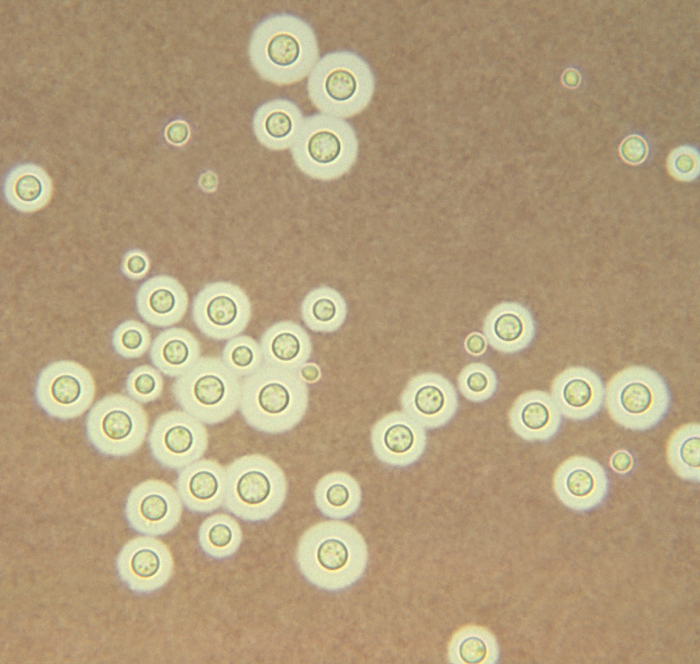 Which of the following should be included in initial treatment for this patient's current condition?
 (Multiple Choice)
4.7/5 (89)
(89) A pharmaceutical researcher is developing a novel agent to prevent meningococcal disease in people exposed to the bacteria. Pili antigens from Neisseria meningitidis are extracted and used to generate monoclonal antibodies that impair normal pili function. The antibodies are administered to experimental animals with no prior exposure to N meningitidis. These animals, along with control animals that had not received the antibodies, are subsequently exposed to the bacteria. Compared to the control animals, a significantly greater proportion of the animals that received the antibodies remain healthy and develop no symptoms. The efficacy of these antibodies in preventing meningococcal disease is most likely due to direct interference with which of the following microbial processes?
(Multiple Choice)
4.8/5 (77)
(77) A 38-year-old man comes to the physician because of fever, malaise, productive cough, and left-sided chest pain for 2 weeks. He was diagnosed with HIV infection 1 year ago. He currently stays at a homeless shelter. He has smoked one pack of cigarettes daily for 22 years. He is receiving combined antiretroviral therapy but sometimes misses doses. His temperature is 38.6°C (101.5°F), pulse is 106/min, and blood pressure is 125/85 mm Hg. Pulse oximetry on room air shows an oxygen saturation of 94%. Chest x-ray reveals a right apical lung infiltrate and cavitary lesion. He is placed in respiratory isolation, and appropriate empiric therapy is started. The cavitary lesions seen in this patient most likely formed through which of the following pathogenic mechanisms?
(Multiple Choice)
4.9/5 (86)
(86) A 20-year-old male comes to the physician because of a 1-week-history of a painless ulceration on his penis. The patient is sexually active with multiple partners and does not use barrier protection. He also has a diffuse maculopapular rash involving the trunk, extremities, palms, and soles. An HIV test is negative. Rapid plasma reagin (RPR) and fluorescent treponemal antibody absorption test (FTA-ABS) are positive. Genital examination reveals multiple elevated lesions on the scrotum and perineal region. Histopathologic evaluation of these lesions would most likely reveal which of the following in this patient?
(Multiple Choice)
4.9/5 (73)
(73) A 45-year-old man comes to the physician due to pain, swelling, and erythema affecting his right leg. He says that he suffered a minor cut to his leg a few days ago while cleaning his garage. Physical examination shows an indurated region surrounding a minor laceration that is draining a purulent exudate. He is diagnosed with cellulitis and started on the appropriate treatment. Gram stain of the exudate shows gram-positive cocci in clusters. The organism most likely responsible for this patient's infection synthesizes a protein as part of its peptidoglycan cell wall that does which of the following?
(Multiple Choice)
4.9/5 (77)
(77) A 63-year-old man comes to the physician because of a 2-day history of redness, swelling, and pain of the right leg. He also has fever, chills, and nausea. He has hypertension and gastroesophageal reflux disease. His current medications include metoprolol, enalapril, and omeprazole. His temperature is 38.7°C (101.7°F), pulse is 106/min, and blood pressure is 142/94 mm Hg. Examination of the right lower leg shows a large area of erythema with poorly-demarcated borders. The area is nonfluctuant, warm, and tender to touch. Examination of the right groin shows several enlarged, tender lymph nodes. There is mild edema of the ankles bilaterally. Blood and wound cultures are collected. Infection with which of the following organisms is most likely responsible for this patient's current symptoms?
(Multiple Choice)
4.7/5 (68)
(68) 
Filters
- Essay(0)
- Multiple Choice(0)
- Short Answer(0)
- True False(0)
- Matching(0)