



 Chat with AI
Exam 9: Microbiology and Virology

Exam 1: Anatomy265 Questions
Exam 2: Behavioral Sciences178 Questions
Exam 3: Biochemistry102 Questions
Exam 4: Embryology59 Questions
Exam 5: Epidemiology, Biostatistics, and Medical Informatics94 Questions
Exam 6: Genetics88 Questions
Exam 7: Histology46 Questions
Exam 8: Immunology147 Questions
Exam 9: Microbiology and Virology330 Questions
Exam 10: Pathology817 Questions
Exam 11: Pharmacology and Toxicology509 Questions
Exam 12: Physiology339 Questions
Exam 13: Psychiatry and Psychotherapy23 Questions
Select questions type


A 28-year-old woman, gravida 1, para 0, at 32 weeks' gestation comes to the physician for a prenatal visit. She has had no prenatal care. She emigrated from China 5 years ago and cannot recall all of her vaccinations. She appears well. Physical examination shows a uterus consistent in size with a 32-week gestation. Serum studies show:
Anti-hepatitis A IgM antibody negative
Anti-hepatitis A IgG antibody positive
Hepatitis B surface antigen negative
Anti-hepatitis B surface antibody positive
Hepatitis B core antigen negative
Anti-hepatitis B core antibody negative
Which of the following is the most appropriate initial action by the physician?
(Multiple Choice)
4.8/5  (64)
(64) A previously healthy 28-year-old woman teacher comes to the emergency department because of diarrhea and abdominal cramps since the previous evening. She has had around 3-4 episodes of watery stools. She feels nauseated and has vomited twice. Six healthy children age 10-11 and two teachers in her school also developed acute vomiting and diarrhea within a 2-day period. . She has been on a vegan diet for 6 months. She takes no medications and has not traveled anywhere recently. Her temperature is 36.8°C (98.2°F), pulse is 73/min, and blood pressure is 110/70 mm Hg. Examination shows dry mucous membranes. Abdominal examination is unremarkable. Which of the following is the most likely causal organism?
(Multiple Choice)
4.9/5 (80)
(80) A 32-year-old nulligravid woman comes to the physician because of postcoital pain and blood-tinged vaginal discharge. She has been sexually active with one male partner for the past 3 months. They do not use condoms. Her only medication is a combined oral contraceptive that she has been taking for the past 2 years. Speculum examination reveals purulent discharge from the cervical os, and the cervix is friable. On bimanual examination, there is no cervical motion tenderness, and the adnexa are nontender bilaterally. Urine pregnancy testing is negative. Microscopy of the discharge shows abundant neutrophils. If left untreated, this patient's condition could lead to which of the following complications?
(Multiple Choice)
4.8/5 (76)
(76) A 1-year-old boy is brought to the emergency department by his mother because of high fever, irritability, and photophobia. He recently underwent ventriculoperitoneal shunt placement for congenital hydrocephalus. On physical examination, his temperature is 38.3° C (101° F), and passive flexion of the neck results in spontaneous flexion of the hips and knees. Blood cultures grow coagulase-negative Staphylococcus. Which of the following is the most important virulence mechanism by which this bacterium causes disease?
(Multiple Choice)
4.8/5 (78)
(78) A previously healthy 22-year-old man comes to the physician because of a 1-week history of fever, fatigue, myalgia, sore throat, and difficulty swallowing. He works as a tour guide but has been unable to go to work for the last few days because he is easily exhausted. He has no history of serious illness and takes no medications. He appears lethargic. His temperature is 38.7°C (101.7°F), pulse is 72/min, and blood pressure is 116/74 mm Hg. Examination of the neck and oropharynx shows tender cervical lymphadenopathy and erythematous, swollen tonsils with white exudates. Lungs are clear to auscultation. The liver is palpated 3 cm below the right costal margin and the spleen is palpated 2 cm below the left costal margin. His hemoglobin concentration is 13.2 g/dL and his leukocyte count is 16,400/mm3. A blood smear shows atypical lymphocytosis. A heterophile antibody test is positive. Which of the following is most likely to be elicited on further history?
(Multiple Choice)
4.9/5 (87)
(87) A 52-year-old woman is evaluated due to 2 weeks of fever, fatigue, nonproductive cough, and dyspnea, which began shortly after visiting her family in Ohio. She also lost 1.5 kg (3.3 lb) over the same period. The patient has a history of rheumatoid arthritis and has been taking adalimumab for the past 6 months. She had negative tuberculosis skin testing prior to beginning the drug. Temperature is 38 C (100.4 F), blood pressure is 130/70 mm Hg, pulse is 92/min, and respirations are 18/min. Physical examination reveals bilateral lung crackles, mild generalized lymphadenopathy, and hepatosplenomegaly. Chest x-ray shows bilateral nodular densities and hilar lymphadenopathy. Urine testing is positive for a fungal antigen. Which of the following pathogenic processes is most important during the development of this patient's infection?
(Multiple Choice)
5.0/5 (79)
(79) A 25-year-old man comes to the physician with a 4-day history of fever and malaise followed by the onset of severe joint pain yesterday. This morning, his body felt unusually stiff. He works as a social media expert and went to Puerto Rico on a business trip 10 days ago. He is in a polyamorous relationship and reports that he was sexually active with one female partner during the business trip; he uses condoms. He appears lethargic but is alert and oriented. His temperature is 39.1°C (102.4°F), pulse is 64/min, respirations are 14/min, and blood pressure is 123/76 mm Hg. Physical examination shows tender deltoid muscles bilaterally as well as tenderness in proximal interphalangeal joints, metacarpophalangeal joints, radiocarpal joints, and tarsophalangeal joints bilaterally. The left first metatarsophalangeal joint is swollen with no erythema or tenderness. A diffuse nonpruritic maculopapular rash is visible. Laboratory testing reveals lymphopenia. Which of the following is the most likely cause of this patient's symptoms?
(Multiple Choice)
4.9/5 (84)
(84) A 55-year-old man arrives at the emergency room with a fever and chills. He has a history of acute myeloid leukemia and is now undergoing treatment. His temperature is 38.3 degrees Celsius (101 degrees Fahrenheit), his blood pressure is 90/50 mm Hg, his pulse rate is 124 beats per minute, and his respirations are 22 per minute. Multiple skin patches with necrotic cores and occasional ulcerations are visible on physical inspection, as illustrated in the figure below. 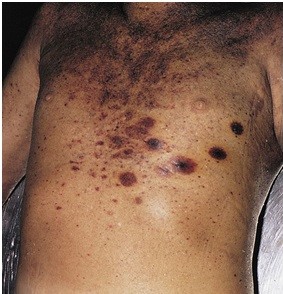 Laboratory results are as follows:
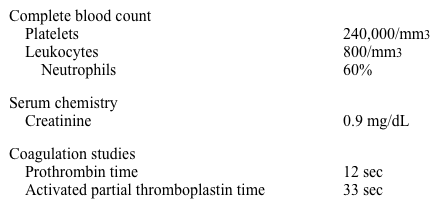 Blood cultures are drawn. Which of the following organisms is most likely responsible for this patient's symptoms?
Laboratory results are as follows: Blood cultures are drawn. Which of the following organisms is most likely responsible for this patient's symptoms? (Multiple Choice)
4.9/5 (90)
(90) The influenza A virus uses a sialic acid as a receptor for cellular entry. The chemical composition of the specific type of sialic acid that the virus interacts with differs among animal species. The avian influenza virus attaches to a specific sialic acid that is present in fowl epithelial cells but absent in human cells, whereas the human influenza virus can only attach to the type of sialic acid present in human respiratory epithelium. When pig epithelial cells, which contain both types of sialic acid, are infected with the combination of avian and human influenza A viruses, some of the new avian influenza viral particles become capable of attaching to human cells. However, the progeny of this new strain of avian influenza virus is still unable to attach to human epithelial cells. Which of the following phenomena best describes the change in the avian influenza virus in this experiment?
(Multiple Choice)
4.8/5 (76)
(76) A 36-year-old man comes to the emergency department because of progressively worsening shortness of breath and fever for 2 days. He also has a nonproductive cough. He does not have chest pain or headache. His temperature is 38.1°C (100.6°F), pulse is 103/min, respirations are 26/min, and blood pressure is 130/70 mm Hg. Pulse oximetry on room air shows an oxygen saturation of 91%. Pulmonary examination shows diffuse crackles. The spleen tip is palpated 4 cm below the left costal margin. The patient's serum fails to agglutinate horse erythrocytes. The agglutination test is repeated a week later and, again, no agglutination is noted. HIV testing is negative. Which of the following is the most likely cause of this patient's condition?
(Multiple Choice)
4.9/5 (79)
(79) A 5-year-old boy is brought to the emergency department because of weakness and spasms for the past 12 hours. His mother states that he has also had difficulty feeding and opening his mouth. He has not had fever, cough, diarrhea, or vomiting. His jaw muscles are tight. Examination shows generalized muscle stiffness and twitches. He has a history of an accidentally cut his right forearm last week while working with his mother's embroidery scissors. Release of which of the following neurotransmitters is most likely to be directly impaired in this patient?
(Multiple Choice)
4.9/5 (83)
(83) A 28-year-old man is brought to the emergency department because of a 3-day history of fever, chills, and generalized weakness. He has no cough. He underwent routine dental cleaning with no complications. The patient has a history of mitral valve prolapse. He takes no medications. He has smoked one pack of cigarettes daily for 10 years and drinks two to three beers daily. He appears ill. His temperature is 38.6°C (101.5°F), pulse is 112/min, respirations are 20/min, and blood pressure is 110/70 mm Hg. There are retinal hemorrhages with pale centers. The lungs are clear to auscultation. A grade 3/6 holosystolic murmur is heard best at the lower left sternal border. Blood cultures are drawn and grow gram-positive bacteria that synthesize dextrans from sucrose. Which of the following would be the most likely adherence site for these bacteria?
(Multiple Choice)
4.9/5 (76)
(76) A 24-year-old woman, gravida 1, para 0, at 33 weeks' gestation, is admitted to the hospital in active labor. She delivers a small male newborn. Apgar scores were 6 and 6 at 1 and 5 minutes, respectively. His mother received no prenatal care. On delivery, the placenta appears enlarged. In addition, the umbilical cord is inflamed with multiple areas of abscess-like foci of necrosis surrounding the umbilical vessels. Which of the following is the most likely cause of these findings?
(Multiple Choice)
4.8/5 (91)
(91) A 32-year-old woman comes to the physician because of a 2-month history of fatigue and muscle pain. Over the past month, she has had intermittent episodes of nausea. She has a history of intravenous drug use, but she has not used illicit drugs for the past five years. She has smoked one pack of cigarettes daily for 14 years and drinks one alcoholic beverage daily. She takes no medications. Her last visit to a physician was 4 years ago. Her temperature is 37.0°C (98.6°F), pulse is 90/min, respirations are 20/min, and blood pressure is 110/70 mm Hg. Physical examination shows jaundice and hepatosplenomegaly. There are blisters and erosions on the dorsum of both hands. The remainder of the examination shows no abnormalities. Laboratory studies show:are positive for hepatitis C virus RNA. Six months previously, she tested negative for hepatitis C. Without treatment, which of the following is the most likely outcome in this patient?
(Multiple Choice)
4.8/5 (72)
(72) A 14-year-old girl comes to the physician with dark urine and facial puffiness. About 4 weeks before presentation, she had pustular skin lesions that broke down over a few days to form thick scabs in the lower extremities. Microscopic examination of the urine sediment shows red blood cell casts. The organism responsible for this patient's symptoms would most likely demonstrate which of the following?
(Multiple Choice)
4.9/5 (73)
(73) A 26-year-old man comes to the office due to a 3-day-history of dysuria and urethral discharge. The symptoms developed about 2 weeks after he had unprotected sexual intercourse with a new partner. His temperature is 37.1 C (98.8 F). On physical examination, a mucoid discharge is expressed with gentle milking of the penis. Gram stain of the discharge reveals numerous neutrophils with intracellular diplococci. A sample of the discharge is placed on an antibiotic-containing medium, and bacterial colonies are cultured. Which of the following terms best describes the medium?
(Multiple Choice)
4.9/5 (91)
(91) A 5-year-old boy is brought to the emergency department for evaluation of a progressive rash that started 2 days ago. The rash began on the face and progressed to the trunk and extremities. Over the past week, he has had a runny nose, a cough, and red, crusty eyes. He immigrated with his family from Turkey 3 months ago. His father and his older brother have Behçet disease. Immunization records are unavailable. The patient appears irritable and cries during the examination. His temperature is 40.0°C (104°F). Examination shows generalized lymphadenopathy and dry mucous membranes. Skin turgor is decreased. There is a blanching, partially confluent erythematous maculopapular exanthem. Examination of the oral cavity shows two 5-mm aphthous ulcers at the base of the tongue. His hemoglobin concentration is 11.5 g/dL, leukocyte count is 6000/mm3, and platelet count is 215,000/mm3. Deficiency of which of the following is associated with a high rate of complications from this patient's condition?
(Multiple Choice)
4.9/5 (74)
(74) A previously healthy 48-year-old man comes to the physician because of a 2-week history of a nonpruritic rash on his right forearm. The rash began as pustules and progressed to form nodules and 2 other similar papules appeared proximal to the original lesion. He works as a gardener. Physical examination shows a 1-cm, nontender, red nodule on the dorsum of the right hand with 2 smaller papules in linear distribution proximal to it. Which of the following histopathologic findings is most likely present in this patient's skin lesions?
(Multiple Choice)
4.8/5 (75)
(75) A 56-year-old woman from New York City comes to the emergency department on Christmas Eve because of a 10-day history of malaise and a progressively worsening headache with occasional nausea and vomiting. She also has had a 6-week history of dyspnea, a productive cough, and night sweats. The patient is accompanied by a 10-year-old boy who says that they initially met while he was walking alone in Central Park and that he found her "covered with pigeons." The patient does not remember her medical history and denies having traveled anywhere recently. She does not smoke cigarettes or use illicit drugs. Her temperature is 38.1°C (100.6°F) and respirations are 25/min. She is alert and fully oriented. Neurologic examination shows no focal findings. There is nuchal rigidity. Her CD4+ T-lymphocyte count is 80/mm3. An HIV screening test is positive. An MRI of the brain shows no abnormalities. India ink staining of cerebrospinal fluid demonstrates spherical yeast forms with thick capsules. Which of the following is the most likely site of primary infection in this patient?
(Multiple Choice)
4.9/5 (76)
(76) A 5-year-old boy is brought to the emergency department with worsening lethargy for 3 days. Six days ago, he experienced abdominal pain, vomiting, and bloody diarrhea that have since resolved. His temperature is 38.8°C (101.8°F), pulse is 128/min, respirations are 30/min, and blood pressure is 96/60 mm Hg. Examination shows pale conjunctivae and scleral icterus. Physical examination shows pallor but is otherwise normal. He has no peripheral edema or rashes. Laboratory evaluation shows anemia, thrombocytopenia, and elevated blood urea nitrogen and serum creatinine. Peripheral blood smear shows fragmented erythrocytes. This patient's condition is most likely related to consumption of which of the following foods?
(Multiple Choice)
4.7/5 (83)
(83) 
Filters
- Essay(0)
- Multiple Choice(0)
- Short Answer(0)
- True False(0)
- Matching(0)