



 Chat with AI
Exam 3: Biochemistry

Exam 1: Anatomy265 Questions
Exam 2: Behavioral Sciences178 Questions
Exam 3: Biochemistry102 Questions
Exam 4: Embryology59 Questions
Exam 5: Epidemiology, Biostatistics, and Medical Informatics94 Questions
Exam 6: Genetics88 Questions
Exam 7: Histology46 Questions
Exam 8: Immunology147 Questions
Exam 9: Microbiology and Virology330 Questions
Exam 10: Pathology817 Questions
Exam 11: Pharmacology and Toxicology509 Questions
Exam 12: Physiology339 Questions
Exam 13: Psychiatry and Psychotherapy23 Questions
Select questions type


After his truck breaks down while searching for gold in Arizona, a 43-year-old man finds stranded in the desert. He carried plenty of water, but only a few granola bars for nourishment. He is able to flag down a passing car and gain transportation to the next village after three days. His liver begins to produce significant amounts of glucose from source molecules such as alanine, lactate, and glycerol throughout this experience. Phosphoenolpyruvate is synthesized from oxaloacetate in a reaction that needs a particular nucleoside triphosphate as a cofactor. Which of the following processes produces this cofactor directly? 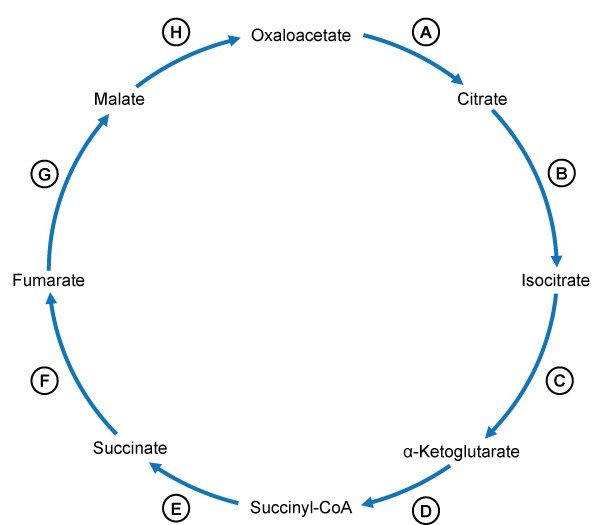

Free
(Multiple Choice)
5.0/5  (69)
(69) Correct Answer: Verified
E
A biologist is studying signal transduction apply an agent to human cells that activates G-protein- dependent phospholipase C. Which of the following intracellular substances is most likely to increase immediately after exposure to this agent?
Free
(Multiple Choice)
4.9/5 (74)
(74) Correct Answer:Verified
VerifiedA
A 79-year-old woman arrives at the office for an examination of walking difficulties caused by weariness and bilateral leg discomfort. The pain began in her lower legs three weeks ago and has now spread to her thighs' muscles. She has also seen red blotches on her legs. The patient has been living alone since her spouse died three years ago and is mostly housebound. Her diet is primarily comprised of bread and tinned meat items. The gums are swollen and sensitive on inspection. The exhibit depicts the patient's skin results. 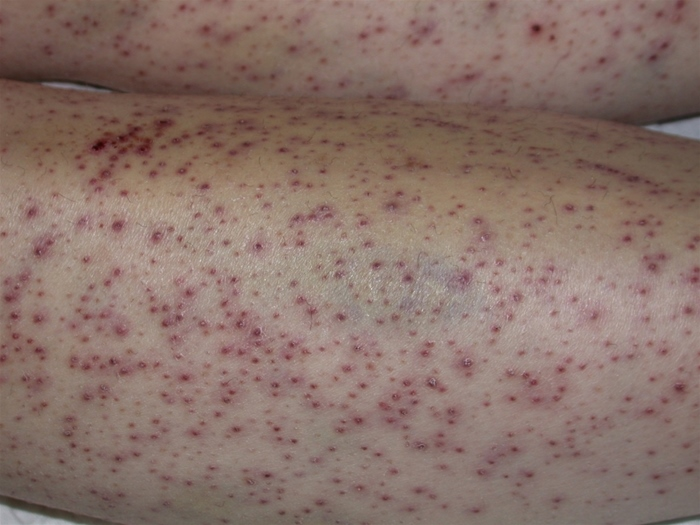 Muscles of the lower limbs are tender to palpation. Imaging studies reveal a tibial subperiosteal hematoma. Which of the following nutrient deficiencies is most likely responsible for this patient's symptoms?
Free
(Multiple Choice)
4.9/5 (72)
(72) Correct Answer:Verified
VerifiedA
A 22-year-old previously healthy man is brought to the emergency department by his mother because of crushing chest pain, nausea, and vomiting for the past 2 hours. The pain is constant and radiates to his left shoulder. Over the past year, he has been admitted to the hospital twice for deep vein thrombosis. He has a history of learning disability and has been held back three grades. The patient is at the 99th percentile for height and the 45th percentile for weight. His pulse is 110/min, respirations are 21/min, and blood pressure is 128/84 mm Hg. His fingers are long and slender, and his arm span exceeds his body height. Electrocardiography shows ST-segment elevation in leads V1 and V2. His serum troponin I concentration is 2.0 ng/mL. Coronary angiography shows 90% occlusion of the proximal left anterior descending artery. Further testing reveals a homozygous mutation in the methylene tetrahydrofolate reductase gene that leads to decreased enzymatic activity. Due to this defect, the patient most likely has impairment converting homocysteine to which of the following?
(Multiple Choice)
4.8/5 (85)
(85) As part of an experiment, healthy volunteers undergo a 12-hour fast and then drink a solution containing radiolabeled alanine. Consecutive blood samples are drawn every 15 minutes for the next 3 hours. Initial blood samples detect the radiolabeled alanine, but analysis of later samples shows that the radiotracer is present in blood primarily in the form of glucose. Before alanine can be converted to glucose, its amino group is transferred to which of the following?
(Multiple Choice)
4.8/5 (76)
(76) A 13-month-old boy is evaluated for failure to thrive and delayed physical and mental development. His mother reports that at 12 months he could barely lift his head and had difficulty sitting unsupported. The toddler has not started babbling or forming words. He is at the 10th percentile for height and 5th percentile for weight. Laboratory results show Megaloblastic anemia and normal ammonia level. Urine specimens reveal increase orotic acid . Supplementation with which of the following substances would most likely benefit this patient?
(Multiple Choice)
4.9/5 (79)
(79) A 55-year-old man is brought to the emergency department for abdominal pain associated with watery diarrhea. His symptoms have been progressive over the last month. He says that he is depressed and often has difficulty remembering things. The patient has a 20-year history of alcohol use disorder. On examination, he appears disheveled. A pigmented scaly skin rash is present in the malar distribution of his face, neck, and back of his hands. The rash has been present for several months and worsens on exposure to sunlight. It is determined that the patient's symptoms are secondary to lack of a specific nutrient. Activity of which of the following enzymes is most likely decreased in the patient as a result of this deficiency?
(Multiple Choice)
4.8/5 (92)
(92) A 13-year-old boy is brought to the emergency department with severe chest pain. He has had intermittent substernal chest pain for the past few months that typically occurs after heavy activity. The boy's activities have been limited due to the chest pain, and he is no longer able to play on the soccer team. The patient does not use tobacco or illicit drugs. His temperature is 36.7 C (98 F), blood pressure is 130/80 mm Hg, pulse is 132/min, respirations are 24/min, and pulse oximetry is 98% on room air. BMI is 17 kg/m2. Physical examination shows an anxious-appearing boy with a rapid but regular pulse. No abnormalities are seen. Troponin is elevated, and ECG reveals ST segment elevations in leads II, III, and aVF. After acute stabilization and treatment, further laboratory workup shows an increased serum methionine level. Which of the following amino acids is most likely essential in this patient?
(Multiple Choice)
5.0/5 (86)
(86) A 40-year-old homeless man comes to the emergency department due to a "pins-and-needles" sensation in his legs. He also has painful lesions on his lips and corners of his mouth. He has had no loss of consciousness, nausea, vomiting, or diplopia. The patient drinks alcohol heavily on a daily basis and has a history of intravenous heroin use. On physical examination, he appears unkempt and ill appearing. Temperature is 36.8 C (98.2 F), blood pressure is 146/90 mm Hg, and pulse is 106/min. He has glossitis and angular stomatitis. Abdominal examination reveals hepatomegaly. Laboratory evaluation shows very low urinary riboflavin excretion. Activity of which of the following enzymes is most likely directly impaired in this patient?
(Multiple Choice)
4.8/5 (78)
(78) A 37-year-old woman is diagnosed with a tumor that is causing symptoms of excessive hormone production. She underwent a surgical resection of the lesion, and the neoplastic tissue is subjected to detailed pathologic studies. Pathologist reveals the tumor cells have highly developed, smooth endoplasmic reticulum. Which of the following is a possible direct effect of the substance secreted by these cells?
(Multiple Choice)
4.9/5 (84)
(84) A dermatology researcher is studying the role of different amino acids in wound healing. She cultures mature dermal fibroblasts in growth media. After several days, the fibroblasts begin synthesizing polypeptide chains that assemble into triple helical structures, followed by fibrils. The fibrillar proteins are hydrolyzed and separated into their constituent amino acids via paper chromatography. Which of the following amino acids is most likely to be found in highest quantity in these proteins?
(Multiple Choice)
4.9/5 (82)
(82) A 6-month-old infant male is brought to the emergency department with a 1-hour history of vomiting and convulsions. He was born at home and had sporadic prenatal care though his parents say that he appeared healthy at birth. He initially fed well; however, his parents have noticed that he has been feeding poorly and is very irritable since they moved on to baby foods. They have also noticed mild yellowing of his skin but assumed it would go away over time. On presentation, he is found to be very sleepy, and physical exam reveals an enlarged liver and spleen. The rest of the physical exam is normal. Which of the following enzymes is most likely to be deficient in this patient?
(Multiple Choice)
4.9/5 (86)
(86) A 32-year-old man is admitted to the hospital after sustaining a head injury and fractures of both femurs in a motor vehicle collision. CT scan of the head reveals a left-sided extradural hematoma. He has no history of chronic illness and takes no medications. The patient receives intravenous fluid boluses and blood transfusions and is taken to the operating room for fracture repair and removal of the hematoma. On the first postoperative day, laboratory results show high plasma glucose and lactate levels. Which of the following is the primary contributor to this patient's elevated blood glucose levels?
(Multiple Choice)
4.8/5 (85)
(85) A 3-year-old boy is brought to the office by his parents due to a concern of abnormal urine color. After he urinated in the toilet last night, his parents forgot to flush the toilet and noticed that the boy's urine turned black overnight. The child has no significant past medical history and takes no medications. He has no abnormal growth and developmental milestone. Examination shows a well-nourished child with no swelling or tenderness of any joints. Urinalysis results are as follows: 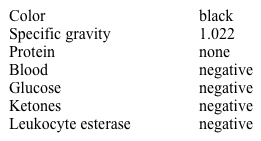 Which of the following conversion pathways is most likely deficient in this patient?
 (Multiple Choice)
4.8/5 (82)
(82) A 62-year-old man comes to the office due to an enlarging mole on his left forearm. The patient works as a farmer and has a significant amount of sun exposure daily. On examination, he has a black-brown macular lesion on the dorsum of his right forearm measuring approximately 1 cm in diameter with an irregular border. Excisional biopsy is performed and histopathology reveals malignant melanoma. Immunohistochemical analysis indicates that the malignant cells have decreased integrin expression. These cells are most likely to exhibit poor adhesion to which of the following components of the extracellular matrix?
(Multiple Choice)
5.0/5 (76)
(76) A 18-month-old boy is brought to the office due to developmental delay and failure to thrive. his mother states that he has recurrent ear infections since 6 months of age. Physical examination shows corneal clouding, hepatosplenomegaly, and restricted joint mobility. Further evaluation shows deficient phosphorylation of mannose residues on certain glycoproteins in the Golgi apparatus. In unaffected patients, these proteins are normally transported to which of the following cellular locations?
(Multiple Choice)
4.8/5 (59)
(59) A group of researchers is looking at the changes in oxygen-hemoglobin binding that occur under different clinical settings. They are particularly interested in circumstances that change the form and location of the oxygen-hemoglobin dissociation curve. Which of the following procedures would most likely cause the blue curve in the graph below to move to the red curve? 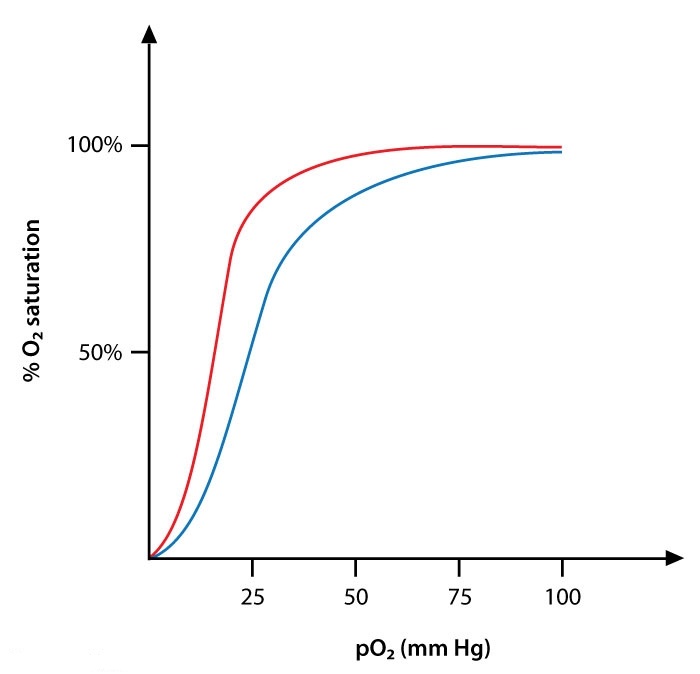
(Multiple Choice)
4.8/5 (69)
(69) A 26-year-old man is brought to the emergency department due to progressive confusion. His roommate says that he has been binge drinking for the last 5 days and probably has had very little to eat. The patient's medical history is significant for alcohol-related seizures 1 year ago. He had been sober until 2 weeks ago, when he started drinking again. The patient's past medical history is otherwise unremarkable. On examination, he responds to voice but does not follow commands. Fingerstick glucose is 35 mg/dL and urine is strongly positive for ketones. Suppression of which of the following is the primary cause of this patient's hypoglycemia?
(Multiple Choice)
4.8/5 (86)
(86) A 6-month-old boy is brought to the emergency department by his mother because of recent onset of vomiting, irritability, and jaundice. The infant was born at term and had been healthy until the onset of these symptoms. All of his vaccinations are up-to-date. He had been breast-fed exclusively until 1 week ago, when cereals and fruit juices were introduced into his diet. Further evaluation reveals hepatomegaly and abnormal liver function tests. Serum glucose is 30 mg/dL. Diagnostic testing confirms aldolase B deficiency. Which of the following should be removed from this patient's diet?
(Multiple Choice)
4.9/5 (91)
(91) Biologists investigating the morphologic changes associated with reversible cellular injury perform a procedure on anesthetized mice to assess the effects of transient hepatic ischemia. During the experiment, they clamp the hepatic artery and obtain liver biopsy samples at varying intervals. The samples are then examined by electron microscopy. Cells that are exposed to longer ischemic periods are found to have reduced numbers of ribosomes attached to the endoplasmic reticulum. This structural change is most likely to impair which of the following cellular functions?
(Multiple Choice)
4.8/5 (90)
(90) 
Filters
- Essay(0)
- Multiple Choice(0)
- Short Answer(0)
- True False(0)
- Matching(0)