



 Chat with AI
Exam 3: Biochemistry

Exam 1: Anatomy265 Questions
Exam 2: Behavioral Sciences178 Questions
Exam 3: Biochemistry102 Questions
Exam 4: Embryology59 Questions
Exam 5: Epidemiology, Biostatistics, and Medical Informatics94 Questions
Exam 6: Genetics88 Questions
Exam 7: Histology46 Questions
Exam 8: Immunology147 Questions
Exam 9: Microbiology and Virology330 Questions
Exam 10: Pathology817 Questions
Exam 11: Pharmacology and Toxicology509 Questions
Exam 12: Physiology339 Questions
Exam 13: Psychiatry and Psychotherapy23 Questions
Select questions type


A research scientist develops an agent that specifically blocks the interaction of inositol triphosphate with its intracellular receptor. A study is then performed in which vascular smooth muscle cells are divided into 2 groups: an experimental group treated with the receptor blocker and an untreated control group. Both groups are exposed to phenylephrine. Compared to the control cells, decreased activity of which of the following enzymes is most likely to be observed in the experimental cells?
(Multiple Choice)
4.9/5  (78)
(78) A 5-day-old boy born to a 24-year-old woman is brought to the office for evaluation of poor feeding and vomiting. The pregnancy was uneventful and the mother had a normal delivery. Family history is noncontributory. The patient's temperature is 37.2 C (99 F), blood pressure is 60/30 mm Hg, pulse is 110/min, and respirations are 56/min. Physical examination reveals a lethargic newborn with exaggerated deep tendon reflexes and clonus. Further investigation reveals that the patient has an inherited condition that results in impaired transport of ornithine from the cytosol to the mitochondria. Nutritional restriction of which of the following substances can improve this patient's condition?
(Multiple Choice)
4.9/5 (78)
(78) A 14-year-old boy is brought to the emergency department due to excessive urination and thirst. He has lost 4.5 kg (10 lb) in the last 3 weeks. The patient has no past medical problems. His father has type 1 diabetes mellitus. Physical examination shows dry mucous membranes. Laboratory studies reveal blood glucose of 455 mg/dL, normal anion gap, and hemoglobin A1c of 11.3%. The patient is diagnosed with type 1 diabetes, and treatment with insulin is initiated. In addition to lowering blood glucose, insulin increases glycogen synthesis in hepatocytes. Activation of which of the following molecules most likely promotes this metabolic effect?
(Multiple Choice)
4.7/5 (83)
(83) A 17-year-old child was discovered unconscious at home after being diagnosed with type 1 diabetes mellitus. According to his family, the patient did not feel well last night and skipped supper, but he nevertheless took his customary insulin dosage. His fingerstick blood glucose level is 32 mg/dL, so paramedics promptly give intramuscular glucagon. In hepatocytes, glucagon interacts to a transmembrane receptor, promoting intracellular GTP binding to a particular receptor-associated protein. This results in further downstream signaling and fast metabolic changes inside hepatocytes, such as a rapid depletion in intracellular glycogen reserves and glucose release into the blood. Which of the following is the most likely cause of these effects?
(Multiple Choice)
4.7/5 (76)
(76) A 3-day-old boy is brought to the office due to poor feeding, vomiting, and progressive lethargy. The parents also report that his diapers have a "burnt sugar smell" differing from their previous children's diapers. The mother and infant were discharged from the hospital yesterday after a normal pregnancy and spontaneous vaginal delivery. The mother is exclusively breastfeeding. Her other 2 children are healthy and have no medical problems. Physical examination shows a lethargic infant with dry mucous membranes and generalized hypertonia. Which of the following should be restricted from this infant's diet?
(Multiple Choice)
4.8/5 (81)
(81) A 7-year-old girl is brought to the office for by her parent due to a concern of short stature. The patient's mother and father are 172.5 cm (5'8") and 183 cm (6') tall, respectively. On physical examination, the patient's height is 3 standard deviations below the mean for her age. Other findings include low-set ears, a high arched palate, a webbed neck, and cubitus valgus. Chromosomal analysis reveals a 45,XO karyotype. The patient is started on a medication to improve growth and normalize her height. Which of the following intracellular pathways is stimulated by the medication used in this patient?
(Multiple Choice)
4.7/5 (88)
(88) Nutrition researchers investigating the relationship between fructose consumption and cardiovascular disease conduct a prospective cohort study on a population of randomly selected young adults. Study participants undergo semiannual measurement of waist circumference, blood pressure, and serum cholesterol and triglyceride concentrations. Dietary fructose consumption is assessed through the use of questionnaires and by measuring urinary fructose excretion. A 23-year-old man enrolled in the study is found to excrete large amounts of fructose in his urine compared to other study participants despite maintaining a moderate fructose intake. Further evaluation shows a hereditary defect in fructose metabolism, but he is asymptomatic and has no other medical problems. This patient most likely remains able to metabolize fructose due to the compensatory activity of which of the following enzymes?
(Multiple Choice)
5.0/5 (74)
(74) A research scientist studying the metabolic pathways that contribute to obesity feeds experimental animals a high-carbohydrate, high-protein diet for a prolonged period. A sample of liver tissue is then obtained from the animals, and the activity of various enzymes involved in fatty acid metabolism is measured and recorded. It is determined that beta-oxidation of fatty acids is inhibited within these cells as a result of the diet. An increase in which of the following substances is most likely responsible for the observed effect?
(Multiple Choice)
4.9/5 (85)
(85) An autopsy is being performed on a 4-year-old boy who recently died from a myocardial infarction. The child had a history of intellectual disability. Autopsy shows a prominent forehead and broad nose. There is a diffuse haze over the corneas bilaterally. The heart, liver, and spleen are enlarged. Sampling of the coronary arteries is most likely to reveal intimal accumulation of which of the following substances?
(Multiple Choice)
4.9/5 (68)
(68) A 3-year-old boy is brought to the emergency department due to altered mental status with fever. He had multiple episodes of emesis this morning, and his mother was unable to wake him from his afternoon nap. The boy has had mild rhinorrhea and fever for the past 3 days. Since the newborn period, the parents say that the patient has had multiple illnesses characterized by vomiting and sleepiness. Prior laboratory testing revealed increased blood ammonia levels during these episodes and markedly increased orotic acid excretion in the urine. Physical examination shows a tachypneic boy who is unresponsive to all stimuli. Which of the following enzymes is most likely to be deficient in this patient?
(Multiple Choice)
5.0/5 (82)
(82) Researchers lyse human cells and isolate a specific messenger RNA template using gel electrophoresis. Reverse transcription polymerase chain reaction is then used to synthesize complementary DNA (cDN A) from the RNA template. Next, the cDNA is modified into an expression vector containing an optimized bacterial promoter, ribosomal binding site, and terminator sequence. After insertion of the vector into appropriate bacterial hosts, the transformed bacteria are cultured in a bioreactor and produce large quantities of a protein containing a domain that binds to a specific DNA sequence. This protein is most likely the receptor for which of the following hormones?
(Multiple Choice)
4.8/5 (73)
(73) A 5-month-old boy is brought by his parent for follow up. He was diagnosed with hyperphenylalaninemia by newborn screening on day one of age. He was placed on a special phenylalanine-restricted diet with tyrosine supplementation. laboratory test results indicate that the infant has a normal serum phenylalanine level. Careful examination, however, reveals some neurological abnormalities, including axial hypotonia and microcephaly. Further workup is notable for elevated prolactin, and his physician suspects a cofactor deficiency. Which of the following enzymes is most likely deficient in this patient?
(Multiple Choice)
4.9/5 (58)
(58) Researchers investigating the fundamentals of oxygen-hemoglobin dissociation have effectively separated hemoglobin tetramers into individual alpha and beta subunits. Under physiological settings, a solution containing exclusively monomeric beta-hemoglobin subunits is generated during an experiment. The oxygen dissociation curve of dissolved beta subunits will most likely resemble which of the following lines if measured? 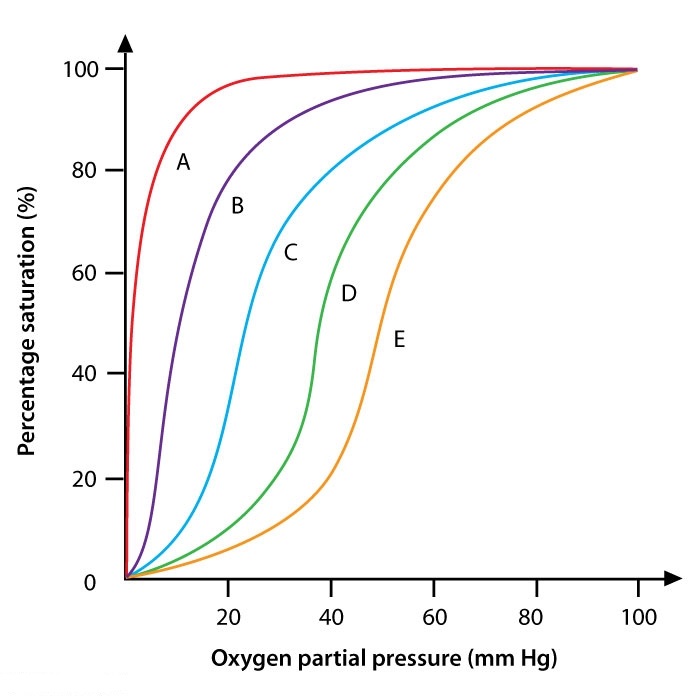
(Multiple Choice)
4.7/5 (85)
(85) A 20-year-old male with no significant medical history comes to you with a urine positive for fructose. When asked about his past medical history, he says that he has no significant medical problems. However, his mother told him that he was born with "a problem metabolizing sugar." The patient maintains no dietary restrictions and regularly eats vegetables, fruits, meats, and processed foods. Urine samples show a repeatedly positive copper reduction test, but glucose oxidase dipstick testing is negative. Which of the following enzymes is most likely to be deficient in this patient?
(Multiple Choice)
4.8/5 (68)
(68) Due to insufficient exercise endurance, a 15-year-old kid is taken to the clinic. He just begun weight lifting with pals but has struggled to complete the routines. According to the sufferer, his arms "feel like jello after just a few repetitions." He also experiences significant muscle cramps and sometimes urine staining following training sessions. Further testing showed that ingesting an oral glucose solution before commencing a demanding activity can significantly increase the patient's exercise tolerance. The vital signs are normal, and the exam is ordinary. Which of the following transformations is most likely catalyzed by this patient's deficiency in an enzyme? 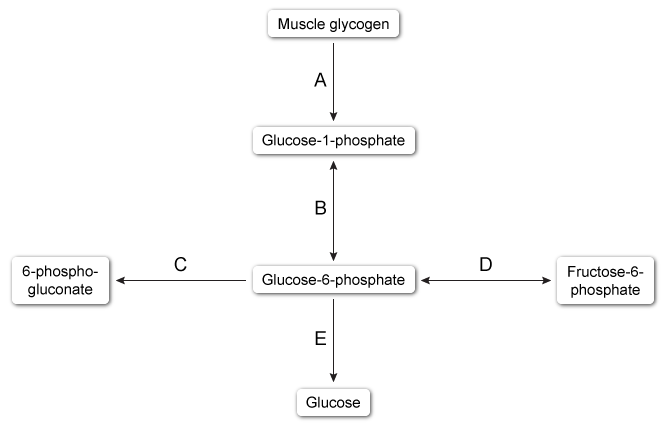
(Multiple Choice)
4.7/5 (84)
(84) A 30-year-old woman comes to the emergency department due to vomiting, and fever. Her symptoms began 24 hours ago, and she has been unable to eat or drink anything since. She has a 2-year-old daughter who had similar symptoms 2 days earlier but is now fine. Laboratory studies show a blood glucose level of 72 mg/dL despite her 24-hour fast. Maintenance of this patient's blood glucose levels is facilitated by hepatic conversion of pyruvate into glucose. Which of the following substances directly stimulates the first enzyme involved in this process?
(Multiple Choice)
4.8/5 (66)
(66) A 34-year-old woman comes to the office for postpartum follow-up. The patient had gestational diabetes mellitus which was diagnosed during routine screening at 28 weeks gestation; she was treated with dietary modification and exercise and required insulin briefly. She has continued to follow dietary recommendations since delivery 12 weeks ago, and her blood glucose has been fairly well controlled without insulin. Fasting blood glucose levels of 100-120 mg/dL. Medical history is otherwise unremarkable. BMI is 23kg/m2. Physical examination shows no abnormalities. Her gestational diabetes and fasting hyperglycemia are suspected to be genetically predisposed. This patient's condition is most likely caused by reduced activity of which of the following enzymes?
(Multiple Choice)
4.7/5 (81)
(81) A 29-year-old woman comes to the physician because of a 1-year history of skin bruising. She has no trauma and sometimes has spontaneous bruising over her legs. The patient has a history of Crohn disease that required a partial bowel resection a year ago. Three months ago, she was treated with oral antibiotics for a perianal fistula. Her mother died of colon cancer when she was 56. Physical examination shows several large ecchymoses on her lower extremities. Which of the following is the most likely diagnosis?
(Multiple Choice)
4.8/5 (69)
(69) An 11-year-old girl is evaluated for blurry vision. The patient was adopted internationally at age 9. She has no history of head or eye trauma or exposure to ionizing radiation. Motor and cognitive milestones have been achieved at the appropriate age. She has a good appetite and does not follow any specific diet. The patient takes no medications and has no allergies. Vaccinations are up to date. Vital signs are normal. She is at the 40th percentile for height and weight. Other than bilateral lens opacities, the rest of her examination is normal. Urine is positive for reducing substances. Deficient activity of which of the following enzymes is the most likely cause of this patient's eye condition?
(Multiple Choice)
4.8/5 (86)
(86) A 3-week-old male is brought to the emergency department because of increasing lethargy. He was born at home without prenatal care or neonatal screening and appeared to be normal at birth. Despite this, his parents noticed that he would vomit after breastfeeding. He then progressively became more lethargic and began to have a few episodes of diarrhea after feeding. His parents do not recall any significant family history and neither of his siblings have had similar symptoms. Upon presentation, the infant is found to be generally unresponsive with mild hepatomegaly. Physical exam further reveals signs of clouding in the lenses of his eyes bilaterally. Which of the following steps in metabolism is most likely impaired in this patient? 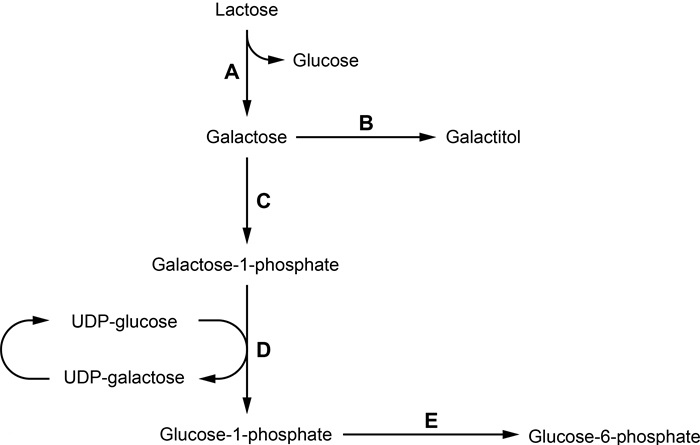
(Multiple Choice)
4.8/5 (77)
(77) 
Filters
- Essay(0)
- Multiple Choice(0)
- Short Answer(0)
- True False(0)
- Matching(0)