



 Chat with AI
Exam 12: Physiology

Exam 1: Anatomy265 Questions
Exam 2: Behavioral Sciences178 Questions
Exam 3: Biochemistry102 Questions
Exam 4: Embryology59 Questions
Exam 5: Epidemiology, Biostatistics, and Medical Informatics94 Questions
Exam 6: Genetics88 Questions
Exam 7: Histology46 Questions
Exam 8: Immunology147 Questions
Exam 9: Microbiology and Virology330 Questions
Exam 10: Pathology817 Questions
Exam 11: Pharmacology and Toxicology509 Questions
Exam 12: Physiology339 Questions
Exam 13: Psychiatry and Psychotherapy23 Questions
Select questions type


An 8-year-old boy is brought by his mother due to concerned to his weight. The patient weight is on 5th percentile for his age. He has no medical conditions or family history of any inheritied diseases. On examination, the patient is hyperactive with sweating hand, impulsive, inattentive, and restless. His grade has declined recently. The thyroid gland is diffusely enlarged to palpation without tenderness or bruit. Neurologic examination reveals no focal findings. Results of thyroid function tests are : elevation of TSH, T4 and Total T3. Which of the following is the most likely etiology of this patient's thyroid function test abnormalities?

Free
(Multiple Choice)
4.7/5  (77)
(77) Correct Answer: Verified
E
A 43-year-old woman with borderline personality disorder is brought to the emergency department after taking an undetermined number of pills. She is lethargic but arousable. She refuses to answer questions. Blood pressure is 110/60 mm Hg and heart rate is 120/min and regular. Laboratory results are as follows: 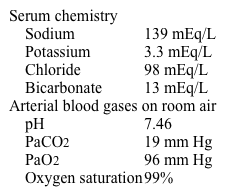 Which of the following best describes this patient's acid-base disturbance?
Free
(Multiple Choice)
4.9/5 (84)
(84) Correct Answer:Verified
VerifiedC
A 28-year-old woman comes to the office for a preconception visit. She has never been pregnant and would like to know how to improve her chances of conceiving. The patient has no family history of genetic abnormalities or infertility. Menarche was at age 13. She menstruates every 28 days, and bleeding lasts for 4 days. She has had no prior surgeries or sexually transmitted infections. Her husband has not fathered a child and has no urogenital problems. The couple has intercourse several times a month. Which of the following hormones would increase the most in concentration after ovulation?
Free
(Multiple Choice)
4.9/5 (86)
(86) Correct Answer:Verified
VerifiedF
A 21-year-old man is brought to the emergency department after being found unresponsive in a public restroom. He has a history of injection drug use. Temperature is 36.1 C (97 F), blood pressure is 110/70 mm Hg, pulse is 62/min, and respiratory rate is 8/min. On physical examination, the patient is unconscious with pinpoint pupils. Endotracheal intubation is performed, and mechanical ventilation is begun. The ventilator settings are adjusted to provide a minute ventilation of 6.0 L/min. Calculated alveolar ventilation is 4.2 L/min. Which of the following most likely accounts for the difference between these 2 parameters?
(Multiple Choice)
4.8/5 (70)
(70) Electric stimulation of the musculocutaneous nerve causes a rapid twitch of the biceps muscle. Electron microscopy shows numerous vesicles within the musculocutaneous nerve terminals. In order for these vesicles to release their contents into the synaptic cleft, which of the following substances is required?
(Multiple Choice)
4.9/5 (84)
(84) A 34-year-old woman arrives at the clinic after experiencing dizziness and mild confusion for the past week. The patient has had seizures since childhood and was recently prescribed carbamazepine by her neurologist. Her temperature is 36.7 degrees Celsius (98 degrees Fahrenheit), her blood pressure is 121/72 mm Hg, her pulse is 68 bpm, and her respirations are 13 / min. The physical examination is within normal parameters. According to laboratory findings, the serum sodium concentration is low. The patient's condition is determined to be caused by an increase in the release of a hormone that is co-secreted with neurophysins. Which of the following sites is most likely where this hormone is secreted into the circulation? ? 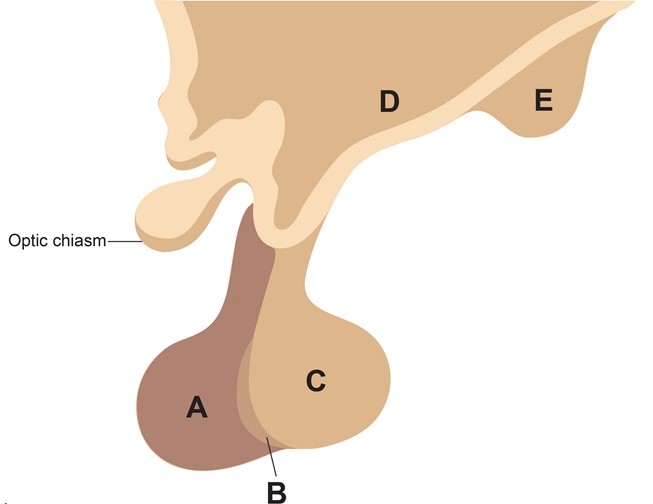
(Multiple Choice)
4.9/5 (84)
(84) A 40-year-old man comes for the office to evaluate the infertility. he has been married for 6 years and he with his wife are unable to concieve despite her wife has a child from previous marriage. A semen analyisi is done and shows a low sperm count. If a rare genetic disease is discoverd afte more investigation that leads to inactive FSH receptors. which of the following substances is most likely decreased in this patient?
(Multiple Choice)
4.9/5 (96)
(96) A 24-year-old healthy lady participates in a research study on exercise. The source of skeletal muscle ATP during exercise is determined in the study using a variety of radiolabeled substances. The participants are given food that is heavy in carbohydrates and instructed to run quickly on a treadmill. Which of the following is the most likely source of the red curve on the graph below, which represents ATP? 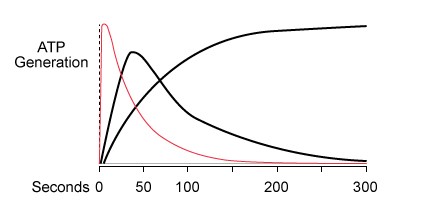
(Multiple Choice)
4.8/5 (77)
(77) A physiologist is conducting an experiment to study potassium channels mutation expressed in pancreatic beta cells. The mutated channels have a higher sensitivity to the substance that normally modulates their activity, causing increased beta cell secretory activity. Which of the following substances normally binds to and regulates the ion channels that are responsible for this patient's hypoglycemia?
(Multiple Choice)
4.7/5 (86)
(86) A 29-year-old woman, gravida 1 para 0, at 28 weeks gestation comes to the office to establish prenatal care after recently moving to a new city. She has had no complications in this pregnancy and had a normal anatomy ultrasound at 20 weeks gestation. On physical examination, the fundal height measures 28 cm. Cardiac auscultation reveals a 2/6 blowing systolic murmur best heard at the left sternal border. The murmur intensifies with inspiration, and there is no ejection click or palpable thrill at the sternal notch. The lungs are clear to auscultation. There is 1+ pitting edema to the midshins bilaterally. Which of the following is most likely responsible for this patient's murmur?
(Multiple Choice)
4.9/5 (80)
(80) A 54-year-old woman arrives at the office complaining of exertional dyspnea and fatigue. The patient experiences shortness of breath while walking two blocks from her home to a store. She also has difficulty breathing at night and sleeps with two or three pillows to prop herself up. She has had palpitations on occasion but no chest pain. The patient does not regularly take medications and does not use tobacco, alcohol, or illegal drugs. She is scheduled for a left heart catheterization after an initial evaluation, the results of which are shown below. 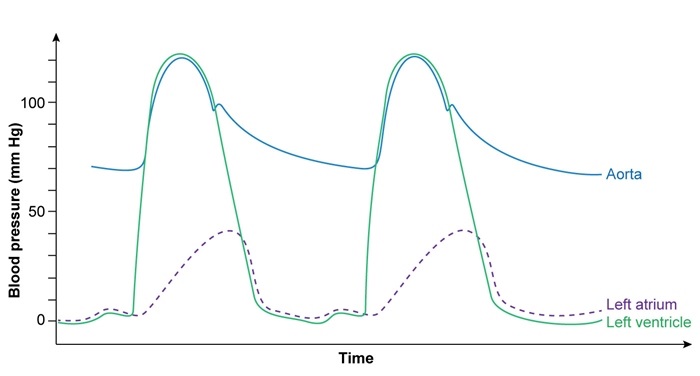 Which of the following is the most likely diagnosis?
 (Multiple Choice)
4.8/5 (85)
(85) During a mountain climb, a 23-year-old hiker loses a foothold and falls several feet. He is not seriously injured, but he does lose his backpack. He walks for 8 hours in the heat without water, and by the time he reaches a shelter, he is extremely thirsty. Which of the following nephron segments' fluid is most likely to be hypoosmotic in this individual? 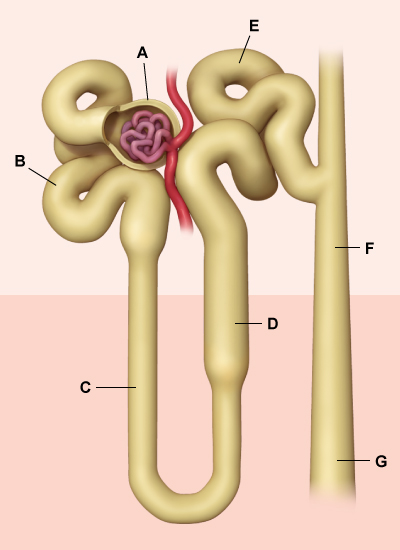
(Multiple Choice)
4.8/5 (83)
(83) A 60 year old man is brought to the ER due to several hematemesis followed by melena. he has a history of peptic ulcer disease and states that he has nausea and feels faints. Temperature is 34.7 c blood pressure is 92/47 mmHg, pulse is 125/ min and respiration are 28/min on examination he has a cold extremities and delayed capillary refill . packed RBCs are given via intravenous access. However, the blood transfusion rate is unacceptably slow, and the patient remains hypotensive. Which of the following will lead to the greatest improvement in flow rate?
(Multiple Choice)
4.8/5 (76)
(76) A 66-year old man comes to the physician because of fatigue for 6 months. He says that he wakes up every morning feeling tired. Most days of the week he feels sleepy during the day and often takes an afternoon nap for an hour. His wife says he snores in the middle of the night. He drinks 1-2 glasses of wine daily with dinner; he does not smoke. BMI is 36 kg/m2. Examination of the oral cavity shows a low-lying palate. Cardiac examination shows an irregularly irregular rhythm and no murmurs. The remainder of the examination shows no abnormalities. The patient is at increased risk of developing which of the following?
(Multiple Choice)
4.9/5 (94)
(94) An 80-year-old man is brought to the ER due to confusion. He has a one week history of cough with purulent sputm production. A chest x-ray reveals right lower lobe pneumonia, and treatment is started with supplemental oxygen and antibiotics. While hospitalized, the patient develops persistent sinus tachycardia. the Lab tests show normal TSH with low total T3 Which of the following is the primary contributor to the decreased total T3 level in this patient?
(Multiple Choice)
4.7/5 (79)
(79) A 16-year-old girl is brought to the physician for recurrent episodes of shortness of breath, nonproductive cough, and chest tightness for 3 months. These episodes occur especially while playing sports and resolve spontaneously with rest. She appears healthy. Her pulse is 63/min, respirations are 15/min, and blood pressure is 102/70 mm Hg. Pulse oximetry on room air shows an oxygen saturation of 98%. Physical examination shows no abnormalities. An x-ray of the chest shows no abnormalities. Skin testing is performed to determine symptom triggers. A pricking device is used to apply allergen extract underneath the skin. After 15 minutes, the patient develops raised, erythematous plaques with surrounding erythema at the application site. Which of the following mediators is the first to be released during the pathogenesis of this patient's skin findings?
(Multiple Choice)
4.8/5 (66)
(66) A physiologist is conducting an experiment to study humen blood circulation. He assess the oxygen consumption in various organs in a healthy man. During the study, the blood oxygen content of the aorta and several other vessels is measured at rest. The greatest difference in these measurements will most likely be between the aorta and which of the following blood vessels?
(Multiple Choice)
4.7/5 (66)
(66) A 54-year-old missionary traveling alone in a remote region of Southern Asia becomes lost. After several days, he arrives at a small village. However, he has gone 24 hours without food or water, and his urine osmolarity is 1150 mOsm/L. The majority of the total amount of water filtered by this individual's glomeruli is reabsorbed in which of the following portions of the nephron?
(Multiple Choice)
4.8/5 (77)
(77) A 58-year-old man comes to the physician because of a 5-day history of progressively worsening shortness of breath and fatigue. The patient had a brief upper respiratory illness about a month ago but began experiencing progressive dyspnea on exertion 2 weeks ago. He has smoked one pack of cigarettes daily for 30 years. His pulse is 96/min, respirations are 26/min, and blood pressure is 100/60 mm Hg. he apical impulse is palpated in the sixth intercostal space along the left anterior axillary line. An S3 is heard on cardiac auscultation. Bibasilar crackles are present. Distal extremities are cold to touch and there is 1+ peripheral edema. Laboratory results are as follows: 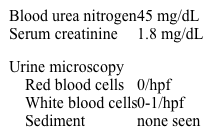 Which of the following is likely to be present in this patient compared to the normal state?
 (Multiple Choice)
4.8/5 (82)
(82) A phsyologist is trying to study the function of neurophysin protein. if a mutation occured in neurophysin gene what the patient most likely to suffer from:
(Multiple Choice)
4.9/5 (83)
(83) 
Filters
- Essay(0)
- Multiple Choice(0)
- Short Answer(0)
- True False(0)
- Matching(0)