



 Chat with AI
Exam 12: Physiology

Exam 1: Anatomy265 Questions
Exam 2: Behavioral Sciences178 Questions
Exam 3: Biochemistry102 Questions
Exam 4: Embryology59 Questions
Exam 5: Epidemiology, Biostatistics, and Medical Informatics94 Questions
Exam 6: Genetics88 Questions
Exam 7: Histology46 Questions
Exam 8: Immunology147 Questions
Exam 9: Microbiology and Virology330 Questions
Exam 10: Pathology817 Questions
Exam 11: Pharmacology and Toxicology509 Questions
Exam 12: Physiology339 Questions
Exam 13: Psychiatry and Psychotherapy23 Questions
Select questions type


According to research, synaptic transmission is potentiated as a result of repeated stimulation of hippocampus neurons involved in memory and learning. Below are patch-clamp recordings of activated neurons. (dotted line: baseline; solid line: after repeated stimulation [potentiated]). 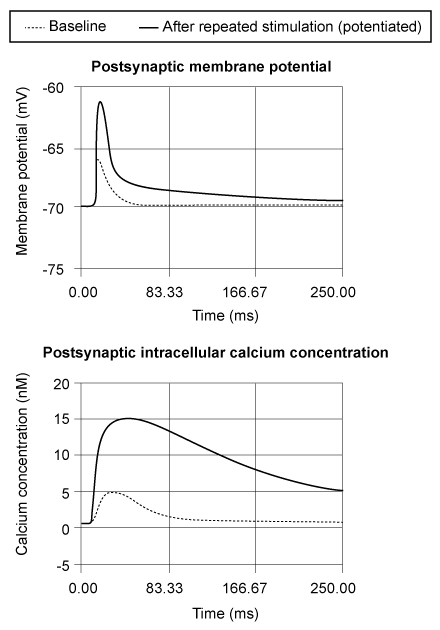 Which of the following neurotransmitter receptors on the postsynaptic membrane is most likely involved in this process?
 (Multiple Choice)
4.8/5  (81)
(81) A 10-year-old boy is brought to the clinic for a follow-up examination. The patient was admitted to the hospital 2 months ago after a nonfatal drowning event that resulted in severe acute respiratory distress syndrome. He was intubated and mechanically ventilated for 1 week and then discharged 2 weeks later. The patient currently feels well and reports mild dyspnea with exertion. Which of the following parameters is most likely increased in this patient compared to a child with normal cardiopulmonary function?
(Multiple Choice)
5.0/5 (88)
(88) A 42-year-old male is brought to the ER due to found to be unresponsive. He has a history of alcohol disorder. In ER he looks disoriented, malnourished, and confused. Thiamine, Folic acid, and dextrose-containing IV fluid are given. After a few hours. He develops marked muscle weakness. On lab tests there is an obvious low serum phosphate concentration of 0.4 mg/dl (normal: 2.5-4.5). Which of the following is the most likely cause of this patient's low serum phosphate level?
(Multiple Choice)
4.8/5 (77)
(77) A woman, 44, visits the office for follow-up. The patient fell from a cliff while hiking and had a total C7 spinal cord damage. She uses a wheelchair and can move her shoulders and upper arms, but she is paralyzed. Due to a neurogenic bladder, the patient has a suprapubic catheter. She doesn't have any other illnesses. She has never smoked in her life. Which of the following respiratory parameter changes in this patient is most likely true? 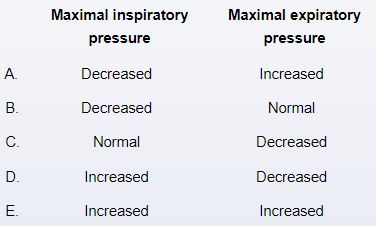
(Multiple Choice)
4.9/5 (90)
(90) Researchers are studying treatment of osteoporotic fractures. Subjects with pelvic fractures due to osteoporosis are divided into 2 groups. The control group receives physical therapy along with calcium and vitamin D supplementation. The experimental group receives a parathyroid hormone analogue in addition to the standard therapy. It is found that the subjects who receive hormonal treatment have a shorter time to fracture healing and improved functional outcome. The benefits of the investigational medication are attributed to increased osteoblastic activity. An elevated level of which of the following markers is most likely to reflect the medication effect in these subjects?
(Multiple Choice)
4.7/5 (85)
(85) A 28-year-old woman, gravida 2 para 1, at 18 weeks gestation comes to the office for a routine prenatal appointment. She is feeling well and has had no complications during this pregnancy. The patient has no chronic medical conditions and has had no previous surgeries. Her only medications are a daily prenatal vitamin and an iron supplement. Blood pressure is 110/70 mm Hg and pulse is 62/min. BMI is 24 kg/m2. Cardiopulmonary examination is unremarkable. The uterus is consistent with 18 weeks gestation and fetal heart tones are normal. There is mild bilateral pedal edema to the shins. Compared to a nonpregnant state, which of the following changes are most likely expected in this patient? 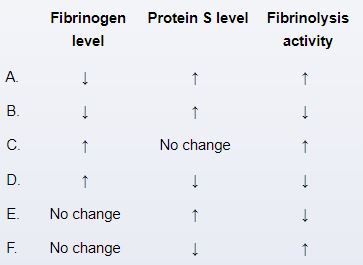
(Multiple Choice)
4.8/5 (82)
(82) A significant pharmaceutical firm is investigating a novel medication that alters blood flow in sick tissue. The experiment includes a healthy 30-year-old man, and patterns of typical blood flow across various tissues are investigated. The illustration below demonstrates one of the patterns: 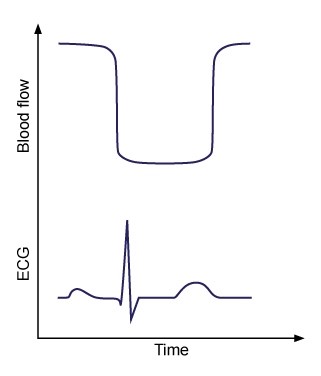 The blood flow curve was most likely obtained from tissue of which of the following?
 (Multiple Choice)
4.8/5 (72)
(72) A 60-year-old woman comes to the office for annual follow up. She has a history of hypertension which is controlled by calcium channel blocker. she states that she increase feeling fatigue and has weight gain recently. Two years ago, her laboratory tests were normal. Blood pressure is 136/97 mmHg. and pulse is 62/ min . BMI is 28 Kg/m2. thyroid gland is mildly enlarged in examination so laboratory tests are done and show elevation TSH and low free T4. High total and LDL cholestrol and increased triglyceride. Which of the following is the most likely underlying mechanism for the elevated cholesterol in this patient?
(Multiple Choice)
4.8/5 (73)
(73) A 1-yaer-old boy is brought to the emergency department due to progressive watery diarrhea and abdominal pain for 5 days ago. this morning he has a vomiting 3 times. the patient attends day care and his immunization is UpToDate. His temperature is 38 C and blood pressure is 80/45 mmHg , pulse is 140/min. His mother states that the infant is less active and has no interest in feeding. Physical examination shows a listless infant with tachycardia, dry mucous membranes, and decreased skin turgor. The abdomen is nontender with hyperactive bowel sounds. Compared to pre-illness levels, which of the following sets of laboratory findings are most likely present in this patient? 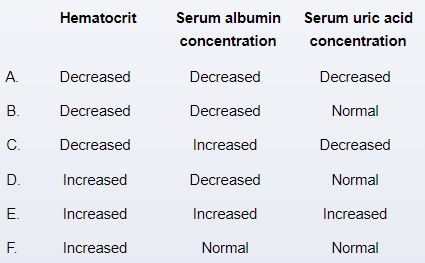
(Multiple Choice)
4.9/5 (74)
(74) A 34-year-old Russian immigrant visits the doctor after complaining of exertional dyspnea and progressive lower extremity swelling for two months. He also complains of abdominal distension and a loss of appetite. Over the last two months, the patient has gained 4.5 kg (10 lbs). Past medical history is important for hypertension and recurrent lung infections that necessitate long-term antibiotic therapy. He has never had coronary artery disease. For the past 15 years, the patient has smoked a pack of cigarettes every day. He is subjected to noninvasive cardiac testing, which is followed by cardiac catheterization. The slide below depicts a jugular venous pressure tracing. 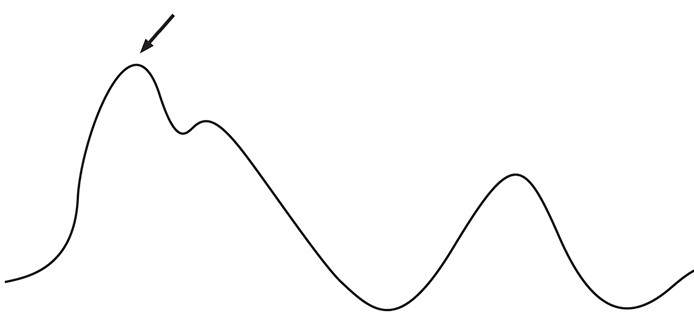 The waveform indicated by the arrow most likely corresponds to which of the following?
 (Multiple Choice)
4.7/5 (73)
(73) A 40-year-old woman is brought to the ER due to colicky abdominal pain in the right upper quadrant which started 6 hours ago after a heavy meal and now is sharp and continuous. She had several episodes before after a fatty meal but were resolved without treatment. Physical examination reveals marked tenderness in the right subcostal area. Which of the following hormones most likely provoked the current attack in this patient?
(Multiple Choice)
4.7/5 (79)
(79) A 2-year-old boy is brought to your office by his mother due to 2 days of diarrhea. The mother states he has passed 5-6 stools daily over the last 2 days. The feces are liquid and contain no blood or mucus. His highest temperature reading at home was 37.8 C (100 F). He is eating, drinking, and being playful as usual. The patient has no prior medical problems and is up to date with vaccinations. which of the following oral fluids is most effective to prevent dehydration in this patient?
(Multiple Choice)
4.8/5 (77)
(77) A 42-year-old man comes to the physician because of a 1-year history of progressive fatigue and shortness of breath on exertion. He also finds it difficult to sleep lying flat and requires 3 pillows to prop himself upright when sleeping. He has smoked one pack of cigarettes daily for 30 years and drinks three to four cans of beer daily. He appears fatigued. Pulse is 94/min, respirations are 23/min, and blood pressure is 150/60 mm Hg. Blood pressure is 170/100 mm Hg, and pulse is 80/min and regular. Physical examination reveals bilateral basilar lung crackles, jugular venous distension, and bilateral lower extremity edema. Chest x-ray reveals cardiomegaly and hilar prominence. ECG shows left ventricular hypertrophy. Echocardiogram shows elevated pressures in the pulmonary artery. Which of the following is the most likely underlying cause of the observed echocardiographic finding in this patient?
(Multiple Choice)
4.9/5 (83)
(83) The parents of a 4-month-old girl bring her to the clinic for a well-child check. She was examined two weeks ago for a diaper rash. During that visit, it was discovered that the patient had erythematous papules in the diaper area that had spared the skin folds. Her symptoms improved after applying a petrolatum barrier ointment after each diaper change. Vital signs and physical examinations are commonplace nowadays. Which of the following most likely contributed to this patient's prior skin findings?
(Multiple Choice)
4.8/5 (68)
(68) A 60-year-old man with a known history of chronic obstructive pulmonary disease is brough to the emergency department due to chest palpitation and lightheadeness. He has a histroy of multiple episodes of intermittent chest palpitations. His only medication is a tiotropium-formoterol inhaler. His pulse is 140/min and irregular. respiration is 17/min and blood pressure 118/72. Pulse oximetry on room air shows an oxygen saturation of 96%. Chest examination reveals no murmurs and the lungs are clear on auscultation. There is trace peripheral edema. Cardiac rhythm strip obtained in the emergency department is shown in the exhibit.
Aberrant electrical activity in which of the following anatomic structures is the most likely trigger for this patient's current condition?
(Multiple Choice)
4.8/5 (89)
(89) A researcher is working to develop a new antiepileptic medication for patients with recurrent and resistant epilepsy if this medication selectively blocks voltage gated calcium channels then this medication will affect which of the following steps of neurotransmission?
(Multiple Choice)
4.8/5 (77)
(77) A researcher is trying to study aging liver changes, He decides to choose healthy people and follow them up from age 40 to 80 and do liver biopsy every 10 years, Which of the following histologic changes has most likely developed over time in an elderly patient?
(Multiple Choice)
4.8/5 (72)
(72) During evaluation of an old man in the outpatient clinic, he states that he has headache which responds to the over-counter medications. He has no medical conditions and takes no medications. Physical examination is normal but his blood pressure is 175/71 mmHg and pulse is 80/ min. CT scan of the head reveals no significant abnormalities. Which of the following age-related changes best explains this patient's blood pressure readings?
(Multiple Choice)
4.9/5 (86)
(86) A 52-year-old guy visits the clinic complaining of dry coughing and shortness of breath for the past two weeks. The patient's reduced ability to tolerate exercise is limiting his everyday activities. The patient's mitral valve is shown to have the following blood flow pattern using a Doppler probe positioned at the cardiac apex. 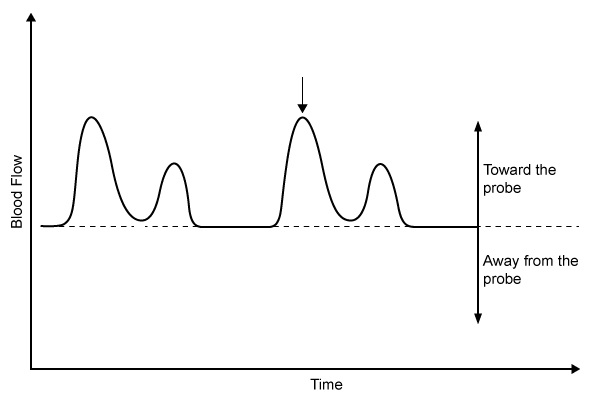 The point marked by the arrow would best correspond to which of the following auscultation findings?
 (Multiple Choice)
4.7/5 (95)
(95) A 30-year-old amn is brought to the emergency departments due to progressive dyspnea. His wife says that he has upper respiratory tract infection which resolved a week ago and he doesn't feel well after that due to chest discomfort and dizziness. He has no prior medical conditions and takes no medications. He has no family history of cardiovascular disease. Echocardiography shows pericardial fluid accumulation with late diastolic collapse of the right atrium. Which of the following physical examination findings is most likely to be seen in this patient?
(Multiple Choice)
4.9/5 (62)
(62) 
Filters
- Essay(0)
- Multiple Choice(0)
- Short Answer(0)
- True False(0)
- Matching(0)