



 Chat with AI
Exam 12: Physiology

Exam 1: Anatomy265 Questions
Exam 2: Behavioral Sciences178 Questions
Exam 3: Biochemistry102 Questions
Exam 4: Embryology59 Questions
Exam 5: Epidemiology, Biostatistics, and Medical Informatics94 Questions
Exam 6: Genetics88 Questions
Exam 7: Histology46 Questions
Exam 8: Immunology147 Questions
Exam 9: Microbiology and Virology330 Questions
Exam 10: Pathology817 Questions
Exam 11: Pharmacology and Toxicology509 Questions
Exam 12: Physiology339 Questions
Exam 13: Psychiatry and Psychotherapy23 Questions
Select questions type


A 22-year-old woman visits the office because she has had persistent facial blemishes for several years that have not responded to over-the-counter treatment. The patient has no other medical problems. She does not smoke, drink, or use illegal drugs. The following image depicts the results of a skin examination:  Which of the following most likely contributed to the pathogenesis of this patient's skin condition?
 (Multiple Choice)
4.8/5  (74)
(74) A physiologist found during an experiment to study pancreatic enzymes that a mutation on the binding protein site on the trypsinogen molecule leads to inhibit the active trypsin moiety. This mutation prevents trypsin from being permanently inactivated by enzymatic cleavage. Patients with this mutation would most likely suffer from which of the following conditions?
(Multiple Choice)
4.8/5 (89)
(89) A 45-year-old man comes to the physician because of dyspnea on exertion and decreased exercise tolerance. During this period, he has also had difficulty concentrating at work and has experienced generalized fatigue. He has fallen asleep multiple times during important meetings. He has smoked one pack of cigarettes daily for 28 years and drinks one alcoholic beverage per day. BMI is 35 kg/m2. His temperature is 37.1°C (98.8°F), pulse is 88/min, respirations are 14/min, and blood pressure is 145/85 mm Hg. Physical examination shows erythema of the face. He is notable for central obesity. Lungs are clear on auscultation bilaterally. Which of the following changes (forced expiratory volume in 1 second [FEV1], forced vital capacity [FVC], expiratory reserve volume [ERV], residual volume [RV], and total lung capacity [TLC]) are most likely to be seen on pulmonary function testing in this patient? 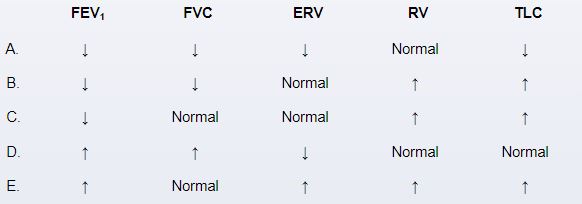
(Multiple Choice)
4.8/5 (85)
(85) A 24-year-old primigravid woman at 8 weeks' gestation is brought to the emergency department because of a 5-day history of nausea and vomiting. She has not been able to eat or drink much. Her symptoms are worse in the morning. She has tried multiple oral antiemetics with limited relief. She has not had fevers, chills, abdominal pain, urinary symptoms, or diarrhea. She appears tired. Her temperature is 37°C (98.6°F), pulse is 105/min, and blood pressure is 108/60 mm Hg. Cardiac examination reveals tachycardia but no murmurs or gallops. The abdomen is soft, nontender, and nondistended. Arterial blood gas analysis is most likely to reveal which of the following sets of values? 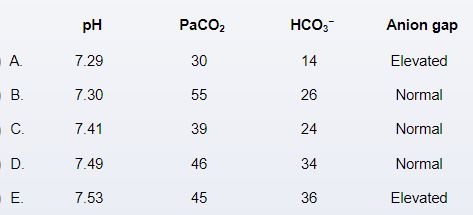
(Multiple Choice)
4.9/5 (80)
(80) A 15-Year-old boy is brought to your office due to concerning muscles weakness. He Has no prior medical disease and take no medication. He states that he has difficulty climbing stairs. and he cannot left his upper extrimities above his head. On examination, he is unable to lift his arms or legs against resistance when fully outstretched. Muscle biopsy is done and shows sparse transverse tubules in some of the muscle fibers. Which of the following is the most likely consequence of this patient's biopsy findings?
(Multiple Choice)
4.9/5 (92)
(92) A 32-year-old man who lives below sea level plans to visit the Mount Everest base camp at an elevation of 5,334 m (17,500 ft). After 8 days of hiking to reach the base of camp he looks fatigued and dyspneic otherwise. Which of the following physiologic changes has most likely occurred in this patient?
(Multiple Choice)
4.7/5 (81)
(81) Recordings of a giant squid axon's membrane potential are being examined by neurophysiologists. On the slide below, a selection from their recordings is displayed. 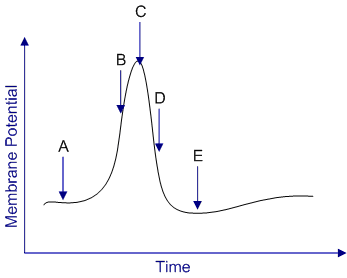 The membrane is most permeable to potassium ions at which of the following points?
 (Multiple Choice)
4.9/5 (72)
(72) A 38-year-old woman, gravida 1 para 0, at 34 weeks gestation comes to the office due to increasing swelling in her hands and legs. The patient first noticed the swelling a few weeks ago but now cannot stand for more than an hour without needing to elevate her legs. She has no orthopnea, dyspnea, or chest pain. The patient has no chronic medical conditions and takes no daily medications. Vital signs are normal. Cardiac examination is within normal limits. Lungs are clear to auscultation. Bilateral lower extremities have 2+ pitting edema to the midshin. Urine dipstick shows no protein. Compared to a healthy nonpregnant woman, which of the following parameters is most likely to be decreased in this patient?
(Multiple Choice)
4.8/5 (87)
(87) A 30-year-old lady who often lives in Florida (height near sea level) is planning a week-long business trip to La Paz, Bolivia (elevation 3,600 m [11,900 ft]). Unremarkable medical history. Which physiologic alteration is anticipated throughout the patient's week in La Paz? 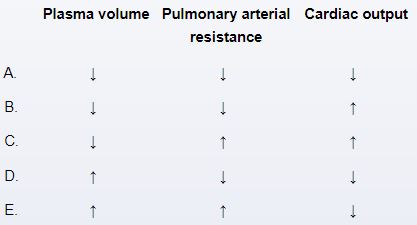
(Multiple Choice)
4.8/5 (81)
(81) After being discovered unresponsive in her apartment, a 20-year-old woman is brought to the emergency department by her boyfriend. She has a history of major depression as well as generalized anxiety disorder. There is no indication of trauma. The patient is obtunded on examination and responds only to painful stimuli. There is no evidence of recent vomiting. Auscultation reveals that the lungs are clear. A toxicology screen revealed that benzodiazepines were present. Which of the following sets of arterial blood gas findings (in mm Hg) are most likely present in this patient? 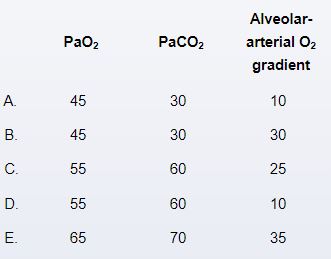
(Multiple Choice)
4.8/5 (78)
(78) A 49-year-old man arrives at the office complaining of "aching bones." He has had insidious-onset pain in his back, pelvis, and lower extremities for the past two months. The pain is dull and worsens after performing weight-bearing activities. The patient has no prior medical history and is not on any medications. He moved to the United States from Central Africa five years ago and works overnight shifts as a cab driver. The vital signs are within normal ranges. A physical examination reveals normal muscle strength in both the upper and lower extremities. The diagnosis is established through a thorough laboratory evaluation. Following a discussion about the most likely cause of his condition, the patient begins spending more time outside in the sun. Which of the following enzymatic steps will most likely be affected by this change in activity? 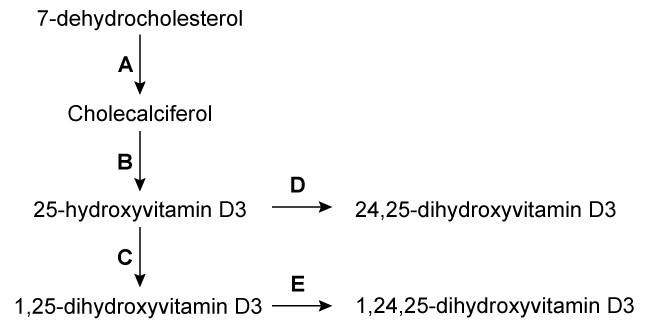
(Multiple Choice)
4.8/5 (83)
(83) A 37-year-old woman, gravida 2 para 1, at 30 weeks gestation comes to the office to discuss her recent laboratory work. At her last visit at 28 weeks gestation, the patient drank a solution containing 50 g of glucose, and her serum glucose was abnormally elevated an hour later. Today, she is scheduled to undergo a confirmatory 3-hour glucose test. Her pregnancy has been uncomplicated, and the patient has no chronic medical conditions. She is taking a daily prenatal vitamin. Vital signs are normal. Physical examination shows a uterine size consistent with gestational age. Fetal heart rate is 140/min. Which of the following hormones is most likely contributing to this patient's abnormal laboratory findings?
(Multiple Choice)
4.7/5 (68)
(68) A 43-year-old woman is being evaluated in the surgery department because of severe central chest pain, mild shortness of breath, and one episode of coughing up blood. Two days ago, she underwent a total hip arthroplasty with no operative complications. CT pulmonary angiogram shows a right lower lobe pulmonary artery occlusion consistent with pulmonary embolism but no evidence of pulmonary infarction. Which of the following is the most likely reason for the lack of lung tissue necrosis in this patient?
(Multiple Choice)
4.8/5 (76)
(76) A 44-year-old man comes to the office due to swelling of the legs and abdomen. The patient has a history of alcohol-induced cirrhosis, and his ascites had been well controlled with furosemide. Over the past week, he has had increasing bilateral lower extremity and abdominal swelling despite taking a diuretic as prescribed. The patient reports no change in dietary sodium or water intake but states he has been taking over-the-counter ibuprofen after injuring his back recently. He stopped drinking alcohol 2 years ago and does not use tobacco or illicit drugs. Physical examination shows 3+ bilateral lower extremity edema and moderate ascites. Which of the following changes most likely contributed to the acute deterioration in this patient's condition? 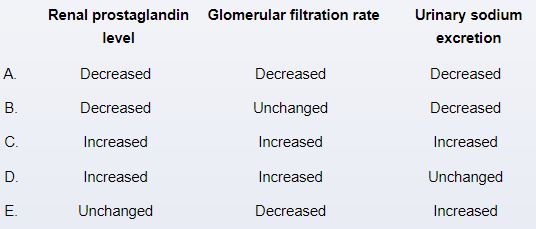
(Multiple Choice)
4.8/5 (92)
(92) A 4-week-old girl has been diagnosed with patent ductus arteriosus and will undergo cardiac catheterization for closure of a patent ductus arteriosus. The patient was born at 30 weeks gestation due to placental abruption. She has been cared for in the neonatal intensive care unit since delivery. Pulse oximetry shows 99% in the right hand and left foot. Echocardiography shows a moderately sized patent ductus arteriosus. After catheterization but before closure, blood gases are obtained from several locations. Compared with the partial pressure of oxygen (PaO2) of a normal infant, this patient would be expected to have a higher PaO2 in which of the following locations?
(Multiple Choice)
4.9/5 (93)
(93) A healthy 32-year-old man enrolls in a clinical study investigating potassium handling by the kidney. During the study period, he is given oral potassium supplements and potassium levels in the serum and urine are closely monitored. Compared to the amount of potassium delivered to the glomerular capillaries, the percentage of potassium remaining in this individual's tubular fluid is most likely to vary by which of the following amounts? 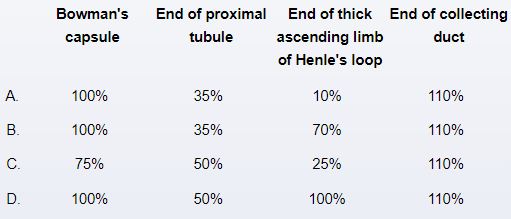
(Multiple Choice)
4.8/5 (88)
(88) During a surgery in a newborn the surgorn noticed perirenal fat containing tissue . The surgical removal of this tissue would most likely contribute to
(Multiple Choice)
4.9/5 (65)
(65) A 42-year-old male is brought to the ER due to found to be unresponsive. He has a history of alcohol disorder. In ER he looks disoriented, malnourished, and confused. Thiamine, Folic acid, and dextrose-containing IV fluid are given. After a few hours. He develops marked muscle weakness. On lab tests there is an obvious low serum phosphate concentration of 0.4 mg/dl (normal: 2.5-4.5). Which of the following is the most likely cause of this patient's low serum phosphate level?
(Multiple Choice)
4.9/5 (78)
(78) During a surgery in a newborn the surgorn noticed perirenal fat containing tissue . The surgical removal of this tissue would most likely contribute to
(Multiple Choice)
4.9/5 (72)
(72) A 38-year-old man is admitted to the hospital after the onset of severe abdominal pain and vomiting. He has a history of alcohol use disorder, and he is diagnosed with acute pancreatitis. Two days after later, he has worsening dyspnea. His temperature is 38.3°C (100.9°F), pulse is 120/min, respirations are 30/min, and blood pressure is 100/60 mm Hg. Pulse oximetry on room air shows an oxygen saturation of 85%. The patient is intubated and mechanically ventilated with a positive end-expiratory pressure of 10 cm H2O is applied. Physical examination shows diffuse lung crackles. Chest x-ray reveals new bilateral opacities. Which of the following is the most likely effect of this latter intervention?
(Multiple Choice)
4.8/5 (87)
(87) 
Filters
- Essay(0)
- Multiple Choice(0)
- Short Answer(0)
- True False(0)
- Matching(0)