Multiple Choice
A 22-year-old woman visits the office because she has had persistent facial blemishes for several years that have not responded to over-the-counter treatment. The patient has no other medical problems. She does not smoke, drink, or use illegal drugs. The following image depicts the results of a skin examination: 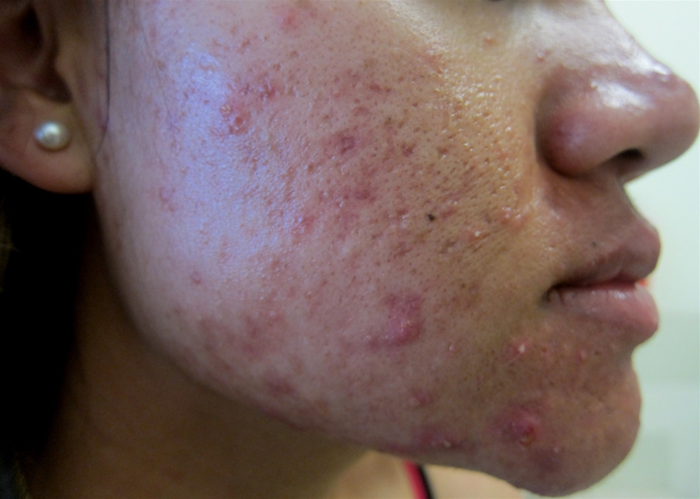 Which of the following most likely contributed to the pathogenesis of this patient's skin condition?
A) Androgen-induced involution of sebaceous glands
B) Bacterial degradation of apocrine gland secretions
C) Estrogen-stimulated secretory function of sebaceous glands
D) Increased desquamation of follicular epithelial cells
E) Proliferation of lipid-utilizing bacteria within pilosebaceous follicles
Correct Answer:

Verified
Correct Answer:
Verified
Q16: A 16-year-old girl is brought to the
Q17: A physiologist is conducting an experiment to
Q18: A 54-year-old missionary traveling alone in a
Q19: A 58-year-old man comes to the physician
Q20: A phsyologist is trying to study the
Q22: A physiologist found during an experiment to
Q23: A 45-year-old man comes to the physician
Q24: A 24-year-old primigravid woman at 8 weeks'
Q25: A 15-Year-old boy is brought to your
Q26: A 32-year-old man who lives below sea