



 Chat with AI
Exam 12: Physiology

Exam 1: Anatomy265 Questions
Exam 2: Behavioral Sciences178 Questions
Exam 3: Biochemistry102 Questions
Exam 4: Embryology59 Questions
Exam 5: Epidemiology, Biostatistics, and Medical Informatics94 Questions
Exam 6: Genetics88 Questions
Exam 7: Histology46 Questions
Exam 8: Immunology147 Questions
Exam 9: Microbiology and Virology330 Questions
Exam 10: Pathology817 Questions
Exam 11: Pharmacology and Toxicology509 Questions
Exam 12: Physiology339 Questions
Exam 13: Psychiatry and Psychotherapy23 Questions
Select questions type


A previuosly healthy man comes to the office due to recent fatigue. He is a long-distant runner and last week, he couldn't complete his training session due to fatigue. he recently had a self-limiting upper respiratory illness. He does not use tobacco, alcohol, or illicit drugs and has not traveled recently. Temperature is 37.2 C (99 F), blood pressure is 110/62 mm Hg, pulse is 80/min, and respirations are 20/min. Physical examination reveals lung crackles. Echocardiography shows no valvular abnormalities and the following parameters:  Based on the observed findings, which of the following is most accurate about this patient?
 (Multiple Choice)
4.7/5  (79)
(79) A physician is conducting a study to evaluate effect of type II diabetes on kidney function in patients have recently been diagnosed with diabetes. An initial set of laboratory tests is obtained in newly enrolled patients to establish baseline renal function parameters The following measurements are taken from a 42-year-old male volunteer. Which of the following is the best estimate of the filtration fraction in this patient assuming a urine flow of 1.0 mL/min? 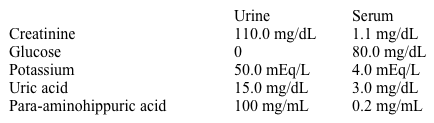
(Multiple Choice)
4.7/5 (83)
(83) A 45-year-old hospitalized man is evaluated for shortness of breath and hypoxemia. The patient was admitted 3 days ago after a motor vehicle collision. At that time, evaluation revealed a femur fracture but no other injuries, and the patient underwent open reduction and internal fixation of the fracture. This morning, he suddenly began experiencing shortness of breath and sharp chest pain. The patient has no significant medical history and has been receiving morphine for pain control. He has smoked a pack of cigarettes daily for 15 years and drinks alcohol occasionally. Temperature is 36.1 C (97 F), blood pressure is 120/70 mm Hg, and pulse is 98/min. BMI is 42 kg/m2. Chest x-ray is unremarkable, and arterial blood gas analysis on room air shows a pH of 7.51, PaCO2 of 30 mm Hg, and PaO2 of 65 mm Hg. Which of the following is the primary cause of hypoxemia in this patient?
(Multiple Choice)
4.9/5 (81)
(81) A 24-year-old man is brought to the emergency department because of a 4-day history of fever and profuse, watery diarrhea. He appears lethargic. Blood pressure is 124/82 mm Hg while supine and 100/70 on standing; pulse is 98/min. Examination shows dry mucous membranes. The abdomen is soft and nontender. Laboratory results are as follows: 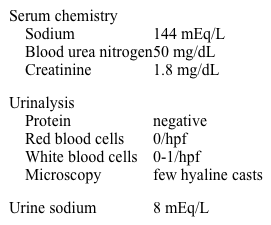 Which of the following changes are most likely to be seen in this patient?
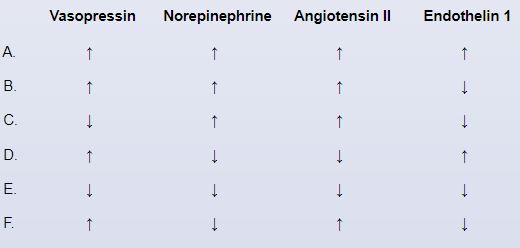
Which of the following changes are most likely to be seen in this patient? (Multiple Choice)
4.9/5 (70)
(70) A 65-year-old lady is sent to the hospital after waking up an hour earlier with rapid onset chest pain and shortness of breath. She has a considerable history of type 2 diabetes, obesity, and hypertension. Blood pressure is 80/50 mm Hg, the temperature is 36.7 C (98.1 F), the pulse is 110/min, and the rate of respiration is 20/min. The extremities feel damp and chilly. There is diaphoresis. ST-segment elevation is seen on the ECG in the lateral leads. Which of the following hemodynamic alterations in this patient is most likely present? 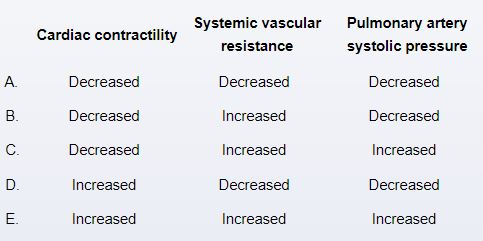
(Multiple Choice)
4.8/5 (72)
(72) A 29-year-old woman comes to the office due to whitish nipple discharge, she also states that she has no menstrual periods for 4 months. The pregnancy test was negative. She also has increased fatigue and feels depression. she has a 10 kg as recent weight gain. The patient has had no headaches or vision changes. She has no prior medical problems and takes no medications. On physical examination, there is thinning of the outer third of the eyebrows. The thyroid is enlarged and nontender to palpation. Abdominal and pelvic examinations are normal. The skin appears dry. On lab tests there are elevated TSH and low thyroxine. an increase in prolactin is also detected. Which of the following is the most likely mechanism causing this patient's elevated prolactin level?
(Multiple Choice)
4.9/5 (78)
(78) A physiologist is conducting an experiment to measure the physiological changes include blood pressure and left ventricular volume after infusion of 3 L isotonic saline. He detects an increasing in blood hormone level after infusion. This hormone is most likely to increase which of the following in this test subject?
(Multiple Choice)
4.7/5 (75)
(75) To identify the variables influencing vascular resistance, a researcher is performing an experiment. Animals used in experiments are sedated, intubated, and connected to a ventilator under control. Each animal has a catheter inserted into a tiny artery in a different organ. The catheter is attached to an oximeter and a manometer, which both record oxygen saturation and pressure over time. At regular intervals, arteriolar resistance is determined from the manometer data and the fraction of inspired oxygen is gradually altered. The results shown below were most likely obtained from which of the following organs? 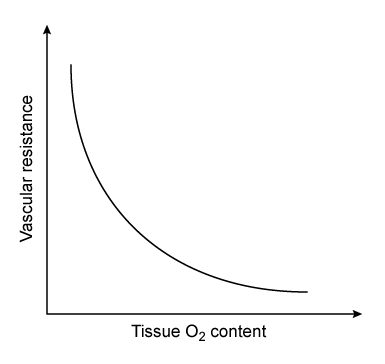
(Multiple Choice)
4.9/5 (78)
(78) After a similar amount of oral and intravenous glucose has been administered, researchers evaluate the blood insulin levels of healthy volunteers. We see the following curves: 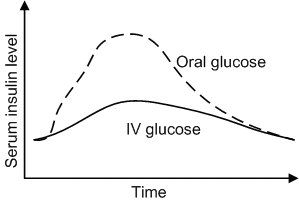 Which of the following endogenous substances best explains the difference between the curves?
 (Multiple Choice)
4.8/5 (79)
(79) A 16-year-old boy is brought to the ER by his mother due to sudden onset of heart palpitations. He has no prior medical conditions or family history of any disease. Blood pressure is 115/75 mm Hg and pulse is 160/min and regular. The physician applied a gentle neck massage just below the angle of the right mandible and his condition is immediatly improved. His blood pressure is now 120/80 mm Hg and pulse is 70/min. Which of the following mechanisms is responsible for improvement of this patient's condition?
(Multiple Choice)
4.8/5 (78)
(78) A66-year-old man comes to the office to discuss his sexual performance. The patient has normal sexula desire but needs more stimulation to achieve an erection and has a longer sexual refractory period than before. The patient has a history of hypertension and takes his medication regularly. He does not use tobacco, alcohol, or illicit drugs. Vital signs are normal. BMI is 23..6 kg/m2
Physical examination, including examination of the testes, is normal. After laboratory testing is completed, the physician finds no evidence of organic disease and concludes that the results are consistent with normal aging. Compared to a healthy young man, which of the following sets of test results would be most consistent with the physician's conclusion?
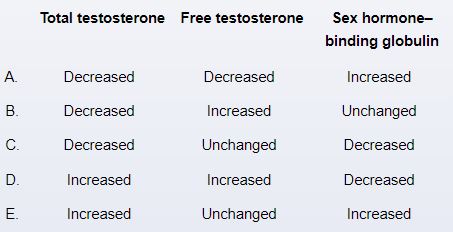
(Multiple Choice)
4.8/5 (73)
(73) A 15-Year-old boy is brought to your office due to concerning muscles weakness. He Has no prior medical disease and take no medication. He states that he has difficulty climbing stairs. and he cannot left his upper extrimities above his head. On examination, he is unable to lift his arms or legs against resistance when fully outstretched. Muscle biopsy is done and shows sparse transverse tubules in some of the muscle fibers. Which of the following is the most likely consequence of this patient's biopsy findings?
(Multiple Choice)
4.8/5 (64)
(64) A 45-year-old male comes to your clinic has a concern why his wife got pregnant despite he underwent vasectomy two month ago, they has 5 children and a few month ago they decided to stop conceiving and his wife stopped using OCP, but they shocked when his wife discovered she is pregnant, what the advice that should the doctor discussed with patient after vasectomy?
(Multiple Choice)
4.7/5 (88)
(88) Exertional dyspnea is assessed in a 73-year-old man. His tolerance for exercise has deteriorated over the last year, and he can only walk 2-3 blocks without stopping. The patient also reports lightheadedness and palpitations on occasion. He has not experienced any chest pain or syncope. He was previously diagnosed with hypertension but does not take any medications. A cardiac murmur is discovered during a physical examination. For further evaluation, the patient is referred to a cardiologist. Cardiac catheterization is carried out, and the results are depicted in the image below. Which of the following points most likely corresponds to the peak murmur intensity in this patient? 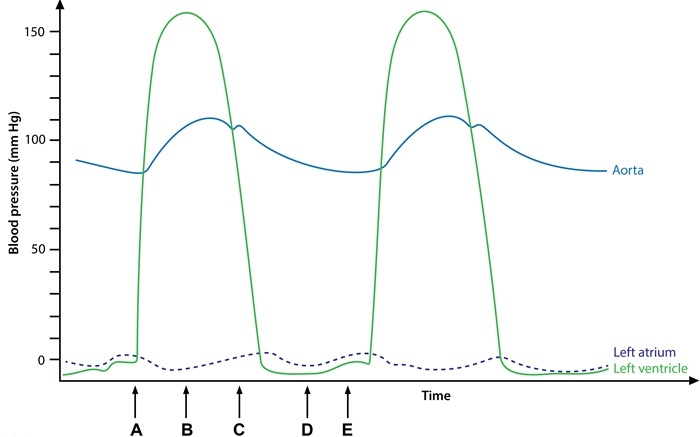
(Multiple Choice)
4.7/5 (75)
(75) A 60-year-old man is brought to the emergency department due to progressive dyspnea and cough. He has an upper respiratory tract infection 5 days ago and has a histroy of heart failure. On physical examination, jugular venous pressure is elevated, breath sounds are decreased at the right lung base with dullness to percussion, and 2+ bilateral lower extremity pitting edema is present. Chest x-ray shows cephalization of the blood vessels, Kerley B lines, and a right pleural effusion. Thoracentesis is performed for pleural fluid analysis. In comparison to plasma fluid, which of the following pleural fluid findings is most likely to be observed?
(Multiple Choice)
4.8/5 (64)
(64) A 35-year-old woman comes to the office for follow up. She has a history of celiac disease and she was diagnosed with iron deficiency anemia , she has started on iron supplements. The woman is concerned about side effects of the supplement. She is reassured that iron homeostasis is closely regulated; as the body's iron stores increase, a hormone is released and functions in reducing the amount of dietary iron absorbed from the intestines. Which of the following cells is most likely responsible for secreting this hormone?
(Multiple Choice)
4.9/5 (72)
(72) To evaluate natural aging-related cardiovascular alterations, a 30-year longitudinal research is conducted from age 50 to 80 in untreated persons without known cardiovascular illness. Each year, a number of variables are monitored. Which of the following alterations among patients beyond the age of 80 compared to when they were 50 is most likely to occur? 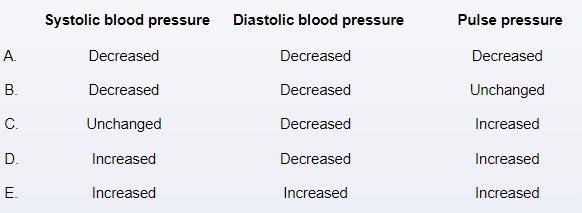
(Multiple Choice)
4.8/5 (83)
(83) A physiologist is conducting an experiment to study the effect of hypertension on blood vessels and blood flow. In one of the patients , he discoves that the right renal artery is narrowed and the left renal is intact. If he concludes the flow in the vessel is decreased by factor of 16 compared to the left. By what percentage has the radius of the lumen been reduced?
(Multiple Choice)
4.9/5 (72)
(72) During physiological experiments on animal spinal fluid biomedical substances level after noxious stimuli. One of the substances increased as a result of the experiment is a pentapeptide with a strong affinity to delta- and mu-receptors. Which of the following substances is most likely to have a common molecular origin with the pentapeptide described above?
(Multiple Choice)
4.8/5 (78)
(78) A 65-year-old woman with chronic obstructive pulmonary disease comes to the emergency department due to worsening shortness of breath and cough. She has a mild productive cough for the past 2 years but she noticed that her sputum is more yellow than usual over the past 2 days. She has not had any recent fevers, chills, sore throat, or a runny nose. Her only medication is a salmeterol inhaler that she uses twice daily. Pulse oximetry shows an oxygen saturation of 85% on room air. Expiratory wheezes are heard throughout the lungs. The patient is started on high-flow oxygen supplementation. Shortly afterward, she becomes increasingly lethargic and confused. This patient's clinical decline is most likely attributable to an increase in which of the following parameters?
(Multiple Choice)
4.8/5 (83)
(83) 
Filters
- Essay(0)
- Multiple Choice(0)
- Short Answer(0)
- True False(0)
- Matching(0)