



 Chat with AI
Exam 12: Physiology

Exam 1: Anatomy265 Questions
Exam 2: Behavioral Sciences178 Questions
Exam 3: Biochemistry102 Questions
Exam 4: Embryology59 Questions
Exam 5: Epidemiology, Biostatistics, and Medical Informatics94 Questions
Exam 6: Genetics88 Questions
Exam 7: Histology46 Questions
Exam 8: Immunology147 Questions
Exam 9: Microbiology and Virology330 Questions
Exam 10: Pathology817 Questions
Exam 11: Pharmacology and Toxicology509 Questions
Exam 12: Physiology339 Questions
Exam 13: Psychiatry and Psychotherapy23 Questions
Select questions type


A 45-year-old man is evaluated for persistent cough and progressive dyspnea on exertion. The patient has no medical issues but has been exposed to large quantities of coal dust while working as a miner for the past 15 years. Chest imaging reveals small, nodular opacities in the upper lobes. Lung biopsy shows fine carbon particles within the patient's respiratory bronchioles and alveolar ducts. Which of the following mechanisms is most directly responsible for clearing the foreign particles from this patient's respiratory tract?
(Multiple Choice)
4.8/5  (74)
(74) A 66-year-old homeless man is brought to the hospital after he is found wandering the streets during a cold winter day. The patient appears confused and has slurred speech. He has no chronic medical conditions and takes no medications. On examination, his temperature is 32 C (89.6 F). Cardiopulmonary examination is normal. No focal neurologic deficits are present. Toxicology screen is negative for any substances. Which of the following physiologic adaptations is most likely occurring in this patient to help maintain homeostasis?
(Multiple Choice)
4.9/5 (84)
(84) A 38- year-old male comes to the office because of a recent scroutm enlargement. He also states that he does not like to have sex anymore. The patient has no chronic medical conditions and takes no medication. Physical examination is notable for significant enlargement of the left testis and bilateral gynecomastia. His other secondary sexual characteristics are normal. Serum B-hCG is markedly elevated and serum TSH is normal. Scrotal ultrasound reveals a 2.8-cm, irregular testicular mass with cystic areas. Which of the following is the most likely cuse of this patient's gynecomastia?
(Multiple Choice)
4.9/5 (84)
(84) A 41-year-old man comes to the office for routine follow up. He feels fatigue, headache, weight loss, sweating, and palpitations. He is otherwise healthy and takes no medications. He does not use tobacco, alcohol, or illicit drugs. Physical examination reveals lid lag and a fine hand tremor. Neck examination reveals mild, diffuse enlargement of the thyroid gland. Laboratory results are high TSH and T4, T3: Which of the following is the most likely cause of this patient's disorder?
(Multiple Choice)
4.9/5 (77)
(77) A physiologist found during conducting a research experiment that glutamate depolarize and triggers cell death. he repeat this experiment by increasing magnesium concentration in the extracellular fluid and found that neuron depolarization and cell death due to glutamate are both decreased which of the following in ion electrolytes demonstrate decrease in cell death in response to magnesium?
(Multiple Choice)
4.9/5 (78)
(78) A 57-year-old man with acute ipsilateral headache and right-sided eye discomfort visits the emergency room. The patient also describes having extreme nausea and seeing "halos" surrounding everything. His discomfort is less intense following first therapy with the proper medicines. He also has increased diuresis and urine that is quite alkaline. Which of the following nephron segments is most frequently affected by the medication used to treat this patient's eye condition? 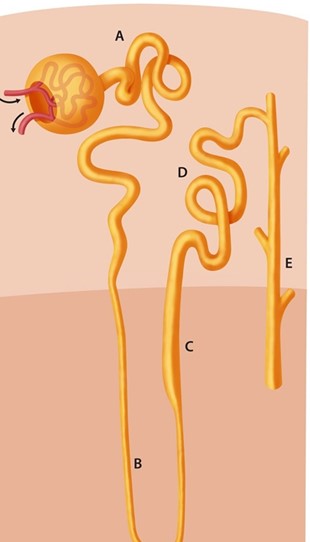
(Multiple Choice)
4.8/5 (65)
(65) A 38-year-old woman comes to the physician because of a 4-month history of worsening fatigue. She has had occasional exertional chest pain and shortness of breath over the past year but has not seen a physician. She takes no medications. Her temperature is 37°C (98.6°F), pulse is 94/min, respirations are 24/min, and blood pressure is 130/84 mm Hg. Physical examination reveals a loud pulmonic component of S2 but is otherwise unremarkable. Chest x-ray is normal. Echocardiography shows elevated pulmonary artery systolic pressure and right ventricular hypertrophy. Left ventricular structure and function are normal. Which of the following patterns of chemical mediators is most likely present in this patient's pulmonary arteries? 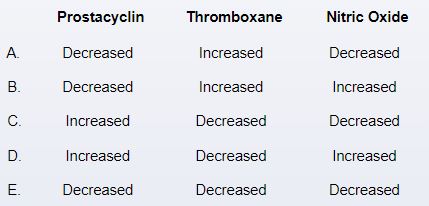
(Multiple Choice)
4.8/5 (73)
(73) A 42-year-old woman was brought to the emergency department after drowning in the sea. The patient was found drowning, the guards were late to reach her. On arrival, paramedics found him pulseless. After 10 minutes of cardiopulmonary resuscitation, the patient regains spontaneous circulation. In the hospital, she is intubated and placed on mechanical ventilation. Her vitals remains stable. After 3 days, the patient remained comatose with fixed dilated pupils. There is a loss of the pupillary light response. An MRI of the brain shows diffuse loss of grey-white matter differentiation with sulcal effacement. which of the following structures has been damaged in this patient?
(Multiple Choice)
4.8/5 (76)
(76) A 43-year-old woman is brought to the emergency department because of severe central chest pain, mild shortness of breath, and one episode of coughing up blood since waking up that morning. The pain worsens on inspiration, and she describes it as 8 out of 10 in intensity. Three months ago, she underwent a left modified radical mastectomy for invasive ductal carcinoma. Her temperature is 37.8°C (100.0 °F), pulse is 103/min, respirations are 20/min, and blood pressure is 102/74 mm Hg. Arterial blood gas drawn on room air shows an arterial partial pressure of oxygen (PaO2) of 54 mm Hg and an arterial partial pressure of carbon dioxide (PaCO2) of 26 mm Hg. Which of the following processes is most likely occurring in this patient?
(Multiple Choice)
4.8/5 (79)
(79) A 70-year-old man is found died in his house this morning. He was living alone after his wife passed away last year. postmartem biopsy revealed the cause of death is due to pulmonary embolism. the biopsy also demonstrates decreased left ventricular cavity size and a sigmoid-shaped ventricular septum. Light microscopy shows increased collagen content within the ventricular wall. Some myocardial cells also have brownish perinuclear cytoplasmic inclusions. The changes described are most consistent with which of the following conditions?
(Multiple Choice)
4.9/5 (73)
(73) A 60-year-old man comes to the physician because of a 2-year history of gradually worsening shortness of breath. He smoked half a pack of cigarettes daily for 10 years but stopped 8 years ago. His pulse is 72/min, blood pressure is 135/75 mm Hg, and respirations are 20/min. Examination shows an increased anteroposterior diameter of the chest. Diminished breath sounds are heard on auscultation of the chest. Chest radiography reveals flattened hemidiaphragms, increased radiolucency of the lungs, and a long, narrow heart shadow. Which of the following parameters is most likely to be increased in this patient?
(Multiple Choice)
4.9/5 (87)
(87) A newborn by normal vaginal delivery is brought for routine screening. you found an increase in TSH and low thyroxine T4 serum level. Apgar scores were 8 and 9 at 1 and 5 minutes, respectively. His mother has no medical conditions. Physical examination reveals normal thyroid gland in the normal position. Neck ultrasound confirms the normal size of the thyroid. Which of the following is the most likely cause of this patient's findings?
(Multiple Choice)
4.9/5 (77)
(77) A 68-year-old man comes to the physician for a routine health maintenance examination. He has had increasing shortness of breath and a productive cough for the past 1 year. He feels breathlessness when walk up a flight of stairs. He has hypertension and his only medication is amlodipine. He smoked 1 pack of cigarettes daily for 30 years but quit 6 years ago. His pulse is 98/min, respirations are 25/min and blood pressure is 134/88 mm Hg. Pulse oximetry on room air shows an oxygen saturation of 92% at rest and 85% with mild exertion. Scattered expiratory wheezing and rhonchi are heard throughout both lung fields. Which of the following additional findings is most likely to be seen in this patient?
(Multiple Choice)
4.8/5 (82)
(82) Physiologists are investigating how the plasma concentration of various substances affects their excretion in the urine. In one experiment, a freely filtered substance at the glomerulus is infused intravenously at various rates. The substance's plasma concentration (mg/mL) and urinary excretion rate (mg/min) are measured. The following observations are made assuming a constant glomerular filtration rate (GFR) of 100 mL/min:  Which of the following substances is most likely to demonstrate a similar pattern of filtration and excretion in a healthy adult?
 (Multiple Choice)
4.8/5 (89)
(89) A 25-year-old man with no significant medical history was playing soccer when he collapsed unexpectedly. He died despite all efforts to save his life. An autopsy is carried out. The heart weighs 580 g (normal: 350 g) on gross examination. The image depicts the cut surface of the heart. 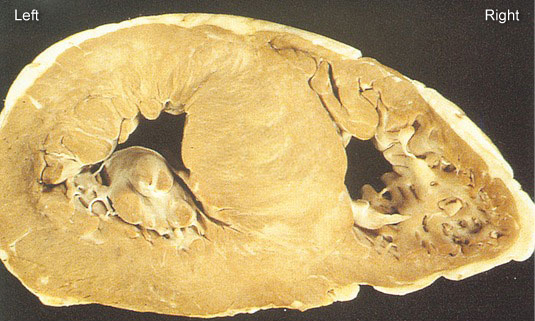 If this patient had a preparticipation sports screening, cardiac auscultation would have likely revealed a murmur that increases in intensity after which of the following?
 (Multiple Choice)
4.8/5 (75)
(75) A 2-week-old girl in NICU due to being born at 28 weeks gestation and had a birth weight of 1 kg. The patient is on minimal respiratory support via nasal cannula and she is evaluated today due to recurrent apanic episodes and respiratory effort stop for 30 seconds at a time then return normal saturation and respiration Examination of the lungs reveals bilateral, clear breath sounds with easy work of breathing. Ultrasound of the head is normal. Arterial blood gas values are normal. This patient's clinical findings are most likely caused by an abnormality in which of the following areas?
(Multiple Choice)
4.7/5 (88)
(88) A 62-year-old guy visits the office to have his abdominal swelling examined. His abdomen has gotten increasingly bloated over the past few weeks, and this has been accompanied by some slight discomfort and a loss of appetite. There have been some admissions for alcohol-induced pancreatitis in the past. The patient currently consumes one pint of alcohol every day and abstains from using tobacco or other substances. Physical examination reveals many spider angiomas on the upper chest and a moderately icteric sclera. When the patient lies on either side, the dullness to percussion shifts to a different position due to the enlarged abdomen. Creatinine is 1.1 mg/dL and serum sodium is 130 mEq/dL. Which of the following would this patient most likely exhibit? 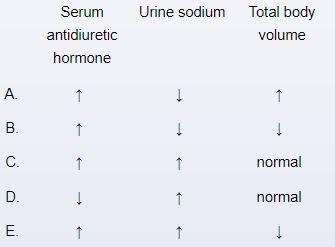
(Multiple Choice)
4.8/5 (79)
(79) A study is conducted to standardize laboratory equipment in a hospital network. In one hospital, 2 healthy volunteers undergo testing. Both are found to have a serum creatinine level of 1.1 mg/dL. Glomerular filtration rate is estimated using the same equation and reveals values of 118 mL/min in one volunteer and 70 mL/min in the other. A difference in which of the following parameters best explains the observed laboratory findings in these volunteers?
(Multiple Choice)
4.9/5 (83)
(83) A 65-year-old woman is brought to the hospital after she collapsed during working outdoor in her garden. The patient has no chest pain, palpitations, or shortness of breath. She has never had a similar episode. There is no family history of sudden death. The patient has a history of fibromyalgia and takes amitriptyline. The patient does not use alcohol or illicit drugs. Temperature is 41 C (105.8 F), blood pressure is 98/56 mm Hg, pulse is100/min, and respirations are 24/min. The skin is warm and red. The patient is not oriented to time, place, or person. Deep tendon reflexes and muscle tone are normal. Which of the following findings in this patient most likely explains why the patient developed symptoms while his grandson remained asymptomatic?
(Multiple Choice)
4.8/5 (73)
(73) A physiologist is conducting an experiment to study the effect of hypertension on blood vessels and blood flow. In one of the patients , he discoves that the right renal artery is narrowed and the left renal is intact. If he concludes the flow in the vessel is decreased by factor of 16 compared to the left. By what percentage has the radius of the lumen been reduced?
(Multiple Choice)
4.8/5 (74)
(74) 
Filters
- Essay(0)
- Multiple Choice(0)
- Short Answer(0)
- True False(0)
- Matching(0)