



 Chat with AI
Exam 12: Physiology

Exam 1: Anatomy265 Questions
Exam 2: Behavioral Sciences178 Questions
Exam 3: Biochemistry102 Questions
Exam 4: Embryology59 Questions
Exam 5: Epidemiology, Biostatistics, and Medical Informatics94 Questions
Exam 6: Genetics88 Questions
Exam 7: Histology46 Questions
Exam 8: Immunology147 Questions
Exam 9: Microbiology and Virology330 Questions
Exam 10: Pathology817 Questions
Exam 11: Pharmacology and Toxicology509 Questions
Exam 12: Physiology339 Questions
Exam 13: Psychiatry and Psychotherapy23 Questions
Select questions type


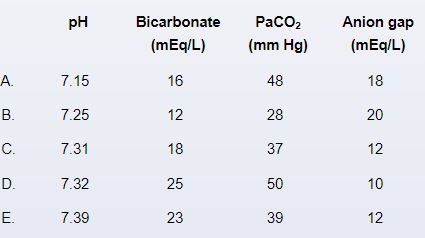
A 23-year-old man arrives at the emergency department after experiencing abdominal pain and nausea for several hours. He also claims to have vomited and to have noticed that his urine has a fruity odor. For several days, the patient has had increased thirst and urination, as well as weight loss. He has no known medical issues and does not take any medications. Pallor with cool extremities is revealed on physical examination. The abdomen is soft and not tender to palpation. To confirm the diagnosis, laboratory tests are ordered. Which of the following graph points best represents this patient's acid-base status? 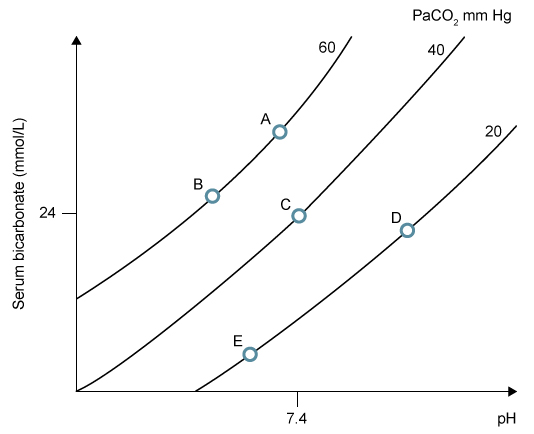
(Multiple Choice)
4.9/5  (82)
(82) Researchers are studying pulmonary gas exchange in various physiological and pathological states using animal models. In one experiment, the partial pressure of oxygen (PO2) in the upper airways is determined to be 150 mm Hg while breathing ambient air at rest. Analysis of the respiratory gases in a particular lung segment reveals the following: 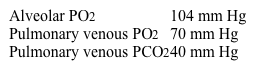 Which of the following best explains these respiratory gas findings?
 (Multiple Choice)
4.8/5 (82)
(82) A 38-year-old man is brought to the emergency department due to progressive nausea, confusion, and unsteady gait. Family members state that symptoms started 4 days ago after he went to the dentist due to a toothache, for which he was prescribed ibuprofen. He also takes lithium for bipolar disorder. On examination, he is drowsy and ataxic, having slurred speech and coarse tremors. His serum lithium level is 3.86 mEq/L (therapeutic range: 0.8-1.2 mEq/L), and serum creatinine and blood urea nitrogen are elevated. While in the emergency department, he develops a generalized tonic-clonic seizure. During emergent hemodialysis treatment, his blood is passed along a semipermeable membrane and allowed to equilibrate with a dialysate solution. Which of the following is most likely to increase the rate of drug removal?
(Multiple Choice)
4.8/5 (91)
(91) In an animal experiment, the pancreatic duct is cannulated and the gland is subjected to various secretory stimulation. When the constituents of pancreatic fluid are measured, the following tracings are produced: 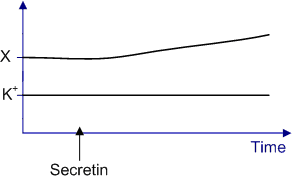 Substance 'X' is most likely which of the following?
 (Multiple Choice)
4.7/5 (87)
(87) A 45-year-old woman is being evaluated in the second post thyroidectomy day. The patient reports a new perioral tingling sensation accompanied with a muscle cramp. Vital signs are normal. Blood pressure is 118/78 mm Hg, pulse is 72/min, and respirations are 15/min. Physical examination shows normal muscle strength and deep tendon reflexes. Light tapping anterior to the ear elicits twitching of the lower facial muscles. An increase in which of the following best explains this patient's current symptoms?
(Multiple Choice)
4.8/5 (78)
(78) A 66-year-old man comes to the hospital due to progressive weakness and lethargy for the past three weeks. He is't compliant with his antihypertensive medications. Blood pressure is 165/102 mm Hg, pulse is 92/min, and respirations are 21/min. Oxygen saturation is 96% on room air. Physical examination shows elevated jugular venous pressure, bilateral crackles, and 3+ pitting edema in both legs. Laboratory results are as follows: 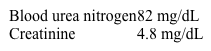 Which of the following additional findings are most likely present in this patient?
Which of the following additional findings are most likely present in this patient? (Multiple Choice)
4.7/5 (62)
(62) An elderly guy in his 80s has been taking part in a longitudinal study of aging. He doesn't have any serious medical issues. In order to track long-term changes in pulmonary gas exchange, arterial blood gas samples are taken once every ten years on room air at sea level. Which of the following outcomes is most consistent with normal aging as compared to 30 years ago? 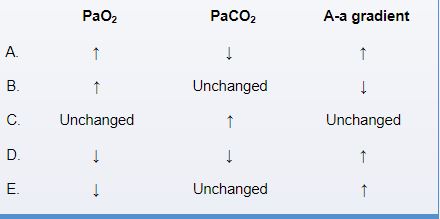
(Multiple Choice)
4.8/5 (70)
(70) A 35-year-old woman is being evaluated for regular health check. During the last 6 months, she has felt dyspnea especially after walking only 3-4 blocks on level ground. She also has an occasional dry cough at night. She has no other symptoms of pain, palpitations or weight loss. On physical examination, the patient appears comfortable. Blood pressure is 122/70 mm Hg and pulse is 75/min and regular. On cardiac auscultation S1 is loud and a diastolic murmur is heard at mid- and end diastole with the patient positioned on her left side and breath held at the end of expiration. Otherwise, examination is unremarkable. Which of the following are the most likely left ventricular hemodynamic findings at rest in this patient? 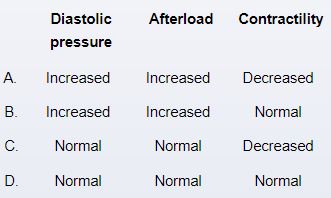
(Multiple Choice)
4.7/5 (79)
(79) A 30 year-old woman comes to the physician for evaluation of double vision for 2 days. She states that she had a tingling sensation and paraesthesia in her hand last month. MRI of the brain demonstrates a lesion in several areas of T2 hyperintensity consistent with axonal demyelination and a diagnosis of multiple sclerosis is made.
Last summer she had an episode of weakness in her right leg that resolved without any intervention.
Which of the following neuronal properties is most likely to decrease as a direct result of demyelination?
(Multiple Choice)
4.9/5 (66)
(66) A 42-year-old woman comes to the physician because of frequent episodes of headaches over the past 3 months. One week ago, she had a brief episode of right arm weakness and numbness that lasted for 3 minutes before spontaneously resolving. She is otherwise healthy and takes no medications. She has smoked one-half pack of cigarettes daily for 22 years. Her pulse is 82/min and blood pressure is 156/104 mm Hg. Neurologic examination shows no focal lesions. Abdominal examination shows no masses or tenderness. A bruit is heard on auscultation of the abdomen. Blood testing in this patient would most likely show which of the following? 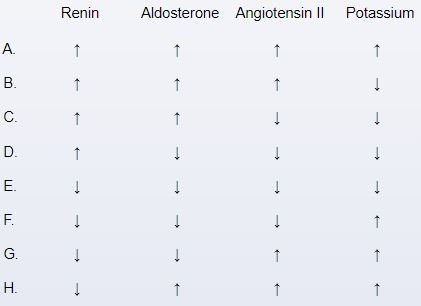
(Multiple Choice)
4.8/5 (59)
(59) A 28-year-old woman comes to the office due to pain at a previous surgery site. The patient underwent cesarean delivery a year ago and had no issues with wound healing. However, over the past 2 months, she has had intermittent sharp and burning pain at the incision site. Physical examination reveals a well-healed, low, transverse scar. There is a small knot palpable at the left end of the scar, light touch of which elicits severe pain. Cutaneous sensory nerve injury and abnormal axonal regeneration are suspected. Which of the following ion channels is most likely upregulated within the affected axons?
(Multiple Choice)
4.9/5 (60)
(60) A 15-year-old girl is brought to the emergency department after she lost her consciousness. on examination she is confused and lethargic but follows simple commands. Family members report that for the last 2 weeks she has experienced polyuria, polydipsia, and increased appetite. . The patient does not use tobacco, alcohol, or illicit drugs. Family history is significant for hypothyroidism in her brother. Temperature is 36.7 C (98 F), blood pressure is 90/60 mm Hg, pulse is 97/min, and respirations are 22/min. Her breath has a fruity odor. This patient is most likely deficient in a hormone that normally performs which of the following actions?
(Multiple Choice)
4.8/5 (79)
(79) A 32-year-old woman arrives at the clinic complaining of progressive exertional dyspnea and easy fatigability. She immigrated to the United States from India several years ago and claims to have had rheumatic fever as a child. Cardiac auscultation reveals a diastolic high-frequency sound and a rumbling diastolic murmur best heard at the midclavicular line in the left fifth intercostal space. Cardiac catheterization is used to evaluate hemodynamics, and the results are shown below. Which of the following letters best corresponds to the timing of the high-frequency sound heard during cardiac auscultation of this patient? 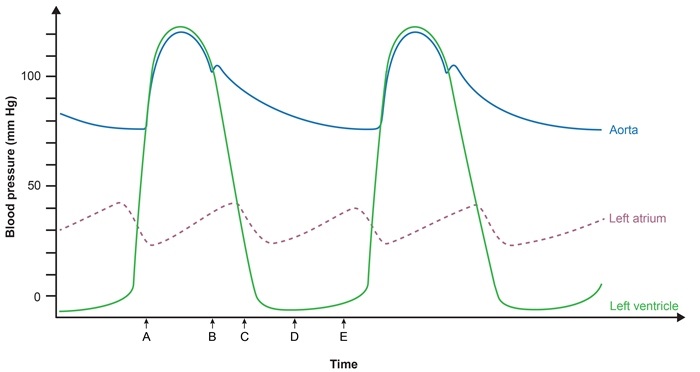
(Multiple Choice)
4.7/5 (90)
(90) A 60-year-old woman is being assessed for chronic fatigue and weakness. She has no other medical issues and does not take any medications. Following preliminary laboratory studies, the physician decides to perform a metyrapone stimulation test. The graph below depicts the changes in urinary 17-hydroxycorticosteroid (17-OHS) excretion after metyrapone administration. 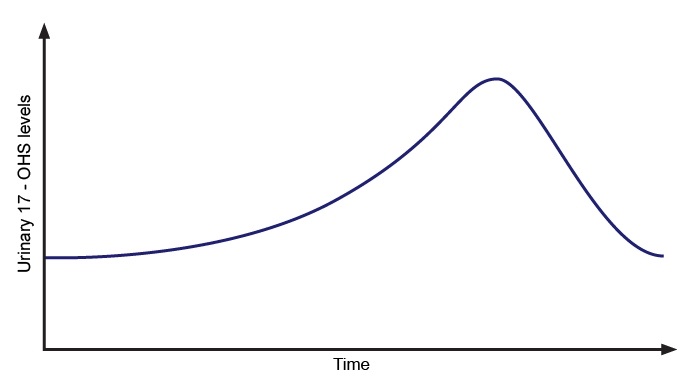 Which of the following mechanisms is most likely responsible for the findings seen in the graph?
 (Multiple Choice)
4.8/5 (76)
(76) An 80-year-old male comes to the office because he feels constipation and fatigue for 1 month. He smokes 15 cigarettes daily. He has chronic hypertension and diabetes type II adhere to his medication. He has no family history of cancer. A colonoscopy is done and revealed a colon cancer, CT shows no metastatic. al. A chemotherapy regimen containing a medication that is primarily metabolized by the liver is chosen for therapy. Because of the patient's age, the physician is considering adjusting the dose to prevent adverse effects. Which of the following parameters is likely to be the most similar between this patient and a healthy 40-year-old individual?
(Multiple Choice)
4.9/5 (100)
(100) An examination of the boy's irritation, sluggish development, and acne is the reason a 16-year-old is brought into the office. The patient participates in soccer and has been pursuing a rigorous strength-training regimen. He acknowledges using a performance-enhancing drug for the previous six months when questioned. What new discoveries are most likely to have been made in this patient since six months ago? 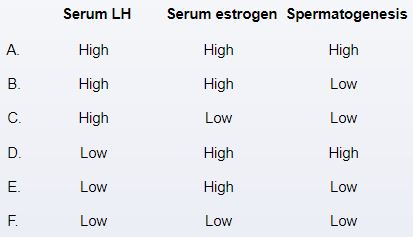
(Multiple Choice)
4.9/5 (77)
(77) A 34-year-old Russian immigrant visits the doctor after complaining of exertional dyspnea and progressive lower extremity swelling for two months. He also complains of abdominal distension and a loss of appetite. Over the last two months, the patient has gained 4.5 kg (10 lbs). Past medical history is important for hypertension and recurrent lung infections that necessitate long-term antibiotic therapy. He has never had coronary artery disease. For the past 15 years, the patient has smoked a pack of cigarettes every day. He is subjected to noninvasive cardiac testing, which is followed by cardiac catheterization. The slide below depicts a jugular venous pressure tracing. 11ec160b 3a8d 1b23 9249 0f7b4d8776df MD0001 00 The waveform indicated by the arrow most likely corresponds to which of the following?
(Multiple Choice)
4.8/5 (88)
(88) A 32-year-old woman comes to the physician because of progressive fatigue and shortness of breath on exertion. She has smoked one pack of cigarettes daily for 20 years. The patient's mother died of pulmonary arterial hypertension at age 42. Vital signs are within normal limits. Physical examination shows jugular venous pulsations 9 cm above the sternal angle. The lungs are clear to auscultation. There is a normal S1 and a loud, split S2. An impulse can be felt with the fingers left of the sternum. The abdomen is soft and nontender to palpation. ECG shows right axis deviation. If this patient's condition is inherited, which of the following is the most likely direct cause of her disease?
(Multiple Choice)
4.8/5 (86)
(86) A 44-year-old woman comes to the clinic due to chronic watery diarrhea with uncomfortable abdominal pain and flatulence. She has a history of long standing type I diabetes mellitus. physical examinations are normal. An upper endoscopy is done in which a jejunal aspiration was taken and the culture of the aspirate reveals >10,000 colony-forming units/mL of Bacteroides species. Which of the following is the most likely cause of this patient's current symptoms?
(Multiple Choice)
4.8/5 (73)
(73) A 67-year-old woman comes to the ER because of intermittent chest pain and palpitation. She states that she felt the same symptoms on multiple occasions before and disappeared without intervention. She has an irregular and fast beat . She has chronic hypertension without any other chronic diseases. Temperature is 37.1 C , pulse is 106/min and irregular, blood pressure is 145/84 mm Hg, and respirations are 17/min. Cardiopulmonary auscultation reveals clear lungs and no heart murmurs. ECG shows an irregularly irregular rhythm with absent P waves. The patient is started on metoprolol and apixaban. Which of the following is likely to be directly affected as the result of this therapy?
(Multiple Choice)
4.8/5 (82)
(82) 
Filters
- Essay(0)
- Multiple Choice(0)
- Short Answer(0)
- True False(0)
- Matching(0)