



 Chat with AI
Exam 12: Physiology

Exam 1: Anatomy265 Questions
Exam 2: Behavioral Sciences178 Questions
Exam 3: Biochemistry102 Questions
Exam 4: Embryology59 Questions
Exam 5: Epidemiology, Biostatistics, and Medical Informatics94 Questions
Exam 6: Genetics88 Questions
Exam 7: Histology46 Questions
Exam 8: Immunology147 Questions
Exam 9: Microbiology and Virology330 Questions
Exam 10: Pathology817 Questions
Exam 11: Pharmacology and Toxicology509 Questions
Exam 12: Physiology339 Questions
Exam 13: Psychiatry and Psychotherapy23 Questions
Select questions type


As aprt of in vetro experiment, the physiologist injet radiolabeled ATP into skeletal muscle. If the labeled ATP is observed to attach to the sacromere during muscle contraction. What does this attachement casue immediately?
(Multiple Choice)
4.9/5  (83)
(83) A 40-year-old man comes for the office to evaluate the infertility. he has been married for 6 years and he with his wife are unable to concieve despite her wife has a child from previous marriage. A semen analyisi is done and shows a low sperm count. If a rare genetic disease is discoverd afte more investigation that leads to inactive FSH receptors. which of the following substances is most likely decreased in this patient?
(Multiple Choice)
4.9/5 (98)
(98) A 54-year-old woman comes to the office due to worsening nonproductive cough and dyspnea for the past several months. She also reports anorexia and an unintentional weight loss of 7 kg (15.4 lb). The patient has no prior medical conditions, takes no medications, and is a lifelong nonsmoker. Physical examination shows decreased breath sounds on the left side. Chest x-ray reveals a large left-sided pleural effusion. Thoracentesis yields fluid with a large number of red blood cells and numerous atypical cells staining positive for mucin. Which of the following is the most likely primary mechanism of this patient's pleural effusion?
(Multiple Choice)
4.9/5 (68)
(68) A 22-year-old primigravida whose pregnancy was complicated by preeclampsia at 26 weeks gestation has undergone cesarian section. Her baby has been evaluated in the NICU due to murmur. Cardiac auscultation reveals a continuous murmur at the left sternal border, and bounding femoral and palmar pulses are palpable. Echocardiography confirms the diagnosis. Compared with a normal infant, this patient most likely has which of the following changes in cardiac parameters? 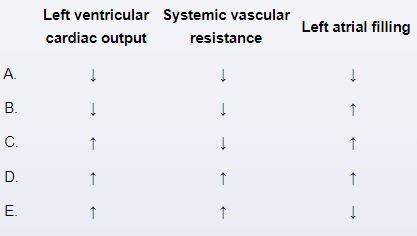
(Multiple Choice)
4.8/5 (74)
(74) During a surgery in a newborn the surgorn noticed perirenal fat containing tissue if the surgicaln removal of this tissue would most likely contribute to
(Multiple Choice)
5.0/5 (78)
(78) A 22-year-old man comes to the clinic for a routine physical. The patient has no medical problems and takes no medication. He does not use tobacco, alcohol, or illicit drugs. He plays on his college football team and participates in intense training sessions and weekly games. Review of systems is unremarkable. Blood pressure is 120/76 mm Hg, pulse is 68/min, and respirations are 15/min. BMI is 28 kg/m. Blood pressures in the upper and lower extremities are equal. There is no jugular venous distension. Carotid upstrokes are brisk. There is a grade 2/6 early systolic murmur along the left sternal border. The murmur decreases in intensity with hand grip and passive leg elevation. Lung sounds are normal without crackles or wheezes. Echocardiogram is most likely to demonstrate which of the following findings? 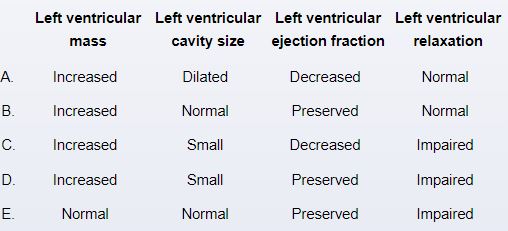
(Multiple Choice)
4.7/5 (84)
(84) A 55-year-old woman with a history of inflamatory bowel disease is admitted to the hospital due to perforated appendicitis. The patient quickly develops respiratory difficulty, and acute respiratory distress syndrome is diagnosed. She is intubated and mechanically ventilated with positive pressure ventilation. Despite the use of high positive end-expiratory pressure, the patient's condition continues to deteriorate. She is intermittently placed in the prone position while mechanically ventilated. Which of the following is most likely to occur due to this position change?
(Multiple Choice)
4.9/5 (70)
(70) A 14-year-old girl is brought to by her mother due to menstrual cycle irregularity. She has menarche at 13, and since that time her period is unpredictable and she has 4 to 5 menstrual cycles per year. when she does have a menstrual period, she bleeds for 7-10 days and occasionally needs to use nearly twice as many tampons a day as her older sister Medical history is unremarkable. BMI is 23 kg/m2. Urine pregnancy test is negative, and a complete blood count is normal
Which of the following is the most likely cause of this patient's irregular bleeding?
(Multiple Choice)
4.8/5 (73)
(73) A 16-year-old man comes to the office due to frequent episodes of disorientation, palpitations, tremulousness, and excessive sweating over the past 3 months. He says the symptoms resolve quickly after drinking some juice or a carbonated beverage. The patient was diagnosed with type 1 diabetes mellitus at age 12 and takes short- and long-acting insulin. He has had no dose changes in the past 2 years or diabetic complications and follows up with an ophthalmologist frequently. The patient is a college student and reports some stress due to an upcoming midterm examination. He does not use tobacco, alcohol, or illicit drugs. Vital signs and physical examination are within normal limits. Laboratory results show a hemoglobin A1c of 6.8% and no proteinuria. Which of the following factors most likely precipitated this patient's current symptoms?
(Multiple Choice)
4.9/5 (70)
(70) A 38-year-old woman is being evaluated after experiencing intermittent tingling and numbness in her left hand for several months. Her symptoms primarily affect the fourth and fifth digits and are frequently triggered by driving a car. A physical examination reveals no anomalies. A nerve stimulator is placed on the left fifth digit and a surface recorder is placed over the ulnar nerve above the elbow during an electrodiagnostic study. An electrical stimulus is applied, and the resulting graph is shown below. The asymptomatic contralateral extremity's results are also shown. Which of the following is most likely to be affected in this patient? 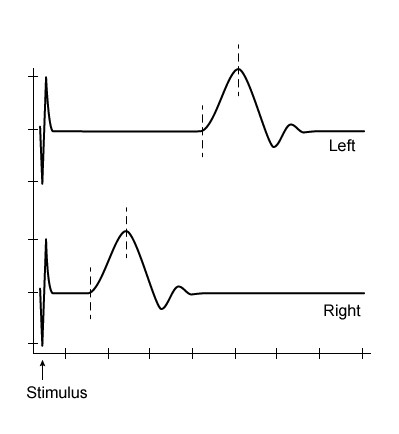
(Multiple Choice)
4.8/5 (77)
(77) A 28-year-old woman, gravida 3 para 2, at 31 weeks gestation comes to the office for a prenatal visit. The patient has had increasing shortness of breath while climbing stairs and during long walks for the past few weeks but has had no cough, sick contacts, hemoptysis, orthopnea, or chest pain. She has had no contractions or vaginal bleeding, and fetal movement is normal. The patient has no chronic medical conditions, and her pregnancy has been uncomplicated. Blood pressure is 110/80 mm Hg, pulse is 70/min, and respirations are 18/min. Fetal heart tones are normal. Cardiac examination reveals no rubs or murmurs. The lungs are clear to auscultation bilaterally. The remainder of the examination is unremarkable. Which of the following laboratory findings will most likely be found in this patient? 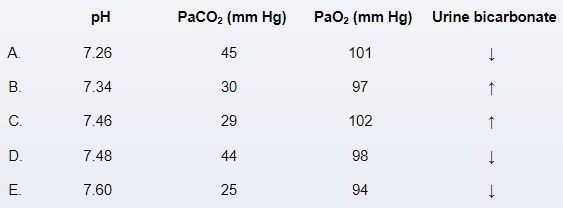
(Multiple Choice)
4.8/5 (88)
(88) A 28-year-old female comes to the clinic to discuss her infertility. She didn't have any child from previous marriage despite her previous partner has 3 children from previous dead wife. She has no prior medical disease and normal physical examination. The blood estradiol level in normal during the first phase of the menstrual. Which of the following cell types that convert androgen to estradiol?
(Multiple Choice)
5.0/5 (71)
(71) A 65-year-old man with type 2 diabetes mellitus visits the doctor for a routine check-up. He began taking oral hypoglycemic medications 12 years ago but was recently switched to long-acting insulin due to poor blood sugar control. His most recent serum creatinine level was 2.1 mg/dL. The patient is concerned about his elevated creatinine level and how it relates to his kidney function. Which of the following graphs most accurately represents the relationship between serum creatinine and glomerular filtration rate?
(Multiple Choice)
4.8/5 (83)
(83) A 26-year-old basketball player passed out and couldn't be revived. He had exertional dyspnea and lightheadedness before the event. An autopsy is carried out. The lungs are in perfect health. The exhibit displays the heart. 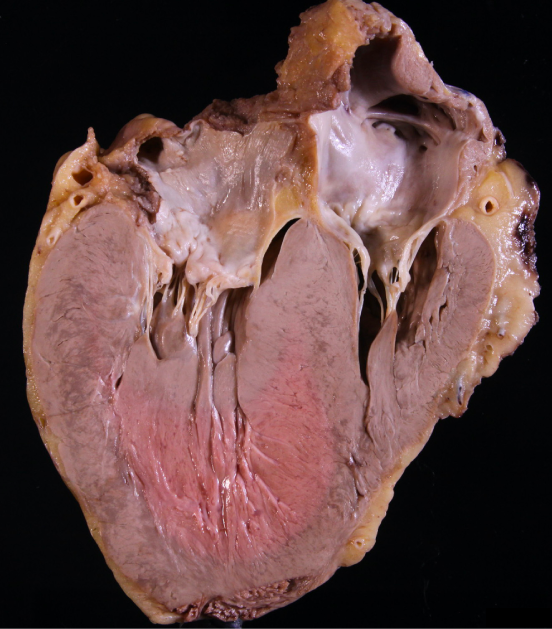 If the patient had been examined prior to death, which of the following would most likely have been present?
 (Multiple Choice)
4.8/5 (89)
(89) A new anti-seizure has been recently approved for epilepsy treatment. If this drug binds and activates GABA-A receptors in the central nervous system. If the resting potential of the nerve is found to be -70 mV what will most likely be the membrane potential of an isolated nerve which is treated by this drug?
(Multiple Choice)
4.8/5 (76)
(76) A physiologist is trying to study the changes in teh blood pressure during exercise. He is conducting his study on healthy participants. During the study he asks to participants to run on a treadmill at incrementally increasing speed until their heart rate reaches 90% of their expected maximum heart rate. Compared to at rest, which of the following changes in blood pressure are expected during this time? 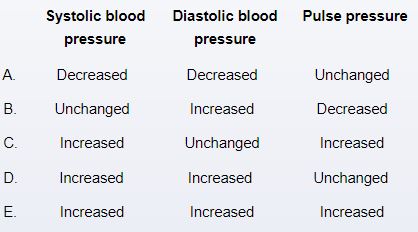
(Multiple Choice)
4.8/5 (88)
(88) A 55-year-old man is brought to the physician because of inappropriate behavior for the past 6 months. He has been making inappropriate comments and jokes while talking to friends and family members. He was arrested 3 weeks ago while trying to kiss strangers on the street. He also has lost interest in talking to his daughter or playing with his grandchildren. During this period, he has developed a strong desire for chocolate pudding and potato chips and has gained 10 kg (22 lb). He appears unkempt. Vital signs are within normal limits. Physical examination is unremarkable. Inability to perform which of the following tasks would be most indicative of frontal lobe dysfunction?
(Multiple Choice)
4.8/5 (82)
(82) A biomedical scientist is conducting an experimental study trying to identify the biomolecular mechanism which responsible for muscle contraction. He obtained a rat muscle fiber to know what is the underlying cellular elements that influence muscular contraction. If an embryo rat striated muscle fibers fail to contract in response to an element normally released from the sarcoplasmic reticulum. A deficiency of which of the following would best explain this finding?
(Multiple Choice)
4.8/5 (89)
(89) A 35-year old man who is a pilot travels between the USA and other countries visits you in the office due to difficulty sleeping. He said that he has been experiencing insomnia and daytime sleepiness after the flights but his sleep improves significantly. Which of the following hypothalamic nuclei is most likely responsible for this delayed improvement in his symptoms?
(Multiple Choice)
4.9/5 (91)
(91) 
Filters
- Essay(0)
- Multiple Choice(0)
- Short Answer(0)
- True False(0)
- Matching(0)