



 Chat with AI
Exam 12: Physiology

Exam 1: Anatomy265 Questions
Exam 2: Behavioral Sciences178 Questions
Exam 3: Biochemistry102 Questions
Exam 4: Embryology59 Questions
Exam 5: Epidemiology, Biostatistics, and Medical Informatics94 Questions
Exam 6: Genetics88 Questions
Exam 7: Histology46 Questions
Exam 8: Immunology147 Questions
Exam 9: Microbiology and Virology330 Questions
Exam 10: Pathology817 Questions
Exam 11: Pharmacology and Toxicology509 Questions
Exam 12: Physiology339 Questions
Exam 13: Psychiatry and Psychotherapy23 Questions
Select questions type


A young male gymnast used to lift heavier weights preparing for a new competition. During last training session, he tried to increase the weight on the exercise bar. After he left the weight for the third times, he attempted to left it for the fourth one but he could not hold the weight more than seconds and suddenly he dropped the weights to the ground and felt muscle relaxed involuntary. Which of the following structures was most likely responsible for the sudden muscle relaxation?
(Multiple Choice)
4.9/5  (83)
(83) A 65-year-old man comes to the clinic for follow up after discharge. 3 weeeks ago, he had a myocardial infarction and a drug- eluting stent was successfully placed. He has no symptoms now and feels well. He states that since discharge hasn't sexually well and he has had difficulty maintaining an erection and delayed ejaculation during sexual intercourse, but he has normal libido and regular nocturnal erections. Medications include metoprolol, rosuvastatin, aspirin, and ticagrelor. Vital signs and physical examination are normal. Which of the following is the most likely cause of this patient's sexual dysfunction?
(Multiple Choice)
4.9/5 (85)
(85) A 47-year-old comes to the physician because of 1 month history of increased urination. She has also had dry mouth and excessive thirst. The patient has no prior medical problems and takes no medications. Her temperature is 36.9, blood pressure is 118/78 mm Hg, and pulse is 86/min. The remainder of her physical examination is normal. Her urine output and osmolality remain unchanged with water deprivation for several hours, but after administration of desmopressin, urine output decreases and urine osmolality increases. Renal clearance of which of the following substances would decrease the most after this patient's injection?
(Multiple Choice)
4.9/5 (82)
(82) Physiologists are looking into renal autoregulatory mechanisms in a species that closely resembles human physiology. Renal blood flow and glomerular filtration rate are measured in an anesthetized animal in response to changes in mean arterial pressure during one of their experiments. The data they collect is depicted in the graph below. 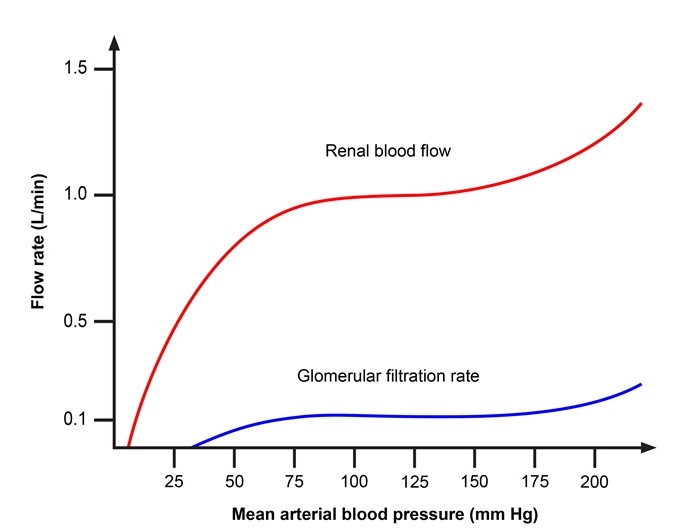 Assuming a hematocrit of 0.50, what is the best estimate of the filtration fraction when the mean arterial pressure is 120 mm Hg?
 (Multiple Choice)
4.9/5 (59)
(59) A 43-year-old patient with dyspnea visits the doctor. The pressure/volume relationship in healthy lung tissue is represented by the black curve in the image below. The patient's lung tissue's pressure/volume connection is shown by the blue curve. 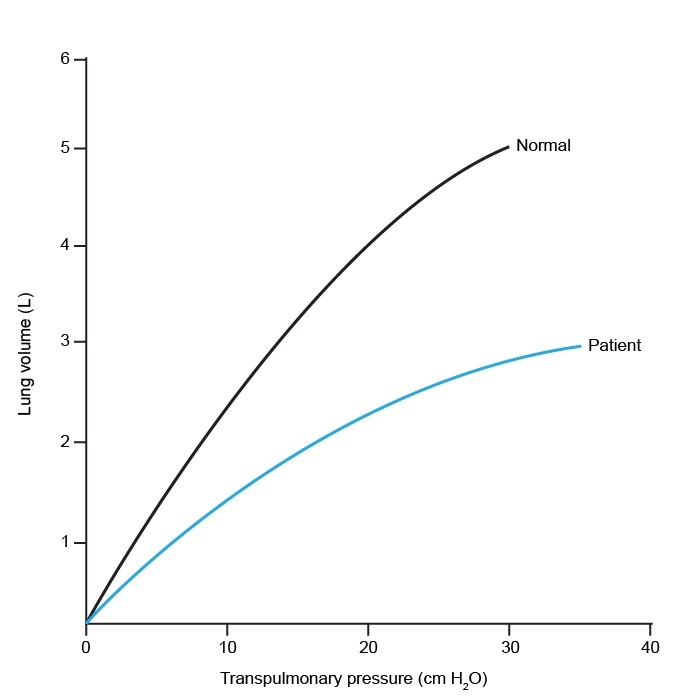 Which of the following is the most likely cause of this patient's symptoms?
 (Multiple Choice)
4.9/5 (78)
(78) During evaluation of a professional andurance athletes, the physician detected a soft heart murmur. The patient has no medical conditions and takes no medications. Blood pressure is 106/62 mm Hg and pulse is 60/min. Physical examination shows a soft systolic murmur best heard at the left second intercostal space in the supine position. The murmur disappears when the patient is upright but reappears after brief exercise. Which of the following cardiovascular adaptations best explains this patient's finding?
(Multiple Choice)
4.9/5 (98)
(98) A 25-year-old man arrives at the emergency department complaining of chest pain and palpitations for the past three hours. He'd had similar episodes in the past year that were resolved with deep breathing, but none had lasted as long as this one. The patient does not have any chronic medical conditions and does not take any medications. He does not smoke, drink alcohol, consume caffeine, or use illegal drugs. The blood pressure is 100/70 mm Hg, and the pulse rate is 160 beats per minute. The neck is flexible, the thyroid is functioning normally, and there is no lymphadenopathy. Auscultation reveals that the lungs are clear. ECG is shown in the exhibit.  Which of the following is the most likely cause of this patient's symptoms?
 (Multiple Choice)
4.9/5 (89)
(89) A 30-year-old man is brought to the emergency department due to chest palpitation and lightheadeness. He has no known medical conditions and takes no mediations. His pulse is 140/min and irregular. respiration is 17/min and blood pressure 118/72. Pulse oximetry on room air shows an oxygen saturation of 96%. Chest examination reveals no murmurs and the lungs are clear on auscultation. There is trace peripheral edema. Cardiac rhythm strip in the emergency department will show :
(Multiple Choice)
4.8/5 (75)
(75) A 35-year-old nulliparous woman comes to the office because they failed to concive with her partner for 2 years. They have been married for 10 years. Menarche was at age 12, and her menstrual cycles occur 2-3 times per year and last 7-10 days. The patient does not use tobacco, alcohol, or illicit drugs. Her blood pressure is 127/83mm Hg and pulse is 85/min. BMI is 36 kg/m2. Physical examination shows mild acne and hair growth on the upper lip and chin. This patient is at greatest risk for which of the following complications?
(Multiple Choice)
4.8/5 (74)
(74) Researchers are looking into how stimulation with neurotransmitters affects the membrane potential of postsynaptic neurons. Baseline experiments show that high membrane permeability for a certain ion generates the resting membrane potential. In response to the onset of neurotransmitter stimulation, ligand-gated ion channels open (black arrow) and enhance the membrane's permeability for an alternative ion, altering the membrane potential. This causes voltage-gated ion channels (red arrow) to open slowly, increasing the permeability of the membrane for a third kind of ion. The graph below displays the experiment's findings. 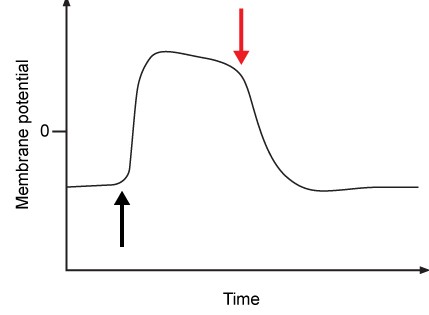 The equilibrium potentials of different ions under physiologic conditions are as follows:
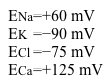 Which of the following options would best explain the changes in this neuron's membrane potential during the experiment?
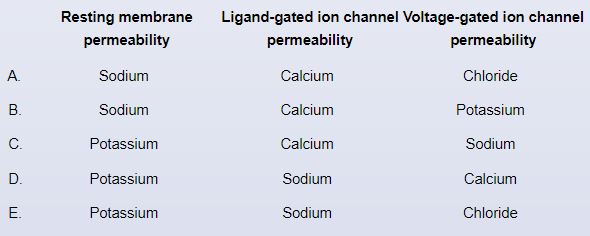
The equilibrium potentials of different ions under physiologic conditions are as follows: Which of the following options would best explain the changes in this neuron's membrane potential during the experiment?
(Multiple Choice)
4.8/5 (84)
(84) A 35-year-old woman is brought to your clinic due to chronic and persistent diarrhea for 5 months. She has 10-12 episodes a day of tea-colored, odorless, watery stools. She tried to avoid dairy products but the symptoms still persist. The patient has uncomfortable abdominal palpation otherwise is normal. Temperature is 37.1 C . Sampling of her gastric contents shows a total lack of gastric acid secretion. Somatostatin treatment promptly relieves the symptoms. An excess of which of the following hormones is most likely responsible for this patient's symptoms?
(Multiple Choice)
4.9/5 (83)
(83) A 70-year-old man comes to the clinic for routine follow up. He has a long term hypertension and diabetes mellitus. He states that he often feels shortness of breath after a mild exertion. His blood pressure is 150/80 mmHg and his heart rate is 85/min. An EKG reveals no ischemic finding. During chest auscultation in the left decubitus position on full expiration reveals a presystolic sound. Which of the following best explains this physical examination finding?
(Multiple Choice)
4.9/5 (72)
(72) A 65-year-old amn is brought to the emergency department after he passed away 30 minutes ago. He was shaving his bear and felt a lightheadedness while shaving around his neck. He has a same episode befor when a physician in ER tried to put a neck collar, blood pressure was 70/40 mm Hg and pulse was 45/min during that episode. Past medical history is significant for hypertension and diet-controlled diabetes mellitus. The patient is a lifetime nonsmoker and drinks alcohol on social occasions. On physical examination, his blood pressure is 125/72 mm Hg and pulse is 76/min without orthostatic changes. Stimulation of afferent sensory fibers in which of the following nerves is most likely responsible for this patient's symptoms?
(Multiple Choice)
4.9/5 (87)
(87) Respiratory physiologists conduct a study on healthy volunteers to assess the airway resistance of the lower respiratory tract. They measure total cross-sectional airflow resistance as it changes between airway generations during the experiment. Which of the following graphs is most likely to be observed in this study?
(Multiple Choice)
4.7/5 (85)
(85) A 50-year-old woman is being evaluated in the ward 5 days post hysterectomy. The nurse reported a sudden-onset left-sided facial droop and arm weakness. She has no chronic medical conditions. CT scan of the head shows a right middle cerebral artery territory acute infarction. Lower extremity ultrasound examination reveals a right femoral vein thrombus. No obvious cardiac structural abnormalities are detected on an echocardiogram. Agitated normal saline is injected into a peripheral vein to evaluate for abnormal right-to-left shunting. No bubbles are seen in the left side of the heart after several minutes. Which of the following is most appropriate to increase right-sided heart pressure to reveal an obscure intracardiac shunt?
(Multiple Choice)
4.8/5 (69)
(69) A 40-year-old man comes to the physician because of a 5-month history of gradually worsening shortness of breath. His pulse is 72/min, blood pressure is 135/75 mm Hg, and respirations are 20/min. The patient does not use tobacco, alcohol, or illicit drugs. His father died due to liver disease. Examination shows an increased anteroposterior diameter of the chest. Laboratory results are as follows: 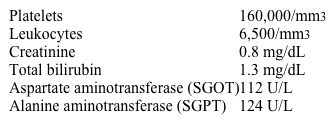 Diminished breath sounds are heard on auscultation of the chest. Which of the following pulmonary function test patterns is most likely to be present in this patient?
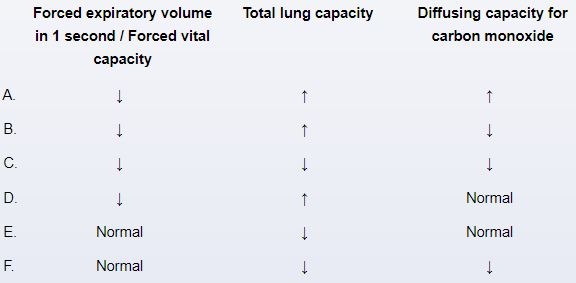
Diminished breath sounds are heard on auscultation of the chest. Which of the following pulmonary function test patterns is most likely to be present in this patient? (Multiple Choice)
4.9/5 (80)
(80) A 32-year-old woman, gravida 2 para 1, at 30 weeks gestation comes to the office for a routine prenatal visit. The patient's pregnancy has been uncomplicated, and she has had no vaginal bleeding or contractions. She has continued to jog daily throughout the pregnancy but is becoming more fatigued by the end of her workouts. The patient has no chronic medical conditions, and her only medication is a daily prenatal vitamin. She does not use tobacco, alcohol, or illicit drugs. Blood pressure is 110/70 mm Hg, pulse is 76/min, and respirations are 20/min. Fetal heart tones are normal. Physical examination is unremarkable. Compared to a nonpregnant state, this patient most likely has which of the following hematologic changes? 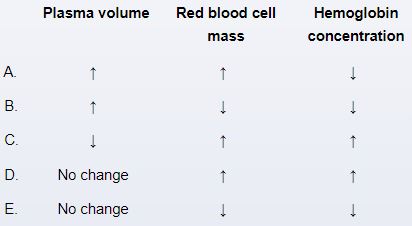
(Multiple Choice)
4.8/5 (84)
(84) A 28-year-old man is being evaluated in the ER due to progressive hypertension. His blood pressure is 195/122 mm Hg, and his pulse is 75/min. The best medications are given and controlled his blood pressure. He states that recently he has felt a weak muscle with a headache. He has no palpitations, tremors. His serum potassium is 2.6 mEq/L. The patient's plasma renin activity is high and his serum aldosterone levels are elevated. A 24-hour urine collection shows increased potassium excretion. Which of the following is the most likely cause of this patient's symptoms?
(Multiple Choice)
4.8/5 (79)
(79) A 25-year-old woman with has a normal vaginal delivery. On physical examination, the infant's external genitalia are atypical and ambiguous. There is an intermediate clitorophallic length and a perineal urethral opening. Well-circumscribed, mobile masses are palpable bilaterally in the inguinal area. Vital signs are normal. Serum testosterone level is within normal limits. A karyotype is performed and shows 46,XY. This infant most likely has a deficiency in which of the following enzymes?
(Multiple Choice)
4.8/5 (71)
(71) A 56-year-old man with polycystic kidney disease and chronic renal insufficiency is evaluated for the placement of an arteriovenous fistula for dialysis access. The blood pressure is 140/90 mm Hg, and the pulse rate is 80 beats per minute. The lower extremities have 2+ bilateral edema, according to the examination. The glomerular filtration rate is estimated to be 15 mL/min/1.73 m2. Which of the following lab results is most likely in this patient?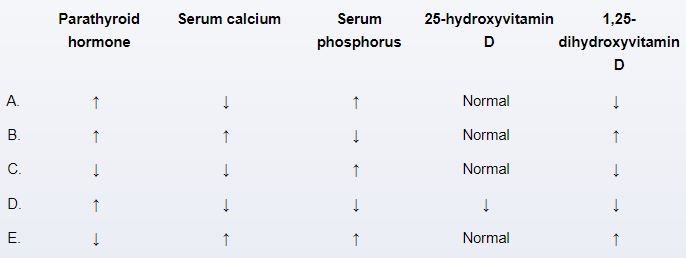
(Multiple Choice)
4.8/5 (77)
(77) 
Filters
- Essay(0)
- Multiple Choice(0)
- Short Answer(0)
- True False(0)
- Matching(0)