



 Chat with AI
Exam 12: Physiology

Exam 1: Anatomy265 Questions
Exam 2: Behavioral Sciences178 Questions
Exam 3: Biochemistry102 Questions
Exam 4: Embryology59 Questions
Exam 5: Epidemiology, Biostatistics, and Medical Informatics94 Questions
Exam 6: Genetics88 Questions
Exam 7: Histology46 Questions
Exam 8: Immunology147 Questions
Exam 9: Microbiology and Virology330 Questions
Exam 10: Pathology817 Questions
Exam 11: Pharmacology and Toxicology509 Questions
Exam 12: Physiology339 Questions
Exam 13: Psychiatry and Psychotherapy23 Questions
Select questions type


A 34-year-old guy visits the clinic to have his heart murmur evaluated. At repose, the patient does not experience any palpitations, chest discomfort, fainting, or shortness of breath. He also routinely exercises without displaying any unusual symptoms. A quiet systolic murmur that radiates to the neck is audible during cardiac auscultation in the second right intercostal region, associated with an ejection click. The figure below displays a typical volume and pressure trace of the left ventricle. Which of the following letters best describes how this patient's valve opening is likely to be affected? 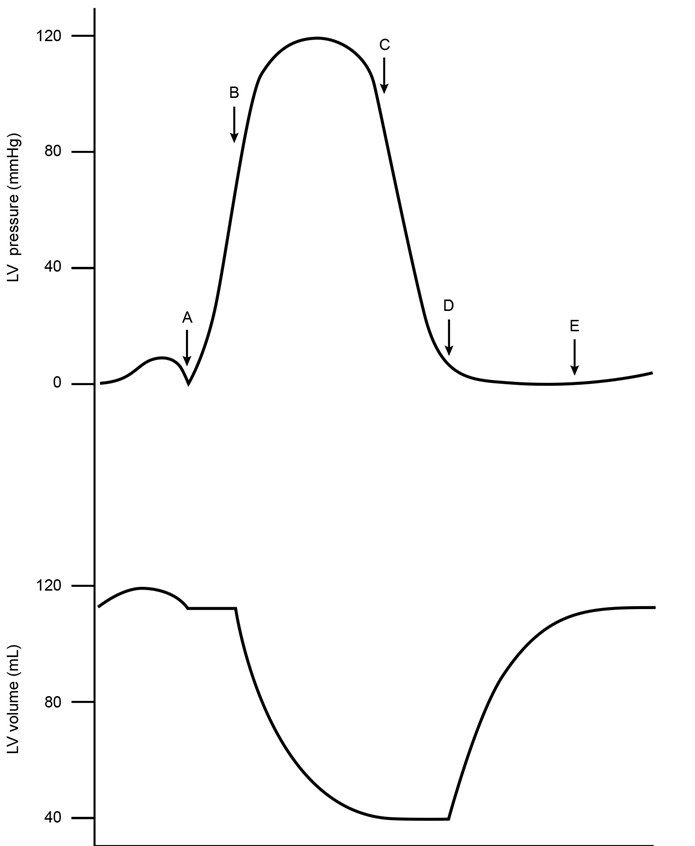
(Multiple Choice)
4.9/5  (81)
(81) A 35-year-old woman is being evaluated due to recent exertional dyspnea and fatigue. She has no prior medical condition and has a sedentary lifestyle. She feels a retrosternal pain accompined with shortenss of breath during exercise. An EKG shows no significant findings. A heart cathetrization is planned. During the procedure, the catheter records periodic pressure changes with a maximum of 25 mm Hg and minimum of 2 mm Hg. The catheter is advanced further, and then shows periodic pressure changes with a maximum of 25 mm Hg and a minimum of 10 mm Hg. Assuming the results of the procedure are normal, the first set of readings was most likely obtained from which of the following locations?
(Multiple Choice)
5.0/5 (82)
(82) A 58-year-old woman comes to the emergency department due to cramping mid-abdominal pain. Imaging shows a small bowel obstruction. Vital signs and laboratory studies, including complete blood count and comprehensive metabolic panel, are within normal limits. The patient is admitted to the hospital for nonsurgical management. Oral intake is withheld to promote bowel rest, and an isotonic saline infusion is administered for hydration. She has no vomiting or diarrhea and after 2 days the abdominal pain improves. Total administration of sodium chloride infusion was approximately 6 L. Which of the following changes have most likely occurred in this patient since the onset of her hospitalization? 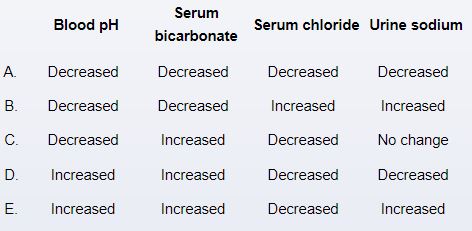
(Multiple Choice)
4.8/5 (67)
(67) A14-year-old girl is brought to the physician by her mother because of episodic shortness of breath and a dry cough that is worse at night. She had an upper respiratory tract infection 4 weeks ago. Lungs are clear to auscultation. Pulmonary function tests are as follows:  . Which of the following would be most helpful in excluding a diagnosis of asthma in this patient?
 (Multiple Choice)
4.8/5 (69)
(69) A previously healthy 16-year-old boy is brought to the office with palpitations. He was watching a documentary in a movie theater when his heart started racing and he became dizzy. The patient claims to have experienced "rapid heartbeats" in the past and assumed they were caused by stress from school exams, but he has never experienced associated lightheadedness. He is not experiencing any chest pain or dyspnea. The physical examination is within normal parameters. The exhibit includes an ECG strip.
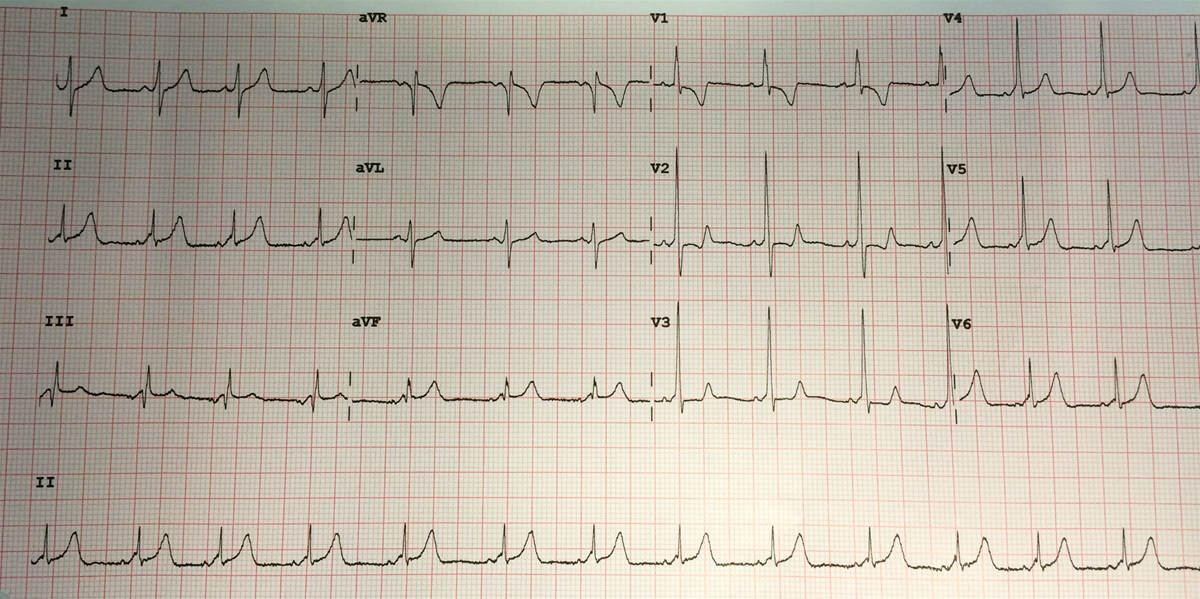 Which of the following is most likely to be seen in this patient?
 (Multiple Choice)
4.9/5 (93)
(93) A 36-year-old man comes to the office due to chronic, mild dyspnea and fatigue. The patient also says that his mind seems "foggy" all the time and he is not able to think clearly. He has no significant past medical history and does not take any medication. He lives a sedentary lifestyle and has smoked a half-pack of cigarettes a day for 5 years. Blood pressure is 140/85 mm Hg, pulse is 84/min, and respirations are 18/min. BMI is 32 kg/m2. Lung auscultation is unremarkable. Chest x-ray is normal. Arterial blood gas analysis shows partial pressure of oxygen (PaO2) is 66 mm Hg and partial pressure of carbon dioxide (PaCO2) is 58 mm Hg. His estimated alveolar to arterial oxygen gradient is 10 mm Hg. Which of the following best explains this patient's laboratory findings?
(Multiple Choice)
4.7/5 (66)
(66) A 50-year-old male comes to the office for routine follow up. He has a chronic kidney disease due to diabetic nephropathy. He has also hypertension and hyperlipidemia. Blood pressure is 140/85 mmHg and pulse is 85/min. weight is 82kg. Physical examinations are normal. Serum creatinine is 1.8 mg/dl and it has been increasing over the past 2 year. Serum calcium and phosphorus levels are in the normal range. Which of the following is most likely responsible for maintaining the serum phosphorus within normal range despite declining renal function?
(Multiple Choice)
4.9/5 (72)
(72) A 56-year-old woman with polycystic kidney disease comes to the office for follow up. Her renal function has been gradually declining, and she is being considered for hemodialysis in the near future. The patient has recently experienced increasing exertional dyspnea and fatigue but has had no fever, dysuria, or flank pain. Other medical conditions include hypertension and renal calculi. Blood pressure is 130/86 mm Hg and pulse is 80/min. Physical examination shows mucosal pallor. The lungs are clear on auscultation and heart sounds are normal. Abdominal examination reveals palpably enlarged kidneys. There is no lower extremity edema. Laboratory results show normocytic, normochromic anemia, which is attributed to insufficient hormone production by the kidneys. This hormone is predominantly secreted by which of the following parts of the kidney?
(Multiple Choice)
4.8/5 (79)
(79) A 40-year-old man is brought to the emergency department due to 5 episodes of bloody emesis. He also describes epigastric pain over the last month that was relieved by over-the-counter antacids. He has a history of alcohol disorder. The patient has smoked a pack of cigarettes daily for the last 15 years. Blood pressure is 80/45 mm Hg and pulse is 130/min and regular. Extremities are cool to the touch with loss of skin turgor. Intravenous access is obtained via 2 large-bore peripheral catheters, and rapid infusion of 2 liters of normal saline is initiated. This intervention is most likely to increase which of the following hemodynamic parameters?
(Multiple Choice)
4.8/5 (80)
(80) A 32-year-old woman comes to the office due to a persistent weight loss.The patient has no medical problems and takes no medications or supplements. She does not use tobacco, alcohol, or illicit drugs. She states that she feels warm compared to other in the room Family history is significant for hypothyroidism in her mother. Temperature is 36.7 C (98 F), blood pressure is 130/60 mm Hg, and pulse is 104/min. BMI is 20 kg/m2. On physical examination, the patient appears anxious and has a staring gaze. There is exophthalmos, lid lag, and a diffusely enlarged thyroid with an audible thyroid bruit. The patient has a fine tremor on outstretched arms, and the skin is warm and moist. Antibodies directed against which of the following are most likely to be found in this patient?
(Multiple Choice)
4.8/5 (84)
(84) A 4 month-old boy is brought by his mother due to large volume diarrhea and failure to thrive. The patient was born full term by normal vaginal delivery. On examination, the abdomen is distended with muscle wasting and mild lower edema. After a series of laboratory tests, a histochemical evaluation reveals absence of enteropeptidase activity in the proximal intestinal villi. Activity of which of the following substances is most likely impaired in this patient?
(Multiple Choice)
4.9/5 (93)
(93) A 30-year-old man comes to the office due to infertility. He has married for 5 years and but failed many times to concive , his partner has 2 child from the previous marriage ,on examination you find the patient has small testes. He has normal male pattern facial and pubic hair. Further laboratory testing reveals a decreased sperm count and normal serum testosterone level. Which of the following is the most likely cause of these findings?
(Multiple Choice)
4.8/5 (87)
(87) An upper respiratory tract illness led to the 81-year-old man's visit to the office. Except for a faint, ineffective cough that is especially annoying at night, his symptoms have mostly subsided. Osteoarthritis of the knee and hypertension are medical histories. The patient still plays golf on the weekends and is physically active. He has no known environmental exposures and is a retired insurance executive. He had never smoked before. The chest x-ray is normal, and the physical examination is uneventful. In this patient, pulmonary function testing is under consideration. Which of the following alterations is most likely anticipated in this patient as a result of normal aging in comparison to midlife? 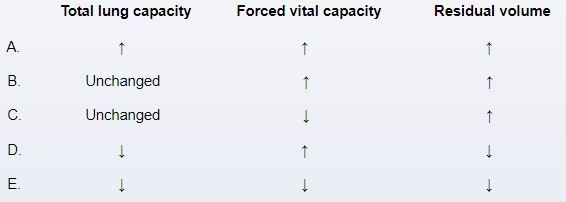
(Multiple Choice)
4.8/5 (83)
(83) The coronary circulation is being researched in both healthy and pathological conditions. They conduct blood flow and pressure measurements (blue circle) in one of the epicardial coronary arteries of a laboratory animal model with heart function that is comparable to humans. After simulating a 60% atherosclerotic stenosis in the artery with a clamp, the flow and pressure distal to the lesion are once again measured. After reaching steady state, which of the following modifications is most likely to be seen? 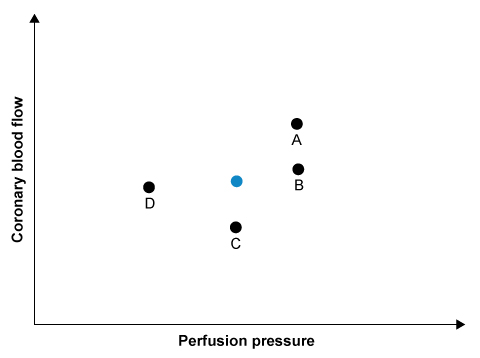
(Multiple Choice)
4.9/5 (86)
(86) A 25-year-old woman arrives at the hospital complaining of worsening dyspnea. The patient was previously healthy; she gave birth to a healthy baby boy at 38 weeks gestation two months ago. Her arterial blood gas analysis reveals hypoventilation. She is asked to take several deep breaths during further evaluation, and the following physiologic information is obtained: 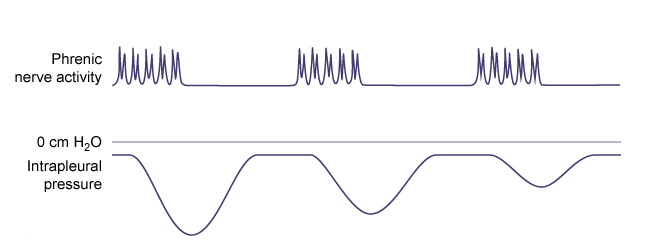 Which of the following locations is the most likely site of this patient's disease?
 (Multiple Choice)
4.8/5 (74)
(74) An 8-week-old term boy is brought to the office due to increased confusion and poor weight gain. The patient has several wet diapers per day. His anterior fontanelle is flat and mucous membranes are dry. Laboratory results include the following: increase sodium and antidiuretic hormone level. Urinalysis shows a specific gravity of 1.002. Which of the following is the most appropriate treatment for this patient's condition?
(Multiple Choice)
4.7/5 (76)
(76) A 58-year-old man comes to the physician because of a 5-day history of progressively worsening shortness of breath and fatigue. The patient had a brief upper respiratory illness about a month ago but began experiencing progressive dyspnea on exertion 2 weeks ago. He has smoked one pack of cigarettes daily for 30 years. His pulse is 96/min, respirations are 26/min, and blood pressure is 100/60 mm Hg. he apical impulse is palpated in the sixth intercostal space along the left anterior axillary line. An S3 is heard on cardiac auscultation. Bibasilar crackles are present. Distal extremities are cold to touch and there is 1+ peripheral edema. Laboratory results are as follows: 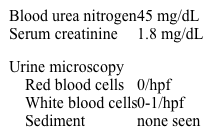 Which of the following is likely to be present in this patient compared to the normal state?
 (Multiple Choice)
5.0/5 (75)
(75) A 32-year-old woman comes to the office with worsening shortness of breath. She has the following arterial blood results: 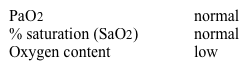 Which of the following is the most likely cause of these results?
 (Multiple Choice)
4.8/5 (82)
(82) A 52-year-old woman with a history of cirrhosis due to chronic alcohole intake experiences worsening dyspnea. She has no other medical conditions. Vital signs are within normal limits. Physical examination shows normal jugular venous pressure, right-sided dullness to percussion and decreased breath sounds, normal heart sounds, and moderate-sized ascites. Chest x-ray reveals a large right-sided pleural effusion with no parenchymal lesions. Thoracentesis yields transudative fluid with normal cell counts. Which of the following is the most likely underlying mechanism of this patient's pulmonary findings?
(Multiple Choice)
4.8/5 (78)
(78) A previously healthy 5 year-old boy is brought to the emergency department due to progressive diarrhea and poor feeding. He has had 4-5 bowel movements every day for the past 3 days. His blood pressure is 64/41 mmHg and temperature is 36.9 C On physical examination, the patient is lethargic. Mucous membranes are dry, and the eyes are sunken. The lungs are clear to auscultation. No murmurs are heard. Abdominal examination shows distension and tenderness; bowel sounds are hyperactive throughout. Which of the following changes is most likely present in this patient?
(Multiple Choice)
5.0/5 (81)
(81) 
Filters
- Essay(0)
- Multiple Choice(0)
- Short Answer(0)
- True False(0)
- Matching(0)