



 Chat with AI
Exam 12: Physiology

Exam 1: Anatomy265 Questions
Exam 2: Behavioral Sciences178 Questions
Exam 3: Biochemistry102 Questions
Exam 4: Embryology59 Questions
Exam 5: Epidemiology, Biostatistics, and Medical Informatics94 Questions
Exam 6: Genetics88 Questions
Exam 7: Histology46 Questions
Exam 8: Immunology147 Questions
Exam 9: Microbiology and Virology330 Questions
Exam 10: Pathology817 Questions
Exam 11: Pharmacology and Toxicology509 Questions
Exam 12: Physiology339 Questions
Exam 13: Psychiatry and Psychotherapy23 Questions
Select questions type


A 48-year-old woman is evaluated for vaginal discharge and postcoital bleeding. A friable mass at the cervix that bleeds easily on touch is discovered during a pelvic examination. A cervical biopsy reveals invasive squamous cell cancer of the cervix and uterus. There are no lymph node metastases. During a radical hysterectomy, the right ureter is accidentally injured but then repaired. Following surgery, imaging studies reveal a partial obstruction of the right ureter with mild dilation of the proximal collecting system. Which of the following changes in the right kidney is most likely? 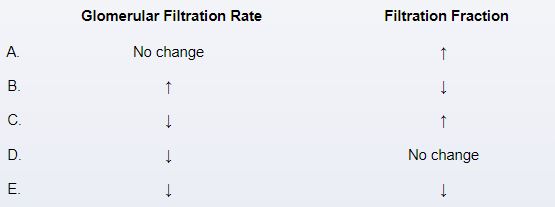
(Multiple Choice)
4.8/5  (82)
(82) A 45-year-old man visits the emergency room after experiencing orthopnea, dyspnea, and ankle edema for two days. He also experienced a headache, nausea, and vomiting this morning. Physical examination reveals pulmonary crackles and bilateral pitting edema up to the knees together with an increased blood pressure. An infusion of sodium nitroprusside is started. Which of the following left ventricular pressure/volume relationships best exemplifies the therapeutic effects? *Solid line = before nitroprusside; dashed line = during nitroprusside infusion.
(Multiple Choice)
4.8/5 (73)
(73) A 56-year-old man comes to the office due to chronic cough and fatigue. The patient has smoked 2 packs of cigarettes daily since age 18. Physical examination shows cyanosis and expiratory wheezes scattered throughout the lungs. During evaluation for long-term oxygen therapy, his respiratory rate decreases shortly after he begins nasal cannular oxygen supplementation. This patient's reduced respiratory rate is most likely caused by a sudden decrease in stimulation of which of the following sensory receptors?
(Multiple Choice)
4.9/5 (79)
(79) A 50-year-old man is being evaluated after a myocardial infarction, he states that he has felt recently a difficulty of breathing and fatigue. He sleeps using 2 pillow to help relieve dyspnea during night. He has a significant history of hypertension and diabetes mellitus. On cardiac auscultation, a low-frequency diastolic heart sound is heard shortly after the second heart sound when the patient lies in the left lateral decubitus position. Cardiac imaging shows hypokinesis of the left ventricular free wall. Which of the following is most likely to accentuate this patient's abnormal auscultation finding?
(Multiple Choice)
4.8/5 (89)
(89) A group of researchers is studying secondary hypertension in porcine models of renal artery stenosis. During an experiment, a clip is placed that constricts the right renal artery to 30% of its original cross-sectional area. A few days later, hemodynamic and biochemical measurements are recorded and compared to measurements obtained before clip placement. Which of the following changes is most likely to be seen in the experimental animals?
(Multiple Choice)
4.8/5 (72)
(72) A 23-year-old man undergoes exercise physiology testing at sea level. He jogs on a treadmill to achieve a moderate-intensity physical activity level based on a target heart rate of 50%-70% of his estimated maximum heart rate. An increase in which of the following is expected at the peak of his exertion?
(Multiple Choice)
4.8/5 (82)
(82) A 25-year-old man with cystic fibrosis comes to the clinic for a routine follow-up appointment. The patient has had multiple hospital admissions over the last few years for pulmonary exacerbations. Pulmonary function testing today will most likely reveal which of the following results? 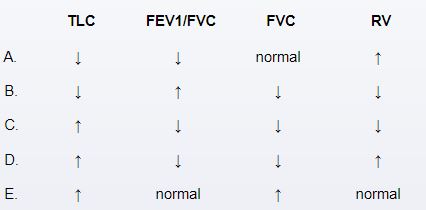
(Multiple Choice)
4.9/5 (82)
(82) A 17-year-old boy is brought to the emergency department by a friend after a syncopal episode during a workout. He has been spending 3-4 hours of running to prepare for a marathone which he felt light-headed and then passed out after completing the session. He is oriented to person and place, but not time; he appears irritable. His temperature is 40.5°C (104.9°F), pulse is 118/min, respirations are 24/min, and blood pressure is 95/70 mm Hg. The patient is profusely sweating and is confused. His pupils are equal and reactive to light. Neurologic examination shows no focal findings. Which of the following is the most likely mechanism of this patient's syncope?
(Multiple Choice)
4.9/5 (72)
(72) A 33-year-old guy arrives at the office feeling tired and with a diminished capacity for exercise during the previous six months. The patient had a course of antibiotic treatment after receiving an infective endocarditis diagnosis last year in the context of intravenous drug usage. Since then, he has not taken narcotics. The patient doesn't take any drugs and doesn't have any other health issues. On auscultation, a heart murmur can be detected. The arterial pulse rises and falls quickly in both carotid arteries. A systolic-diastolic bruit is produced when the stethoscope partially compresses the femoral arteries. When this patient's heart is catheterized, which of the following sets of pressure results is most likely to be seen? 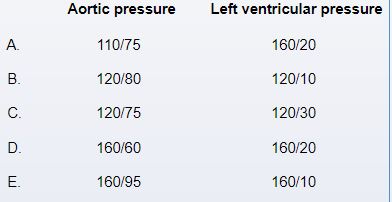
(Multiple Choice)
4.8/5 (90)
(90) Scientists studying the kidney's response to severe renal artery stenosis that reduces blood flow to the kidney by about 70%. they perform a right nephrectomy and examine the glomeruli and tubules microscopically. Which of the following cell types would be most likely to undergo hyperplasia as a result of the clip placement?
(Multiple Choice)
4.8/5 (74)
(74) A 43-year-old man is brought to the emergency department after being found unresponsive by his wife. She says he was in his usual state of health when she left home a few hours ago. The patient has a history of depression and type 2 diabetes mellitus. He was recently laid off from work. Blood pressure is 100/60 mm Hg and pulse is 64/min. On physical examination, the patient is responsive to deep sternal rub and has mildly dry mucous membranes. Arterial blood gas analysis reveals the following: 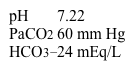 Which of the following is the most likely current acid-base status in this patient?
 (Multiple Choice)
4.8/5 (84)
(84) A 33-year-old diabetic man comes to the clinic for follow up. The patient has been diagnosed with type I diabetes since age 10 and he takes insulin to controls blood suger. Recently, he has had more frequent episodes of hypoglycemia despite no changes in his treatment, diet, or physical activity, but the episodes have been associated with less severe hypoglycemic symptoms compared to prior episodes. Physical examination is unremarkable. Laboratory results show normal basic metabolic panel and serum TSH level. Hemoglobin A1c is 7.0%. Which of the following factors is primarily responsible for this patient's increased frequency of hypoglycemia?
(Multiple Choice)
4.7/5 (77)
(77) A 35-year-old woman arrives at the office for a check-up following a recent hospitalization. The patient arrived at the ER with a fever and malaise and was diagnosed with infective endocarditis. She was on antibiotics for a long time, and her last dosage was 5 days ago. She no longer has a fever or shortness of breath and has resumed her normal activities. There are no other medical issues with the patient. The blood pressure is 128/72 mm Hg, and the pulse rate is 78 beats per minute. The phonocardiogram below depicts auscultatory results obtained at the left sternal boundary. 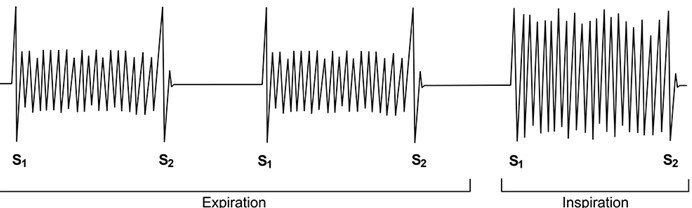 Which of the following is the most likely cause of the murmur depicted above?
 (Multiple Choice)
4.8/5 (80)
(80) A 60-year-old woman comes to the emergency department due to left flank pain radiates to the left groin. Medical history is significant for recurrent urinary tract infections and hypothyroidism. Blood pressure is 130/80 mm Hg and pulse is 80/min. Physical examination shows left flank tenderness. There is no costovertebral angle tenderness. Imaging shows a stone in the middle of the right ureter. Which of the following is most likely to be seen on laboratory evaluation of this patient?
(Multiple Choice)
4.8/5 (83)
(83) A 34-year-old Russian immigrant with recent weakness, exertional dyspnea, and orthopnea visits the doctor. Over the cardiac apex, a snap followed by a rumbling diastolic murmur can be detected during cardiac auscultation. Which of the following positions on the heart pressure-volume loop is where the snap most commonly happens? 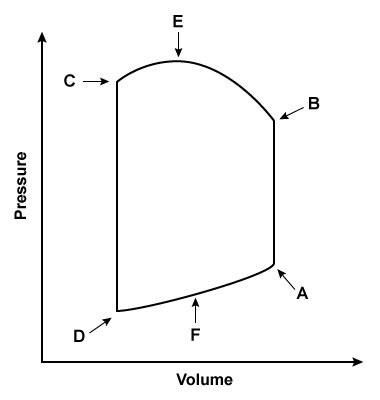
(Multiple Choice)
4.8/5 (82)
(82) A 24-year-old primigravid woman at 36 weeks gestation comes to the physician complaining of lightheadedness and nausea at bedtime. Her pregnancy has been uncomplicated and her past medical history is unremarkable. She takes one multivitamin and one iron tablet daily. Her blood pressure is 115/75 mm Hg when sitting, 110/70 mm Hg when standing, and 80/60 mm Hg when supine. Physical examination shows a uterus consistent in size with 36 weeks gestation. Which of the following is the most likely explanation for this patient's hypotension while supine?
(Multiple Choice)
5.0/5 (83)
(83) A 30-year-old woman comes to the office due to intermittent abdominal pain which relieved with defecation. She states that she has bloating. abdominal cramps and intermittent diarrhea. She describes her job as a stressful job. She has no medical or surgical history. Vital signs are within normal limits BMI is 26kg/m. The patient is well-appearing, with a nontender abdomen. The patient is diagnosed with irritable bowel syndrome, and it is recommended that she take loperamide and consume an adequate amount of dietary fiber. After reading about her disorder on the internet, the patient decides to manage her symptoms with a strict vegan diet. Which of the following should be provided as a nutritional supplement for this patient?
(Multiple Choice)
4.9/5 (73)
(73) A 30-year-old woman comes to the office due to a 4 days history of anterior neck pain. The patient had an upper respiratory infection a month ago, during which she experienced nasal congestion, rhinorrhea, and a cough productive of clear sputum; her respiratory symptoms lasted for 5 days and resolved spontaneously. She has no history of serious illness On examination, mild fever, palpitations, and excessive sweating. Pulse is 110/min. The thyroid gland is tender to palpation and diffusely enlarged. Laboratory studies show suppressed TSH and elevated free thyroxine levels. Erythrocyte sedimentation rate is 70 mm/hr.
Which of the following additional findings is most likely to be present in this patient at this time?
(Multiple Choice)
4.7/5 (82)
(82) A 45-year-old woman is examined two weeks after breaking her left radius in a fall from standing height. She had passed a renal stone two months prior. There is no history of osteoporosis or hypercalcemia in the family. The physical exam is unremarkable. The following are the serum laboratory results: 11ec160b 3abb 7e90 9249 2faf1d8276f1 MD0001 00 The use of dual-energy x-ray absorptiometry to measure bone density reveals osteoporosis. Which of the following is the major contributor to bone loss in this patient?
(Multiple Choice)
5.0/5 (65)
(65) A 6-year-old boy playing in a dusty field in windy weather inhales many small particles that become lodged in his terminal bronchioles. Which of the following respiratory components is most important in clearing these particles?
(Multiple Choice)
4.7/5 (81)
(81) 
Filters
- Essay(0)
- Multiple Choice(0)
- Short Answer(0)
- True False(0)
- Matching(0)