



 Chat with AI
Exam 12: Physiology

Exam 1: Anatomy265 Questions
Exam 2: Behavioral Sciences178 Questions
Exam 3: Biochemistry102 Questions
Exam 4: Embryology59 Questions
Exam 5: Epidemiology, Biostatistics, and Medical Informatics94 Questions
Exam 6: Genetics88 Questions
Exam 7: Histology46 Questions
Exam 8: Immunology147 Questions
Exam 9: Microbiology and Virology330 Questions
Exam 10: Pathology817 Questions
Exam 11: Pharmacology and Toxicology509 Questions
Exam 12: Physiology339 Questions
Exam 13: Psychiatry and Psychotherapy23 Questions
Select questions type


A physiologist is trying to study the function of neurophysin protein. if a mutation occured in neurophysin gene what the patient most likely to suffer from:
(Multiple Choice)
4.9/5  (88)
(88) A 33-year-old woman comes to the office due to progressive shortness of breath. She cannot walk more than 5 blocks on level ground till she feels fatigue and dyspnea. The patient has no family history of heart disease. As part of her evaluation, she undergoes right and left heart catheterization. The following data are obtained: Which of the following is the most likely cause of this patient's symptoms?
(Multiple Choice)
4.9/5 (57)
(57) A 30-year-old woman arrives at the clinic complaining of substantial weight gain despite not making any dietary or exercise adjustments. Additionally, she has been experiencing regular constipation and a recent increase in fatigue. The patient is drug-free and has no history of illness. She had a healthy baby three years ago after having one pregnancy. Family history is significant for her mother's thyroid condition. Both the blood pressure and the pulse measure 116/90 mm Hg. 28.5 kg/m2 is the BMI. Upon physical examination, the thyroid is found to be diffusely enlarged, non-tender, and free of nodules. Deep tendon reflexes take longer to relax. Her skin seems dry, and she has scant hair. Which of the following sets of laboratory findings is most likely to be seen in this patient? 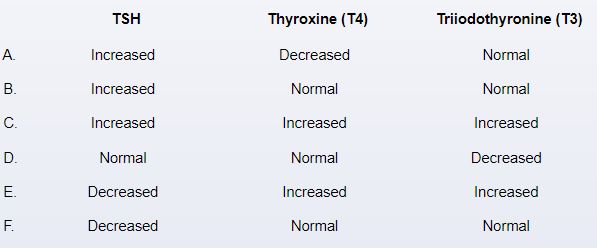
(Multiple Choice)
4.9/5 (79)
(79) A 3-year-old boy is brought to the office with 5 days of productive cough and fever. Examination shows a tachypneic, ill-appearing child with rales over the right lower lung. Chest x-ray reveals right lower lobe pneumonia. The boy is admitted to the hospital for intravenous antibiotics. Review of his medical history shows 4 prior pneumonias, and his weight is at the third percentile. Further testing demonstrates high sweat chloride content, and genetic sequencing shows a mutation in a transmembrane protein. Which of the following best describes the dysfunctional transmembrane protein causing this patient's disease?
(Multiple Choice)
4.9/5 (72)
(72) A certain kind of cardiac cell's shift in membrane potential is seen using specialized electrodes. The graph below shows these modifications. 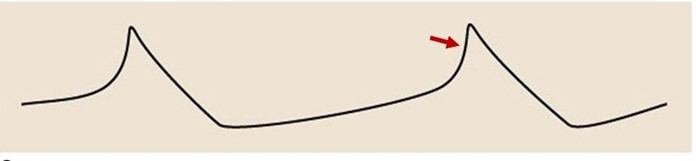 The deflection indicated by the arrow is most likely caused by movement of which of the following ions?
 (Multiple Choice)
5.0/5 (89)
(89) A 62-year-old guy visits the office to have his abdominal swelling examined. His abdomen has gotten increasingly bloated over the past few weeks, and this has been accompanied by some slight discomfort and a loss of appetite. There have been some admissions for alcohol-induced pancreatitis in the past. The patient currently consumes one pint of alcohol every day and abstains from using tobacco or other substances. Physical examination reveals many spider angiomas on the upper chest and a moderately icteric sclera. When the patient lies on either side, the dullness to percussion shifts to a different position due to the enlarged abdomen. Creatinine is 1.1 mg/dL and serum sodium is 130 mEq/dL. Which of the following would this patient most likely exhibit? 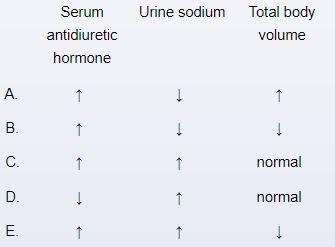
(Multiple Choice)
4.7/5 (96)
(96) A 47-year-old man comes to the emergency department due to a 30-minute history of sudden-onset severe chest pain and shortness of breath. He is on an RV road trip with his family and has had pain in and swelling of the left leg for the past 2 days. The patient has no significant medical history and takes no medications. Temperature is 37.2 C (99 F), blood pressure is 90/56 mm Hg, pulse is 124/min, and respirations are 32/min. Oxygen saturation is 82% on room air. BMI is 36 kg/m2. ECG shows sinus tachycardia. Chest x-ray shows no abnormalities. Which of the following is most likely increased in this patient?
(Multiple Choice)
4.9/5 (78)
(78) A 50-year-old female presents with abdominal pain, diarrhea, and weight loss. She was diagnosed with diabetes mellitus two months ago. Her serum somatostatin level is highly elevated. Further evaluation reveals biliary stones. Suppression of which of the following hormones is most likely responsible for biliary stones?
(Multiple Choice)
4.9/5 (74)
(74) Researchers do an experiment to find out how exercise affects hemodynamics. Invasive parameter monitoring is done to create a left ventricular pressure-volume loop. Which of the following changes is most likely to occur after moderate to intense activity in comparison to at rest? (solid line: at rest; dashed line: during exercise)
(Multiple Choice)
4.8/5 (61)
(61) A researcher is trying to study aging liver changes, He decides to choose healthy people and follow them up from age 40 to 80 and do liver biopsy every 10 years, Which of the following histologic changes has most likely developed over time in an elderly patient?
(Multiple Choice)
4.9/5 (83)
(83) A 14-year-old girl is brought to the office due to headache, nausea, and visual disturbances. She experienced a pulsatile bilateral headache that associated with an episode of vomiting. She has had 4 episodes of same pain on the right side of her head over the last 2 months. Medical history is unremarkable, and the patient recently began menses. Ibuprofen and acetaminophen have not improved her symptoms. Neurologic examination is unremarkable. Which of the following is most likely involved in the pathogenesis of this patient's current condition?
(Multiple Choice)
4.8/5 (81)
(81) A researcher is conducting an animal study to assess the forces affect glomerular ultafiltration using a single nephron. He measures the hydrostatic pressure the glomerular capillary and Bowman space. Colloid osmotic pressure in the glomerular capillary is estimated using the difference in plasma protein concentration in the afferent and efferent arterioles. The glomerular surface is assumed to be functionally intact with negligible filtration of plasma proteins into the Bowman space. From the data obtained, net filtration pressure is calculated at 10 mm Hg. A substance is instilled into the renal artery, and measurements are repeated. The net filtration pressure after the intervention is 20 mm Hg. Which of the following substances was most likely used in this experiment?
(Multiple Choice)
5.0/5 (71)
(71) A 23-year-old woman, gravida 1, para 0, comes to the office for a routine prenatal care visit. She is at 35 weeks gestation and feels well. She reports regular fetal movement and no contractions, loss of fluid, or vaginal bleeding. Pregnancy to date has been uncomplicated and the patient has no underlying medical conditions. She signed up for a clinical trial investigating prolactin. At 34 weeks gestation, she had a serum prolactin level several times higher than what was recorded prior to pregnancy. Which of the following hormones prevents lactation in this patient?
(Multiple Choice)
4.8/5 (86)
(86) A researcher is working to develop a new medication fot treatment fo patient with heart failure. if this treatment improve patient symptoms by increasing urine output and decreasing peripheral vascular resistance. The medication works by inhibiting a metalloprotease to prolong the action of endogenous polypeptides. These polypeptides are most likely secreted by which of the following cell types?
(Multiple Choice)
4.9/5 (74)
(74) A 34-year-old woman comes to the office due to a 3-day history of watery diarrhea. The patient has no fever. She has no other medical conditions and takes no medications. Blood pressure is 120/80 mm Hg and pulse is 90/min. Examination shows mild abdominal discomfort but is otherwise normal. Compared to normal laboratory values, which of the following findings are most likely present in this patient? 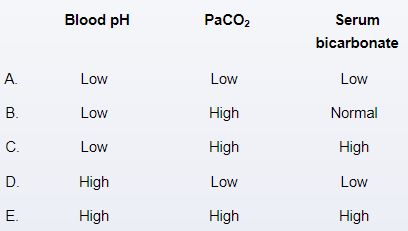
(Multiple Choice)
4.8/5 (79)
(79) A 1-month-old preterm African American is brought to the office for routine check-up. He is exclusively breastfed. He was in the NICU due to cyanosis but discharged after he became well. The boy is at the 60th percentile for weight and the 70th percentile for height. His physical examination is normal. At this time, supplementation with which of the following should be recommended for this infant?
(Multiple Choice)
4.8/5 (95)
(95) A 48-year-old man is brought to the hospital due to sudden onset of central chest pain radiating to the lower jaw. He is a known cocaine abuser. In the ER patient appears anxious and diaphoretic. Blood pressure is 165/102 mmHg, Pulse is 96/min, and respirations are 19/ min. ECG reveals ST-elevation in the anterior leads. Laboratory studies reveal an elevated cardiac troponin level and a serum potassium concentration of 3.2 mEq/L. Which of the following is the most likely cause of this patient's hypokalemia?
(Multiple Choice)
4.9/5 (75)
(75) A newborn by normal vaginal delivery is brought for routine screening. you found an increase in TSH and low thyroxine T4. Apgar scores were 8 and 9 at 1 and 5 minutes, respectively. Physical examination reveals an enlarged thyroid gland in the normal position. Neck ultrasound confirms thyroid enlargement. Which of the following is the most likely cause of this patient's findings?
(Multiple Choice)
4.8/5 (87)
(87) A 1-month-old boy is brought to the office on a hot summer day due to vomiting and excessive sleepiness. He had been exclusively breastfeeding with normal feeding patterns until this afternoon, when he had 2 episodes of emesis and appeared much sleepier than usual. The infant was born at 41 weeks gestation after an unremarkable pregnancy. Newborn screening was positive for a homozygous F508 mutation affecting an epithelial transmembrane protein; further confirmatory testing is pending. Physical examination shows a somnolent boy with a sunken fontanelle and dry mucous membranes. Which of the following electrolyte disturbances is most likely responsible for this patient's current symptoms?
(Multiple Choice)
4.9/5 (83)
(83) A physiologist is working on an experiment to develop a substance that selectively constrict the efferent arteriole. If this experiment is conducted what will occur to the glomerular filtration rate (GFR) and filtration fraction (FF) during the infusion substance?
(Multiple Choice)
5.0/5 (83)
(83) 
Filters
- Essay(0)
- Multiple Choice(0)
- Short Answer(0)
- True False(0)
- Matching(0)