



 Chat with AI
Exam 7: Histology

Exam 1: Anatomy265 Questions
Exam 2: Behavioral Sciences178 Questions
Exam 3: Biochemistry102 Questions
Exam 4: Embryology59 Questions
Exam 5: Epidemiology, Biostatistics, and Medical Informatics94 Questions
Exam 6: Genetics88 Questions
Exam 7: Histology46 Questions
Exam 8: Immunology147 Questions
Exam 9: Microbiology and Virology330 Questions
Exam 10: Pathology817 Questions
Exam 11: Pharmacology and Toxicology509 Questions
Exam 12: Physiology339 Questions
Exam 13: Psychiatry and Psychotherapy23 Questions
Select questions type


A 22-year-old woman arrives to the clinic after suffering from severe weariness for two weeks, which has prevented her from attending college classes. Fever and a sore throat preceded the weariness, but these have since subsided. The patient is a Turkish exchange student with no past medical issues. She does not smoke, drink, or use illegal drugs. The vital indicators are within normal ranges. There are no abnormalities found during an oropharyngeal examination. Bilaterally, there are numerous swollen lymph nodes posterior to the sternocleidomastoid muscle. The cardiopulmonary test is unremarkable. 1 cm below the left costal border, the spleen is palpable. There are no skin rashes or other signs of lymphadenopathy. As indicated in the display, peripheral blood examination reveals an increase in the number of aberrant white blood cells. 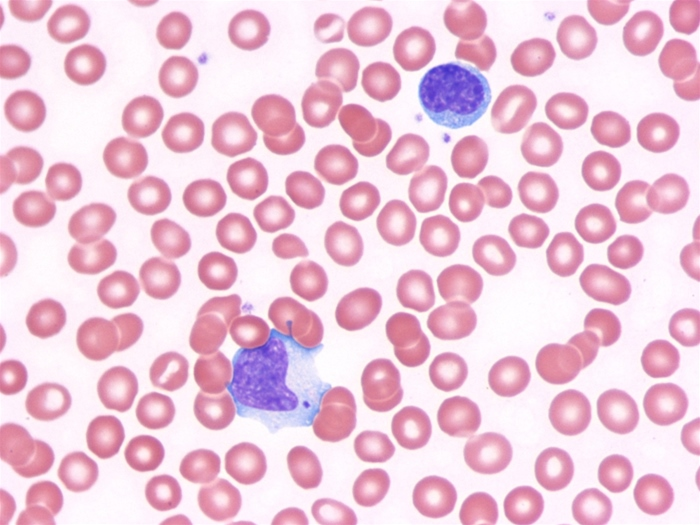 The observed cytoplasmic granules of these cells are most likely to contain which of the following substances?
Free
(Multiple Choice)
4.8/5  (75)
(75) Correct Answer: Verified
D
A 44-year-old man comes to the office due to progressive shorten of breath with mild exertion and cough. He has had no chest pain, or leg swelling. The patient smokes 1-pack-daily. Temperature is 37.2 C (99 F), blood pressure is 115/75 mm Hg, pulse is 92/min, and respirations are 18/min. Oxygen saturation at rest is 88% on room air. Lung auscultation shows scattered crackles. other examination are normal. Chest x-ray reveals bilateral midalveolar and lower alveolar opacities. Transbronchial lung biopsy reveals lipoproteinaceous material that is positive on periodic acid-Schiff stain and fills up the terminal bronchioles and alveoli. Electron microscopy of the substance shows lamellar bodies. Impaired function of which of the following most likely caused excessive accumulation of the substance in this patient's alveoli?
Free
(Multiple Choice)
4.8/5 (78)
(78) Correct Answer:Verified
VerifiedA
A 72-year-old man with a history of myocardial infarction is being autopsied. Light microscopy of a section of the left ventricle reveals the following findings: 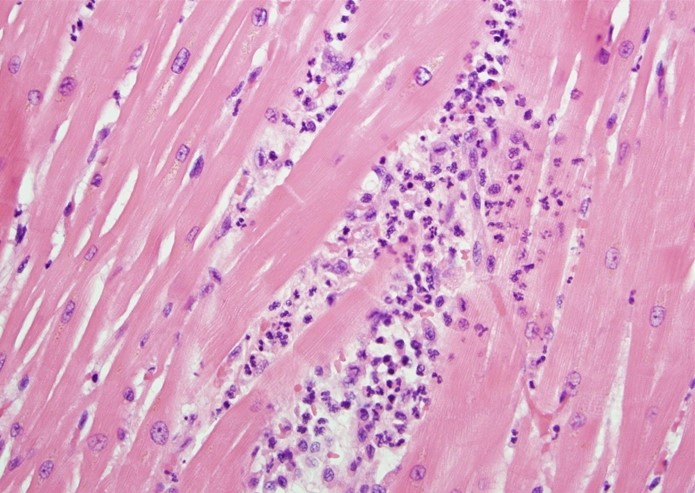 This patient most likely sustained the myocardial infarction during which of the following time frames prior to his death?
Free
(Multiple Choice)
4.8/5 (81)
(81) Correct Answer:Verified
VerifiedB
A 43-year-old woman, gravida 3 para 3, comes to the office due to heavy and painful menstrual bleeding over the past 4 months. The patient's last menstrual period was 3 weeks ago. Menarche was at age 11, and menstrual periods last for 3-5 days and occur every 30 days. She is sexually active with her husband and does not have pain with intercourse. The patient had a bilateral tubal ligation 3 years ago after the birth of her last child. She takes no medications and has no allergies. BMI is 24 kg/m2. Vital signs are normal. On bimanual examination, the uterus is uniformly enlarged and tender. Urine beta-hCG is negative. Which of the following is the most likely cause of this patient's symptoms?
(Multiple Choice)
4.7/5 (86)
(86) An 8-year-old boy is evaluated in the office for walking difficulties. Running, jumping, and walking up stairs are all difficult for the patient. There is no family history of neurological disorders. A physical examination reveals bilateral weakness of lower extremity muscles. The image below shows electron microscopy of a calf muscle biopsy sample. 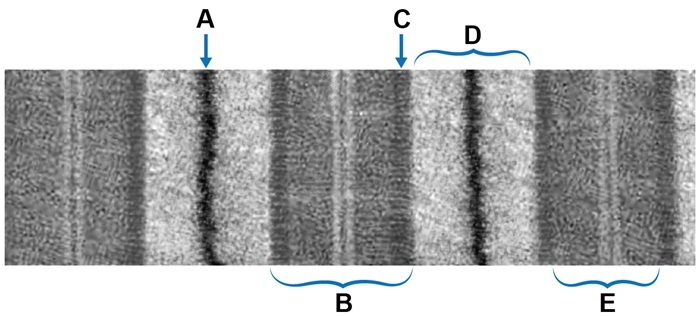 Which of the following labeled regions contains only thick filaments and no thin filaments?
 (Multiple Choice)
4.8/5 (76)
(76) Physicians involved in regenerative medicine research conduct a series of animal experiments to determine pulmonary tissue regeneration capacity. During one of the experiments, lung alveoli are exposed to NO2 and massive necrosis of the epithelial lining ensues. Histologic examination of the injured tissues a month later shows partial recovery of the alveolar epithelial lining. This regenerated tissue is most likely derived from which of the following cell types?
(Multiple Choice)
4.9/5 (92)
(92) A 65-year-old man presented to the office complaining of recurrent abdominal distension and diarrhea. He did notice weight changes or blood in the stool. The symptoms did not seem to be related to dairy products. Physical examination is unremarkable. The stool guiac test is positive. Upper endoscopy with biopsy shows hyperplasia of branched, tubular glands in the submucosa layer. The glands have alkaline secretions. Which of the following is the site of the biopsy?
(Multiple Choice)
4.9/5 (78)
(78) A 58-year-old homeless man is brought to the emergency department after being found unresponsive on a sidewalk. The patient has been hospitalized on several occasions for alcohol and illicit drug intoxication. He also has a history of hypertension but is not adherent with medical therapy. On arrival, the patient is obtunded, febrile, and hypotensive. Despite appropriate intervention, the patient dies. Autopsy reveals extensive atherosclerotic disease involving the coronary and internal carotid arteries. Histopathologic examination of the brain shows neurons with intensely eosinophilic cytoplasm and nuclear fragmentation. Based on these findings, this patient's cerebral injury most likely occurred approximately how long ago?
(Multiple Choice)
5.0/5 (75)
(75) A 4-month-old girl is brought to the clinic because she has been suffering from a rash on her cheeks for the previous two weeks. The rash has not spread, and the patient may be observed scratching her face often. There have been no changes in bath soaps or detergents, and there are no animals or plants in the house. Vaccinations are current. The patient is nursed exclusively, and her height and weight are in the 50th percentiles. Vital indicators are typical. The exhibit depicts a skin inspection. 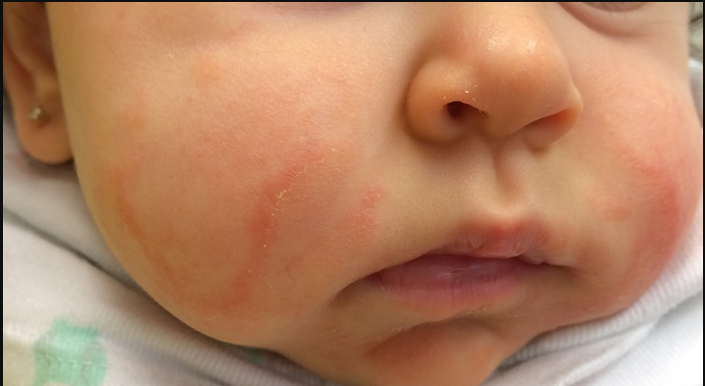 The remainder of the examination is unremarkable. . Which of the following conditions is this patient at increased risk for developing?
 (Multiple Choice)
4.8/5 (64)
(64) A 62-year-old man arrives at the office for a jaundice evaluation. Medical history is important in the case of uncontrolled type 2 diabetes and morbid obesity. He does not smoke, drink, or use illegal drugs. There is no history of liver illness in the family. The vital indicators are within normal ranges. The average BMI is 47 kg/m2. There is mild scleral icterus. Normal heart and lung sounds The abdomen is not painful or swollen. There is some bilateral lower extremities edema. Transaminases are shown to be increased in laboratory tests. A liver biopsy is performed, and trichrome staining reveals: 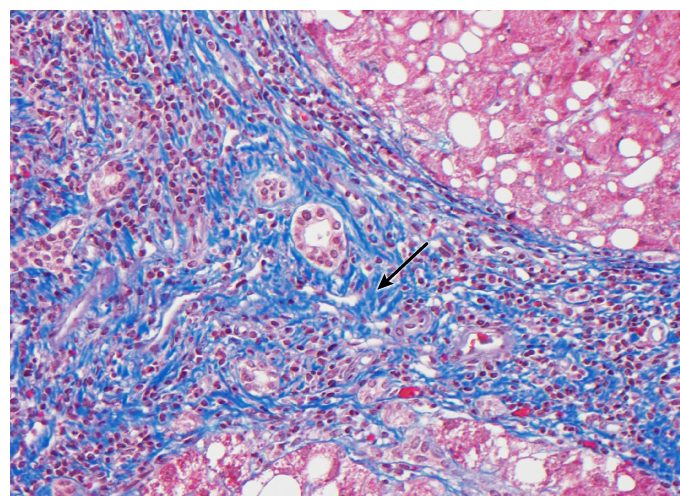 Which of the following cells is directly responsible for the histologic finding indicated by the arrow?
 (Multiple Choice)
4.9/5 (81)
(81) Due to severe face puffiness, an 8-year-old child is brought to the doctor. His mother adds that he has been easily exhausted and has had black urine for the previous 24 hours. The patient had a skin infection three weeks ago and has no chronic medical issues. The temperature is 36.1 degrees Celsius (97 degrees Fahrenheit), and the blood pressure is 140/94 mm Hg. Periorbital edema and moderate pitting edema around the ankles are seen on physical examination. The rest of the test reveals no abnormalities. The picture below depicts a representative kidney biopsy sample. 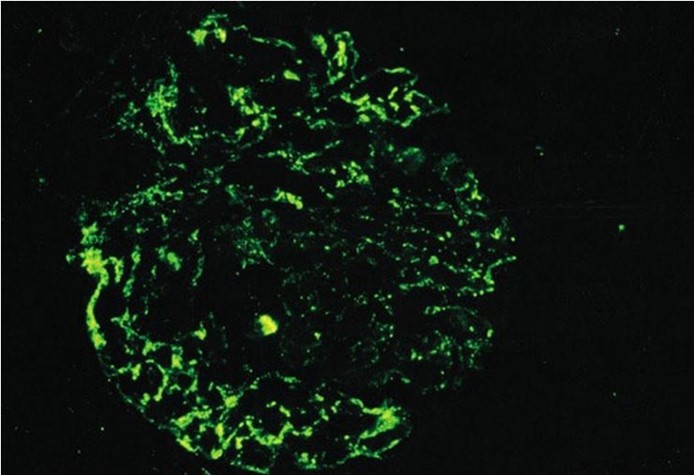 The fluorescent areas on the slide most likely indicate the presence of which of the following substances?
 (Multiple Choice)
5.0/5 (77)
(77) A 43-year-old man arrives to the office complaining of shortness of breath and exhaustion. His weariness has been so severe over the previous two weeks that he has "little energy, even to get out of bed." The patient has no chills but has recently gained weight and had ankle edema. He has no previous medical issues and does not use any drugs. The blood pressure is 168/94 mm Hg, and the pulse rate is 95 beats per minute. The patient has bilateral pitting edema of the lower extremities that is localized to the ankles. Urinalysis showed 2+ protein, 5-7 white blood cell count/hpf, and 75-100 red blood cell count/hpf. He had a kidney biopsy, and the results of immunofluorescent microscopy are displayed in the figure below. 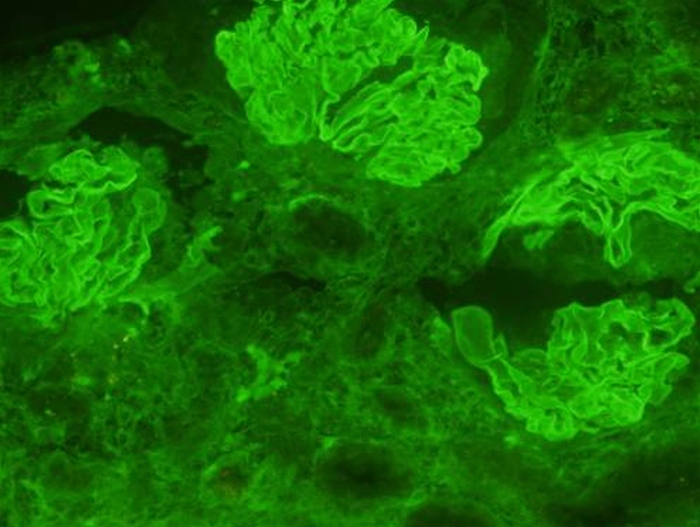 Which of the following would be the most likely finding on light microscopy in this patient?
 (Multiple Choice)
4.8/5 (77)
(77) A 30-year-old man comes to the physician for follow-up evaluation for episodic throbbing headaches, palpitations, and paroxysmal sweating. He was adopted shortly after birth and does not know his biological parents. Blood pressure is 160/90 mm Hg. He appears pale but physical examination is otherwise unremarkable. The patient is found to have a neoplastic mass producing excessive amounts of hormones that are causing her symptoms. Surgical resection of the abnormal tissue is performed with no operative complications. Microscopic examination of the tumor cells shows electron-dense, membrane-bound secretory granules. Immunohistochemistry is positive for synaptophysin, chromogranin, and neuron-specific enolase. The abnormal tissue most likely originated from which of the following?
(Multiple Choice)
4.9/5 (72)
(72) A 29-year-old woman, gravida 2 para 2, comes to the emergency department with severe abdominal pain in the left lower quadrant and vaginal bleeding. She is saturating a pad every 3-4 hours. Her last menstrual period was 7 weeks ago. Past surgical history is significant for 2 cesarean deliveries and permanent sterilization via a bilateral tubal ligation. A urine pregnancy test is positive, and an ultrasound shows a 2-cm mass in the left adnexa adjacent to the ovary and a thickened endometrial stripe. If a uterine curettage is performed, which of the following findings would be expected in this patient?
(Multiple Choice)
4.9/5 (87)
(87) A 68-year-old man with a history of Parkinson disease is hospitalized for pneumonia and sepsis. The patient is treated with intravenous (IV) fluids and antibiotics. He is also started on an infusion of IV dopamine for hemodynamic support. Although the manifestations of Parkinson disease are attributed to dopaminergic neuron degeneration in the substantia nigra, IV dopamine does not improve this patient's Parkinson symptoms. Which of the following cell structures accounts for this lack of responsiveness?
(Multiple Choice)
4.9/5 (83)
(83) A 22-year-old woman, gravida 2 para 1, at 39 weeks gestation comes to the labor and delivery unit with regular painful contractions. The patient's first pregnancy was uncomplicated and resulted in a full-term, spontaneous vaginal delivery 3 years ago, and her current pregnancy has been uncomplicated. She takes a prenatal vitamin daily and has no chronic medical conditions. In response to rising estrogen levels, the patient's myometrial cells increase the expression of genes that encode the oxytocin receptor and connexin 43. These molecular changes most likely result in increased formation of which of the following?
(Multiple Choice)
4.8/5 (78)
(78) After the patient recovers from his severe sickness, a 48-hour injection of Candida antigen into his skin showed no evidence of inflammation. The identical test on his mother results in 12 mm of skin induration in 48 hours. Which of the following cells is directly engaged in the mother's effector response?
(Multiple Choice)
4.8/5 (81)
(81) A 70-year-old man is brought to the emergency department due to left-sided weakness and slurred speech upon awakening 30 minutes ago. The patient was asymptomatic when he went to bed last night. Medical history includes type 2 diabetes mellitus, hypertension, and hyperlipidemia. He dies despite proper treatment. The brain autopsy reveals neurons with shrunken nuclei and eosinophilic cytoplasm lacking Nissl bodies. Which of the following is the most likely cause of these findings?
(Multiple Choice)
4.9/5 (64)
(64) An 18-year-old man is hospitalized due to trauma sustained during a motor vehicle collision. He subsequently develops worsening shortness of breath and confusion and dies despite appropriate management. Autopsy shows dilation of the bronchial tree, which extends almost to the pleural surface. Many of the small airways are filled with mucin plugs containing abundant inflammatory cells and debris. Which of the following is the most likely cause of this patient's autopsy findings?
(Multiple Choice)
4.8/5 (81)
(81) A 24-year-old woman arrives at the clinic with a pruritic rash on her arms and legs that has been present on and off for the majority of her life. As seen in the exhibit, erythematous patches and papules are found on the posterior left leg.  A similar rash is present on the right leg and bilateral antecubital fossae. Which of the following cytokines primarily initiated her current exacerbation?
 (Multiple Choice)
4.9/5 (71)
(71) 
Filters
- Essay(0)
- Multiple Choice(0)
- Short Answer(0)
- True False(0)
- Matching(0)