



 Chat with AI
Exam 7: Histology

Exam 1: Anatomy265 Questions
Exam 2: Behavioral Sciences178 Questions
Exam 3: Biochemistry102 Questions
Exam 4: Embryology59 Questions
Exam 5: Epidemiology, Biostatistics, and Medical Informatics94 Questions
Exam 6: Genetics88 Questions
Exam 7: Histology46 Questions
Exam 8: Immunology147 Questions
Exam 9: Microbiology and Virology330 Questions
Exam 10: Pathology817 Questions
Exam 11: Pharmacology and Toxicology509 Questions
Exam 12: Physiology339 Questions
Exam 13: Psychiatry and Psychotherapy23 Questions
Select questions type


In an experiment, laboratory animals are subjected to a toxic insult that specifically targets the protein kinesin. Which of the following is most likely to be absent from tissues on histological examination as a result?
(Multiple Choice)
4.7/5  (92)
(92) A 60-year-old man comes to the emergency department with right-side body weakness and slurred speech. His medical problems include type 2 diabetes mellitus, hypertension, and hyperlipidemia. He takes atorvastatin, metformin, lisinopril, and low-dose aspirin. The patient has smoked a pack of cigarettes daily for the past 40 years. His temperature is 36.7 C (98 F), blood pressure is 160/90 mm Hg, and pulse is 118/min. He is mildly dysarthric with a right lower facial droop and right-sided hemiparesis. Brain Imaging reveals an acute subcortical infarct in the left internal capsule. Which of the following is most likely to be seen in the affected brain area in the subsequent weeks?
(Multiple Choice)
4.8/5 (91)
(91) A 58-year-old man comes to the physician because of headaches and back pain for 5 months. He also noted that his favorite hat no longer fits him. He has hypertension, hypothyroidism, and benign prostate hyperplasia. His father had prostate cancer and osteoporosis. Current medications include calcium supplementation, metoprolol, and L-thyroxine. He does not smoke or drink alcohol. Vital signs are within normal limits. On examination, there is enlargement of the anterior head. An x-ray of the skull shows a thickened calvaria and osteoblastic and osteolytic lesions. The initial phase of this patient's disorder involves increased activity of which of the following cell types?
(Multiple Choice)
4.9/5 (91)
(91) A 35-year-old woman, gravida 1, para 0, at 12 weeks gestation comes to the office for evaluation of genital warts. She first noticed the warts last week and is concerned that it has persisted. The patient has occasional mild pruritus but no pain. She is currently sexually active with her boyfriend and engages in oral and vaginal intercourse. Examination shows several verrucous, skin-colored lesions over the labia majora. The patient asks whether the lesion could affect her future child. The virus involved in this patient's condition also has an affinity to infect which of the following structures?
(Multiple Choice)
4.8/5 (91)
(91) Fourth-year medical students are recruited for a research study assessing their ability to interpret biopsy samples obtained during routine clinical practice. As part of the study, they are given samples of normal respiratory mucosa and asked to identify the cell types present after staining with hematoxylin and eosin. The students observe that the respiratory epithelium changes in composition as the airways continue distally from the trachea to the alveolar ducts. Which of the following features is last to disappear?
(Multiple Choice)
4.8/5 (88)
(88) A 52-year-old man is brought to the emergency department by ambulance 40 minutes after a generalized tonic-clonic seizure. According to his son, who had called the ambulance, the patient has had headaches and mild nausea for the past 3 weeks. His father "has been acting really strange recently." The patient has no other history of serious illness. He does not smoke cigarettes, drink alcohol, or use illicit drugs. His only medication is a daily fish oil supplement. an intracranial mass detected on head CT scan. Biopsy of the mass reveals neoplastic cells that stain positive for synaptophysin and negative for glial fibrillary acidic protein. These neoplastic cells most likely originate from the same precursor tissue as which of the following?
(Multiple Choice)
4.8/5 (72)
(72) A 50-year-old lady visits the office to have a mole on her back evaluated. The mole has been there for some years, but her daughter is concerned that it has recently expanded in size. The patient has no significant medical issues, however he was sunburned frequently as a youngster. The picture below depicts a dermoscopic inspection of the lesion. 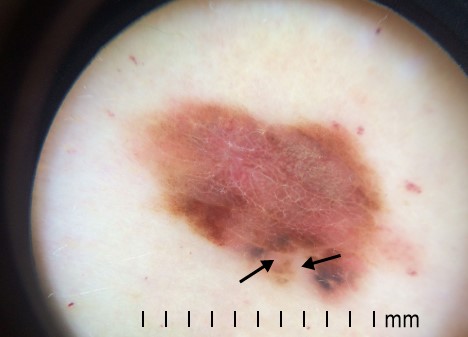 The lesion has multiple color variations, including dark brown, pink, red, and whitish areas. Excisional biopsy of the lesion is performed. The whitish areas (arrows) seen on histologic examination most likely represent which of the following underlying processes?
 (Multiple Choice)
4.8/5 (78)
(78) A 6mm punch biopsy of normal appearing epidermis reveals stellar cells that contain intracytoplasmic granules having the shape of a tennis racquet. These cells demonstrate some myeloid surface markers and can interact closely with T lymphocytes. The cells described above are best referred to as which of the following?
(Multiple Choice)
4.8/5 (70)
(70) A 24-year-old woman comes to the office at 12 weeks gestation for prenatal counseling. She is 120 cm (3 ft 11 in) tall with short upper and lower extremities but normal torso length. Her husband is phenotypically normal and has no medical problems. The patient knows that there is a 50% chance of passing on her condition to the fetus. An abnormality involving which of the following cells is most likely responsible for this patient's features?
(Multiple Choice)
4.9/5 (80)
(80) A 20-year-old woman arrives at the office with blisters around her lips and a minor burning sensation. She reports regular recurrences of similar lesions, which disappear spontaneously within a few days. She has no medical issues and is not on any drugs. The results of the physical examination are depicted in the figure below. 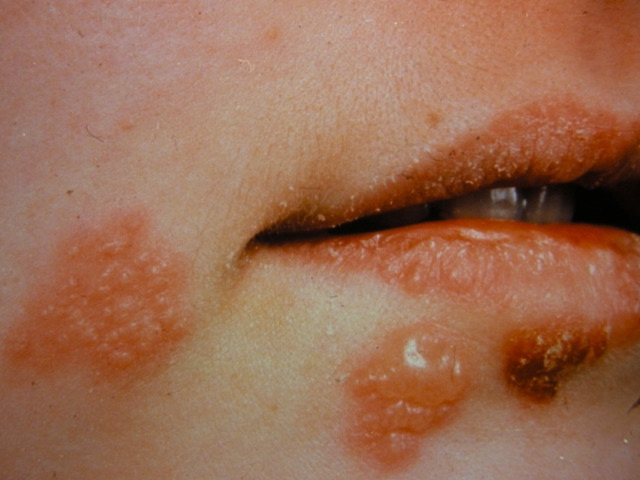 The causal organism of this patient's disease is found to be dormant in the neuronal cell bodies of sensory ganglia. When the virus is reactivated, it travels to the skin through the nerve axon. Which of the following proteins is most likely involved in the disease recurrence transport process?
 (Multiple Choice)
4.8/5 (93)
(93) A 29-year-old African American woman is being evaluated for exertional dyspnea and dry cough. She has no significant medical history and takes no medications. The patient works part-time as a bird keeper at a zoo. She smokes 4 packs daily. CT-guided lung biopsy is performed; findings are shown in the image below. 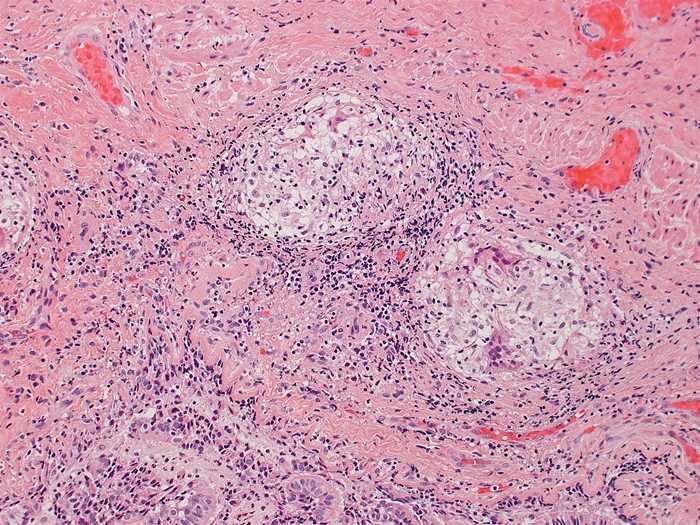 This patient most likely has which of the following conditions?
 (Multiple Choice)
4.9/5 (85)
(85) A 32-year-old hospitalized man is evaluated for new-onset shortness of breath and confusion. The patient was admitted for a displaced femoral neck fracture of the left hip acquired after a fall the day before. The surgery under general anesthesia with sevoflurane was uneventful. She appears cyanotic, drowsy, and is oriented only to person. Her temperature is 38.6°C (101.5°F), pulse is 135/minute, respirations are 36/min, and blood pressure is 155/95 mm Hg. Pulse oximetry on room air shows an oxygen saturation of 81%. There are several scattered petechiae on the anterior chest wall. An ECG shows sinus tachycardia. Which of the following histologic changes has most likely taken place in this patient's lung tissue?
(Multiple Choice)
4.8/5 (68)
(68) A feverish eight-year-old boy is taken to the physician with a runny nose and lethargy. The pediatrician finds that the youngster has a viral infection and does not require any special treatment after evaluating him. The mother inquires as to why an antibiotic is not required, and the doctor explains the distinctions between bacterial and viral illnesses. The immune system is made up of both cellular and humoral components that can create an efficient response to a variety of viral and bacterial diseases. The picture below depicts a portion of a normal lymph node. 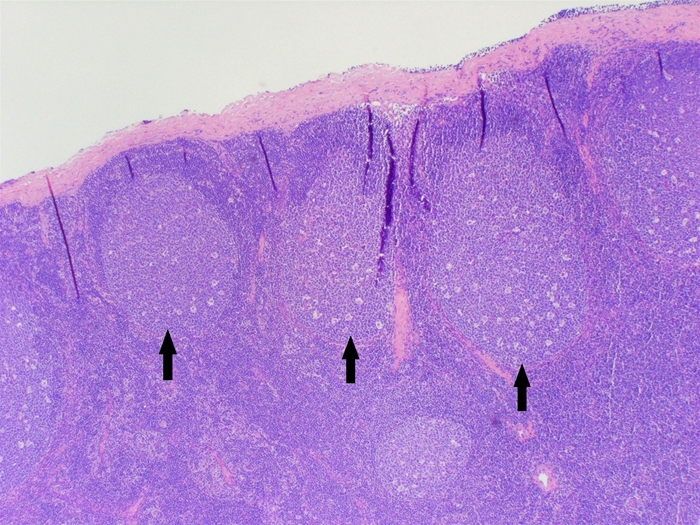 The structures indicated by the arrows are most likely to contain cells undergoing which of the following processes?
 (Multiple Choice)
4.8/5 (80)
(80) A 14-month-old kid is brought to the office because she has had diarrhea for the past two months. Her parents note that she gets 3-5 loose, nonbloody bowel motions per day, with some vomiting. She was solely breastfed until she was 9 months old and has since enjoyed a diversified diet that includes whole milk, fruits, vegetables, bread, and meats. However, the girl has been less interested in food in recent weeks. There is no history of travel or interaction with people who have comparable symptoms. The patient seems well on physical examination, but has dropped 1.1 kg (2.5 lb) in the previous two months. The display depicts the results of a duodenal biopsy after laboratory assessment. 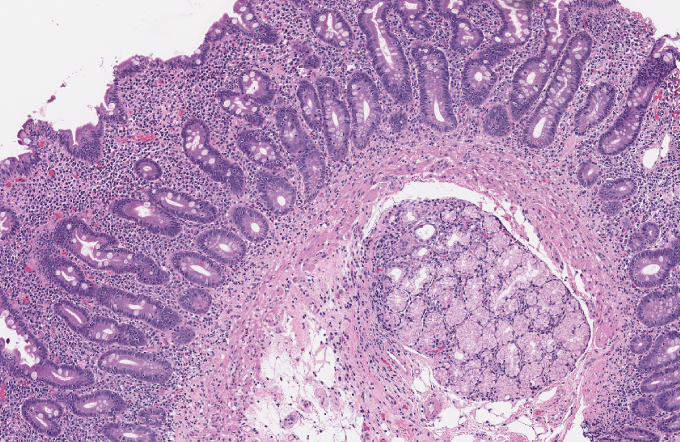 Which of the following would most likely improve this patient's symptoms?
 (Multiple Choice)
4.9/5 (84)
(84) A 34-year-old woman comes to the office with bleeding from the right nipple. The patient has noticed blood staining her bra on several occasions over the past week but has no fever or breast pain. She has no chronic medical conditions and does not take any medications. Breast examination shows no palpable masses or skin changes. A thin, blood-tinged discharge can be expressed from the right nipple. There are no enlarged axillary lymph nodes. Which of the following is the most likely histopathologic finding in this patient's right breast?
(Multiple Choice)
4.9/5 (76)
(76) A 68-year-old woman arrives at the clinic after suffering from recurrent bacterial sinusitis, pneumonia, and urinary tract infections for several months. There are no preexisting medical issues or a history of serious illnesses in infancy for the patient. She does not smoke, drink, or use illegal drugs. The temperature is 36.6 C (97.9 F), the blood pressure is 130/76 mm Hg, and the pulse rate is 72 beats per minute. The lungs are clear to auscultation, the heart sounds are normal, and the belly is soft and nontender with no hepatosplenomegaly on physical examination. Laboratory results show normocytic normochromic anemia. As demonstrated here, a bone marrow aspirate has an increased number of cells. 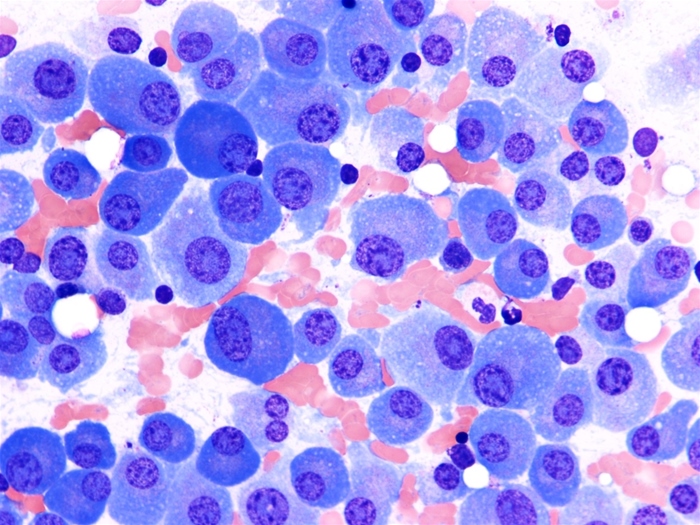 Which of the following is the most likely cause of this patient's increased susceptibility to infections?
 (Multiple Choice)
4.7/5 (86)
(86) A 19-year-old man arrives to the office complaining of a painful subcutaneous forearm nodule. He had stitches done two weeks previously after suffering a cut on his left forearm while playing soccer. The lesion is biopsied, and the results are presented below: 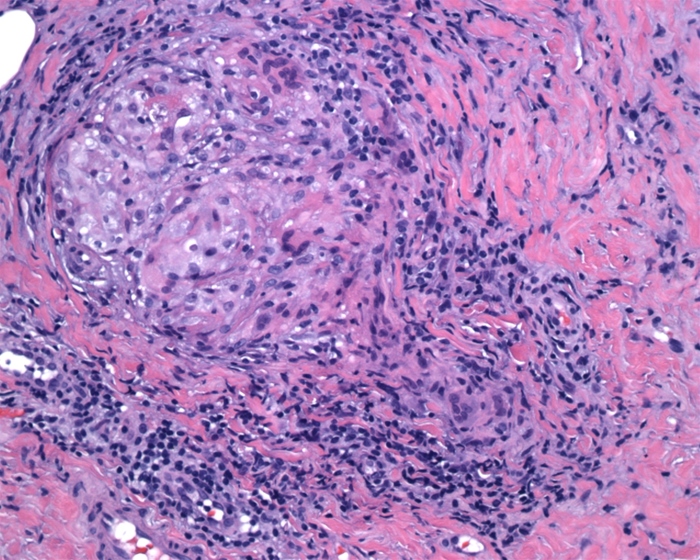 Which of the following is most likely responsible for this patient's condition?
 (Multiple Choice)
4.9/5 (88)
(88) A scientist is studying the structure of the sarcomere using skeletal muscle from an experimental animal. He creates monoclonal antibodies against a specific skeletal muscle protein and discovers that these antibodies prevent actin from attaching to structural support components within the sarcomere. The picture below depicts electron microscopy of a sarcomere. 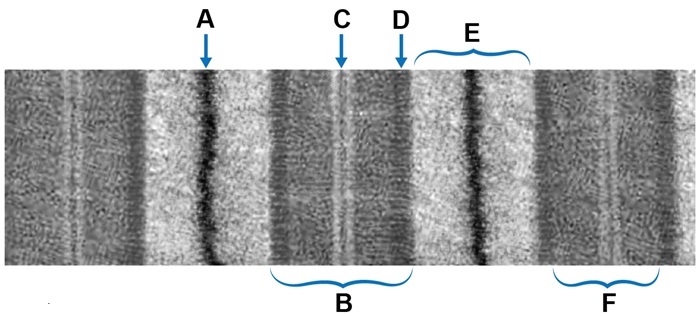 Which of the following labeled regions do these antibodies most likely bind?
 (Multiple Choice)
4.9/5 (73)
(73) A 9-year-old child is brought to the office after experiencing facial and ocular puffiness for two days. About three weeks ago, the patient had antibiotic treatment for a rash on her leg. The temperature is 37.2 degrees Celsius (99 degrees Fahrenheit), and the blood pressure is 150/90 mm Hg. There is widespread edema but no rash on physical examination. Proteinuria and hematuria are shown by urinalysis. The following electron microscope picture represents this patient's illness process: 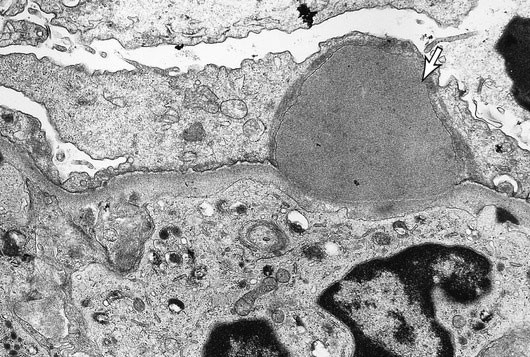 The area marked by the white arrow most likely represents which of the following?
 (Multiple Choice)
4.7/5 (85)
(85) A 34-year-old electric company employee visits the doctor with a skin rash on his right leg. He hasn't tried any new meals or used any different detergents, soaps, or lotions. When pressed further, the patient recalls working on a repair project in an unmaintained, forested region. As a youngster, he experienced atopic dermatitis but no other severe ailments. On inspection, he seems uneasy and is continually clawing his leg. His lungs are both clean, and his heart sounds are normal. The findings of his right leg examination are shown in the figure below. 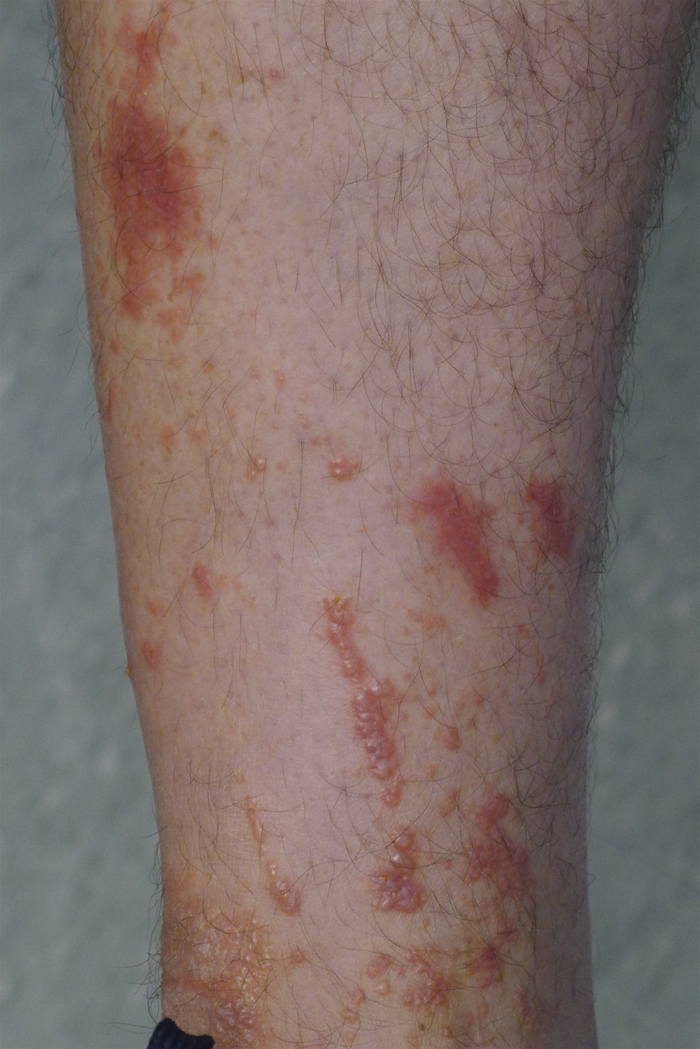 Which of the following cells is most responsible for causing the tissue damage seen in this patient?
 (Multiple Choice)
4.7/5 (87)
(87) 
Filters
- Essay(0)
- Multiple Choice(0)
- Short Answer(0)
- True False(0)
- Matching(0)