



 Chat with AI
Exam 12: Physiology

Exam 1: Anatomy265 Questions
Exam 2: Behavioral Sciences178 Questions
Exam 3: Biochemistry102 Questions
Exam 4: Embryology59 Questions
Exam 5: Epidemiology, Biostatistics, and Medical Informatics94 Questions
Exam 6: Genetics88 Questions
Exam 7: Histology46 Questions
Exam 8: Immunology147 Questions
Exam 9: Microbiology and Virology330 Questions
Exam 10: Pathology817 Questions
Exam 11: Pharmacology and Toxicology509 Questions
Exam 12: Physiology339 Questions
Exam 13: Psychiatry and Psychotherapy23 Questions
Select questions type


Ion movements across the cell membrane are recorded coupled with changes in membrane potential in an isolated heart muscle cell (see graph below). . 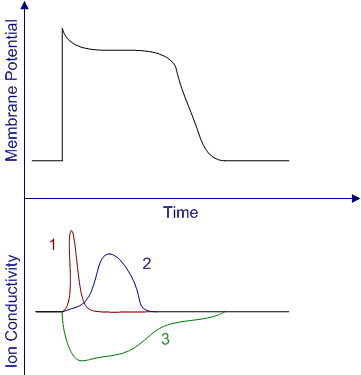 Which of the following ion sequences corresponds to regions 1-2-3 on the graph, respectively?
 (Multiple Choice)
4.9/5  (77)
(77) A 56-year-old guy who has been experiencing palpitations for many hours visits the emergency room. He has never had symptoms like this. The patient hasn't had syncope, lightheadedness, shortness of breath, or chest discomfort. On the weekends, he consumes booze, but not illegal substances. There is no history of heart disease in his family. The reading is 145/78 mm Hg. 40 kg/m2 is the BMI. The exhibit displays an ECG.  The patient is treated medically in the emergency department. He is then taken to the electrophysiology laboratory for radiofrequency catheter ablation to terminate his arrhythmia. The ablation procedure should create a conduction block through which of the following areas?
 (Multiple Choice)
4.9/5 (74)
(74) A 54-year-old man arrives at the office after experiencing dizziness while walking his dog in the morning. He hasn't been experiencing any chest pain, shortness of breath, weakness, or headaches. The exhibit includes cardiac auscultation findings at the right sternal border. 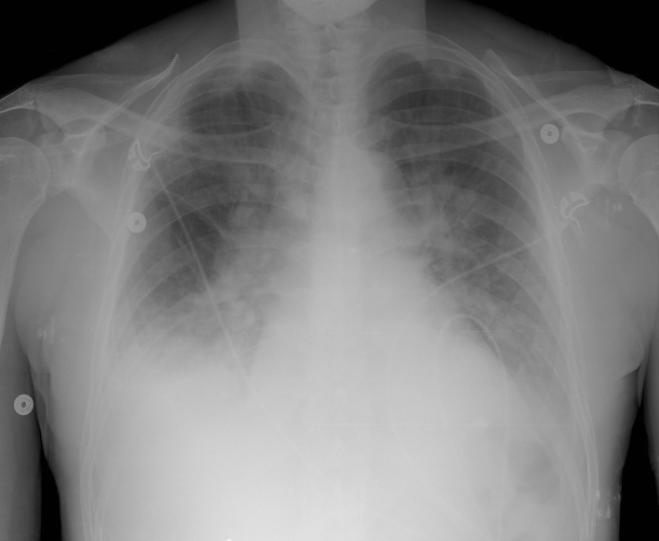 Which of the following is the most likely cause of this patient's symptoms?
 (Multiple Choice)
4.8/5 (80)
(80) Scientists studying the specifics of human kidney function develop a new technique for measuring the concentration of various compounds along the length of the proximal tubule. They measure the concentrations of several endogenous substances in the fluid traversing the proximal tubule during an experiment. The following image depicts the tubular fluid/plasma ultrafiltrate concentration ratios for the measured substances: 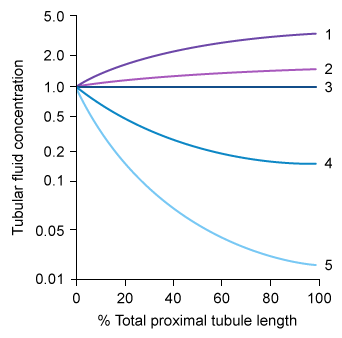 Which of the following substances are most likely to produce lines 2 and 4, respectively?
 (Multiple Choice)
4.9/5 (76)
(76) A 66-year-old woman comes to the physician for a routine health maintenance examination. She feels well but is unhappy about being overweight. She has tried to lose weight for several years without success. She goes for a walk 3 times a week but she has difficulty following a low-calorie diet. She has type 2 diabetes mellitus and osteoarthritis. Her only current medication is metformin. She has never smoked. She is 160 cm (5 ft 3 in) tall and weighs 100 kg (220 lb); BMI is 39 kg/m2. Vital signs are within normal limits. Hyperpigmentation in skinfolds is noted at the neck as shown in the image below. 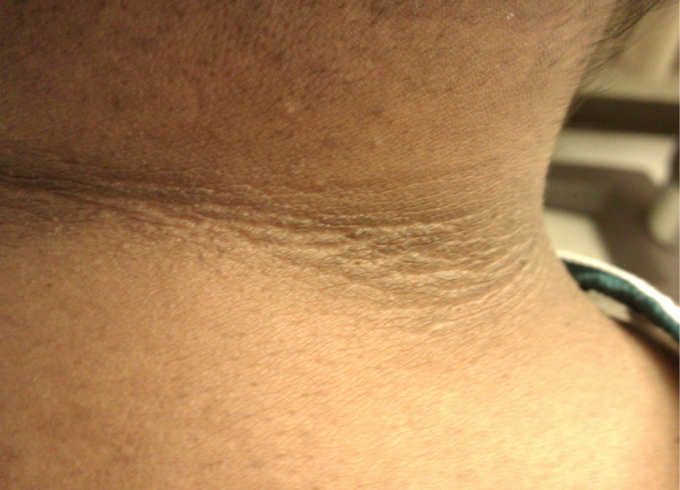 Serum studies show an HbA1c of 9.5%, and a fasting serum glucose concentration of 158 mg/dL. Elevated serum levels of which of the following substances are most likely contributing to this patient's disease process?
 (Multiple Choice)
4.8/5 (79)
(79) A physiologist is conducting an experiment to study potassium channels mutation expressed in pancreatic beta cells. The mutated channels have a higher sensitivity to the substance that normally modulates their activity, causing increased beta cell secretory activity. Which of the following substances normally binds to and regulates the ion channels that are responsible for this patient's hypoglycemia?
(Multiple Choice)
4.8/5 (78)
(78) A 33-year-old pilot is transported to the emergency department after she was involved in a motor vehicle collision. She is conscious but confused. She has no history of serious illness and takes no medications. Physical examination shows numerous lacerations and ecchymoses over the face, trunk, and upper extremities. The lower extremities are cool to the touch. There is continued bleeding despite the application of firm pressure to the sites of injury. X-rays show pelvic and left femoral shaft fractures. Which of the following findings are most likely present in this patient? 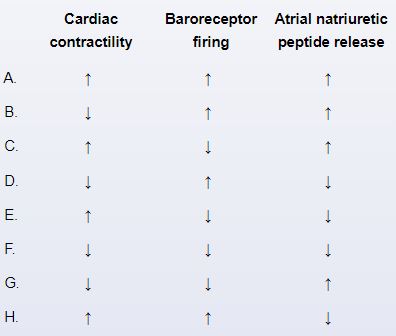
(Multiple Choice)
4.8/5 (82)
(82) A boy's micropenis was discovered when he was a newborn. The Sertoli cell activity is selectively impaired as a result of a known mutation in the NR5A1/SF-1 gene, according to genetic study. Unaffected is the rest of the hypothalamic-pituitary-gonadal axis. The patient has a generally normal childhood and pubertal development and receives routine follow-up care from a pediatric endocrinologist. His serum hormone levels are measured at age 16. Which of the following blood hormone pattern patterns is most indicative of this patient's condition? 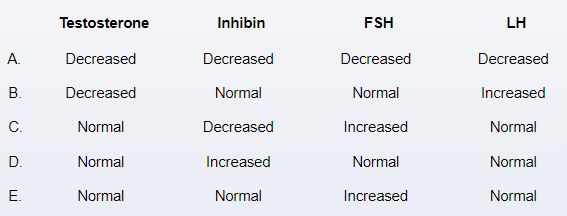
(Multiple Choice)
4.8/5 (85)
(85) A 40-year-old man is being evaluated in the office for routine health follow up. He states that he feels chest discomfort which started 2 days ago. He is well and active , he also has a family history of an ischemic heart disease. The patient has no medical conditions and does not use tobacco. He leads an active lifestyle and exercises every day. He undergoes treadmill exercise stress testing. Baseline blood pressure is 120/73 mm Hg and pulse is 59/min. After 10 minutes of exercise, his blood pressure is 156/82 mm Hg and pulse is 153/min. He has no chest pain and ECG shows no abnormalities. Compared to pretest conditions, which of the following is the single most important limiting factor for left ventricular myocardial blood supply during the test?
(Multiple Choice)
4.9/5 (89)
(89) A 52-year-old man is brought to the emergency department after being found unresponsive on the street. The patient's medical history is unknown. Temperature is 36.2 C (97.2 F), blood pressure is 108/62 mm Hg, and pulse is 72/min. On physical examination, he is unresponsive to verbal and tactile stimuli but moans to deep sternal rub. An arterial blood gas analysis on room air shows a partial pressure of oxygen of 60 mm Hg. The partial pressure of oxygen in his alveoli is calculated to be 68 mm Hg. Which of the following is the most likely cause of this patient's symptoms?
(Multiple Choice)
4.7/5 (70)
(70) A 34-year-old man comes to the physician because of frequent headaches and blurry vision during the past 4 months. He has also had difficulties achieving an erection over the past few weeks. Medical history is unremarkable, and he takes no medications. He does not use tobacco, alcohol, or illicit drugs. Physical examination shows a temporal visual field deficit bilaterally. An MRI of the brain shows an intrasellar mass. Which of the following changes in serum GnRH, LH, and testosterone are most likely to be found in this patient? 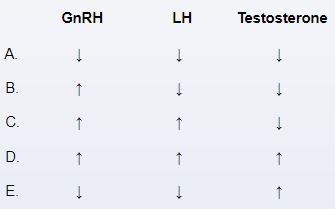
(Multiple Choice)
4.8/5 (86)
(86) Physiologists are researching the normal mechanisms of pleural fluid formation and absorption. They obtain healthy experimental animals with human-like pleuropulmonary anatomy and physiology. These animals are given intravenous radioisotope tracers and closely monitored to track fluid movement into and out of the pleural space. Which of the following pathways of pleural fluid turnover is most likely to be observed? 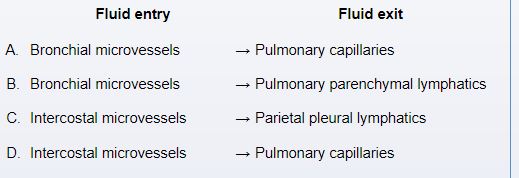
(Multiple Choice)
4.9/5 (76)
(76) A 40-year-old man comes to hte office due to dizzy spills accompained by palpitations and sweating during exercise. He feels well if he drinks an orang juice or eat any sweat candy. The patient was diagnosed with type 2 diabetes 4months ago and advised to lose weight with dietary modification and exercise. Since then, he has been working out intensively and has lost 10 kg (22 lb). Which of the following mechanisms is responsible for this patient's symptoms when exercising?
(Multiple Choice)
5.0/5 (73)
(73) The patient's genetic defect has resulted in decreased beta globin chain synthesis. Which of the following is most likely to be seen on laboratory testing?
(Multiple Choice)
4.9/5 (86)
(86) A 67-year-old woman is admitted to the hospital due to worsening abdominal pain. The patient has long-term end-stage renal disease caused by diabetic nephropathy, for which she receives hemodialysis three times per week. The temperature is 37 degrees Celsius (98.6 degrees F), the blood pressure is 159/79 mm Hg, the pulse rate is 97 bpm, and the respirations rate is 16 /minute. High-pitched bowel sounds and mild distension without rebound tenderness are seen on abdominal examination. Blood urea nitrogen and creatinine levels are elevated, according to laboratory results. A small bowel obstruction is visible on a noncontrast CT scan of the abdomen. The arrows in the abdominal CT scan below show the following findings in the patient: 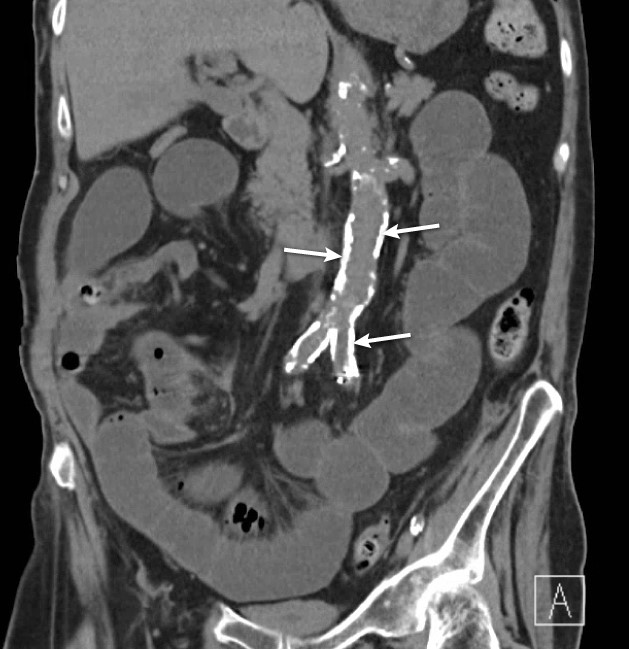 Which of the following most likely contributed to the observed findings?
 (Multiple Choice)
4.9/5 (79)
(79) A 40-year-old man is brought to the emergency department due to sudden onset palpitation and chest discomfort. He has no prior medical conditions and takes no mediations. Chest examination reveals no murmurs and the lungs are clear on auscultation. ECG reveals a heart rate of 126/min with an irregularly irregular rhythm, narrow QRS complexes, and no organized P waves. Which of the following physiologic factors most likely determines the ventricular contraction rate in this patient?
(Multiple Choice)
4.8/5 (70)
(70) A5-year-old boy is seen in the outpatient clinic, his parent are concerned due to bed-wetting. He has no medical condition and his developmental growth is normal. He can stay dray during the daytime but has continued to wet 4 to 5 nights a week. His parent tried to decrease night drinking and wake him up two time nightly to go to the bathroom. Vital signs and examination are normal. Urinalysis is unremarkable. This patient's bed-wetting is most likely caused by which of the following?
(Multiple Choice)
4.9/5 (85)
(85) A 34-year-old man arrives at the emergency department complaining of weakness, dizziness, and facial and extremity paresthesias. He's never experienced symptoms like this before. He had eaten fish at a new Japanese restaurant two hours before. A neurological examination reveals decreased muscle strength and deep-tendon reflexes. Which of the following parts of the action potential curve is most likely to be affected in this patient? 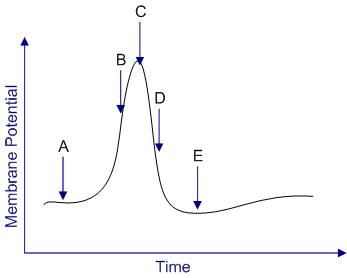
(Multiple Choice)
4.9/5 (90)
(90) A65-year-old man is brought to the ER due to recent dyspnea on exertion and generalized fatigue. He has a history of recurrent heart failure exacerbations last year. He has hypertension, myocardial infarction and hypercholesteromia. he has a 30-pack-yaer smoking history in addition to 15-year history of alcohol abuse. Physical examination reveals tachycardia, distended neck veins, bilateral crackles on lung auscultation, a third heart sound on cardiac auscultation, and pedal edema. The appropriate therapy is initiated. On the third day of hospitalization, his hematocrit level increases to 50%, up from 44% on admission. An arterial blood gas analysis shows an arterial O2 partial pressure (PaO2) of 70 mm Hg. A 51Cr-tagged red blood cell infusion indicates normal red blood cell mass. Which of the following is the most likely cause of this patient's polycythemia?
(Multiple Choice)
5.0/5 (68)
(68) A 53 year old woman comes to the office because she has missed her menstrual periods for more than 7 months she took oral contraceptive pills for 10 year and discountined 8 months ago, and her menses have not returned. the patient has been married for 25 years and has 3 childern without any history of a medical disease. She has a regular sexual intercourse with her husbend but she states that feels a vaginal dryness and pain during intercourse. Speculum examination shows a normal vaginal mucosa and cervix. Bimanual examination shows a normal uterus and ovaries. Urine pregnancy test is negative. Which of the following hormones is most likely elevated in this patient?
(Multiple Choice)
4.9/5 (80)
(80) 
Filters
- Essay(0)
- Multiple Choice(0)
- Short Answer(0)
- True False(0)
- Matching(0)